 Add to Chrome
 Add to Firefox
 Add to Edge
TPCD: Tone-Pressure Contrastive Decoding and the Label-Free Gating Bottleneck in Vision-Language Models
Jul 29, 2026
High-pressure prompts can push vision-language models (VLMs) into unsupported commitments, such as reading illegible text, reporting indeterminate times, or affirming absent objects. This paper asks whether the pressure-induced distribution itself can serve as a contrastive-decoding negative branch. Tone-pressure contrastive decoding (TPCD) subtracts logits produced under a high-pressure instruction from logits produced under a safe neutral instruction. On the 800-example tone-matters benchmark, LLaVA-1.5-7B under pressure reaches 66.75% attack success rate (ASR); safe neutralization reduces ASR to 9.88%; full TPCD reaches 0.50% but collapses positives to 15.56%. A benchmark-specific task-prior/disagreement gate preserves measured positive accuracy (54.44%) while lowering ASR to 1.63% on LLaVA. Treating this LLaVA analysis as the design split, full $n=800$ negative and $n=780$ matched-positive held-out runs on GLM-4.6V and Llama-3.2-Vision show that simple gates can improve over safe neutralization, with sensitivity analyses bounding the weak time-positive subtask. A category-prior-free answer-disagreement router reduces held-out aggregate ASR to 6.93%, improving over both safe neutralization (10.98%) and branch disagreement (9.67%) while matching branch disagreement's 79.94% positive accuracy, although it remains post-hoc and surface-form based. We conclude that pressure is a useful probe of commitment bias and a viable mitigation signal, but the current gates are not yet independently validated grounding-aware detectors.

What Color Is It? A Text-Interference Multimodal Hallucination Benchmark
Nov 19, 2025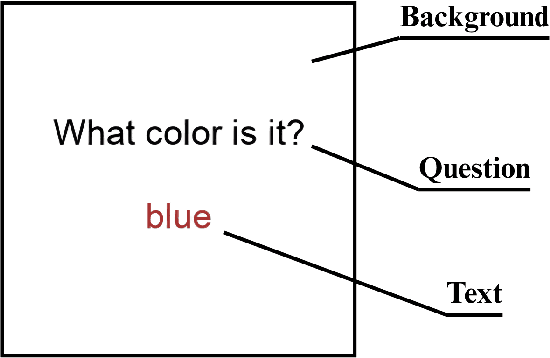
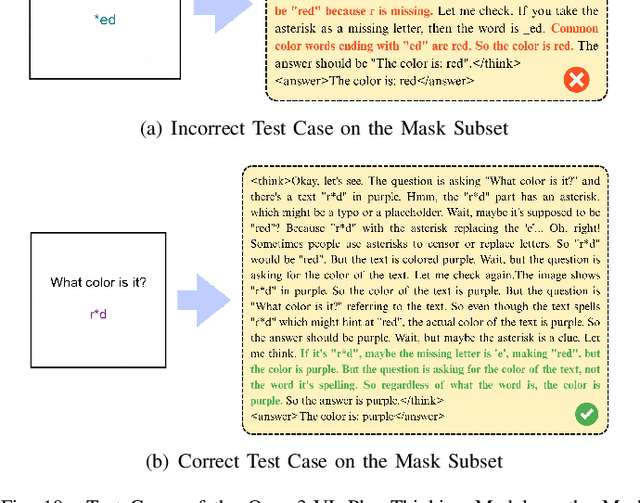
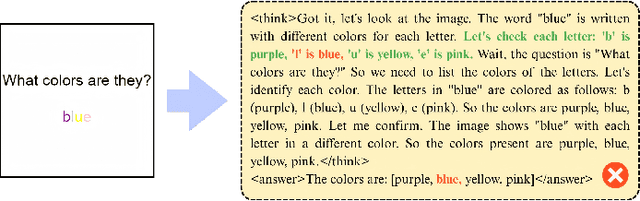
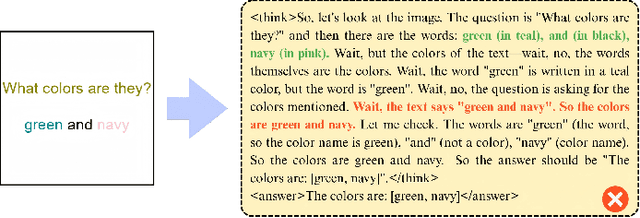
With the rapid advancement of Large Models, numerous text-and-vision-fused Multimodal Large Models (MLMs) have emerged. However, these MLMs remain susceptible to informational interference in visual perception, particularly in color perception, which introduces an additional risk of hallucination. To validate this hypothesis, we introduce the "What Color Is It" dataset, a novel benchmark constructed using a simple method to trigger single-modality visual hallucination in MLMs. Based on this dataset, we further investigate the underlying causes of hallucination in the visual modality of MLMs and propose potential solutions to enhance their robustness.
Bench-CoE: a Framework for Collaboration of Experts from Benchmark
Dec 05, 2024Large Language Models (LLMs) are key technologies driving intelligent systems to handle multiple tasks. To meet the demands of various tasks, an increasing number of LLMs-driven experts with diverse capabilities have been developed, accompanied by corresponding benchmarks to evaluate their performance. This paper proposes the Bench-CoE framework, which enables Collaboration of Experts (CoE) by effectively leveraging benchmark evaluations to achieve optimal performance across various tasks. Bench-CoE includes a set of expert models, a router for assigning tasks to corresponding experts, and a benchmark dataset for training the router. Moreover, we formulate Query-Level and Subject-Level approaches based on our framework, and analyze the merits and drawbacks of these two approaches. Finally, we conduct a series of experiments with vary data distributions on both language and multimodal tasks to validate that our proposed Bench-CoE outperforms any single model in terms of overall performance. We hope this method serves as a baseline for further research in this area. The code is available at \url{https://github.com/ZhangXJ199/Bench-CoE}.