 Add to Chrome
 Add to Firefox
 Add to Edge
i1: A Simple and Fully Open Recipe for Strong Text-to-Image Models
Jun 09, 2026
Diffusion models have consistently driven progress in text-to-image generation. However, it is challenging to attribute recent progress to specific modeling and data choices: state-of-the-art open-weight models provide limited ablations, and do not disclose their training data and full training details. The research community needs fully open (weights, data, and code) models as a foundation for further research; yet existing fully open models still fall significantly short of leading models in performance. In this project, we conduct a systematic investigation of the modeling and data design choices in text-to-image diffusion training and inference with 300+ controlled experiments totaling 700K+ TPU v6e hours. Our experiments highlight several empirical findings (e.g., equal weighting is a strong default for mixing curated datasets) and simple design decisions (e.g., larger text encoder adapters improve performance with minimal added parameters) for training strong models. Guided by these insights, we train i1, a 3B-parameter text-to-image diffusion model using only publicly available datasets. i1 is competitive with leading models on five representative benchmarks (GenEval, DPG, PRISM, CVTG-2K, and LongText), and outperforms the best existing fully open model by 29.5 absolute percentage points on average. We provide the i1 checkpoints, training and inference code, and the data processing pipeline. Together, our findings and the i1 recipe establish a practical foundation for future open research in text-to-image diffusion models. Our code is available at https://github.com/zlab-princeton/i1.

Memorization in 3D Shape Generation: An Empirical Study
Dec 29, 2025Generative models are increasingly used in 3D vision to synthesize novel shapes, yet it remains unclear whether their generation relies on memorizing training shapes. Understanding their memorization could help prevent training data leakage and improve the diversity of generated results. In this paper, we design an evaluation framework to quantify memorization in 3D generative models and study the influence of different data and modeling designs on memorization. We first apply our framework to quantify memorization in existing methods. Next, through controlled experiments with a latent vector-set (Vecset) diffusion model, we find that, on the data side, memorization depends on data modality, and increases with data diversity and finer-grained conditioning; on the modeling side, it peaks at a moderate guidance scale and can be mitigated by longer Vecsets and simple rotation augmentation. Together, our framework and analysis provide an empirical understanding of memorization in 3D generative models and suggest simple yet effective strategies to reduce it without degrading generation quality. Our code is available at https://github.com/zlab-princeton/3d_mem.
Interleaved Scene Graph for Interleaved Text-and-Image Generation Assessment
Nov 26, 2024Many real-world user queries (e.g. "How do to make egg fried rice?") could benefit from systems capable of generating responses with both textual steps with accompanying images, similar to a cookbook. Models designed to generate interleaved text and images face challenges in ensuring consistency within and across these modalities. To address these challenges, we present ISG, a comprehensive evaluation framework for interleaved text-and-image generation. ISG leverages a scene graph structure to capture relationships between text and image blocks, evaluating responses on four levels of granularity: holistic, structural, block-level, and image-specific. This multi-tiered evaluation allows for a nuanced assessment of consistency, coherence, and accuracy, and provides interpretable question-answer feedback. In conjunction with ISG, we introduce a benchmark, ISG-Bench, encompassing 1,150 samples across 8 categories and 21 subcategories. This benchmark dataset includes complex language-vision dependencies and golden answers to evaluate models effectively on vision-centric tasks such as style transfer, a challenging area for current models. Using ISG-Bench, we demonstrate that recent unified vision-language models perform poorly on generating interleaved content. While compositional approaches that combine separate language and image models show a 111% improvement over unified models at the holistic level, their performance remains suboptimal at both block and image levels. To facilitate future work, we develop ISG-Agent, a baseline agent employing a "plan-execute-refine" pipeline to invoke tools, achieving a 122% performance improvement.
Thinking Before Looking: Improving Multimodal LLM Reasoning via Mitigating Visual Hallucination
Nov 15, 2024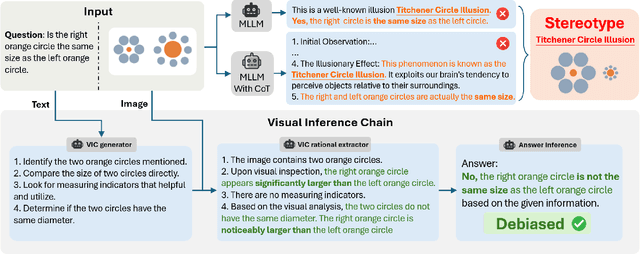
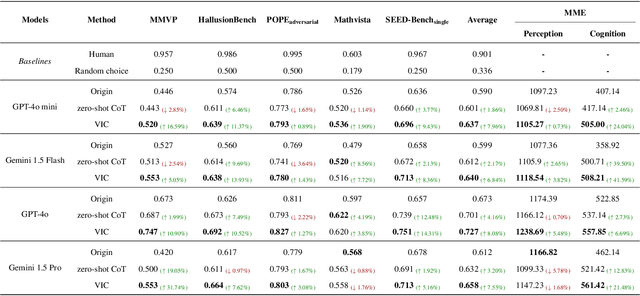
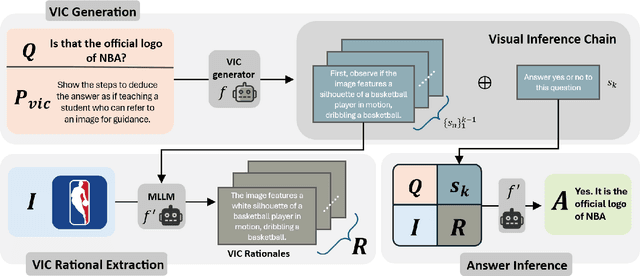
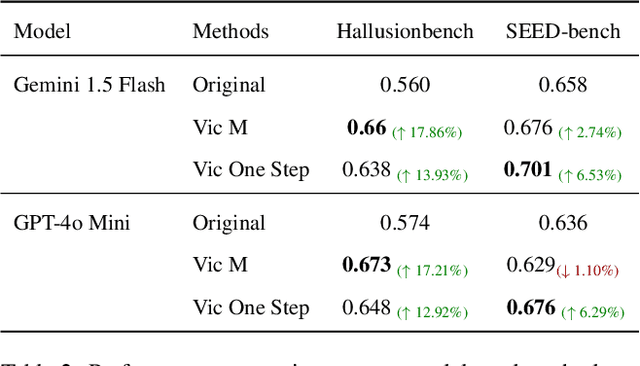
Multimodal large language models (MLLMs) have advanced the integration of visual and linguistic modalities, establishing themselves as the dominant paradigm for visual-language tasks. Current approaches like chain of thought (CoT) reasoning have augmented the cognitive capabilities of large language models (LLMs), yet their adaptation to MLLMs is hindered by heightened risks of hallucination in cross-modality comprehension. In this paper, we find that the thinking while looking paradigm in current multimodal CoT approaches--where reasoning chains are generated alongside visual input--fails to mitigate hallucinations caused by misleading images. To address these limitations, we propose the Visual Inference Chain (VIC) framework, a novel approach that constructs reasoning chains using textual context alone before introducing visual input, effectively reducing cross-modal biases and enhancing multimodal reasoning accuracy. Comprehensive evaluations demonstrate that VIC significantly improves zero-shot performance across various vision-related tasks, mitigating hallucinations while refining the reasoning capabilities of MLLMs. Our code repository can be found at https://github.com/Terry-Xu-666/visual_inference_chain.