 Add to Chrome
 Add to Firefox
 Add to Edge
Are LLMs Capable of Data-based Statistical and Causal Reasoning? Benchmarking Advanced Quantitative Reasoning with Data
Feb 27, 2024
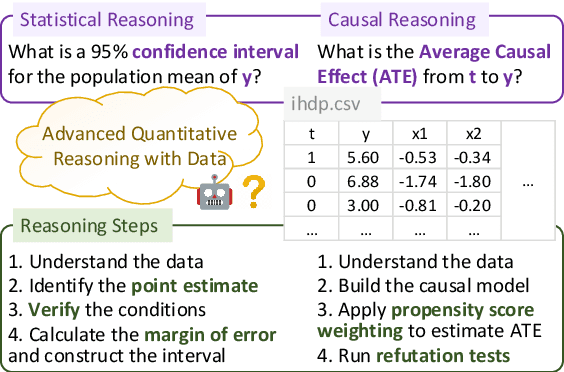
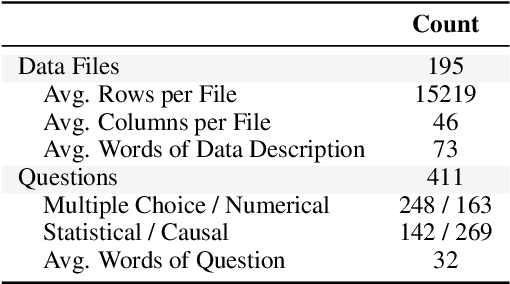
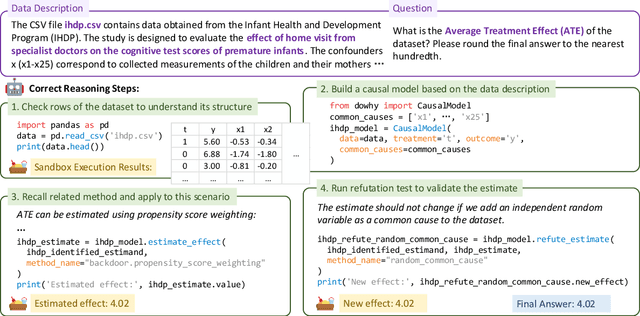
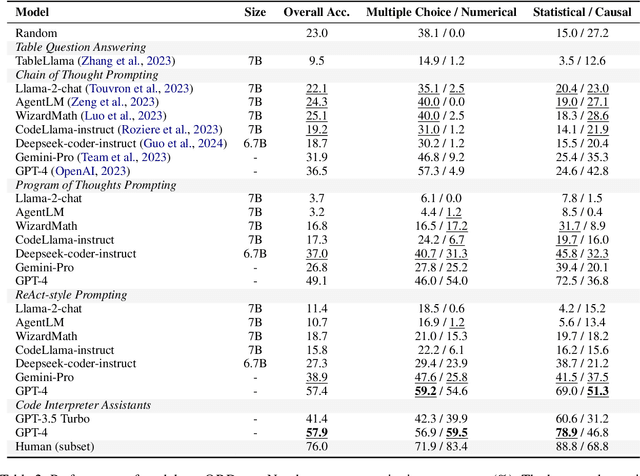
Quantitative reasoning is a critical skill to analyze data, yet the assessment of such ability remains limited. To address this gap, we introduce the Quantitative Reasoning with Data (QRData) benchmark, aiming to evaluate Large Language Models' capability in statistical and causal reasoning with real-world data. The benchmark comprises a carefully constructed dataset of 411 questions accompanied by data sheets from textbooks, online learning materials, and academic papers. To compare models' quantitative reasoning abilities on data and text, we enrich the benchmark with an auxiliary set of 290 text-only questions, namely QRText. We evaluate natural language reasoning, program-based reasoning, and agent reasoning methods including Chain-of-Thought, Program-of-Thoughts, ReAct, and code interpreter assistants on diverse models. The strongest model GPT-4 achieves an accuracy of 58%, which has a large room for improvement. Among open-source models, Deepseek-coder-instruct, a code LLM pretrained on 2T tokens, gets the highest accuracy of 37%. Analysis reveals that models encounter difficulties in data analysis and causal reasoning, and struggle in using causal knowledge and provided data simultaneously. Code and data are in https://github.com/xxxiaol/QRData.

EMO-SUPERB: An In-depth Look at Speech Emotion Recognition
Feb 22, 2024Speech emotion recognition (SER) is a pivotal technology for human-computer interaction systems. However, 80.77% of SER papers yield results that cannot be reproduced. We develop EMO-SUPERB, short for EMOtion Speech Universal PERformance Benchmark, which aims to enhance open-source initiatives for SER. EMO-SUPERB includes a user-friendly codebase to leverage 15 state-of-the-art speech self-supervised learning models (SSLMs) for exhaustive evaluation across six open-source SER datasets. EMO-SUPERB streamlines result sharing via an online leaderboard, fostering collaboration within a community-driven benchmark and thereby enhancing the development of SER. On average, 2.58% of annotations are annotated using natural language. SER relies on classification models and is unable to process natural languages, leading to the discarding of these valuable annotations. We prompt ChatGPT to mimic annotators, comprehend natural language annotations, and subsequently re-label the data. By utilizing labels generated by ChatGPT, we consistently achieve an average relative gain of 3.08% across all settings.
On Leveraging Encoder-only Pre-trained Language Models for Effective Keyphrase Generation
Feb 21, 2024This study addresses the application of encoder-only Pre-trained Language Models (PLMs) in keyphrase generation (KPG) amidst the broader availability of domain-tailored encoder-only models compared to encoder-decoder models. We investigate three core inquiries: (1) the efficacy of encoder-only PLMs in KPG, (2) optimal architectural decisions for employing encoder-only PLMs in KPG, and (3) a performance comparison between in-domain encoder-only and encoder-decoder PLMs across varied resource settings. Our findings, derived from extensive experimentation in two domains reveal that with encoder-only PLMs, although KPE with Conditional Random Fields slightly excels in identifying present keyphrases, the KPG formulation renders a broader spectrum of keyphrase predictions. Additionally, prefix-LM fine-tuning of encoder-only PLMs emerges as a strong and data-efficient strategy for KPG, outperforming general-domain seq2seq PLMs. We also identify a favorable parameter allocation towards model depth rather than width when employing encoder-decoder architectures initialized with encoder-only PLMs. The study sheds light on the potential of utilizing encoder-only PLMs for advancing KPG systems and provides a groundwork for future KPG methods. Our code and pre-trained checkpoints are released at https://github.com/uclanlp/DeepKPG.
Codec-SUPERB: An In-Depth Analysis of Sound Codec Models
Feb 20, 2024


The sound codec's dual roles in minimizing data transmission latency and serving as tokenizers underscore its critical importance. Recent years have witnessed significant developments in codec models. The ideal sound codec should preserve content, paralinguistics, speakers, and audio information. However, the question of which codec achieves optimal sound information preservation remains unanswered, as in different papers, models are evaluated on their selected experimental settings. This study introduces Codec-SUPERB, an acronym for Codec sound processing Universal PERformance Benchmark. It is an ecosystem designed to assess codec models across representative sound applications and signal-level metrics rooted in sound domain knowledge.Codec-SUPERB simplifies result sharing through an online leaderboard, promoting collaboration within a community-driven benchmark database, thereby stimulating new development cycles for codecs. Furthermore, we undertake an in-depth analysis to offer insights into codec models from both application and signal perspectives, diverging from previous codec papers mainly concentrating on signal-level comparisons. Finally, we will release codes, the leaderboard, and data to accelerate progress within the community.
The Male CEO and the Female Assistant: Probing Gender Biases in Text-To-Image Models Through Paired Stereotype Test
Feb 16, 2024Recent large-scale Text-To-Image (T2I) models such as DALLE-3 demonstrate great potential in new applications, but also face unprecedented fairness challenges. Prior studies revealed gender biases in single-person image generation, but T2I model applications might require portraying two or more people simultaneously. Potential biases in this setting remain unexplored, leading to fairness-related risks in usage. To study these underlying facets of gender biases in T2I models, we propose a novel Paired Stereotype Test (PST) bias evaluation framework. PST prompts the model to generate two individuals in the same image. They are described with two social identities that are stereotypically associated with the opposite gender. Biases can then be measured by the level of conformation to gender stereotypes in generated images. Using PST, we evaluate DALLE-3 from 2 perspectives: biases in gendered occupation and biases in organizational power. Despite seemingly fair or even anti-stereotype single-person generations, PST still unveils gendered occupational and power associations. Moreover, compared to single-person settings, DALLE-3 generates noticeably more masculine figures under PST for individuals with male-stereotypical identities. PST is therefore effective in revealing underlying gender biases in DALLE-3 that single-person settings cannot capture. Our findings reveal the complicated patterns of gender biases in modern T2I models, further highlighting the critical fairness challenges in multimodal generative systems.
Prompt-Driven LLM Safeguarding via Directed Representation Optimization
Jan 31, 2024


Prepending model inputs with safety prompts is a common practice of safeguarding large language models (LLMs) from complying with queries that contain harmful intents. However, the working mechanisms of safety prompts have not yet been fully understood, which hinders the potential for automatically optimizing them for improved LLM safety. Motivated by this problem, we investigate the impact of safety prompts from the perspective of model representations. We find that in models' representation space, harmful and harmless queries can be largely distinguished, but this is not noticeably enhanced by safety prompts. Instead, the queries' representations are moved by different safety prompts in similar directions, where models become more prone to refusal (i.e., refusing to provide assistance) even when the queries are harmless. Inspired by these findings, we propose a method called DRO (Directed Representation Optimization) for automatic safety prompt optimization. DRO treats safety prompts as continuous, trainable embeddings and learns to move the representations of harmful/harmless queries along/opposite the direction in which the model's refusal probability increases. We demonstrate that DRO remarkably improves the safeguarding performance of human-crafted safety prompts and outperforms strong baselines, as evaluated on out-of-domain benchmarks, without compromising the general model capability.
TrustLLM: Trustworthiness in Large Language Models
Jan 25, 2024
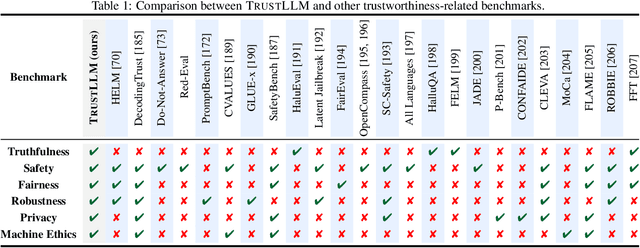
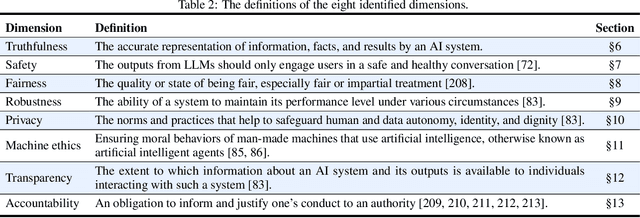

Large language models (LLMs), exemplified by ChatGPT, have gained considerable attention for their excellent natural language processing capabilities. Nonetheless, these LLMs present many challenges, particularly in the realm of trustworthiness. Therefore, ensuring the trustworthiness of LLMs emerges as an important topic. This paper introduces TrustLLM, a comprehensive study of trustworthiness in LLMs, including principles for different dimensions of trustworthiness, established benchmark, evaluation, and analysis of trustworthiness for mainstream LLMs, and discussion of open challenges and future directions. Specifically, we first propose a set of principles for trustworthy LLMs that span eight different dimensions. Based on these principles, we further establish a benchmark across six dimensions including truthfulness, safety, fairness, robustness, privacy, and machine ethics. We then present a study evaluating 16 mainstream LLMs in TrustLLM, consisting of over 30 datasets. Our findings firstly show that in general trustworthiness and utility (i.e., functional effectiveness) are positively related. Secondly, our observations reveal that proprietary LLMs generally outperform most open-source counterparts in terms of trustworthiness, raising concerns about the potential risks of widely accessible open-source LLMs. However, a few open-source LLMs come very close to proprietary ones. Thirdly, it is important to note that some LLMs may be overly calibrated towards exhibiting trustworthiness, to the extent that they compromise their utility by mistakenly treating benign prompts as harmful and consequently not responding. Finally, we emphasize the importance of ensuring transparency not only in the models themselves but also in the technologies that underpin trustworthiness. Knowing the specific trustworthy technologies that have been employed is crucial for analyzing their effectiveness.
ConTextual: Evaluating Context-Sensitive Text-Rich Visual Reasoning in Large Multimodal Models
Jan 24, 2024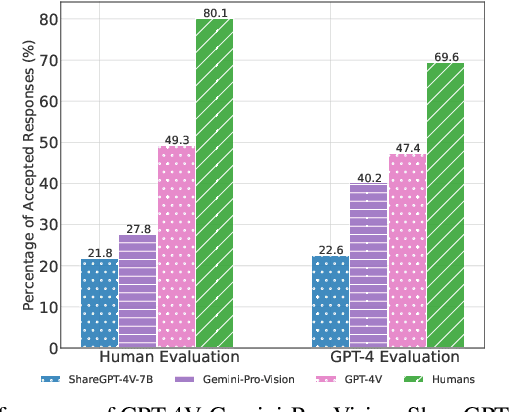
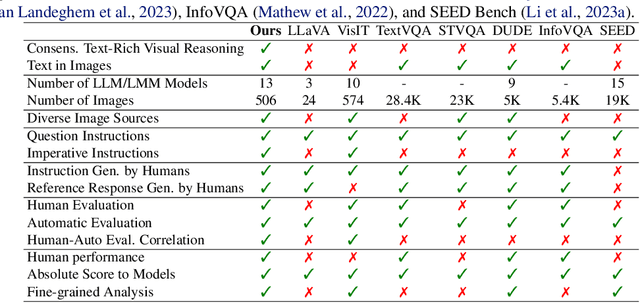
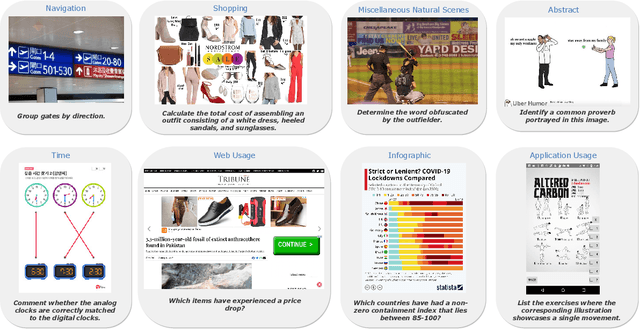

Recent advancements in AI have led to the development of large multimodal models (LMMs) capable of processing complex tasks involving joint reasoning over text and visual content in the image (e.g., navigating maps in public places). This paper introduces ConTextual, a novel benchmark comprising instructions designed explicitly to evaluate LMMs' ability to perform context-sensitive text-rich visual reasoning. ConTextual emphasizes diverse real-world scenarios (e.g., time-reading, navigation, shopping and more) demanding a deeper understanding of the interactions between textual and visual elements. Our findings reveal a significant performance gap of 30.8% between the best-performing LMM, GPT-4V(ision), and human capabilities using human evaluation indicating substantial room for improvement in context-sensitive text-rich visual reasoning. Notably, while GPT-4V excelled in abstract categories like meme and quote interpretation, its overall performance still lagged behind humans. In addition to human evaluations, we also employed automatic evaluation metrics using GPT-4, uncovering similar trends in performance disparities. We also perform a fine-grained evaluation across diverse visual contexts and provide qualitative analysis which provides a robust framework for future advancements in the LMM design. https://con-textual.github.io/
DeepEdit: Knowledge Editing as Decoding with Constraints
Jan 19, 2024We develop a new perspective of knowledge editing for large language models (LLMs) as decoding with constraints. We propose DeepEdit (Depth-first Search based Progressive Decoding for Knowledge Editing), a neuro-symbolic method that improves knowledge editing with better coherence of reasoning, relevance to the question, and awareness of updated knowledge. DeepEdit can be flexibly applied to all black-box LLMs: it does not require any access to the model parameters, representations, or output vocabulary distributions. DeepEdit progressively produces the high-quality reasoning steps towards effective knowledge editing. It utilizes a depth-first search to revise the LLMs' output, which improves the output's informativeness to the input question and awareness of the updated knowledge. Qualitatively, DeepEdit effectively controls LLMs to produce more succinct reasoning in accord with knowledge editing. Quantitatively, DeepEdit yields significant gains on MQuaKE, a challenging multi-hop question-answering dataset with knowledge editing. We release the source code at https://github.com/wangywUST/DeepEdit.
CASA: Causality-driven Argument Sufficiency Assessment
Jan 10, 2024The argument sufficiency assessment task aims to determine if the premises of a given argument support its conclusion. To tackle this task, existing works often train a classifier on data annotated by humans. However, annotating data is laborious, and annotations are often inconsistent due to subjective criteria. Motivated by the probability of sufficiency (PS) definition in the causal literature, we propose CASA, a zero-shot causality-driven argument sufficiency assessment framework. PS measures how likely introducing the premise event would lead to the conclusion, when both the premise and conclusion events are absent. To estimate this probability, we propose to use large language models (LLMs) to generate contexts that are inconsistent with the premise and conclusion, and revise them by injecting the premise event. Experiments on two logical fallacy detection datasets demonstrate that CASA accurately identifies insufficient arguments. We further deploy CASA in a writing assistance application, and find that suggestions generated by CASA enhance the sufficiency of student-written arguments. Code and data are available at https://github.com/xxxiaol/CASA.