 Add to Chrome
 Add to Firefox
 Add to Edge
Is Your Trajectory Displacement Safe in Long-tail?
Jun 15, 2026
Long-tail scenarios remain a major bottleneck for autonomous driving evaluation, even as datasets grow by orders of magnitude. Existing evaluation pipelines are rarely human-aligned, safety-aware, verifiable, and explainable at the same time: closed-loop metrics often saturate among strong planners, while unstructured human ratings can be noisy without a carefully designed protocol. We formulate planning evaluation as additional-threat detection: given a planner trajectory and an expert reference, does the planner's displacement introduce new unsafe driving behavior? We propose FluidTest, an evaluation pipeline with three components: a pairwise WebUI protocol for reliable human annotation; a taxonomy of 32 semantic threats with evidence-grounded decision graphs; and a three-agent verification system with reflection for precision and auditability. Experiments on the WOD-E2E dataset show that FluidTest produces consistent labels among trained annotators and identifies additional threats in 65% of Poutine trajectories and 51% of RAP trajectories. These results show that state-of-the-art planners can still exhibit substantial safety-relevant failures despite high Rater Feedback Scores (RFS) and low Average Displacement Error (ADE). Additional details, guidance, and code are available at https://fluidtest.web.app.

DriveMA: Driving Vision-Language-Action Models with verifiable Meta-Actions
May 29, 2026Driving Vision-Language-Action Models (Driving VLAs) aim to use language to improve end-to-end planning, but the language-action gap limits this promise. We propose DriveMA, a Driving VLA framework built on verifiable meta-actions, which summarize future ego motion into compact language-domain intentions and can be constructed from expert trajectories with a trajectory-grounded annotation pipeline and can be verified against generated trajectories through rule-based projection. DriveMA exploits this verifiability with action-centric supervised training and a data-efficient turn-level credit assignment reinforcement learning framework, explicitly aligning high-level decisions with low-level trajectory planning through dense rewards and precise credit assignment. DriveMA sets a new state of the art on the Waymo Open Dataset Vision-based E2E Driving, achieving a Rater Feedback Score of 8.060 with a 2B model and further improving it to 8.079 with a 4B model; it also obtains competitive closed-loop planning performance on NAVSIM. These results show that even a simple meta-action interface can achieve state-of-the-art planning when made verifiable and optimized for language-action alignment. Code, data, and models will be released to facilitate future research.
DriveMA: Rethinking Language Interfaces in Driving VLAs with One-Step Meta-Actions
May 21, 2026Driving Vision-Language-Action Models (Driving VLAs) commonly introduce natural-language reasoning as an intermediate interface for end-to-end planning, but reasoning-centric interfaces face three practical bottlenecks: obtaining high-quality reasoning annotations is difficult, generating and understanding long reasoning chains is challenging for compact models, and inference latency is substantially increased. In this paper, we rethink the design of language interfaces in Driving VLAs and show that concise one-step meta-actions are a simple yet effective alternative to verbose reasoning. Meta-actions provide semantic decision grounding while remaining low-entropy, and being automatically derivable from expert trajectories, enabling scalable supervision and reliable trajectory conditioning. Building on this interface, we propose DriveMA, which combines action-centric supervised training with a turn-level credit-assignment reinforcement learning framework that jointly optimizes meta-action correctness, trajectory quality, and trajectory--meta-action consistency. Experiments show that DriveMA already achieves a new state of the art on the Waymo End-to-End Driving Challenge with a 2B model, reaching a Rater Feedback Score (RFS) of 8.060, while its 4B version further improves the state of the art to 8.079; DriveMA also obtains competitive performance on NAVSIM. Ablations demonstrate that one-step meta-actions offer a better practical trade-off between expressiveness, predictability, and inference efficiency than natural-language reasoning or finer-grained action sequences. Code, data, and models will be released to facilitate future research.
KITINet: Kinetics Theory Inspired Network Architectures with PDE Simulation Approaches
May 23, 2025Despite the widely recognized success of residual connections in modern neural networks, their design principles remain largely heuristic. This paper introduces KITINet (Kinetics Theory Inspired Network), a novel architecture that reinterprets feature propagation through the lens of non-equilibrium particle dynamics and partial differential equation (PDE) simulation. At its core, we propose a residual module that models feature updates as the stochastic evolution of a particle system, numerically simulated via a discretized solver for the Boltzmann transport equation (BTE). This formulation mimics particle collisions and energy exchange, enabling adaptive feature refinement via physics-informed interactions. Additionally, we reveal that this mechanism induces network parameter condensation during training, where parameters progressively concentrate into a sparse subset of dominant channels. Experiments on scientific computation (PDE operator), image classification (CIFAR-10/100), and text classification (IMDb/SNLI) show consistent improvements over classic network baselines, with negligible increase of FLOPs.
KO: Kinetics-inspired Neural Optimizer with PDE Simulation Approaches
May 20, 2025The design of optimization algorithms for neural networks remains a critical challenge, with most existing methods relying on heuristic adaptations of gradient-based approaches. This paper introduces KO (Kinetics-inspired Optimizer), a novel neural optimizer inspired by kinetic theory and partial differential equation (PDE) simulations. We reimagine the training dynamics of network parameters as the evolution of a particle system governed by kinetic principles, where parameter updates are simulated via a numerical scheme for the Boltzmann transport equation (BTE) that models stochastic particle collisions. This physics-driven approach inherently promotes parameter diversity during optimization, mitigating the phenomenon of parameter condensation, i.e. collapse of network parameters into low-dimensional subspaces, through mechanisms analogous to thermal diffusion in physical systems. We analyze this property, establishing both a mathematical proof and a physical interpretation. Extensive experiments on image classification (CIFAR-10/100, ImageNet) and text classification (IMDB, Snips) tasks demonstrate that KO consistently outperforms baseline optimizers (e.g., Adam, SGD), achieving accuracy improvements while computation cost remains comparable.
Optimal Control Operator Perspective and a Neural Adaptive Spectral Method
Dec 17, 2024


Optimal control problems (OCPs) involve finding a control function for a dynamical system such that a cost functional is optimized. It is central to physical systems in both academia and industry. In this paper, we propose a novel instance-solution control operator perspective, which solves OCPs in a one-shot manner without direct dependence on the explicit expression of dynamics or iterative optimization processes. The control operator is implemented by a new neural operator architecture named Neural Adaptive Spectral Method (NASM), a generalization of classical spectral methods. We theoretically validate the perspective and architecture by presenting the approximation error bounds of NASM for the control operator. Experiments on synthetic environments and a real-world dataset verify the effectiveness and efficiency of our approach, including substantial speedup in running time, and high-quality in- and out-of-distribution generalization.
MTS-Net: Dual-Enhanced Positional Multi-Head Self-Attention for 3D CT Diagnosis of May-Thurner Syndrome
Jun 07, 2024May-Thurner Syndrome (MTS), also known as iliac vein compression syndrome or Cockett's syndrome, is a condition potentially impacting over 20 percent of the population, leading to an increased risk of iliofemoral deep venous thrombosis. In this paper, we present a 3D-based deep learning approach called MTS-Net for diagnosing May-Thurner Syndrome using CT scans. To effectively capture the spatial-temporal relationship among CT scans and emulate the clinical process of diagnosing MTS, we propose a novel attention module called the dual-enhanced positional multi-head self-attention (DEP-MHSA). The proposed DEP-MHSA reconsiders the role of positional embedding and incorporates a dual-enhanced positional embedding in both attention weights and residual connections. Further, we establish a new dataset, termed MTS-CT, consisting of 747 subjects. Experimental results demonstrate that our proposed approach achieves state-of-the-art MTS diagnosis results, and our self-attention design facilitates the spatial-temporal modeling. We believe that our DEP-MHSA is more suitable to handle CT image sequence modeling and the proposed dataset enables future research on MTS diagnosis. We make our code and dataset publicly available at: https://github.com/Nutingnon/MTS_dep_mhsa.
TrustLLM: Trustworthiness in Large Language Models
Jan 25, 2024
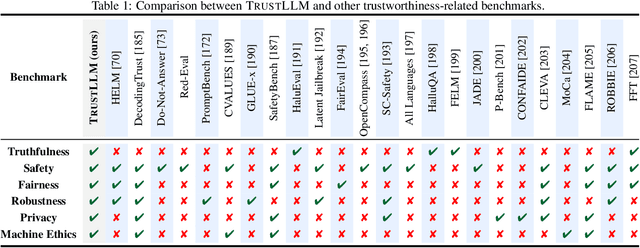
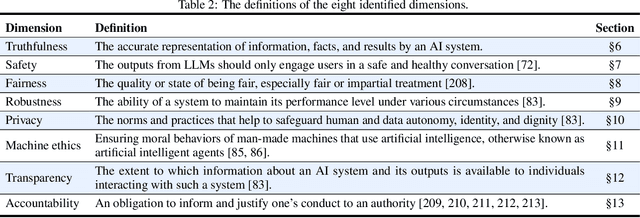

Large language models (LLMs), exemplified by ChatGPT, have gained considerable attention for their excellent natural language processing capabilities. Nonetheless, these LLMs present many challenges, particularly in the realm of trustworthiness. Therefore, ensuring the trustworthiness of LLMs emerges as an important topic. This paper introduces TrustLLM, a comprehensive study of trustworthiness in LLMs, including principles for different dimensions of trustworthiness, established benchmark, evaluation, and analysis of trustworthiness for mainstream LLMs, and discussion of open challenges and future directions. Specifically, we first propose a set of principles for trustworthy LLMs that span eight different dimensions. Based on these principles, we further establish a benchmark across six dimensions including truthfulness, safety, fairness, robustness, privacy, and machine ethics. We then present a study evaluating 16 mainstream LLMs in TrustLLM, consisting of over 30 datasets. Our findings firstly show that in general trustworthiness and utility (i.e., functional effectiveness) are positively related. Secondly, our observations reveal that proprietary LLMs generally outperform most open-source counterparts in terms of trustworthiness, raising concerns about the potential risks of widely accessible open-source LLMs. However, a few open-source LLMs come very close to proprietary ones. Thirdly, it is important to note that some LLMs may be overly calibrated towards exhibiting trustworthiness, to the extent that they compromise their utility by mistakenly treating benign prompts as harmful and consequently not responding. Finally, we emphasize the importance of ensuring transparency not only in the models themselves but also in the technologies that underpin trustworthiness. Knowing the specific trustworthy technologies that have been employed is crucial for analyzing their effectiveness.