 Add to Chrome
 Add to Firefox
 Add to Edge
Bridging the Age Gap: Towards Detecting Neural Audio Codec Synthesized Elderly Speech Deepfake
Jun 19, 2026
In this study, we introduce the Elderly CodecFake Detection (ECFD) task and release the Elderly-CodecFake (ECF) dataset in English and Chinese. We show that state-of-the-art CF detectors trained on previous benchmark CF datasets generalize poorly to elderly speech, revealing a critical vulnerability. We further hypothesize and demonstrate that multimodal foundation models (FMs) such as LanguageBind (LB) and ImageBind (IB) are more effective for ECFD due to their exposure to elderly content during cross-modal pretraining. Motivated by prior evidence that fusion of FMs enhances downstream performance, we explore fusion of FMs for ECFD. To this end, we propose BONSAI, a novel framework that employs Jensen-Shannon Divergence as the fusion mechanism. BONSAI with the fusion of LB and IB achieves an average EER (%) of 1.66 and outperforms individual FMs as well as competitive SOTA baselines, establishing a new benchmark for the ECFD task.

AdaLTM: Adaptive Layer-wise Task Vector Merging for Categorical Speech Emotion Recognition with ASR Knowledge Integration
Mar 26, 2026Integrating Automatic Speech Recognition (ASR) into Speech Emotion Recognition (SER) enhances modeling by providing linguistic context. However, conventional feature fusion faces performance bottlenecks, and multi-task learning often suffers from optimization conflicts. While task vectors and model merging have addressed such conflicts in NLP and CV, their potential in speech tasks remains largely unexplored. In this work, we propose an Adaptive Layer-wise Task Vector Merging (AdaLTM) framework based on WavLM-Large. Instead of joint optimization, we extract task vectors from in-domain ASR and SER models fine-tuned on emotion datasets. These vectors are integrated into a frozen base model using layer-wise learnable coefficients. This strategy enables depth-aware balancing of linguistic and paralinguistic knowledge across transformer layers without gradient interference. Experiments on the MSP-Podcast demonstrate that the proposed approach effectively mitigates conflicts between ASR and SER.
RE-LLM: Refining Empathetic Speech-LLM Responses by Integrating Emotion Nuance
Feb 11, 2026With generative AI advancing, empathy in human-AI interaction is essential. While prior work focuses on emotional reflection, emotional exploration, key to deeper engagement, remains overlooked. Existing LLMs rely on text which captures limited emotion nuances. To address this, we propose RE-LLM, a speech-LLM integrating dimensional emotion embeddings and auxiliary learning. Experiments show statistically significant gains in empathy metrics across three datasets. RE-LLM relatively improves the Emotional Reaction score by 14.79% and 6.76% compared to text-only and speech-LLM baselines on ESD. Notably, it raises the Exploration score by 35.42% and 3.91% on IEMOCAP, 139.28% and 9.83% on ESD, and 60.95% and 22.64% on MSP-PODCAST. It also boosts unweighted accuracy by 5.4% on IEMOCAP, 2.3% on ESD, and 6.9% on MSP-PODCAST in speech emotion recognition. These results highlight the enriched emotional understanding and improved empathetic response generation of RE-LLM.
ASR for Affective Speech: Investigating Impact of Emotion and Speech Generative Strategy
Jan 28, 2026This work investigates how emotional speech and generative strategies affect ASR performance. We analyze speech synthesized from three emotional TTS models and find that substitution errors dominate, with emotional expressiveness varying across models. Based on these insights, we introduce two generative strategies: one using transcription correctness and another using emotional salience, to construct fine-tuning subsets. Results show consistent WER improvements on real emotional datasets without noticeable degradation on clean LibriSpeech utterances. The combined strategy achieves the strongest gains, particularly for expressive speech. These findings highlight the importance of targeted augmentation for building emotion-aware ASR systems.
Joint Learning using Mixture-of-Expert-Based Representation for Enhanced Speech Generation and Robust Emotion Recognition
Sep 10, 2025Speech emotion recognition (SER) plays a critical role in building emotion-aware speech systems, but its performance degrades significantly under noisy conditions. Although speech enhancement (SE) can improve robustness, it often introduces artifacts that obscure emotional cues and adds computational overhead to the pipeline. Multi-task learning (MTL) offers an alternative by jointly optimizing SE and SER tasks. However, conventional shared-backbone models frequently suffer from gradient interference and representational conflicts between tasks. To address these challenges, we propose the Sparse Mixture-of-Experts Representation Integration Technique (Sparse MERIT), a flexible MTL framework that applies frame-wise expert routing over self-supervised speech representations. Sparse MERIT incorporates task-specific gating networks that dynamically select from a shared pool of experts for each frame, enabling parameter-efficient and task-adaptive representation learning. Experiments on the MSP-Podcast corpus show that Sparse MERIT consistently outperforms baseline models on both SER and SE tasks. Under the most challenging condition of -5 dB signal-to-noise ratio (SNR), Sparse MERIT improves SER F1-macro by an average of 12.0% over a baseline relying on a SE pre-processing strategy, and by 3.4% over a naive MTL baseline, with statistical significance on unseen noise conditions. For SE, Sparse MERIT improves segmental SNR (SSNR) by 28.2% over the SE pre-processing baseline and by 20.0% over the naive MTL baseline. These results demonstrate that Sparse MERIT provides robust and generalizable performance for both emotion recognition and enhancement tasks in noisy environments.
Lessons Learnt: Revisit Key Training Strategies for Effective Speech Emotion Recognition in the Wild
Aug 10, 2025In this study, we revisit key training strategies in machine learning often overlooked in favor of deeper architectures. Specifically, we explore balancing strategies, activation functions, and fine-tuning techniques to enhance speech emotion recognition (SER) in naturalistic conditions. Our findings show that simple modifications improve generalization with minimal architectural changes. Our multi-modal fusion model, integrating these optimizations, achieves a valence CCC of 0.6953, the best valence score in Task 2: Emotional Attribute Regression. Notably, fine-tuning RoBERTa and WavLM separately in a single-modality setting, followed by feature fusion without training the backbone extractor, yields the highest valence performance. Additionally, focal loss and activation functions significantly enhance performance without increasing complexity. These results suggest that refining core components, rather than deepening models, leads to more robust SER in-the-wild.
Is It Still Fair? Investigating Gender Fairness in Cross-Corpus Speech Emotion Recognition
Jan 02, 2025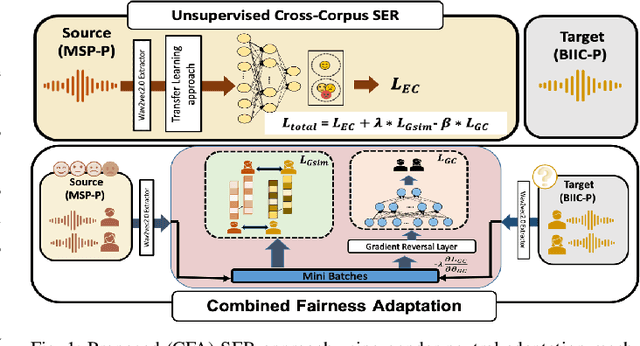


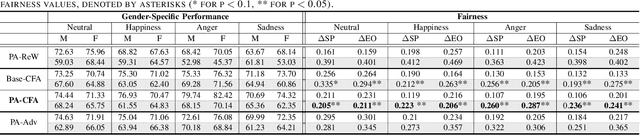
Speech emotion recognition (SER) is a vital component in various everyday applications. Cross-corpus SER models are increasingly recognized for their ability to generalize performance. However, concerns arise regarding fairness across demographics in diverse corpora. Existing fairness research often focuses solely on corpus-specific fairness, neglecting its generalizability in cross-corpus scenarios. Our study focuses on this underexplored area, examining the gender fairness generalizability in cross-corpus SER scenarios. We emphasize that the performance of cross-corpus SER models and their fairness are two distinct considerations. Moreover, we propose the approach of a combined fairness adaptation mechanism to enhance gender fairness in the SER transfer learning tasks by addressing both source and target genders. Our findings bring one of the first insights into the generalizability of gender fairness in cross-corpus SER systems.
Mouth Articulation-Based Anchoring for Improved Cross-Corpus Speech Emotion Recognition
Dec 27, 2024Cross-corpus speech emotion recognition (SER) plays a vital role in numerous practical applications. Traditional approaches to cross-corpus emotion transfer often concentrate on adapting acoustic features to align with different corpora, domains, or labels. However, acoustic features are inherently variable and error-prone due to factors like speaker differences, domain shifts, and recording conditions. To address these challenges, this study adopts a novel contrastive approach by focusing on emotion-specific articulatory gestures as the core elements for analysis. By shifting the emphasis on the more stable and consistent articulatory gestures, we aim to enhance emotion transfer learning in SER tasks. Our research leverages the CREMA-D and MSP-IMPROV corpora as benchmarks and it reveals valuable insights into the commonality and reliability of these articulatory gestures. The findings highlight mouth articulatory gesture potential as a better constraint for improving emotion recognition across different settings or domains.
Stimulus Modality Matters: Impact of Perceptual Evaluations from Different Modalities on Speech Emotion Recognition System Performance
Sep 16, 2024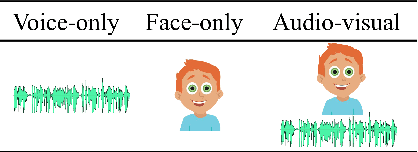
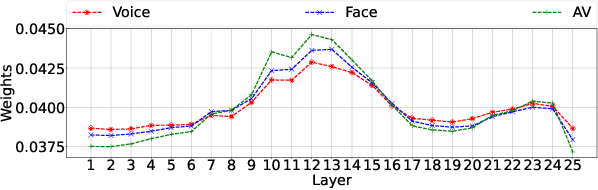
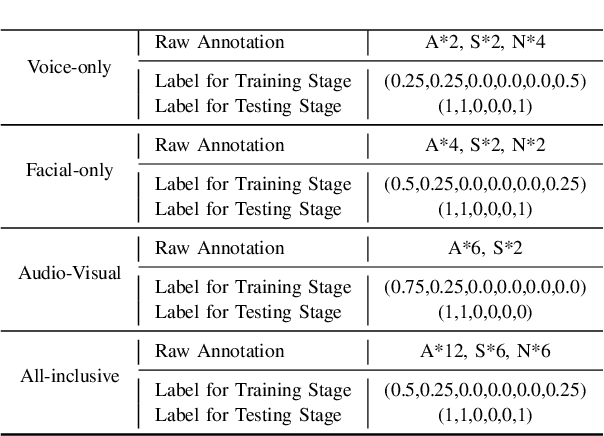
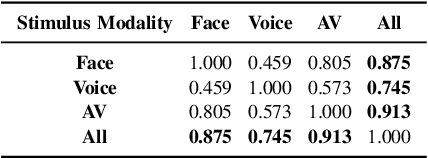
Speech Emotion Recognition (SER) systems rely on speech input and emotional labels annotated by humans. However, various emotion databases collect perceptional evaluations in different ways. For instance, the IEMOCAP dataset uses video clips with sounds for annotators to provide their emotional perceptions. However, the most significant English emotion dataset, the MSP-PODCAST, only provides speech for raters to choose the emotional ratings. Nevertheless, using speech as input is the standard approach to training SER systems. Therefore, the open question is the emotional labels elicited by which scenarios are the most effective for training SER systems. We comprehensively compare the effectiveness of SER systems trained with labels elicited by different modality stimuli and evaluate the SER systems on various testing conditions. Also, we introduce an all-inclusive label that combines all labels elicited by various modalities. We show that using labels elicited by voice-only stimuli for training yields better performance on the test set, whereas labels elicited by voice-only stimuli.
DiffEVC: Any-to-Any Emotion Voice Conversion with Expressive Guidance
Sep 05, 2024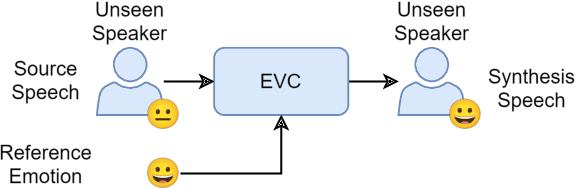
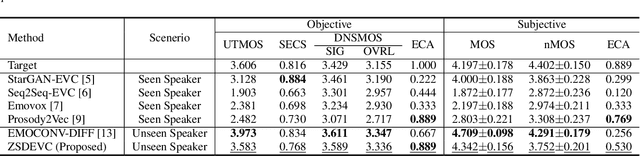
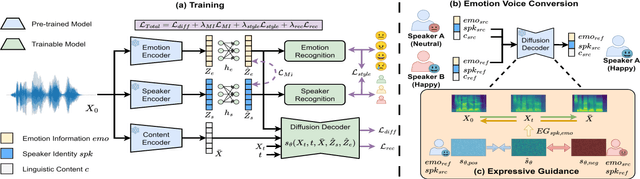
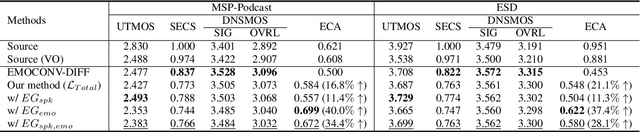
Emotional Voice Conversion (EVC) modifies speech emotion to enhance communication by amplifying positive cues and reducing negative ones. This complex task involves entangled factors like voice quality, speaker traits, and content. Traditional deep learning models like GANs and autoencoders have achieved some success in EVC by learning mappings or disentangling features but face challenges like instability and voice quality degradation. Diffusion models offer stable training and high-quality generation. We propose a diffusion-based EVC framework that disentangles emotion and speaker identity using mutual information loss and auxiliary models. An expressive guidance mechanism is introduced to improve emotion conversion while maintaining speaker traits. Experimental results demonstrate our approach's effectiveness for unseen speakers and emotions, achieving state-of-the-art performance in EVC tasks.