 Add to Chrome
 Add to Firefox
 Add to Edge
PeerMathDial: A Middle School Dialogue Dataset for Student Collaborative Math Problem Solving
Jun 19, 2026
Collaborative Problem Solving (CPS) is a core skill in education, where the process of peer interaction is highly important. However, existing educational dialogue datasets mostly focus on classroom instruction or tutoring (i.e., teacher/tutor-student interaction), yet datasets centering small-group, student-student interaction are limited. This thus leaves research with limited resources for studying how students interact, coordinate, and solve problems together in real educational settings. To address this, we introduce PeerMathDial, the first dataset of peer CPS dialogues collected from authentic middle school math classrooms. It contains 55 dialogues from 27 students, totaling 6,406 turns. To facilitate research on CPS discourse analysis, we further build a corpus-grounded dialogue act taxonomy assisted by LLMs. Using the dataset and the dialogue act taxonomy, we demonstrate the practical applications of PeerMathDial across three use cases. First, we track how dialogues evolve over time and measure the impact of teacher interventions. Second, we align dialogue actions with student surveys to reveal the connection between students' traits (e.g., confidence, leadership) and their actual behaviors. Third, by evaluating LLMs on dialogue act prediction, we glimpse at the potential of LLMs for student simulation in educational applications. Our dataset and source code will be released to the community.

Real-Time Trend Prediction via Continually-Aligned LLM Query Generation
Jan 24, 2026Trending news detection in low-traffic search environments faces a fundamental cold-start problem, where a lack of query volume prevents systems from identifying emerging or long-tail trends. Existing methods relying on keyword frequency or query spikes are inherently slow and ineffective in these sparse settings, lagging behind real-world shifts in attention. We introduce RTTP, a novel Real-Time Trending Prediction framework that generates search queries directly from news content instead of waiting for users to issue them. RTTP leverages a continual learning LLM (CL-LLM) that converts posts into search-style queries and scores them using engagement strength + creator authority, enabling early trend surfacing before search volume forms. To ensure adaptation without degrading reasoning, we propose Mix-Policy DPO, a new preference-based continual learning approach that combines on-policy stability with off-policy novelty to mitigate catastrophic forgetting during model upgrades. Deployed at production scale on Facebook and Meta AI products, RTTP delivers +91.4% improvement in tail-trend detection precision@500 and +19% query generation accuracy over industry baselines, while sustaining stable performance after multi-week online training. This work demonstrates that LLM-generated synthetic search signals, when aligned and continually updated, unlock timely trend understanding in low-traffic search environments.
TrustLLM: Trustworthiness in Large Language Models
Jan 25, 2024
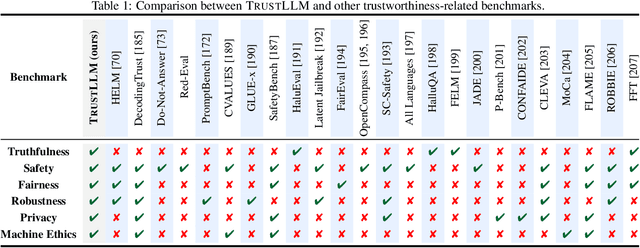
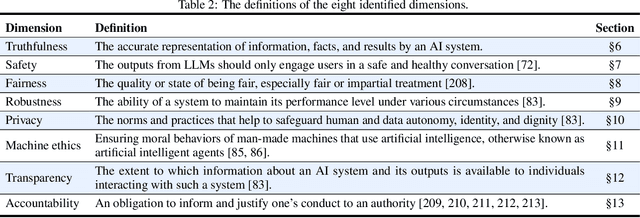

Large language models (LLMs), exemplified by ChatGPT, have gained considerable attention for their excellent natural language processing capabilities. Nonetheless, these LLMs present many challenges, particularly in the realm of trustworthiness. Therefore, ensuring the trustworthiness of LLMs emerges as an important topic. This paper introduces TrustLLM, a comprehensive study of trustworthiness in LLMs, including principles for different dimensions of trustworthiness, established benchmark, evaluation, and analysis of trustworthiness for mainstream LLMs, and discussion of open challenges and future directions. Specifically, we first propose a set of principles for trustworthy LLMs that span eight different dimensions. Based on these principles, we further establish a benchmark across six dimensions including truthfulness, safety, fairness, robustness, privacy, and machine ethics. We then present a study evaluating 16 mainstream LLMs in TrustLLM, consisting of over 30 datasets. Our findings firstly show that in general trustworthiness and utility (i.e., functional effectiveness) are positively related. Secondly, our observations reveal that proprietary LLMs generally outperform most open-source counterparts in terms of trustworthiness, raising concerns about the potential risks of widely accessible open-source LLMs. However, a few open-source LLMs come very close to proprietary ones. Thirdly, it is important to note that some LLMs may be overly calibrated towards exhibiting trustworthiness, to the extent that they compromise their utility by mistakenly treating benign prompts as harmful and consequently not responding. Finally, we emphasize the importance of ensuring transparency not only in the models themselves but also in the technologies that underpin trustworthiness. Knowing the specific trustworthy technologies that have been employed is crucial for analyzing their effectiveness.