 Add to Chrome
 Add to Firefox
 Add to Edge
HPD-Parsing: Hierarchical Parallel Document Parsing
Jul 21, 2026
Efficient teamwork typically combines global coordination with parallel execution, a principle not yet fully reflected in unified Vision-Language Model (VLM)-based document parsers. Existing unified parsers process an entire page jointly but generate its output through a single token-by-token autoregressive trajectory, creating a sequential bottleneck that grows with document length. Such full-page sequential generation overlooks a key property of document parsing: layout must be analyzed globally, whereas block content can be parsed in parallel. Based on this observation, we introduce HPD-Parsing, which replaces full-page autoregressive generation with a Hierarchical Parallel Decoding paradigm. A main layout branch organizes the overall document structure and dynamically assigns block-level content decoding to concurrent branches, while progressive multi-token prediction (P-MTP) further reduces the decoding steps within each branch. Experiments on public benchmarks show that HPD-Parsing achieves 4,752 tokens per second, delivering $2.62\times$ the throughput of the fastest existing document parsing model and $3.06\times$ that of the vanilla autoregressive baseline, while maintaining competitive parsing accuracy. These results establish hierarchical parallel decoding as an effective alternative to full-page autoregressive generation, opening a new direction for efficient unified document parsing.

P-MTP: Efficient Document Parsing via Multi-Token Prediction with Progressive Depth Scaling
Jun 23, 2026Vision-Language Models (VLMs) have revolutionized document parsing by enabling end-to-end mapping from images to structured text, imposing a significant latency bottleneck, particularly for token-dense documents. While Multi-Token Prediction (MTP) has emerged as a promising approach for accelerating inference, its potential is constrained by optimization instability when scaling to deeper look-ahead depth. In this paper, we propose \textbf{P-MTP}, a framework that leverages \textbf{Progressive Multi-Token Prediction} with a lightweight MTP module to scale the look-ahead depth for high-throughput document parsing. Specifically, we introduce Progressive Curriculum Loss that adaptively re-weights different look-ahead depths using cumulative path reliability and retrospective target consistency. By effectively suppressing gradient noise in long-range predictions, P-MTP, facilitates an automated easy-to-hard optimization transition, enabling the model to master increasingly distant look-ahead depths. Furthermore, we propose Confidence-Gated Dynamic Drafting to maximize the effective look-ahead depth and acceptance rate by adaptively calibrating speculative length during inference, thereby minimizing computational waste and further pushing the boundaries of inference speedup. Experimental results across multiple benchmarks and architectures demonstrate that P-MTP, achieves up to a $5\times$ speedup with negligible loss in accuracy, providing the first successful validation of extensive look-ahead MTP in the document parsing domain.
Unlimited OCR Works
Jun 22, 2026Recently, end-to-end OCR models, exemplified by DeepSeek OCR, have once again thrust OCR into the spotlight. A widely held view is that employing a large language model (LLM) as the decoder allows the model to leverage the prior distribution of language, leading to improved OCR performance. However, the downside is equally evident: as the output sequence lengthens, the accumulated KV cache drives up memory consumption and progressively slows down generation. This stands in stark contrast to humans, who exhibit no such decline in efficiency during long-horizon copying tasks. In this technical report, we propose Unlimited OCR, a model designed to emulate human parsing working memory. Taking DeepSeek OCR as the baseline, we replace all attention layers in the decoder with our proposed Reference Sliding Window Attention (R-SWA), which reduces attention computation costs while maintaining a constant KV cache throughout the entire decoding process. By combining the high compression rate of DeepSeek OCR's encoder with our constant KV cache design, Unlimited OCR can transcribe dozens of pages of documents in a single forward pass under a standard maximum length of 32K. More importantly, R-SWA is a general-purpose parsing attention mechanism - beyond OCR, it is equally applicable to tasks such as ASR, translation, etc. Codes and model weights are publicly available at http://github.com/baidu/Unlimited-OCR.
Beyond Augmentation: Score-Guided Pathological Prior for EEG-based Depression Detection
May 29, 2026Deep learning-based Major Depressive Disorder (MDD) detection using Electroencephalography (EEG) is fundamentally constrained by the "small-sample dilemma." Prevailing generative data augmentation methods not only incur heavy computational overhead but also risk introducing synthetic noise, thereby blurring classification boundaries. To challenge the traditional "data quantity first" convention, we propose a novel framework "Beyond Augmentation": Score-Guided Classification (SGC). SGC does not synthesize pseudo-samples; instead, it utilizes an unsupervised generative network architecture to model the structural and statistical anomaly degrees of samples, serving as the core "Pathological Prior". This prior, after robust normalization, is explicitly fused with deep feature representations, thereby precisely guiding the classifier's decision boundary. Furthermore, to dynamically adapt to varying channel configurations, we propose a Cross-Channel Spatial Adaptation module, utilizing a spatial mapping mechanism to effectively resolve the hardware heterogeneity of mismatched channels in multi-center datasets. Extensive experiments on the Mumtaz2016 and high-density MODMA datasets demonstrate the effectiveness and exceptional generalizability of our method under the challenging "zero data augmentation" setting and at "zero sample synthesis cost". Keywords: Electroencephalography (EEG), Depression Detection, Anomaly Score, Diffusion Models, Few-Shot Learning
PassNet: Scaling Large Language Models for Graph Compiler Pass Generation
May 28, 2026Modern tensor compilers such as TorchInductor deliver substantial speedups on mainstream models, yet face a systematic performance ceiling on long-tail workloads -- our profiling shows that 43% of real-world subgraphs experience end-to-end slowdowns under default compilation. While LLMs offer a path toward automated optimization, existing efforts focus on standalone kernel generation. We argue that pass generation -- where LLMs author structured graph transformations that integrate directly into compiler pipelines -- is the more appropriate abstraction. We propose PassNet, the first large-scale ecosystem for LLM-based compiler pass generation, comprising: (1) PassNet-Dataset, over 18K unique computational graphs from 100K real-world models; and (2) PassBench, 200 curated long-tail fusible tasks (comprising 2,060 subgraphs in total) evaluated under the Error-aware Speedup Score (ES_t) -- a metric unifying correctness, stability, and performance -- with layered integrity defenses against systematic LLM exploitation. Experiments reveal that PassBench is both highly discriminative and genuinely unsaturated: the best frontier model trails TorchInductor by 37% in aggregate, yet on individual subgraphs LLMs achieve up to 3x speedup over the same compiler -- indicating that the bottleneck is consistency, not capability. Fine-tuning a small model on merely ~4K PassNet trajectories yields a 2.67x improvement approaching frontier-model performance, demonstrating substantial headroom and validating PassNet as live training infrastructure for advancing LLM-driven compiler optimization. All data, benchmarks, and tooling are publicly available.
ERNIE 5.0 Technical Report
Feb 04, 2026In this report, we introduce ERNIE 5.0, a natively autoregressive foundation model desinged for unified multimodal understanding and generation across text, image, video, and audio. All modalities are trained from scratch under a unified next-group-of-tokens prediction objective, based on an ultra-sparse mixture-of-experts (MoE) architecture with modality-agnostic expert routing. To address practical challenges in large-scale deployment under diverse resource constraints, ERNIE 5.0 adopts a novel elastic training paradigm. Within a single pre-training run, the model learns a family of sub-models with varying depths, expert capacities, and routing sparsity, enabling flexible trade-offs among performance, model size, and inference latency in memory- or time-constrained scenarios. Moreover, we systematically address the challenges of scaling reinforcement learning to unified foundation models, thereby guaranteeing efficient and stable post-training under ultra-sparse MoE architectures and diverse multimodal settings. Extensive experiments demonstrate that ERNIE 5.0 achieves strong and balanced performance across multiple modalities. To the best of our knowledge, among publicly disclosed models, ERNIE 5.0 represents the first production-scale realization of a trillion-parameter unified autoregressive model that supports both multimodal understanding and generation. To facilitate further research, we present detailed visualizations of modality-agnostic expert routing in the unified model, alongside comprehensive empirical analysis of elastic training, aiming to offer profound insights to the community.
MEnvAgent: Scalable Polyglot Environment Construction for Verifiable Software Engineering
Jan 30, 2026The evolution of Large Language Model (LLM) agents for software engineering (SWE) is constrained by the scarcity of verifiable datasets, a bottleneck stemming from the complexity of constructing executable environments across diverse languages. To address this, we introduce MEnvAgent, a Multi-language framework for automated Environment construction that facilitates scalable generation of verifiable task instances. MEnvAgent employs a multi-agent Planning-Execution-Verification architecture to autonomously resolve construction failures and integrates a novel Environment Reuse Mechanism that reduces computational overhead by incrementally patching historical environments. Evaluations on MEnvBench, a new benchmark comprising 1,000 tasks across 10 languages, demonstrate that MEnvAgent outperforms baselines, improving Fail-to-Pass (F2P) rates by 8.6% while reducing time costs by 43%. Additionally, we demonstrate the utility of MEnvAgent by constructing MEnvData-SWE, the largest open-source polyglot dataset of realistic verifiable Docker environments to date, alongside solution trajectories that enable consistent performance gains on SWE tasks across a wide range of models. Our code, benchmark, and dataset are available at https://github.com/ernie-research/MEnvAgent.
Recognition-Synergistic Scene Text Editing
Mar 11, 2025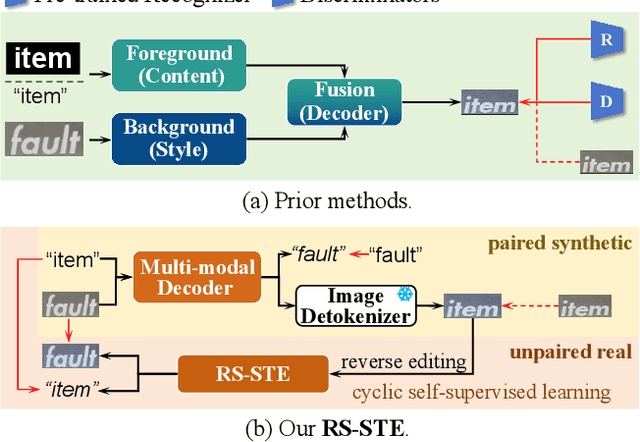
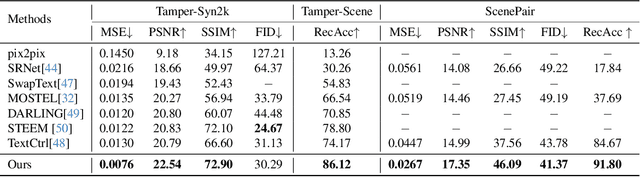
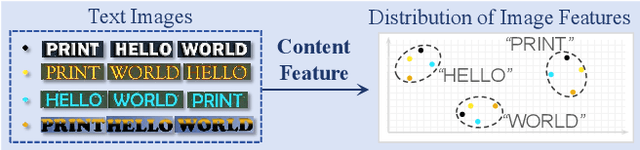
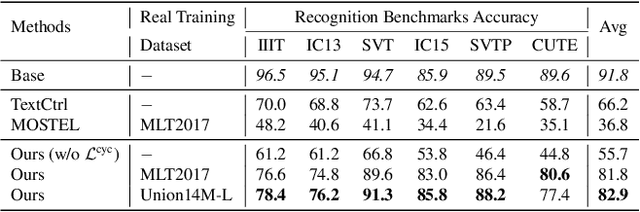
Scene text editing aims to modify text content within scene images while maintaining style consistency. Traditional methods achieve this by explicitly disentangling style and content from the source image and then fusing the style with the target content, while ensuring content consistency using a pre-trained recognition model. Despite notable progress, these methods suffer from complex pipelines, leading to suboptimal performance in complex scenarios. In this work, we introduce Recognition-Synergistic Scene Text Editing (RS-STE), a novel approach that fully exploits the intrinsic synergy of text recognition for editing. Our model seamlessly integrates text recognition with text editing within a unified framework, and leverages the recognition model's ability to implicitly disentangle style and content while ensuring content consistency. Specifically, our approach employs a multi-modal parallel decoder based on transformer architecture, which predicts both text content and stylized images in parallel. Additionally, our cyclic self-supervised fine-tuning strategy enables effective training on unpaired real-world data without ground truth, enhancing style and content consistency through a twice-cyclic generation process. Built on a relatively simple architecture, \mymodel achieves state-of-the-art performance on both synthetic and real-world benchmarks, and further demonstrates the effectiveness of leveraging the generated hard cases to boost the performance of downstream recognition tasks. Code is available at https://github.com/ZhengyaoFang/RS-STE.
Efficient Vision Language Model Fine-tuning for Text-based Person Anomaly Search
Feb 05, 2025
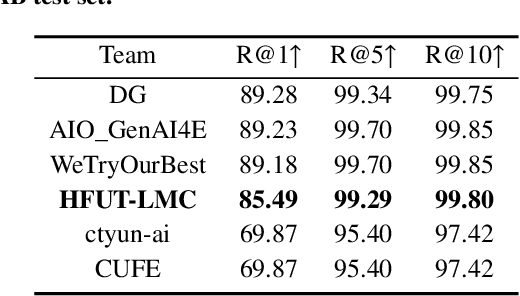

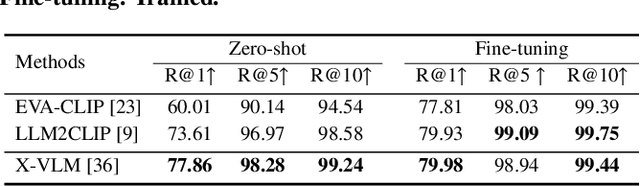
This paper presents the HFUT-LMC team's solution to the WWW 2025 challenge on Text-based Person Anomaly Search (TPAS). The primary objective of this challenge is to accurately identify pedestrians exhibiting either normal or abnormal behavior within a large library of pedestrian images. Unlike traditional video analysis tasks, TPAS significantly emphasizes understanding and interpreting the subtle relationships between text descriptions and visual data. The complexity of this task lies in the model's need to not only match individuals to text descriptions in massive image datasets but also accurately differentiate between search results when faced with similar descriptions. To overcome these challenges, we introduce the Similarity Coverage Analysis (SCA) strategy to address the recognition difficulty caused by similar text descriptions. This strategy effectively enhances the model's capacity to manage subtle differences, thus improving both the accuracy and reliability of the search. Our proposed solution demonstrated excellent performance in this challenge.
Discrete to Continuous: Generating Smooth Transition Poses from Sign Language Observation
Nov 25, 2024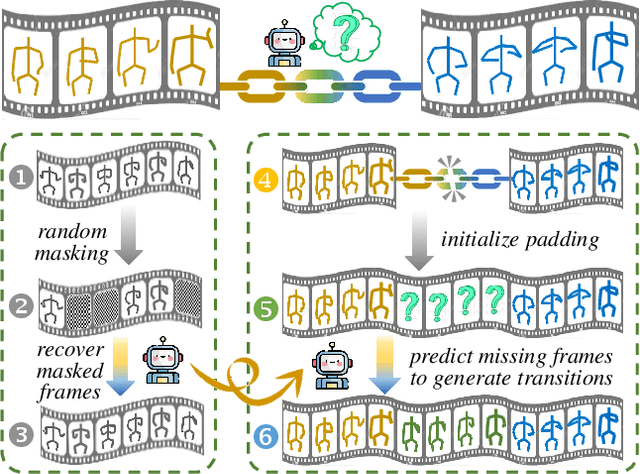
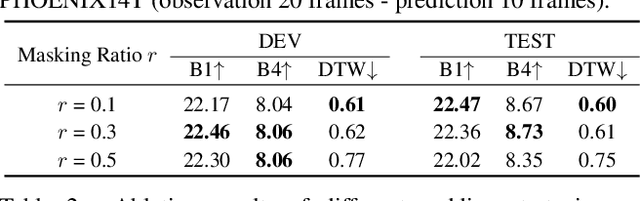
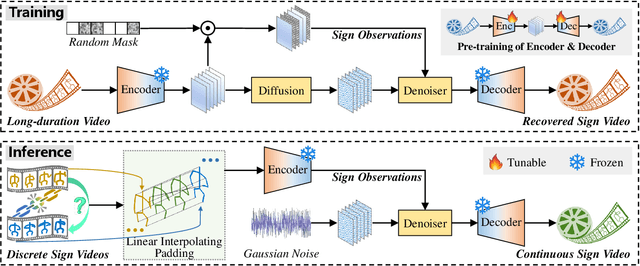
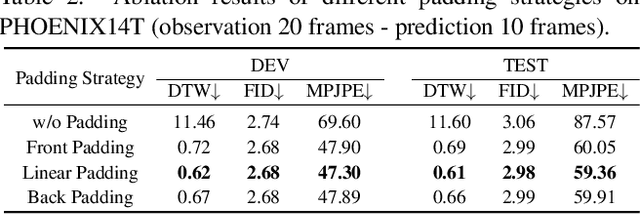
Generating continuous sign language videos from discrete segments is challenging due to the need for smooth transitions that preserve natural flow and meaning. Traditional approaches that simply concatenate isolated signs often result in abrupt transitions, disrupting video coherence. To address this, we propose a novel framework, Sign-D2C, that employs a conditional diffusion model to synthesize contextually smooth transition frames, enabling the seamless construction of continuous sign language sequences. Our approach transforms the unsupervised problem of transition frame generation into a supervised training task by simulating the absence of transition frames through random masking of segments in long-duration sign videos. The model learns to predict these masked frames by denoising Gaussian noise, conditioned on the surrounding sign observations, allowing it to handle complex, unstructured transitions. During inference, we apply a linearly interpolating padding strategy that initializes missing frames through interpolation between boundary frames, providing a stable foundation for iterative refinement by the diffusion model. Extensive experiments on the PHOENIX14T, USTC-CSL100, and USTC-SLR500 datasets demonstrate the effectiveness of our method in producing continuous, natural sign language videos.