 Add to Chrome
 Add to Firefox
 Add to Edge
HPD-Parsing: Hierarchical Parallel Document Parsing
Jul 21, 2026
Efficient teamwork typically combines global coordination with parallel execution, a principle not yet fully reflected in unified Vision-Language Model (VLM)-based document parsers. Existing unified parsers process an entire page jointly but generate its output through a single token-by-token autoregressive trajectory, creating a sequential bottleneck that grows with document length. Such full-page sequential generation overlooks a key property of document parsing: layout must be analyzed globally, whereas block content can be parsed in parallel. Based on this observation, we introduce HPD-Parsing, which replaces full-page autoregressive generation with a Hierarchical Parallel Decoding paradigm. A main layout branch organizes the overall document structure and dynamically assigns block-level content decoding to concurrent branches, while progressive multi-token prediction (P-MTP) further reduces the decoding steps within each branch. Experiments on public benchmarks show that HPD-Parsing achieves 4,752 tokens per second, delivering $2.62\times$ the throughput of the fastest existing document parsing model and $3.06\times$ that of the vanilla autoregressive baseline, while maintaining competitive parsing accuracy. These results establish hierarchical parallel decoding as an effective alternative to full-page autoregressive generation, opening a new direction for efficient unified document parsing.

P-MTP: Efficient Document Parsing via Multi-Token Prediction with Progressive Depth Scaling
Jun 23, 2026Vision-Language Models (VLMs) have revolutionized document parsing by enabling end-to-end mapping from images to structured text, imposing a significant latency bottleneck, particularly for token-dense documents. While Multi-Token Prediction (MTP) has emerged as a promising approach for accelerating inference, its potential is constrained by optimization instability when scaling to deeper look-ahead depth. In this paper, we propose \textbf{P-MTP}, a framework that leverages \textbf{Progressive Multi-Token Prediction} with a lightweight MTP module to scale the look-ahead depth for high-throughput document parsing. Specifically, we introduce Progressive Curriculum Loss that adaptively re-weights different look-ahead depths using cumulative path reliability and retrospective target consistency. By effectively suppressing gradient noise in long-range predictions, P-MTP, facilitates an automated easy-to-hard optimization transition, enabling the model to master increasingly distant look-ahead depths. Furthermore, we propose Confidence-Gated Dynamic Drafting to maximize the effective look-ahead depth and acceptance rate by adaptively calibrating speculative length during inference, thereby minimizing computational waste and further pushing the boundaries of inference speedup. Experimental results across multiple benchmarks and architectures demonstrate that P-MTP, achieves up to a $5\times$ speedup with negligible loss in accuracy, providing the first successful validation of extensive look-ahead MTP in the document parsing domain.
Unlimited OCR Works
Jun 22, 2026Recently, end-to-end OCR models, exemplified by DeepSeek OCR, have once again thrust OCR into the spotlight. A widely held view is that employing a large language model (LLM) as the decoder allows the model to leverage the prior distribution of language, leading to improved OCR performance. However, the downside is equally evident: as the output sequence lengthens, the accumulated KV cache drives up memory consumption and progressively slows down generation. This stands in stark contrast to humans, who exhibit no such decline in efficiency during long-horizon copying tasks. In this technical report, we propose Unlimited OCR, a model designed to emulate human parsing working memory. Taking DeepSeek OCR as the baseline, we replace all attention layers in the decoder with our proposed Reference Sliding Window Attention (R-SWA), which reduces attention computation costs while maintaining a constant KV cache throughout the entire decoding process. By combining the high compression rate of DeepSeek OCR's encoder with our constant KV cache design, Unlimited OCR can transcribe dozens of pages of documents in a single forward pass under a standard maximum length of 32K. More importantly, R-SWA is a general-purpose parsing attention mechanism - beyond OCR, it is equally applicable to tasks such as ASR, translation, etc. Codes and model weights are publicly available at http://github.com/baidu/Unlimited-OCR.
Post-Completion Learning for Language Models
Jul 27, 2025Current language model training paradigms typically terminate learning upon reaching the end-of-sequence (<eos>}) token, overlooking the potential learning opportunities in the post-completion space. We propose Post-Completion Learning (PCL), a novel training framework that systematically utilizes the sequence space after model output completion, to enhance both the reasoning and self-evaluation abilities. PCL enables models to continue generating self-assessments and reward predictions during training, while maintaining efficient inference by stopping at the completion point. To fully utilize this post-completion space, we design a white-box reinforcement learning method: let the model evaluate the output content according to the reward rules, then calculate and align the score with the reward functions for supervision. We implement dual-track SFT to optimize both reasoning and evaluation capabilities, and mixed it with RL training to achieve multi-objective hybrid optimization. Experimental results on different datasets and models demonstrate consistent improvements over traditional SFT and RL methods. Our method provides a new technical path for language model training that enhances output quality while preserving deployment efficiency.
Dolphin: Document Image Parsing via Heterogeneous Anchor Prompting
May 20, 2025Document image parsing is challenging due to its complexly intertwined elements such as text paragraphs, figures, formulas, and tables. Current approaches either assemble specialized expert models or directly generate page-level content autoregressively, facing integration overhead, efficiency bottlenecks, and layout structure degradation despite their decent performance. To address these limitations, we present \textit{Dolphin} (\textit{\textbf{Do}cument Image \textbf{P}arsing via \textbf{H}eterogeneous Anchor Prompt\textbf{in}g}), a novel multimodal document image parsing model following an analyze-then-parse paradigm. In the first stage, Dolphin generates a sequence of layout elements in reading order. These heterogeneous elements, serving as anchors and coupled with task-specific prompts, are fed back to Dolphin for parallel content parsing in the second stage. To train Dolphin, we construct a large-scale dataset of over 30 million samples, covering multi-granularity parsing tasks. Through comprehensive evaluations on both prevalent benchmarks and self-constructed ones, Dolphin achieves state-of-the-art performance across diverse page-level and element-level settings, while ensuring superior efficiency through its lightweight architecture and parallel parsing mechanism. The code and pre-trained models are publicly available at https://github.com/ByteDance/Dolphin
Operator Feature Neural Network for Symbolic Regression
Aug 14, 2024Symbolic regression is a task aimed at identifying patterns in data and representing them through mathematical expressions, generally involving skeleton prediction and constant optimization. Many methods have achieved some success, however they treat variables and symbols merely as characters of natural language without considering their mathematical essence. This paper introduces the operator feature neural network (OF-Net) which employs operator representation for expressions and proposes an implicit feature encoding method for the intrinsic mathematical operational logic of operators. By substituting operator features for numeric loss, we can predict the combination of operators of target expressions. We evaluate the model on public datasets, and the results demonstrate that the model achieves superior recovery rates and high $R^2$ scores. With the discussion of the results, we analyze the merit and demerit of OF-Net and propose optimizing schemes.
Harmonizing Visual Text Comprehension and Generation
Jul 23, 2024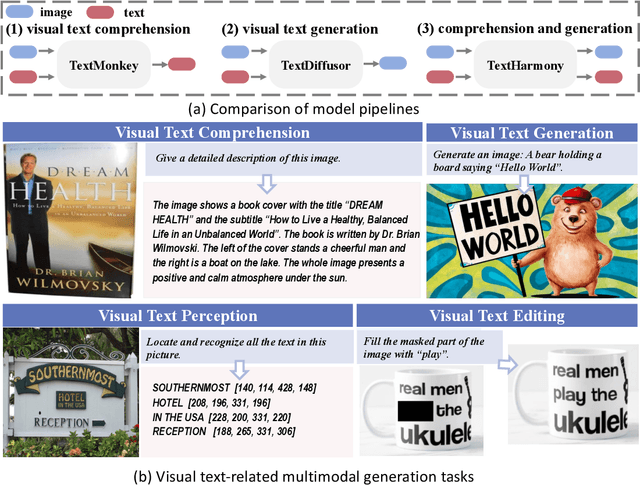
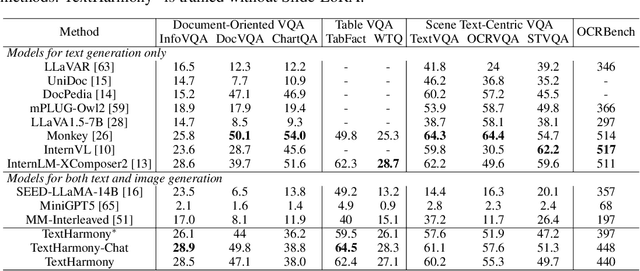
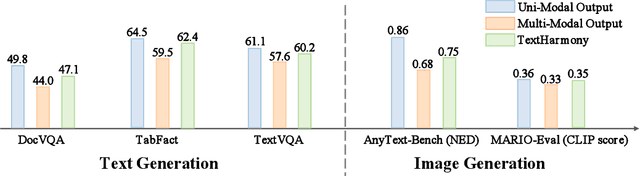
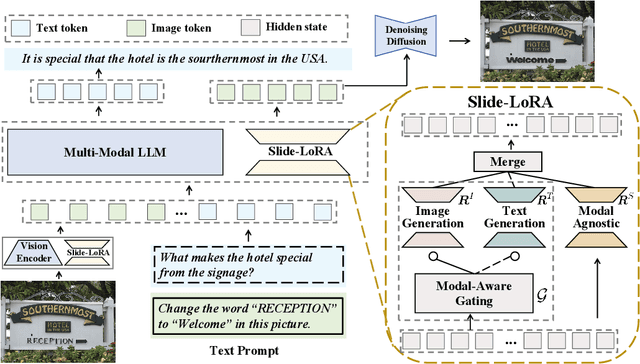
In this work, we present TextHarmony, a unified and versatile multimodal generative model proficient in comprehending and generating visual text. Simultaneously generating images and texts typically results in performance degradation due to the inherent inconsistency between vision and language modalities. To overcome this challenge, existing approaches resort to modality-specific data for supervised fine-tuning, necessitating distinct model instances. We propose Slide-LoRA, which dynamically aggregates modality-specific and modality-agnostic LoRA experts, partially decoupling the multimodal generation space. Slide-LoRA harmonizes the generation of vision and language within a singular model instance, thereby facilitating a more unified generative process. Additionally, we develop a high-quality image caption dataset, DetailedTextCaps-100K, synthesized with a sophisticated closed-source MLLM to enhance visual text generation capabilities further. Comprehensive experiments across various benchmarks demonstrate the effectiveness of the proposed approach. Empowered by Slide-LoRA, TextHarmony achieves comparable performance to modality-specific fine-tuning results with only a 2% increase in parameters and shows an average improvement of 2.5% in visual text comprehension tasks and 4.0% in visual text generation tasks. Our work delineates the viability of an integrated approach to multimodal generation within the visual text domain, setting a foundation for subsequent inquiries.
DN-CL: Deep Symbolic Regression against Noise via Contrastive Learning
Jun 21, 2024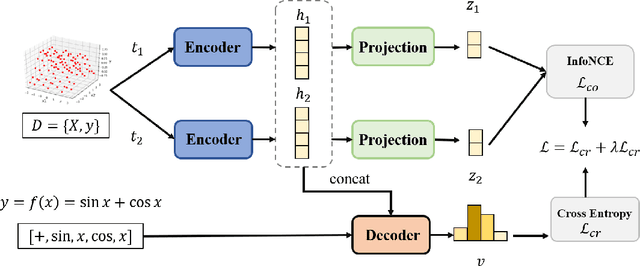
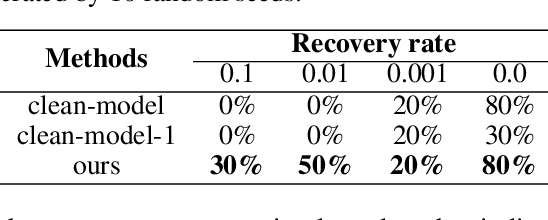
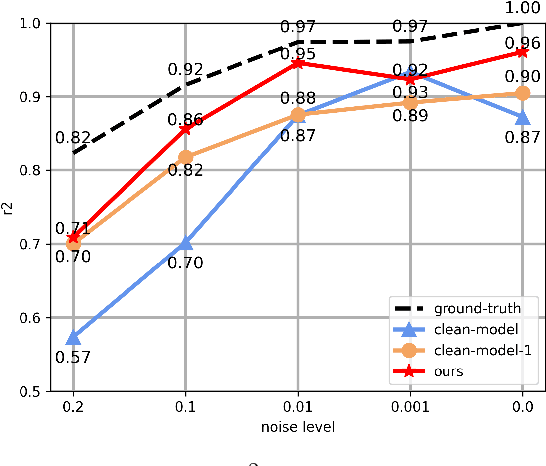
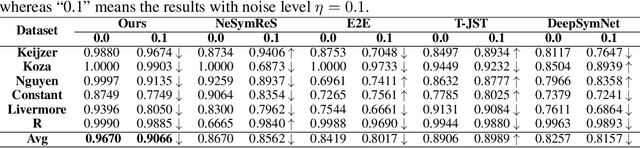
Noise ubiquitously exists in signals due to numerous factors including physical, electronic, and environmental effects. Traditional methods of symbolic regression, such as genetic programming or deep learning models, aim to find the most fitting expressions for these signals. However, these methods often overlook the noise present in real-world data, leading to reduced fitting accuracy. To tackle this issue, we propose \textit{\textbf{D}eep Symbolic Regression against \textbf{N}oise via \textbf{C}ontrastive \textbf{L}earning (DN-CL)}. DN-CL employs two parameter-sharing encoders to embed data points from various data transformations into feature shields against noise. This model treats noisy data and clean data as different views of the ground-truth mathematical expressions. Distances between these features are minimized, utilizing contrastive learning to distinguish between 'positive' noise-corrected pairs and 'negative' contrasting pairs. Our experiments indicate that DN-CL demonstrates superior performance in handling both noisy and clean data, presenting a promising method of symbolic regression.
MLLM-SR: Conversational Symbolic Regression base Multi-Modal Large Language Models
Jun 08, 2024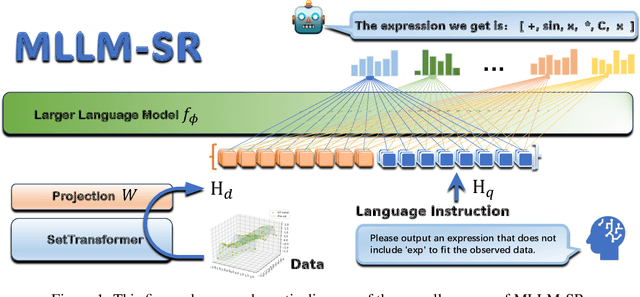
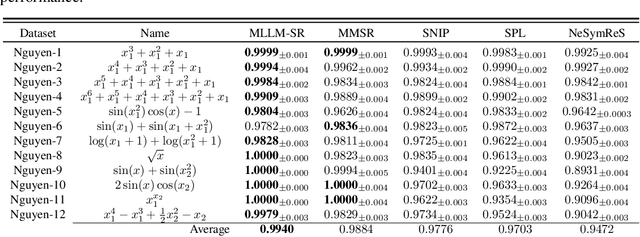


Formulas are the language of communication between humans and nature. It is an important research topic of artificial intelligence to find expressions from observed data to reflect the relationship between each variable in the data, which is called a symbolic regression problem. The existing symbolic regression methods directly generate expressions according to the given observation data, and we cannot require the algorithm to generate expressions that meet specific requirements according to the known prior knowledge. For example, the expression needs to contain $\sin$ or be symmetric, and so on. Even if it can, it often requires very complex operations, which is very inconvenient. In this paper, based on multi-modal large language models, we propose MLLM-SR, a conversational symbolic regression method that can generate expressions that meet the requirements simply by describing the requirements with natural language instructions. By experimenting on the Nguyen dataset, we can demonstrate that MLLM-SR leads the state-of-the-art baselines in fitting performance. More notably, we experimentally demonstrate that MLLM-SR can well understand the prior knowledge we add to the natural language instructions. Moreover, the addition of prior knowledge can effectively guide MLLM-SR to generate correct expressions.
TabPedia: Towards Comprehensive Visual Table Understanding with Concept Synergy
Jun 03, 2024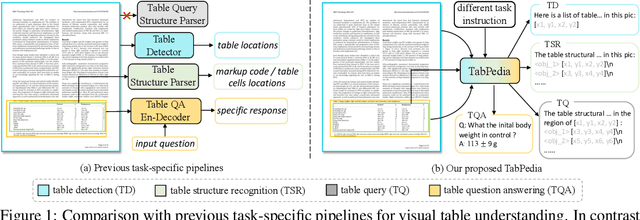
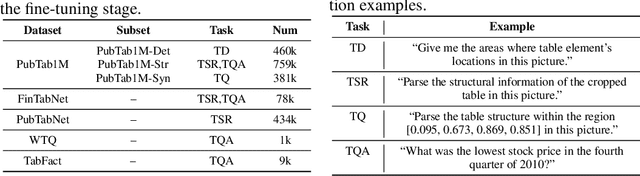
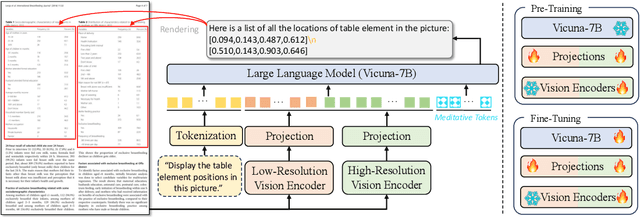
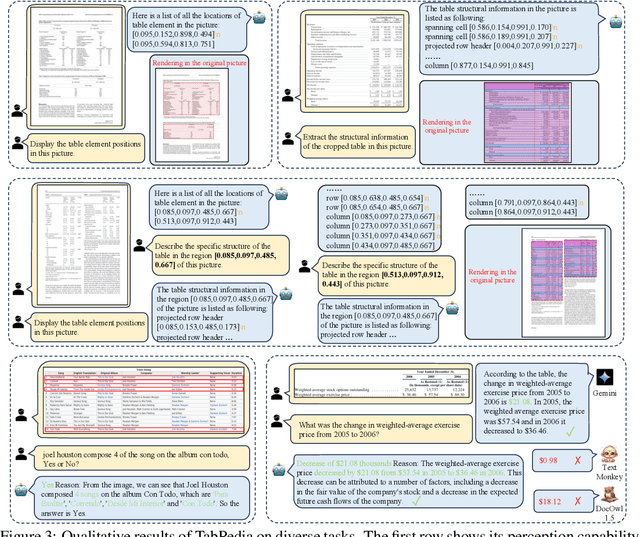
Tables contain factual and quantitative data accompanied by various structures and contents that pose challenges for machine comprehension. Previous methods generally design task-specific architectures and objectives for individual tasks, resulting in modal isolation and intricate workflows. In this paper, we present a novel large vision-language model, TabPedia, equipped with a concept synergy mechanism. In this mechanism, all the involved diverse visual table understanding (VTU) tasks and multi-source visual embeddings are abstracted as concepts. This unified framework allows TabPedia to seamlessly integrate VTU tasks, such as table detection, table structure recognition, table querying, and table question answering, by leveraging the capabilities of large language models (LLMs). Moreover, the concept synergy mechanism enables table perception-related and comprehension-related tasks to work in harmony, as they can effectively leverage the needed clues from the corresponding source perception embeddings. Furthermore, to better evaluate the VTU task in real-world scenarios, we establish a new and comprehensive table VQA benchmark, ComTQA, featuring approximately 9,000 QA pairs. Extensive quantitative and qualitative experiments on both table perception and comprehension tasks, conducted across various public benchmarks, validate the effectiveness of our TabPedia. The superior performance further confirms the feasibility of using LLMs for understanding visual tables when all concepts work in synergy. The benchmark ComTQA has been open-sourced at https://huggingface.co/datasets/ByteDance/ComTQA. The source code and model will be released later.