 Add to Chrome
 Add to Firefox
 Add to Edge
HyMobileAgent: Data-Environment Co-Scaling for Efficient GUI Agents
Jul 16, 2026
As large multimodal models move from understanding content to operating on digital environments, mobile GUI has emerged as a challenging and consequential testbed for digital embodied intelligence. Mobile agents operate under three coupled constraints: precise perception of complex interfaces, scalable acquisition of high-quality interaction data, and robust long-horizon decision making under compounding execution errors. This report presents HyMobileAgent, a mobile GUI agent built on Hy3.0-VL-A3B, a vision-native foundation model featuring native any-resolution input, an A3B-scale deployment budget, and a 32K context window to model extended interaction histories. Rather than relying solely on model scaling, we develop a joint data and environment centric scaling framework to address the key bottlenecks of mobile interaction. Our framework integrates a GUI perception flywheel combining mock-interface synthesis, rejection sampling, and icon-specific augmentation; a knowledge pipeline that transforms tutorial videos into structured interaction data; a million-scale action data pipeline deployed across more than 2000 sandbox and real-device instances with automated failure attribution; the PhoneWorld Mock App Factory, providing a resettable training environment with 34 mock applications and over 34000 tasks; and a structured Planning-and-Reflection mechanism with explicit dead-loop detection for reliable long-horizon execution. We also introduce a progressive training recipe consisting of mid-training, supervised fine-tuning, and reinforcement learning with task-specific reward designs.

PhoneBuddy: Training Open Models for Agentic Phone Use
Jun 24, 2026Phones are becoming an important execution surface for general-purpose agents, but training open models for reliable phone use remains difficult because the environment that matters at deployment, real devices running real apps, is slow, stateful, side-effectful, and hard to reset or verify, while scalable mock environments only approximate real behavior. We present PhoneBuddy, a training recipe and open-model line for agentic phone use that combines a real-app environment with a mock-app environment, PhoneWorld, which reconstructs runnable mock apps from real GUI usage structure. PhoneBuddy first builds a shared supervised fine-tuning stage from trajectories collected in both environments, then compares real-app RL against mixed RL across both environments. Across a 150-task human evaluation on real phones spanning apps, mini-apps, and cross-app workflows, task success rate improves from 36.67\% after supervised fine-tuning to 40.67\% after real-app RL and 45.33\% after mixed RL. On AndroidWorld, the same progression rises from 60.3\% to 77.2\% to 83.2\%. These results show that mock-app training is not a replacement for real-app RL, but a complementary source of scalable, resettable, and automatically checked interaction. The gains are strongest on app and mini-app tasks, while long-horizontal cross-app workflows remain an important open challenge.
PhoneHarness: Harnessing Phone-Use Agents through Mixed GUI, CLI, and Tool Actions
Jun 12, 2026Phone agents are increasingly expected to complete real mobile workflows rather than merely predict the next screen action. However, much of the current mobile-agent literature still evaluates agents primarily as GUI controllers that observe a screen, emit taps and swipes, and are scored by target app state. Real phone-use tasks are broader: they require deciding when to use app GUIs, device-side commands, or structured tools, while leaving evidence that the intended side effect actually occurred. We introduce PhoneHarness, a mixed-action benchmark and execution harness for studying phone-use agents on verifiable mobile workflows. PhoneHarness runs a device-side agent loop over GUI, CLI, and host-side tool actions, combining deterministic action routing with bounded GUI delegation and auditable execution traces. Its benchmark, PhoneHarness Bench, evaluates whether agents complete tasks with observable side effects, not only whether they produce plausible final answers. On the annotated evaluation split, PhoneHarness reaches a 75.0% pass rate, outperforming the strongest non-PhoneHarness settings by 12.9 percentage points. PhoneHarness and PhoneHarness Bench therefore play distinct but mutually dependent roles: the harness makes mixed phone workflows executable, while the benchmark measures whether agents can use that harness reliably and safely. Our findings suggest that reliable phone automation depends on action-surface routing and verifiable execution, not only visual GUI control.
PhoneWorld: Scaling Phone-Use Agent Environments
May 28, 2026A central bottleneck for phone-use agents is that controllable, reproducible environments covering real mobile behavior are hard to build at scale. Existing mobile-agent benchmarks have made important progress on evaluation, but they do not by themselves provide a scalable way to construct many new phone-use environments. We present PhoneWorld, a reusable pipeline that converts real GUI trajectories and screenshots into controllable phone-use environments, executable tasks, automatic verifiers, and training rollouts. Rather than hand-building one mobile benchmark at a time, PhoneWorld uses real trajectories to recover which screens matter, how screens connect, which interactions must change environment state, and which user goals admit automatic verification. From these signals, it builds runnable mock Android apps backed by read-only app content and mutable state, then derives executable tasks, rule-based verifiers, and training rollouts from the same environments. In its current instantiation, PhoneWorld covers 34 apps across 16 domains, spanning common consumer mobile behaviors such as search, browsing, shopping, booking, media, and social interaction. Under a fixed training budget, replacing 10K steps from an auxiliary AndroidWorld corpus in an AndroidWorld-based baseline with broad PhoneWorld supervision improves all four evaluation benchmarks at once, raising HYMobileBench by 17.7 points, AndroidControl by 6.0 points, AndroidWorld by 14.7 points, and PhoneWorld by 52.5 points. We then study two additional scaling questions: increasing the amount of PhoneWorld supervision strongly improves PhoneWorld performance, and under a fixed PhoneWorld budget, expanding app coverage yields even larger gains. Overall, PhoneWorld shifts the focus from building one mobile benchmark at a time to scaling the supply of phone-use environments themselves.
Manifold-Optimal Guidance: A Unified Riemannian Control View of Diffusion Guidance
Mar 12, 2026Classifier-Free Guidance (CFG) serves as the de facto control mechanism for conditional diffusion, yet high guidance scales notoriously induce oversaturation, texture artifacts, and structural collapse. We attribute this failure to a geometric mismatch: standard CFG performs Euclidean extrapolation in ambient space, inadvertently driving sampling trajectories off the high-density data manifold. To resolve this, we present Manifold-Optimal Guidance (MOG), a framework that reformulates guidance as a local optimal control problem. MOG yields a closed-form, geometry-aware Riemannian update that corrects off-manifold drift without requiring retraining. Leveraging this perspective, we further introduce Auto-MOG, a dynamic energy-balancing schedule that adaptively calibrates guidance strength, effectively eliminating the need for manual hyperparameter tuning. Extensive validation demonstrates that MOG yields superior fidelity and alignment compared to baselines, with virtually no added computational overhead.
Too Vivid to Be Real? Benchmarking and Calibrating Generative Color Fidelity
Mar 11, 2026Recent advances in text-to-image (T2I) generation have greatly improved visual quality, yet producing images that appear visually authentic to real-world photography remains challenging. This is partly due to biases in existing evaluation paradigms: human ratings and preference-trained metrics often favor visually vivid images with exaggerated saturation and contrast, which make generations often too vivid to be real even when prompted for realistic-style images. To address this issue, we present Color Fidelity Dataset (CFD) and Color Fidelity Metric (CFM) for objective evaluation of color fidelity in realistic-style generations. CFD contains over 1.3M real and synthetic images with ordered levels of color realism, while CFM employs a multimodal encoder to learn perceptual color fidelity. In addition, we propose a training-free Color Fidelity Refinement (CFR) that adaptively modulates spatial-temporal guidance scale in generation, thereby enhancing color authenticity. Together, CFD supports CFM for assessment, whose learned attention further guides CFR to refine T2I fidelity, forming a progressive framework for assessing and improving color fidelity in realistic-style T2I generation. The dataset and code are available at https://github.com/ZhengyaoFang/CFM.
Prune Redundancy, Preserve Essence: Vision Token Compression in VLMs via Synergistic Importance-Diversity
Mar 11, 2026Vision-language models (VLMs) face significant computational inefficiencies caused by excessive generation of visual tokens. While prior work shows that a large fraction of visual tokens are redundant, existing compression methods struggle to balance importance preservation and information diversity. To address this, we propose PruneSID, a training-free Synergistic Importance-Diversity approach featuring a two-stage pipeline: (1) Principal Semantic Components Analysis (PSCA) for clustering tokens into semantically coherent groups, ensuring comprehensive concept coverage, and (2) Intra-group Non-Maximum Suppression (NMS) for pruning redundant tokens while preserving key representative tokens within each group. Additionally, PruneSID incorporates an information-aware dynamic compression ratio mechanism that optimizes token compression rates based on image complexity, enabling more effective average information preservation across diverse scenes. Extensive experiments demonstrate state-of-the-art performance, achieving 96.3% accuracy on LLaVA-1.5 with only 11.1% token retention, and 92.8% accuracy at extreme compression rates (5.6%) on LLaVA-NeXT, outperforming prior methods by 2.5% with 7.8 $\times$ faster prefilling speed compared to the original model. Our framework generalizes across diverse VLMs and both image and video modalities, showcasing strong cross-modal versatility. Code is available at https://github.com/ZhengyaoFang/PruneSID.
Recognition-Synergistic Scene Text Editing
Mar 11, 2025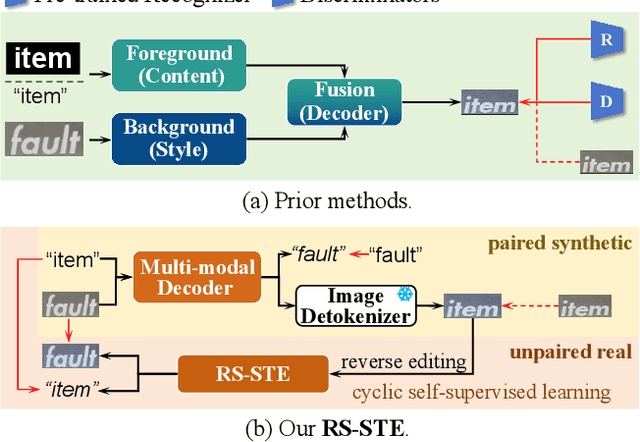
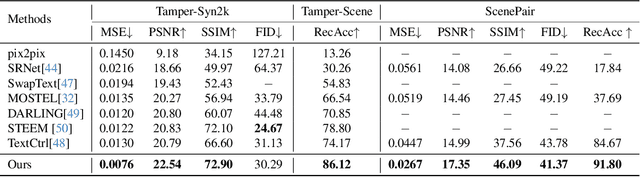
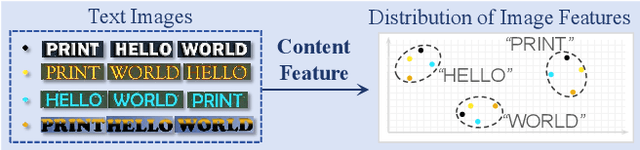
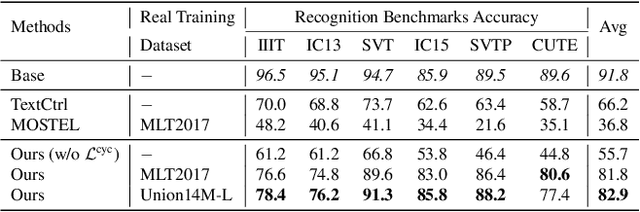
Scene text editing aims to modify text content within scene images while maintaining style consistency. Traditional methods achieve this by explicitly disentangling style and content from the source image and then fusing the style with the target content, while ensuring content consistency using a pre-trained recognition model. Despite notable progress, these methods suffer from complex pipelines, leading to suboptimal performance in complex scenarios. In this work, we introduce Recognition-Synergistic Scene Text Editing (RS-STE), a novel approach that fully exploits the intrinsic synergy of text recognition for editing. Our model seamlessly integrates text recognition with text editing within a unified framework, and leverages the recognition model's ability to implicitly disentangle style and content while ensuring content consistency. Specifically, our approach employs a multi-modal parallel decoder based on transformer architecture, which predicts both text content and stylized images in parallel. Additionally, our cyclic self-supervised fine-tuning strategy enables effective training on unpaired real-world data without ground truth, enhancing style and content consistency through a twice-cyclic generation process. Built on a relatively simple architecture, \mymodel achieves state-of-the-art performance on both synthetic and real-world benchmarks, and further demonstrates the effectiveness of leveraging the generated hard cases to boost the performance of downstream recognition tasks. Code is available at https://github.com/ZhengyaoFang/RS-STE.
WeCromCL: Weakly Supervised Cross-Modality Contrastive Learning for Transcription-only Supervised Text Spotting
Jul 28, 2024Transcription-only Supervised Text Spotting aims to learn text spotters relying only on transcriptions but no text boundaries for supervision, thus eliminating expensive boundary annotation. The crux of this task lies in locating each transcription in scene text images without location annotations. In this work, we formulate this challenging problem as a Weakly Supervised Cross-modality Contrastive Learning problem, and design a simple yet effective model dubbed WeCromCL that is able to detect each transcription in a scene image in a weakly supervised manner. Unlike typical methods for cross-modality contrastive learning that focus on modeling the holistic semantic correlation between an entire image and a text description, our WeCromCL conducts atomistic contrastive learning to model the character-wise appearance consistency between a text transcription and its correlated region in a scene image to detect an anchor point for the transcription in a weakly supervised manner. The detected anchor points by WeCromCL are further used as pseudo location labels to guide the learning of text spotting. Extensive experiments on four challenging benchmarks demonstrate the superior performance of our model over other methods. Code will be released.