 Add to Chrome
 Add to Firefox
 Add to Edge
Explainable AI for Next-Generation Wireless Physical Layer: Basics, State-of-the-Art, and Open Challenges
Jun 23, 2026
Next-generation wireless systems are expected to be ``AI-native," with neural networks (NNs) embedded throughout the physical (PHY) layer protocol stack to improve spectral efficiency, latency, and network autonomy. However, the opacity of deep learning (DL) models raises increasing concerns about system reliability, safety, and privacy, especially under complex and time-varying network environments. This survey studies explainable AI (XAI) in wireless PHY layers from the explainability perspective. We first formalize a series of responsibility-oriented goals for wireless XAI. Then, we develop a systematic taxonomy of explainability approaches and distill practical criteria for deploying explanations in communication scenarios. We provide a comprehensive review of where and how XAI can be applied throughout the PHY layer, connecting representative learning paradigms to appropriate explanation techniques, evaluation metrics, and deployment considerations. Open challenges and future directions are discussed, including explainability-performance tradeoffs, explainability-aware data processing, customized XAI for communication-specific structures, cross-layer explanation consistency, and emerging needs for explaining LLM- and Agentic-AI-driven PHY layers.

The Scissors Effect: When Resize-Based Input Diversity Helps or Hurts Transfer Attacks
Jun 21, 2026Input Diversity (DI), which applies random resizing and padding at each attack iteration, is a near-default ingredient of transfer-based adversarial attacks, widely assumed to improve transferability. We show this assumption is regime-dependent and, for robustly trained surrogates, often reversed. Varying only the surrogate, increasing the DI probability raises transfer success for standard surrogates but lowers it for robust ones: the two response curves separate like a pair of scissors, a pattern we call the Scissors Effect. The effect is strong and consistent on ImageNet, where blind DI costs the robust source 10.3% attack success on average across CNN, ViT, Swin, and ConvNeXt targets and across ten attacks spanning 2018-2024; it is smaller on CIFAR-10 unless DI is made aggressive. A controlled robustness-strength sweep that varies only the training budget shows the harm is graded rather than binary, crossing from beneficial to harmful already in the little-robustness regime. We trace it to gradient geometry: a resize/translation decomposition attributes roughly 67% of the harm to resize, and a direct source-target gradient-alignment measurement confirms the same resize operation improves alignment for standard surrogates but degrades it for robust ones. We summarize the regime with Local Gradient Consistency (LGC), a single input-space probe that separates the two surrogate types, and prove a bias-variance crossover theorem isolating where DI helps from where its resize bias dominates. A training-free rule (CG-DI) that disables diversity when LGC is high avoids the loss on robust surrogates while keeping DI's benefit on standard ones, positioning the Scissors Effect as a DI-specific manifestation of the broader robustness-transferability trade-off.
ReConFuse: Reconstruction-Error Guided Semantic Fusion for AI-Generated Video Detection
Jun 03, 2026AI-generated videos are becoming increasingly realistic, raising serious concerns about misinformation, content authenticity, and media trust. Reliable AI-generated video detection is therefore essential for multimedia forensics, yet remains challenging due to the need to capture spatial artifacts, temporal dynamics, and generalize to evolving generative models. In this paper, we explore reconstruction error as a discriminative forensic cue for AI-generated video detection. By reconstructing input videos with a pretrained WF-VAE, we observe that real and generated videos exhibit distinguishable frame-wise reconstruction error patterns, suggesting that reconstruction errors can reveal their distributional discrepancies. However, extending reconstruction-based image detection to videos is non-trivial, since video reconstruction errors are temporally organized across frames and require semantic context for effective interpretation. To address these challenges, we propose ReConFuse, a reconstruction-guided semantic fusion framework for video-level AI-generated video detection. ReConFuse extracts reconstruction error cues from WF-VAE reconstructed videos, aligns them with multi-frame semantic features, and uses a Mamba-based module to model temporal evolution for video-level classification. Experiments across multiple generators and evaluation settings demonstrate the effectiveness and strong generalization ability of ReConFuse.
Beyond Augmentation: Score-Guided Pathological Prior for EEG-based Depression Detection
May 29, 2026Deep learning-based Major Depressive Disorder (MDD) detection using Electroencephalography (EEG) is fundamentally constrained by the "small-sample dilemma." Prevailing generative data augmentation methods not only incur heavy computational overhead but also risk introducing synthetic noise, thereby blurring classification boundaries. To challenge the traditional "data quantity first" convention, we propose a novel framework "Beyond Augmentation": Score-Guided Classification (SGC). SGC does not synthesize pseudo-samples; instead, it utilizes an unsupervised generative network architecture to model the structural and statistical anomaly degrees of samples, serving as the core "Pathological Prior". This prior, after robust normalization, is explicitly fused with deep feature representations, thereby precisely guiding the classifier's decision boundary. Furthermore, to dynamically adapt to varying channel configurations, we propose a Cross-Channel Spatial Adaptation module, utilizing a spatial mapping mechanism to effectively resolve the hardware heterogeneity of mismatched channels in multi-center datasets. Extensive experiments on the Mumtaz2016 and high-density MODMA datasets demonstrate the effectiveness and exceptional generalizability of our method under the challenging "zero data augmentation" setting and at "zero sample synthesis cost". Keywords: Electroencephalography (EEG), Depression Detection, Anomaly Score, Diffusion Models, Few-Shot Learning
Networking-Aware Energy Efficiency in Agentic AI Inference: A Survey
Apr 09, 2026The rapid emergence of Large Language Models (LLMs) has catalyzed Agentic artificial intelligence (AI), autonomous systems integrating perception, reasoning, and action into closed-loop pipelines for continuous adaptation. While unlocking transformative applications in mobile edge computing, autonomous systems, and next-generation wireless networks, this paradigm creates fundamental energy challenges through iterative inference and persistent data exchange. Unlike traditional AI where bottlenecks are computational Floating Point Operations (FLOPs), Agentic AI faces compounding computational and communication energy costs. In this survey, we propose an energy accounting framework identifying computational and communication costs across the Perception-Reasoning-Action cycle. We establish a unified taxonomy spanning model simplification, computation control, input and attention optimization, and hardware-aware inference. We explore cross-layer co-design strategies jointly optimizing model parameters, wireless transmissions, and edge resources. Finally, we identify open challenges of federated green learning, carbon-aware agency, 6th generation mobile communication (6G)-native Agentic AI, and self-sustaining systems, providing a roadmap for scalable autonomous intelligence.
FBA$^2$D: Frequency-based Black-box Attack for AI-generated Image Detection
Dec 10, 2025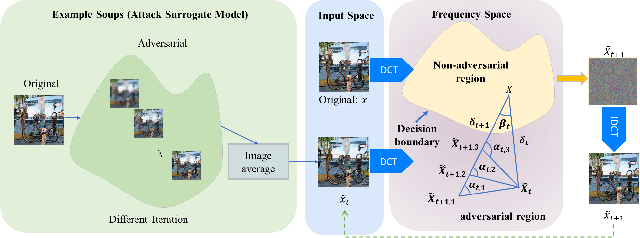
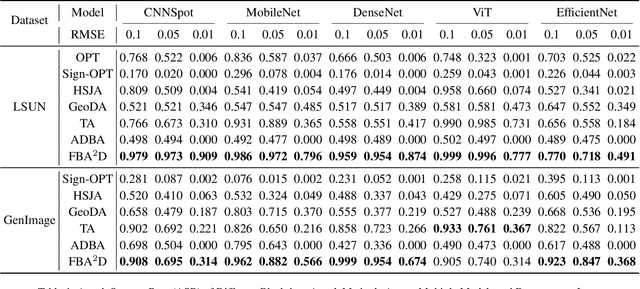
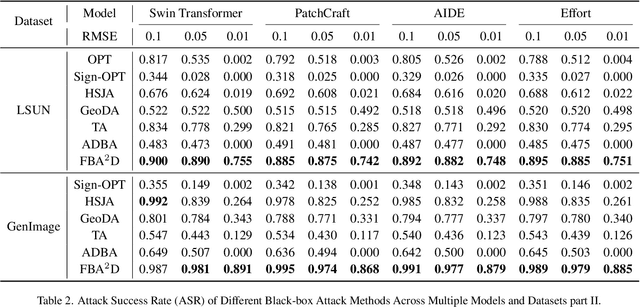
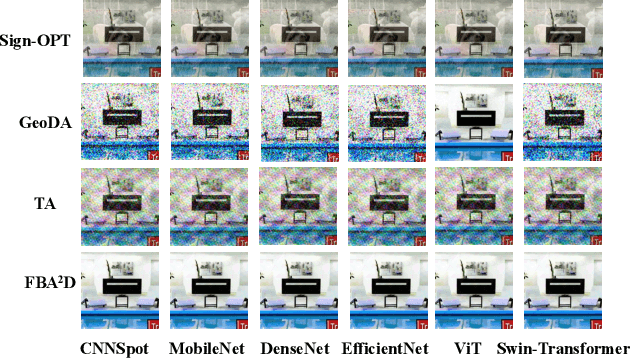
The prosperous development of Artificial Intelligence-Generated Content (AIGC) has brought people's anxiety about the spread of false information on social media. Designing detectors for filtering is an effective defense method, but most detectors will be compromised by adversarial samples. Currently, most studies exposing AIGC security issues assume information on model structure and data distribution. In real applications, attackers query and interfere with models that provide services in the form of application programming interfaces (APIs), which constitutes the black-box decision-based attack paradigm. However, to the best of our knowledge, decision-based attacks on AIGC detectors remain unexplored. In this study, we propose \textbf{FBA$^2$D}: a frequency-based black-box attack method for AIGC detection to fill the research gap. Motivated by frequency-domain discrepancies between generated and real images, we develop a decision-based attack that leverages the Discrete Cosine Transform (DCT) for fine-grained spectral partitioning and selects frequency bands as query subspaces, improving both query efficiency and image quality. Moreover, attacks on AIGC detectors should mitigate initialization failures, preserve image quality, and operate under strict query budgets. To address these issues, we adopt an ``adversarial example soup'' method, averaging candidates from successive surrogate iterations and using the result as the initialization to accelerate the query-based attack. The empirical study on the Synthetic LSUN dataset and GenImage dataset demonstrate the effectiveness of our prosed method. This study shows the urgency of addressing practical AIGC security problems.
IREE Oriented Active RIS-Assisted Green communication System with Outdated CSI
Nov 17, 2024
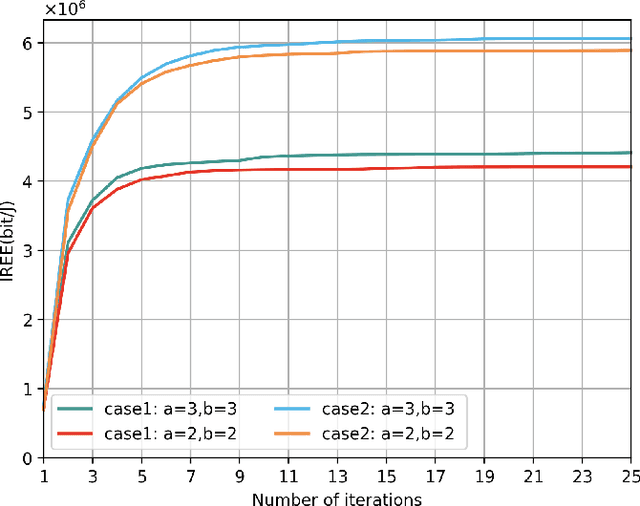
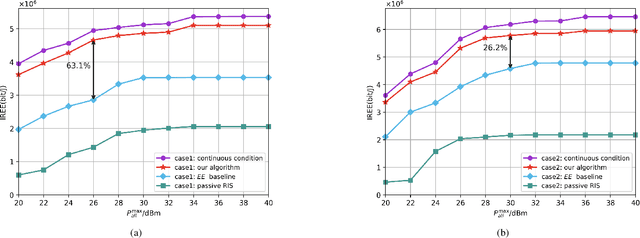

The rapid evolution of communication technologies has spurred a growing demand for energy-efficient network architectures and performance metrics. Active Reconfigurable Intelligent Surfaces (RIS) are emerging as a key component in green network architectures. Compared to passive RIS, active RIS are equipped with amplifiers on each reflecting element, allowing them to simultaneously reflect and amplify signals, thereby overcoming the double multiplicative fading in the phase response, and improving both system coverage and performance. Additionally, the Integrated Relative Energy Efficiency (IREE) metric, as introduced in [1], addresses the dynamic variations in traffic and capacity over time and space, enabling more energy-efficient wireless systems. Building on these advancements, this paper investigates the problem of maximizing IREE in active RIS-assisted green communication systems. However, acquiring perfect Channel State Information (CSI) in practical systems poses significant challenges and costs. To address this, we derive the average achievable rate based on outdated CSI and formulated the corresponding IREE maximization problem, which is solved by jointly optimizing beamforming at both the base station and RIS. Given the non-convex nature of the problem, we propose an Alternating Optimization Successive Approximation (AOSO) algorithm. By applying quadratic transform and relaxation techniques, we simplify the original problem and alternately optimize the beamforming matrices at the base station and RIS. Furthermore, to handle the discrete constraints of the RIS reflection coefficients, we develop a successive approximation method. Experimental results validate our theoretical analysis of the algorithm's convergence , demonstrating the effectiveness of the proposed algorithm and highlighting the superiority of IREE in enhancing the performance of green communication networks.
Towards Dynamic Resource Allocation and Client Scheduling in Hierarchical Federated Learning: A Two-Phase Deep Reinforcement Learning Approach
Jun 21, 2024


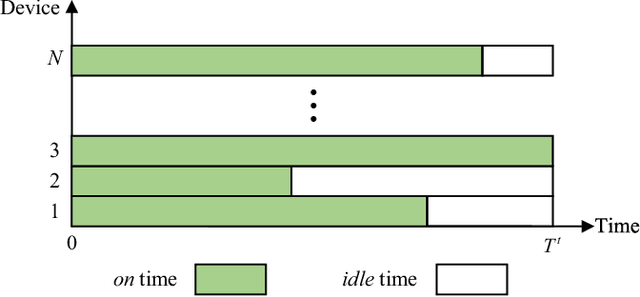
Federated learning (FL) is a viable technique to train a shared machine learning model without sharing data. Hierarchical FL (HFL) system has yet to be studied regrading its multiple levels of energy, computation, communication, and client scheduling, especially when it comes to clients relying on energy harvesting to power their operations. This paper presents a new two-phase deep deterministic policy gradient (DDPG) framework, referred to as ``TP-DDPG'', to balance online the learning delay and model accuracy of an FL process in an energy harvesting-powered HFL system. The key idea is that we divide optimization decisions into two groups, and employ DDPG to learn one group in the first phase, while interpreting the other group as part of the environment to provide rewards for training the DDPG in the second phase. Specifically, the DDPG learns the selection of participating clients, and their CPU configurations and the transmission powers. A new straggler-aware client association and bandwidth allocation (SCABA) algorithm efficiently optimizes the other decisions and evaluates the reward for the DDPG. Experiments demonstrate that with substantially reduced number of learnable parameters, the TP-DDPG can quickly converge to effective polices that can shorten the training time of HFL by 39.4% compared to its benchmarks, when the required test accuracy of HFL is 0.9.
Quality of Experience Oriented Cross-layer Optimization for Real-time XR Video Transmission
Apr 15, 2024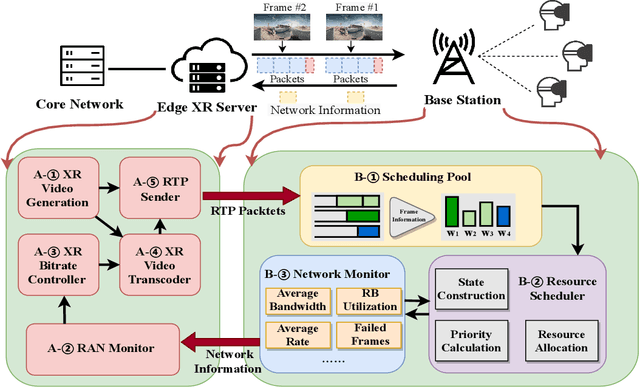

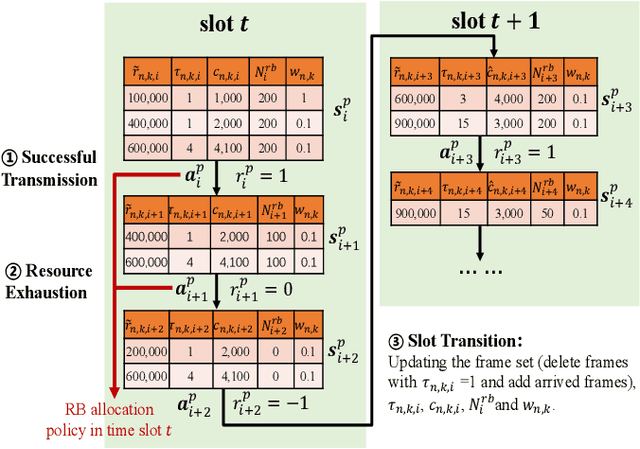
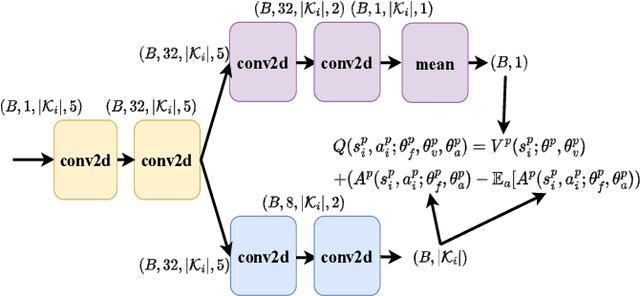
Extended reality (XR) is one of the most important applications of beyond 5G and 6G networks. Real-time XR video transmission presents challenges in terms of data rate and delay. In particular, the frame-by-frame transmission mode of XR video makes real-time XR video very sensitive to dynamic network environments. To improve the users' quality of experience (QoE), we design a cross-layer transmission framework for real-time XR video. The proposed framework allows the simple information exchange between the base station (BS) and the XR server, which assists in adaptive bitrate and wireless resource scheduling. We utilize the cross-layer information to formulate the problem of maximizing user QoE by finding the optimal scheduling and bitrate adjustment strategies. To address the issue of mismatched time scales between two strategies, we decouple the original problem and solve them individually using a multi-agent-based approach. Specifically, we propose the multi-step Deep Q-network (MS-DQN) algorithm to obtain a frame-priority-based wireless resource scheduling strategy and then propose the Transformer-based Proximal Policy Optimization (TPPO) algorithm for video bitrate adaptation. The experimental results show that the TPPO+MS-DQN algorithm proposed in this study can improve the QoE by 3.6% to 37.8%. More specifically, the proposed MS-DQN algorithm enhances the transmission quality by 49.9%-80.2%.
Real-time Extended Reality Video Transmission Optimization Based on Frame-priority Scheduling
Feb 08, 2024


Extended reality (XR) is one of the most important applications of 5G. For real-time XR video transmission in 5G networks, a low latency and high data rate are required. In this paper, we propose a resource allocation scheme based on frame-priority scheduling to meet these requirements. The optimization problem is modelled as a frame-priority-based radio resource scheduling problem to improve transmission quality. We propose a scheduling framework based on multi-step Deep Q-network (MS-DQN) and design a neural network model based on convolutional neural network (CNN). Simulation results show that the scheduling framework based on frame-priority and MS-DQN can improve transmission quality by 49.9%-80.2%.