 Add to Chrome
 Add to Firefox
 Add to Edge
OpenForgeRL: Train Harness-native Agents in Any Environment
Jul 24, 2026
Modern AI agents rely on elaborate inference harnesses such as Claude Code, Codex, and OpenClaw to drive multi-turn reasoning, tool use, and access to external systems. While powerful, these complex harnesses also make agents hard to train end-to-end with open infrastructure, whose SFT/RL stacks cannot natively express stateful, multi-process harness inference. To address this, we present OpenForgeRL, an open-source framework for training harness-based agents end-to-end in diverse environments. OpenForgeRL achieves this with a lightweight proxy that serves the harness's model calls while recording them as training data for a standard RL codebase (e.g., veRL), and a Kubernetes orchestrator that runs each rollout in its own remote container, together enabling training on any harness in any environment at scale. By decoupling training and inference, OpenForgeRL allows researchers to easily train, study, and improve agents directly in the real harnesses and environments they are deployed with. We validate our framework across diverse, complex harnesses and environments, spanning tool/claw-based agents and multimodal GUI browser- and computer-use agents. Using only hundreds to a few thousand tasks, OpenForgeClaw reaches 31.7 pass^3 and 55.9 pass@3 on ClawEval and 33.7 on QwenClawBench. OpenForgeGUI reaches 37.7 on OSWorld-Verified, 63.0 on Online-Mind2Web, and 72.3 on WebVoyager. Both outperform open baselines of similar size on nearly all benchmarks, and in the GUI setting match or surpass models several times larger. Beyond benchmarks, we analyze how harness choice (e.g., ZeroClaw, OpenClaw, Codex) and RL shape agent behavior. We find that some harnesses are substantially harder to learn than others, and that RL improves agentic reliability, such as self-verification, tool coverage, and completing multi-step plans, though critical abilities such as error recovery remain weak.

HPD-Parsing: Hierarchical Parallel Document Parsing
Jul 21, 2026Efficient teamwork typically combines global coordination with parallel execution, a principle not yet fully reflected in unified Vision-Language Model (VLM)-based document parsers. Existing unified parsers process an entire page jointly but generate its output through a single token-by-token autoregressive trajectory, creating a sequential bottleneck that grows with document length. Such full-page sequential generation overlooks a key property of document parsing: layout must be analyzed globally, whereas block content can be parsed in parallel. Based on this observation, we introduce HPD-Parsing, which replaces full-page autoregressive generation with a Hierarchical Parallel Decoding paradigm. A main layout branch organizes the overall document structure and dynamically assigns block-level content decoding to concurrent branches, while progressive multi-token prediction (P-MTP) further reduces the decoding steps within each branch. Experiments on public benchmarks show that HPD-Parsing achieves 4,752 tokens per second, delivering $2.62\times$ the throughput of the fastest existing document parsing model and $3.06\times$ that of the vanilla autoregressive baseline, while maintaining competitive parsing accuracy. These results establish hierarchical parallel decoding as an effective alternative to full-page autoregressive generation, opening a new direction for efficient unified document parsing.
OSWorld2.0: Benchmarking Computer Use Agents on Long-Horizon Real-World Tasks
Jun 28, 2026Existing computer-use benchmarks fail to capture the realism, complexity, and long-horizon demands of real-world computer use, limiting their ability to reveal the limitations of frontier agents. We introduce OSWorld 2.0, a benchmark of 108 long-horizon computer-use workflows across everyday and professional tasks, designed to capture complex and challenging real-world phenomena. Each task represents a realistic end-to-end workflow that takes human users a median of about 1.6 hours to complete and requires an average of 318 tool calls with Claude Opus 4.7 using maximum thinking, compared with about 30 in OSWorld 1.0. OSWorld 2.0 targets challenge phenomena that are common in real workflows yet underrepresented in prior benchmarks, spanning interaction-design challenges such as streaming interaction and dynamic environments, as well as agent-pattern challenges such as cross-source reasoning, implicit-state inference, and visual-spatial precision. Tasks are grounded in authentic input artifacts and cross-referenced against realistic stateful user profile data, and include separate safety reports auditing safety-sensitive execution. Under our primary binary-completion metric at 500 steps, Claude Opus 4.8 with maximum thinking and batched tool calls scores best but still completes only 20.6% of tasks at a 54.8% partial score; GPT-5.5 is far more token-efficient yet plateaus near 13%. These results show that current agents are still far from professional-level computer use: rather than stumbling on basic GUI control or coding, they lose track of constraints, miss information that arrives mid-task, guess rather than ask the user, and skip verification, struggling most when a task hinges on hidden state they must recover.
Unlimited OCR Works
Jun 22, 2026Recently, end-to-end OCR models, exemplified by DeepSeek OCR, have once again thrust OCR into the spotlight. A widely held view is that employing a large language model (LLM) as the decoder allows the model to leverage the prior distribution of language, leading to improved OCR performance. However, the downside is equally evident: as the output sequence lengthens, the accumulated KV cache drives up memory consumption and progressively slows down generation. This stands in stark contrast to humans, who exhibit no such decline in efficiency during long-horizon copying tasks. In this technical report, we propose Unlimited OCR, a model designed to emulate human parsing working memory. Taking DeepSeek OCR as the baseline, we replace all attention layers in the decoder with our proposed Reference Sliding Window Attention (R-SWA), which reduces attention computation costs while maintaining a constant KV cache throughout the entire decoding process. By combining the high compression rate of DeepSeek OCR's encoder with our constant KV cache design, Unlimited OCR can transcribe dozens of pages of documents in a single forward pass under a standard maximum length of 32K. More importantly, R-SWA is a general-purpose parsing attention mechanism - beyond OCR, it is equally applicable to tasks such as ASR, translation, etc. Codes and model weights are publicly available at http://github.com/baidu/Unlimited-OCR.
Detect, Remask, Repair: Diffusion Editing for Faithful Summarization of Evolving Contexts
Jun 11, 2026Summaries of real-world events can become outdated as contexts evolve and new information arrives. A common response is to generate a new summary from the updated context, but full regeneration discards the previous draft, can obscure what changed, and may be unnecessary when only a few claims are unsupported. We study localized faithfulness repair: updating outdated spans in an existing summary while preserving supported content. We propose DETECT-REMASK-REPAIR, a diffusion-based framework that identifies, remasks, and repairs outdated regions with masked diffusion language models. To evaluate evolving-context summarization, we introduce StreamSum, a benchmark of synthetic event timelines. Experiments on DialogSum and StreamSum show that localized diffusion repair provides a controllable alternative to full rewriting: faithfulness-steered repair improves early drafts, one-step repair reduces repair cost to under half a second, with the framework enabling faithfulness-speed-preservation tradeoffs across datasets. We also find that the framework can provide a post-hoc correction step that improves faithfulness for autoregressive systems.
Partial Fairness Awareness: Belief-Guided Strategic Mechanism for Strategic Agents
May 30, 2026Strategic machine learning investigates scenarios where agents manipulate their features to receive favorable decisions from predictive models. To address fairness concerns intrinsic to strategic classification, recent work has introduced group-specific fairness constraints. However, current fairness-aware approaches face a fundamental dilemma in the issue of fairness exposure: making these constraints public enables strategic manipulation and can lead to fairness reversal, while keeping them hidden may reduce social welfare and discourage genuine improvement. To fill this gap, we subsequently propose the problem of partial fairness awareness (PFA), as our theoretical analysis informs that such a dilemma can be mitigated by releasing the candidate set of fairness constraints and concealing the grounding constraint. To be specific, we introduce a belief-guided strategic mechanism, wherein agents iteratively interact with the decision system and maintain a belief distribution over the candidate set of fairness constraints. This belief-guided process enables agents, through iterative interaction and feedback, to update their belief distribution over the candidate set, thereby gradually aligning their belief with the grounding fairness constraint employed by the system. Extensive experiments on real-world and synthetic datasets demonstrate that PFA achieves lower group fairness gaps, higher acceptance of truly qualified individuals, and more stable outcomes compared to fully public or private fairness regimes.
Detecting Unobserved Confounders: A Kernelized Regression Approach
Jan 01, 2026Detecting unobserved confounders is crucial for reliable causal inference in observational studies. Existing methods require either linearity assumptions or multiple heterogeneous environments, limiting applicability to nonlinear single-environment settings. To bridge this gap, we propose Kernel Regression Confounder Detection (KRCD), a novel method for detecting unobserved confounding in nonlinear observational data under single-environment conditions. KRCD leverages reproducing kernel Hilbert spaces to model complex dependencies. By comparing standard and higherorder kernel regressions, we derive a test statistic whose significant deviation from zero indicates unobserved confounding. Theoretically, we prove two key results: First, in infinite samples, regression coefficients coincide if and only if no unobserved confounders exist. Second, finite-sample differences converge to zero-mean Gaussian distributions with tractable variance. Extensive experiments on synthetic benchmarks and the Twins dataset demonstrate that KRCD not only outperforms existing baselines but also achieves superior computational efficiency.
Generating Risky Samples with Conformity Constraints via Diffusion Models
Dec 21, 2025Although neural networks achieve promising performance in many tasks, they may still fail when encountering some examples and bring about risks to applications. To discover risky samples, previous literature attempts to search for patterns of risky samples within existing datasets or inject perturbation into them. Yet in this way the diversity of risky samples is limited by the coverage of existing datasets. To overcome this limitation, recent works adopt diffusion models to produce new risky samples beyond the coverage of existing datasets. However, these methods struggle in the conformity between generated samples and expected categories, which could introduce label noise and severely limit their effectiveness in applications. To address this issue, we propose RiskyDiff that incorporates the embeddings of both texts and images as implicit constraints of category conformity. We also design a conformity score to further explicitly strengthen the category conformity, as well as introduce the mechanisms of embedding screening and risky gradient guidance to boost the risk of generated samples. Extensive experiments reveal that RiskyDiff greatly outperforms existing methods in terms of the degree of risk, generation quality, and conformity with conditioned categories. We also empirically show the generalization ability of the models can be enhanced by augmenting training data with generated samples of high conformity.
GEA: Generation-Enhanced Alignment for Text-to-Image Person Retrieval
Nov 13, 2025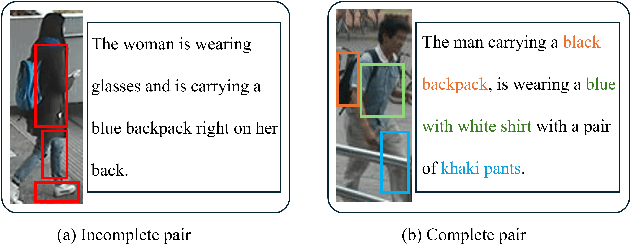
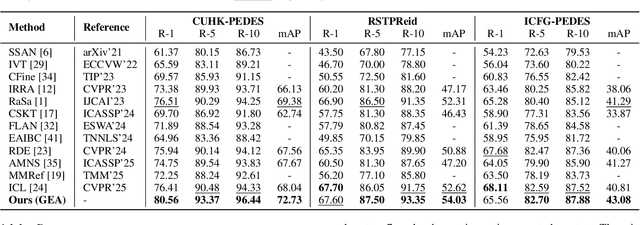
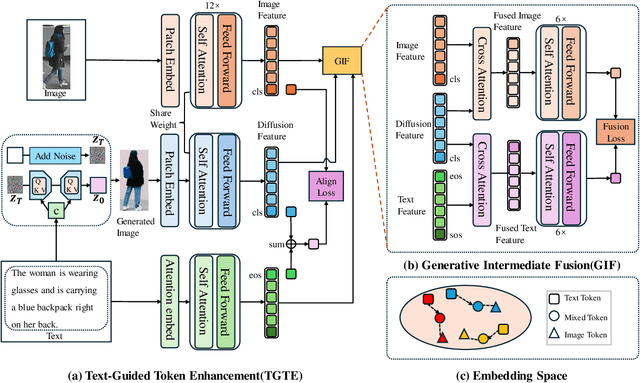
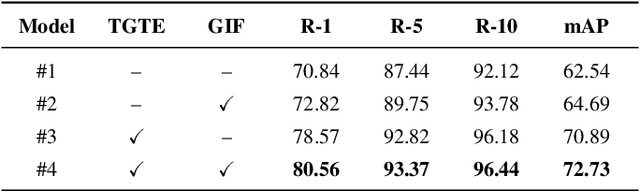
Text-to-Image Person Retrieval (TIPR) aims to retrieve person images based on natural language descriptions. Although many TIPR methods have achieved promising results, sometimes textual queries cannot accurately and comprehensively reflect the content of the image, leading to poor cross-modal alignment and overfitting to limited datasets. Moreover, the inherent modality gap between text and image further amplifies these issues, making accurate cross-modal retrieval even more challenging. To address these limitations, we propose the Generation-Enhanced Alignment (GEA) from a generative perspective. GEA contains two parallel modules: (1) Text-Guided Token Enhancement (TGTE), which introduces diffusion-generated images as intermediate semantic representations to bridge the gap between text and visual patterns. These generated images enrich the semantic representation of text and facilitate cross-modal alignment. (2) Generative Intermediate Fusion (GIF), which combines cross-attention between generated images, original images, and text features to generate a unified representation optimized by triplet alignment loss. We conduct extensive experiments on three public TIPR datasets, CUHK-PEDES, RSTPReid, and ICFG-PEDES, to evaluate the performance of GEA. The results justify the effectiveness of our method. More implementation details and extended results are available at https://github.com/sugelamyd123/Sup-for-GEA.
LimiX: Unleashing Structured-Data Modeling Capability for Generalist Intelligence
Sep 03, 2025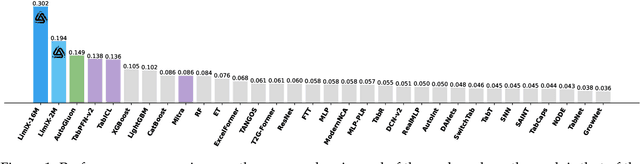
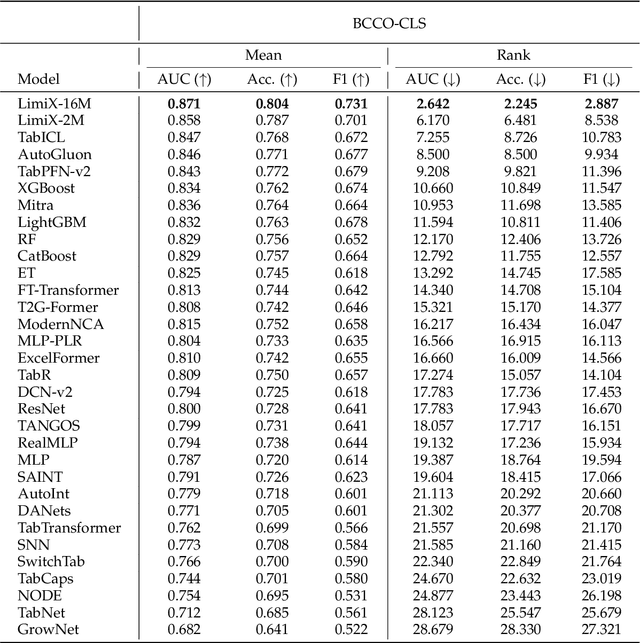
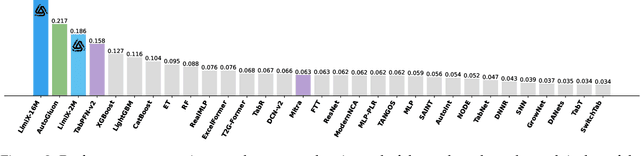
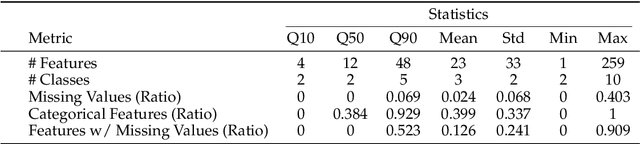
We argue that progress toward general intelligence requires complementary foundation models grounded in language, the physical world, and structured data. This report presents LimiX, the first installment of our large structured-data models (LDMs). LimiX treats structured data as a joint distribution over variables and missingness, thus capable of addressing a wide range of tabular tasks through query-based conditional prediction via a single model. LimiX is pretrained using masked joint-distribution modeling with an episodic, context-conditional objective, where the model predicts for query subsets conditioned on dataset-specific contexts, supporting rapid, training-free adaptation at inference. We evaluate LimiX across 10 large structured-data benchmarks with broad regimes of sample size, feature dimensionality, class number, categorical-to-numerical feature ratio, missingness, and sample-to-feature ratios. With a single model and a unified interface, LimiX consistently surpasses strong baselines including gradient-boosting trees, deep tabular networks, recent tabular foundation models, and automated ensembles, as shown in Figure 1 and Figure 2. The superiority holds across a wide range of tasks, such as classification, regression, missing value imputation, and data generation, often by substantial margins, while avoiding task-specific architectures or bespoke training per task. All LimiX models are publicly accessible under Apache 2.0.