 Add to Chrome
 Add to Firefox
 Add to Edge
PertMind: Eliciting Emergent Biological Reasoning in LLM via Reinforcement Learning on Cellular Perturbation Data
Aug 17, 2026
Large language models can describe mechanisms, yet scalable post-training still depends on costly, manually curated biological reasoning traces. Here we show that cellular perturbation atlases can instead become reinforcement-learning environments, where measured gene responses provide computable rewards for biological reasoning. We introduce PertMind, which combines trusted-trajectory supervised initialization with gene-, pathway-, and format-level reinforcement signals. Trained only on forward perturbation-response prediction, PertMind improved response inference in unseen cellular contexts while retaining general language capabilities. It also transferred without task-specific post-training to reverse perturbation identification, double-perturbation reasoning, phenotypic-screen prioritization, and biological-process interpretation. PertMind further generated biological profiles that supported competitive gene, cell, and donor representations across multiscale downstream tasks. These results support the hypothesis that reinforcement on experimental endpoints can concentrate reusable biological strategies already accessible to pretrained models. More broadly, perturbation-derived reinforcement learning offers a scalable route for transforming expanding experimental atlases into training environments for general-purpose biological reasoning.

PhysEditWorld: A Large-Scale Dataset Toward Physics-Editable World Models
Jun 25, 2026Recent game world models can synthesize visually plausible, action-conditioned rollouts. However, their interaction behaviors often remain limited to exploratory or wandering trajectories, and physical dynamics are typically learned as implicit correlations from data rather than as controllable variables. This limitation hinders their applicability to authored game environments, where physical rules are deliberately designed and require explicit manipulation. We introduce PhysEditWorld, a multimodal dataset with physical parameters, with a primary focus on gravity in this initial version. At its core, PhysEditWorld is built upon a replay paradigm implemented with a UE5 replay-and-rendering pipeline. Each scenario records a normalized action trace and replays the same initial state, character controller, action sequence, and camera policy under multiple gravity configurations, enabling controlled and attributable physical variation. PhysEditWorld contains 12 cinematic UE5 scenes, over 100 hours of gameplay interactions, and more than 60 million rendered rollout frames. Each sample provides synchronized multimodal signals, including RGB, depth, normals, audio, action traces, camera trajectory, engine states, semantic annotations, and explicit gravity labels. We further conduct initial utility studies on both generative video models and world understanding models, demonstrating that PhysEditWorld enables improved gravity-faithful dynamics modeling, enhances consistency under physical edits, and provides a scalable foundation for controllable world modeling research.
UnityShots: Memory-Driven Multi-Shot Audio-Video Generation with Boundary-Aware Gating
Jun 19, 2026Generating a coherent multi-shot video requires structured cross-shot memory. Subject appearance, scene context, and speaker identity must persist across cuts. Existing approaches either train end-to-end over fixed-length sequences and cannot scale, generate shot-by-shot with memory banks that grow linearly, or orchestrate pretrained generators under an LLM planner without a multi-shot-aware backbone. We present UnityShots, a memory-driven multi-shot audio-video generation system built on LTX-2.3, trained on annotated cinematic and music-video shots. The video stream maintains two fixed-size slots, a long-term memory (LTM) slot anchored to the opening shot and a short-term memory (STM) slot holding the immediately preceding tail, both updated at every cut by a boundary-conditioned gate that fuses visual cut probability and beat-tracker signals. The audio stream injects a reference speaker token at every shot to preserve vocal timbre without a sliding audio bank. A discrete cut-type prior, learned through AdaLN, becomes an inference-time control knob over transition strength. We release a benchmark of $200$ multi-cultural multi-shot sequences spanning six ethnic regions and ten or more languages, with per-shot reference identities, reference audio, and per-boundary transition labels. Evaluated across I2V, T2V, and R2V conditioning modes, UnityShots leads open-source baselines on every cross-shot coherence metric and matches the strongest closed-source system on the multi-shot axes.
Agentic World Modeling: Foundations, Capabilities, Laws, and Beyond
Apr 24, 2026As AI systems move from generating text to accomplishing goals through sustained interaction, the ability to model environment dynamics becomes a central bottleneck. Agents that manipulate objects, navigate software, coordinate with others, or design experiments require predictive environment models, yet the term world model carries different meanings across research communities. We introduce a "levels x laws" taxonomy organized along two axes. The first defines three capability levels: L1 Predictor, which learns one-step local transition operators; L2 Simulator, which composes them into multi-step, action-conditioned rollouts that respect domain laws; and L3 Evolver, which autonomously revises its own model when predictions fail against new evidence. The second identifies four governing-law regimes: physical, digital, social, and scientific. These regimes determine what constraints a world model must satisfy and where it is most likely to fail. Using this framework, we synthesize over 400 works and summarize more than 100 representative systems spanning model-based reinforcement learning, video generation, web and GUI agents, multi-agent social simulation, and AI-driven scientific discovery. We analyze methods, failure modes, and evaluation practices across level-regime pairs, propose decision-centric evaluation principles and a minimal reproducible evaluation package, and outline architectural guidance, open problems, and governance challenges. The resulting roadmap connects previously isolated communities and charts a path from passive next-step prediction toward world models that can simulate, and ultimately reshape, the environments in which agents operate.
From Inpainting to Editing: A Self-Bootstrapping Framework for Context-Rich Visual Dubbing
Dec 31, 2025Audio-driven visual dubbing aims to synchronize a video's lip movements with new speech, but is fundamentally challenged by the lack of ideal training data: paired videos where only a subject's lip movements differ while all other visual conditions are identical. Existing methods circumvent this with a mask-based inpainting paradigm, where an incomplete visual conditioning forces models to simultaneously hallucinate missing content and sync lips, leading to visual artifacts, identity drift, and poor synchronization. In this work, we propose a novel self-bootstrapping framework that reframes visual dubbing from an ill-posed inpainting task into a well-conditioned video-to-video editing problem. Our approach employs a Diffusion Transformer, first as a data generator, to synthesize ideal training data: a lip-altered companion video for each real sample, forming visually aligned video pairs. A DiT-based audio-driven editor is then trained on these pairs end-to-end, leveraging the complete and aligned input video frames to focus solely on precise, audio-driven lip modifications. This complete, frame-aligned input conditioning forms a rich visual context for the editor, providing it with complete identity cues, scene interactions, and continuous spatiotemporal dynamics. Leveraging this rich context fundamentally enables our method to achieve highly accurate lip sync, faithful identity preservation, and exceptional robustness against challenging in-the-wild scenarios. We further introduce a timestep-adaptive multi-phase learning strategy as a necessary component to disentangle conflicting editing objectives across diffusion timesteps, thereby facilitating stable training and yielding enhanced lip synchronization and visual fidelity. Additionally, we propose ContextDubBench, a comprehensive benchmark dataset for robust evaluation in diverse and challenging practical application scenarios.
UnityVideo: Unified Multi-Modal Multi-Task Learning for Enhancing World-Aware Video Generation
Dec 08, 2025Recent video generation models demonstrate impressive synthesis capabilities but remain limited by single-modality conditioning, constraining their holistic world understanding. This stems from insufficient cross-modal interaction and limited modal diversity for comprehensive world knowledge representation. To address these limitations, we introduce UnityVideo, a unified framework for world-aware video generation that jointly learns across multiple modalities (segmentation masks, human skeletons, DensePose, optical flow, and depth maps) and training paradigms. Our approach features two core components: (1) dynamic noising to unify heterogeneous training paradigms, and (2) a modality switcher with an in-context learner that enables unified processing via modular parameters and contextual learning. We contribute a large-scale unified dataset with 1.3M samples. Through joint optimization, UnityVideo accelerates convergence and significantly enhances zero-shot generalization to unseen data. We demonstrate that UnityVideo achieves superior video quality, consistency, and improved alignment with physical world constraints. Code and data can be found at: https://github.com/dvlab-research/UnityVideo
LaVieID: Local Autoregressive Diffusion Transformers for Identity-Preserving Video Creation
Aug 11, 2025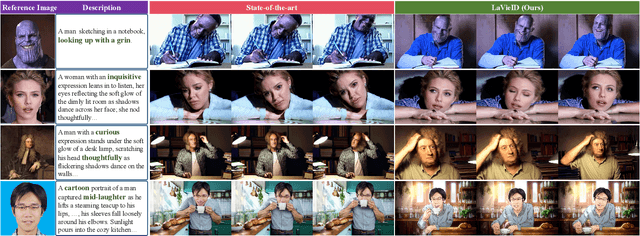

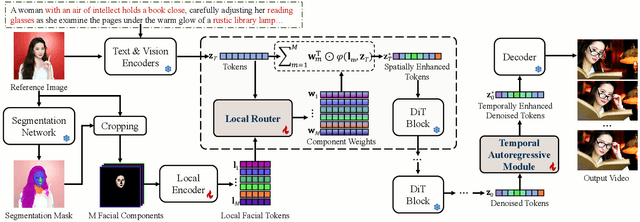

In this paper, we present LaVieID, a novel \underline{l}ocal \underline{a}utoregressive \underline{vi}d\underline{e}o diffusion framework designed to tackle the challenging \underline{id}entity-preserving text-to-video task. The key idea of LaVieID is to mitigate the loss of identity information inherent in the stochastic global generation process of diffusion transformers (DiTs) from both spatial and temporal perspectives. Specifically, unlike the global and unstructured modeling of facial latent states in existing DiTs, LaVieID introduces a local router to explicitly represent latent states by weighted combinations of fine-grained local facial structures. This alleviates undesirable feature interference and encourages DiTs to capture distinctive facial characteristics. Furthermore, a temporal autoregressive module is integrated into LaVieID to refine denoised latent tokens before video decoding. This module divides latent tokens temporally into chunks, exploiting their long-range temporal dependencies to predict biases for rectifying tokens, thereby significantly enhancing inter-frame identity consistency. Consequently, LaVieID can generate high-fidelity personalized videos and achieve state-of-the-art performance. Our code and models are available at https://github.com/ssugarwh/LaVieID.
BridgeIV: Bridging Customized Image and Video Generation through Test-Time Autoregressive Identity Propagation
May 11, 2025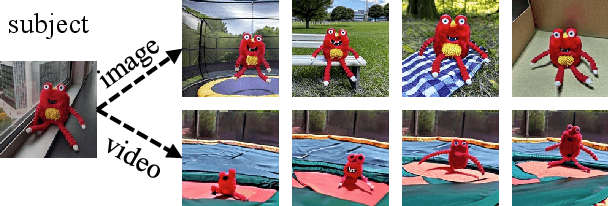
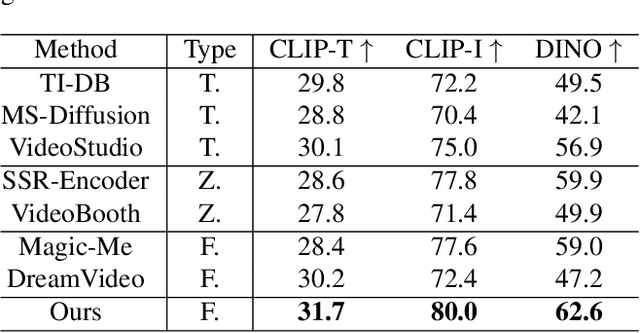
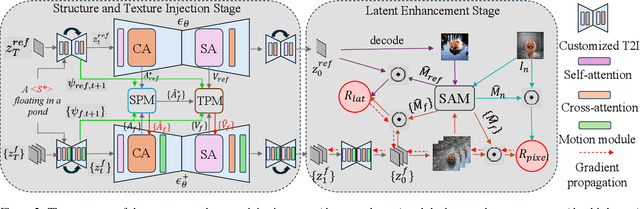
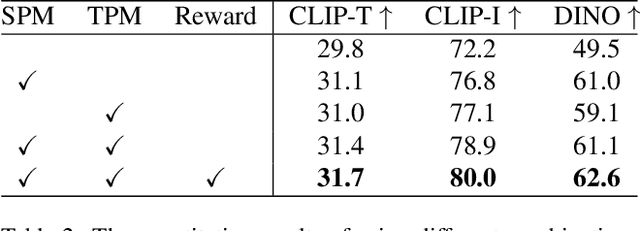
Both zero-shot and tuning-based customized text-to-image (CT2I) generation have made significant progress for storytelling content creation. In contrast, research on customized text-to-video (CT2V) generation remains relatively limited. Existing zero-shot CT2V methods suffer from poor generalization, while another line of work directly combining tuning-based T2I models with temporal motion modules often leads to the loss of structural and texture information. To bridge this gap, we propose an autoregressive structure and texture propagation module (STPM), which extracts key structural and texture features from the reference subject and injects them autoregressively into each video frame to enhance consistency. Additionally, we introduce a test-time reward optimization (TTRO) method to further refine fine-grained details. Quantitative and qualitative experiments validate the effectiveness of STPM and TTRO, demonstrating improvements of 7.8 and 13.1 in CLIP-I and DINO consistency metrics over the baseline, respectively.
ComposeAnyone: Controllable Layout-to-Human Generation with Decoupled Multimodal Conditions
Jan 21, 2025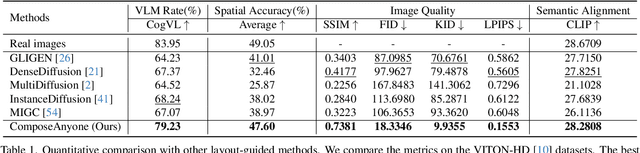
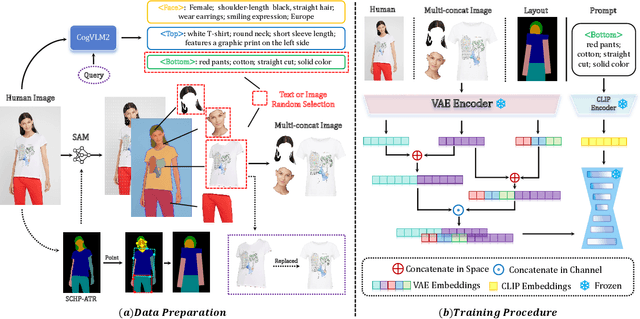
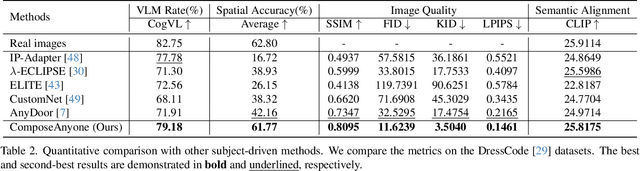
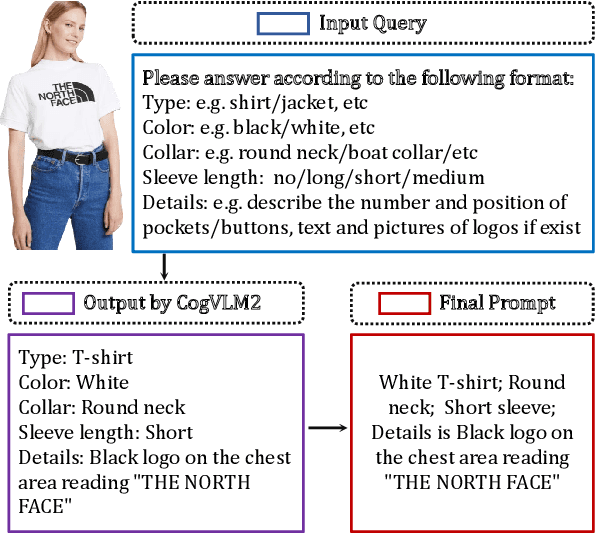
Building on the success of diffusion models, significant advancements have been made in multimodal image generation tasks. Among these, human image generation has emerged as a promising technique, offering the potential to revolutionize the fashion design process. However, existing methods often focus solely on text-to-image or image reference-based human generation, which fails to satisfy the increasingly sophisticated demands. To address the limitations of flexibility and precision in human generation, we introduce ComposeAnyone, a controllable layout-to-human generation method with decoupled multimodal conditions. Specifically, our method allows decoupled control of any part in hand-drawn human layouts using text or reference images, seamlessly integrating them during the generation process. The hand-drawn layout, which utilizes color-blocked geometric shapes such as ellipses and rectangles, can be easily drawn, offering a more flexible and accessible way to define spatial layouts. Additionally, we introduce the ComposeHuman dataset, which provides decoupled text and reference image annotations for different components of each human image, enabling broader applications in human image generation tasks. Extensive experiments on multiple datasets demonstrate that ComposeAnyone generates human images with better alignment to given layouts, text descriptions, and reference images, showcasing its multi-task capability and controllability.
ConsistentID: Portrait Generation with Multimodal Fine-Grained Identity Preserving
Apr 25, 2024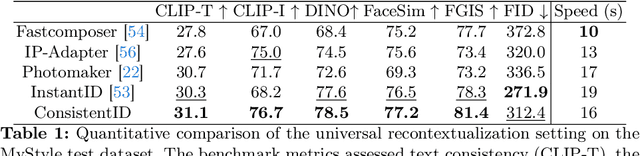


Diffusion-based technologies have made significant strides, particularly in personalized and customized facialgeneration. However, existing methods face challenges in achieving high-fidelity and detailed identity (ID)consistency, primarily due to insufficient fine-grained control over facial areas and the lack of a comprehensive strategy for ID preservation by fully considering intricate facial details and the overall face. To address these limitations, we introduce ConsistentID, an innovative method crafted for diverseidentity-preserving portrait generation under fine-grained multimodal facial prompts, utilizing only a single reference image. ConsistentID comprises two key components: a multimodal facial prompt generator that combines facial features, corresponding facial descriptions and the overall facial context to enhance precision in facial details, and an ID-preservation network optimized through the facial attention localization strategy, aimed at preserving ID consistency in facial regions. Together, these components significantly enhance the accuracy of ID preservation by introducing fine-grained multimodal ID information from facial regions. To facilitate training of ConsistentID, we present a fine-grained portrait dataset, FGID, with over 500,000 facial images, offering greater diversity and comprehensiveness than existing public facial datasets. % such as LAION-Face, CelebA, FFHQ, and SFHQ. Experimental results substantiate that our ConsistentID achieves exceptional precision and diversity in personalized facial generation, surpassing existing methods in the MyStyle dataset. Furthermore, while ConsistentID introduces more multimodal ID information, it maintains a fast inference speed during generation.