 Add to Chrome
 Add to Firefox
 Add to Edge
MM-Interleaved: Interleaved Image-Text Generative Modeling via Multi-modal Feature Synchronizer
Jan 18, 2024
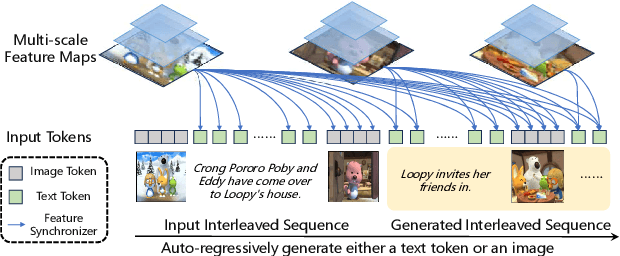


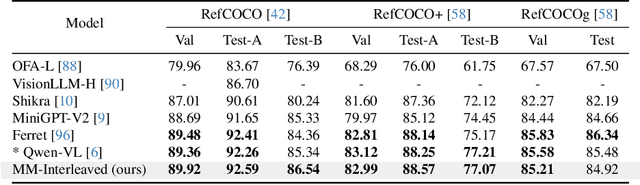
Developing generative models for interleaved image-text data has both research and practical value. It requires models to understand the interleaved sequences and subsequently generate images and text. However, existing attempts are limited by the issue that the fixed number of visual tokens cannot efficiently capture image details, which is particularly problematic in the multi-image scenarios. To address this, this paper presents MM-Interleaved, an end-to-end generative model for interleaved image-text data. It introduces a multi-scale and multi-image feature synchronizer module, allowing direct access to fine-grained image features in the previous context during the generation process. MM-Interleaved is end-to-end pre-trained on both paired and interleaved image-text corpora. It is further enhanced through a supervised fine-tuning phase, wherein the model improves its ability to follow complex multi-modal instructions. Experiments demonstrate the versatility of MM-Interleaved in recognizing visual details following multi-modal instructions and generating consistent images following both textual and visual conditions. Code and models are available at \url{https://github.com/OpenGVLab/MM-Interleaved}.

Generative Multi-Modal Knowledge Retrieval with Large Language Models
Jan 16, 2024


Knowledge retrieval with multi-modal queries plays a crucial role in supporting knowledge-intensive multi-modal applications. However, existing methods face challenges in terms of their effectiveness and training efficiency, especially when it comes to training and integrating multiple retrievers to handle multi-modal queries. In this paper, we propose an innovative end-to-end generative framework for multi-modal knowledge retrieval. Our framework takes advantage of the fact that large language models (LLMs) can effectively serve as virtual knowledge bases, even when trained with limited data. We retrieve knowledge via a two-step process: 1) generating knowledge clues related to the queries, and 2) obtaining the relevant document by searching databases using the knowledge clue. In particular, we first introduce an object-aware prefix-tuning technique to guide multi-grained visual learning. Then, we align multi-grained visual features into the textual feature space of the LLM, employing the LLM to capture cross-modal interactions. Subsequently, we construct instruction data with a unified format for model training. Finally, we propose the knowledge-guided generation strategy to impose prior constraints in the decoding steps, thereby promoting the generation of distinctive knowledge clues. Through experiments conducted on three benchmarks, we demonstrate significant improvements ranging from 3.0% to 14.6% across all evaluation metrics when compared to strong baselines.
Efficient Deformable ConvNets: Rethinking Dynamic and Sparse Operator for Vision Applications
Jan 11, 2024

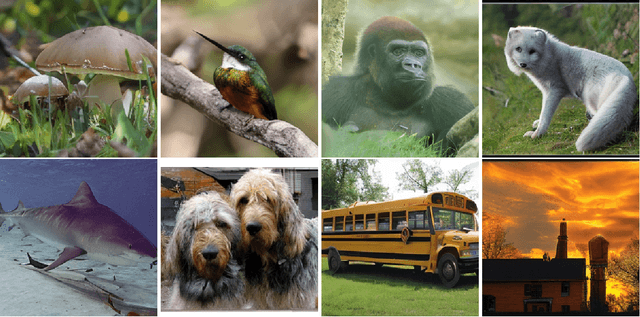
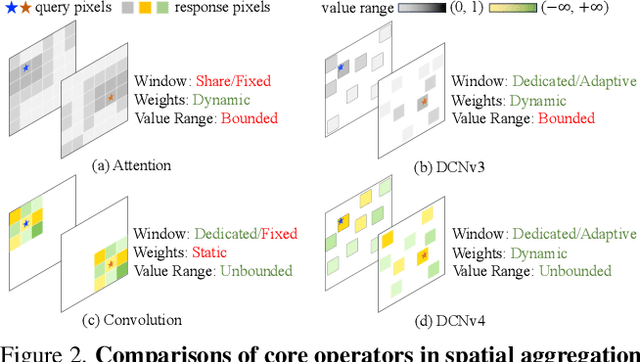
We introduce Deformable Convolution v4 (DCNv4), a highly efficient and effective operator designed for a broad spectrum of vision applications. DCNv4 addresses the limitations of its predecessor, DCNv3, with two key enhancements: 1. removing softmax normalization in spatial aggregation to enhance its dynamic property and expressive power and 2. optimizing memory access to minimize redundant operations for speedup. These improvements result in a significantly faster convergence compared to DCNv3 and a substantial increase in processing speed, with DCNv4 achieving more than three times the forward speed. DCNv4 demonstrates exceptional performance across various tasks, including image classification, instance and semantic segmentation, and notably, image generation. When integrated into generative models like U-Net in the latent diffusion model, DCNv4 outperforms its baseline, underscoring its possibility to enhance generative models. In practical applications, replacing DCNv3 with DCNv4 in the InternImage model to create FlashInternImage results in up to 80% speed increase and further performance improvement without further modifications. The advancements in speed and efficiency of DCNv4, combined with its robust performance across diverse vision tasks, show its potential as a foundational building block for future vision models.
Domain Similarity-Perceived Label Assignment for Domain Generalized Underwater Object Detection
Dec 20, 2023The inherent characteristics and light fluctuations of water bodies give rise to the huge difference between different layers and regions in underwater environments. When the test set is collected in a different marine area from the training set, the issue of domain shift emerges, significantly compromising the model's ability to generalize. The Domain Adversarial Learning (DAL) training strategy has been previously utilized to tackle such challenges. However, DAL heavily depends on manually one-hot domain labels, which implies no difference among the samples in the same domain. Such an assumption results in the instability of DAL. This paper introduces the concept of Domain Similarity-Perceived Label Assignment (DSP). The domain label for each image is regarded as its similarity to the specified domains. Through domain-specific data augmentation techniques, we achieved state-of-the-art results on the underwater cross-domain object detection benchmark S-UODAC2020. Furthermore, we validated the effectiveness of our method in the Cityscapes dataset.
MELO: Enhancing Model Editing with Neuron-Indexed Dynamic LoRA
Dec 19, 2023Large language models (LLMs) have shown great success in various Natural Language Processing (NLP) tasks, whist they still need updates after deployment to fix errors or keep pace with the changing knowledge in the world. Researchers formulate such problem as Model Editing and have developed various editors focusing on different axes of editing properties. However, current editors can hardly support all properties and rely on heavy computational resources. In this paper, we propose a plug-in Model Editing method based on neuron-indexed dynamic LoRA (MELO), which alters the behavior of language models by dynamically activating certain LoRA blocks according to the index built in an inner vector database. Our method satisfies various editing properties with high efficiency and can be easily integrated into multiple LLM backbones. Experimental results show that our proposed MELO achieves state-of-the-art editing performance on three sequential editing tasks (document classification, question answering and hallucination correction), while requires the least trainable parameters and computational cost.
A Soft Contrastive Learning-based Prompt Model for Few-shot Sentiment Analysis
Dec 16, 2023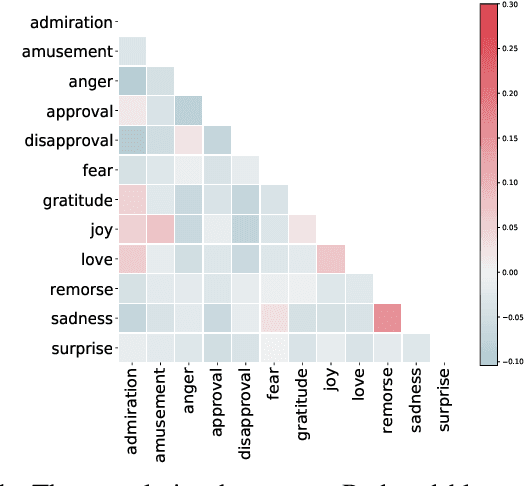
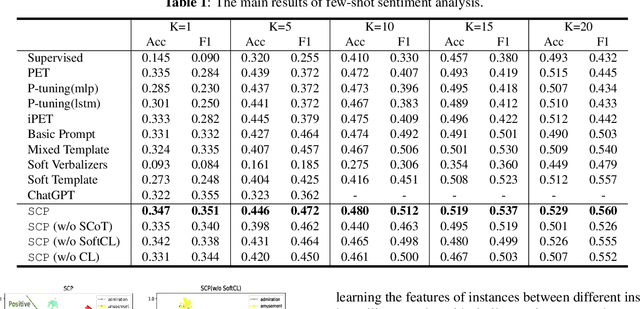
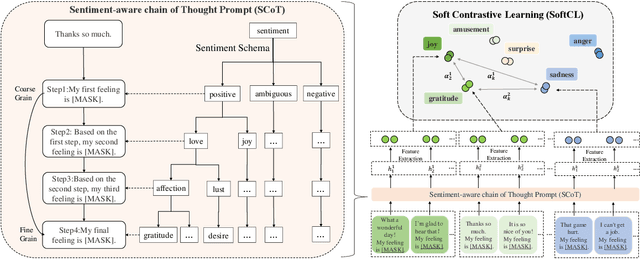
Few-shot text classification has attracted great interest in both academia and industry due to the lack of labeled data in many fields. Different from general text classification (e.g., topic classification), few-shot sentiment classification is more challenging because the semantic distances among the classes are more subtle. For instance, the semantic distances between the sentiment labels in a positive or negative polarity (e.g., ``love" and ``joy", ``remorse" and ``sadness") are close, while the distances are large for the sentiment labels in two opposite polarities (e.g., ``love" and ``sadness"). To address this problem, we propose a Soft Contrastive learning-based Prompt (\texttt{SCP}) model for few-shot sentiment analysis. First, we design a sentiment-aware chain of thought prompt module to guide the model to predict the sentiment from coarse grain to fine grain via a series of intermediate reasoning steps. Then, we propose a soft contrastive learning algorithm to take the correlation of the labels into account. A series of experiments on several sentiment analysis datasets show the great advantages of \texttt{SCP} by comparing it with SOTA baselines (e.g., ChatGPT).
Mathematical Language Models: A Survey
Dec 14, 2023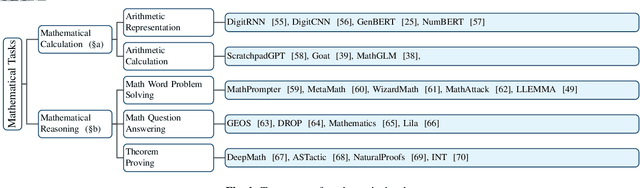

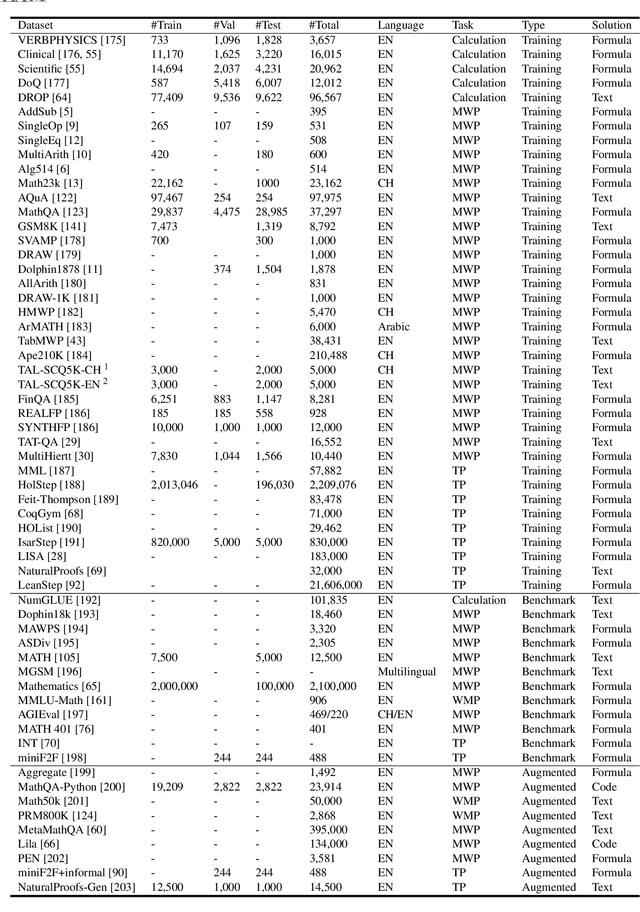
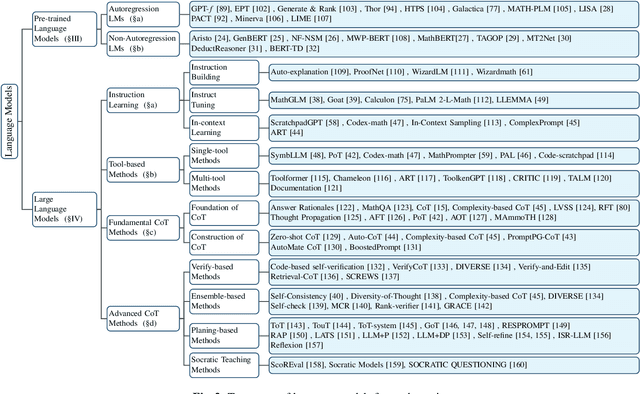
In recent years, there has been remarkable progress in leveraging Language Models (LMs), encompassing Pre-trained Language Models (PLMs) and Large-scale Language Models (LLMs), within the domain of mathematics. This paper conducts a comprehensive survey of mathematical LMs, systematically categorizing pivotal research endeavors from two distinct perspectives: tasks and methodologies. The landscape reveals a large number of proposed mathematical LLMs, which are further delineated into instruction learning, tool-based methods, fundamental CoT techniques, and advanced CoT methodologies. In addition, our survey entails the compilation of over 60 mathematical datasets, including training datasets, benchmark datasets, and augmented datasets. Addressing the primary challenges and delineating future trajectories within the field of mathematical LMs, this survey is positioned as a valuable resource, poised to facilitate and inspire future innovation among researchers invested in advancing this domain.
Auto MC-Reward: Automated Dense Reward Design with Large Language Models for Minecraft
Dec 14, 2023
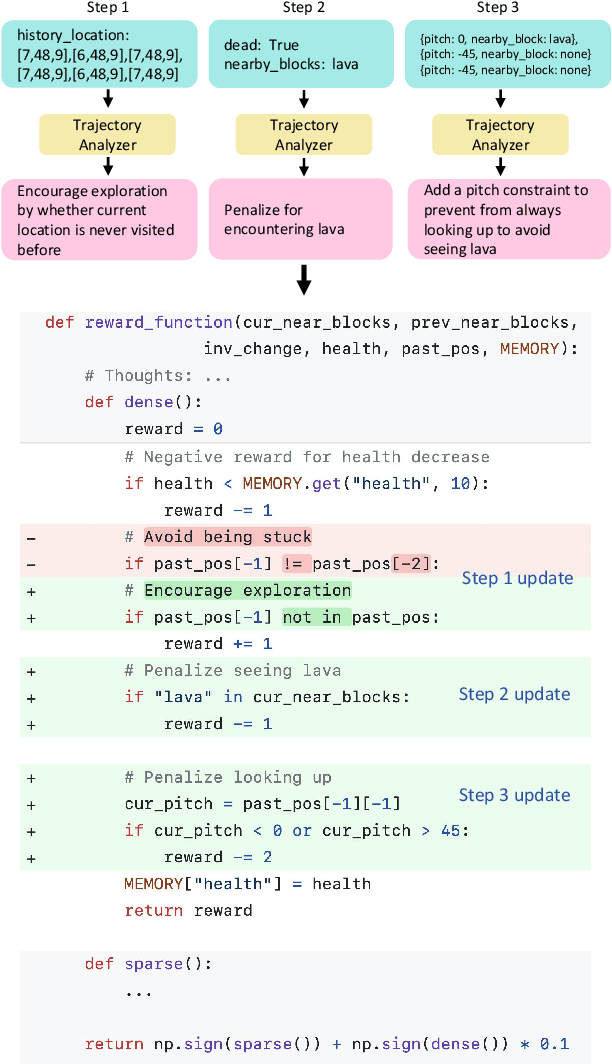


Traditional reinforcement-learning-based agents rely on sparse rewards that often only use binary values to indicate task completion or failure. The challenge in exploration efficiency makes it difficult to effectively learn complex tasks in Minecraft. To address this, this paper introduces an advanced learning system, named Auto MC-Reward, that leverages Large Language Models (LLMs) to automatically design dense reward functions, thereby enhancing the learning efficiency. Auto MC-Reward consists of three important components: Reward Designer, Reward Critic, and Trajectory Analyzer. Given the environment information and task descriptions, the Reward Designer first design the reward function by coding an executable Python function with predefined observation inputs. Then, our Reward Critic will be responsible for verifying the code, checking whether the code is self-consistent and free of syntax and semantic errors. Further, the Trajectory Analyzer summarizes possible failure causes and provides refinement suggestions according to collected trajectories. In the next round, Reward Designer will take further refine and iterate the dense reward function based on feedback. Experiments demonstrate a significant improvement in the success rate and learning efficiency of our agents in complex tasks in Minecraft, such as obtaining diamond with the efficient ability to avoid lava, and efficiently explore trees and animals that are sparse on the plains biome.
PointVoxel: A Simple and Effective Pipeline for Multi-View Multi-Modal 3D Human Pose Estimation
Dec 12, 2023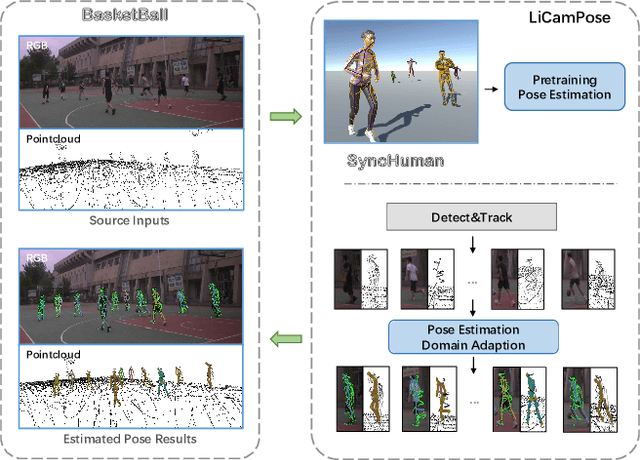
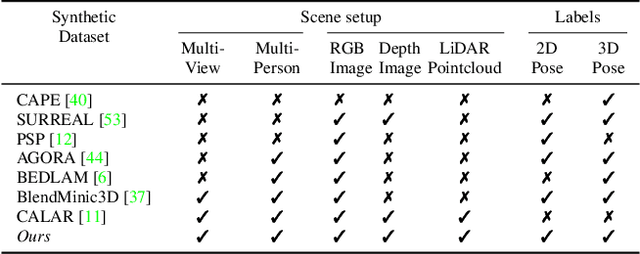
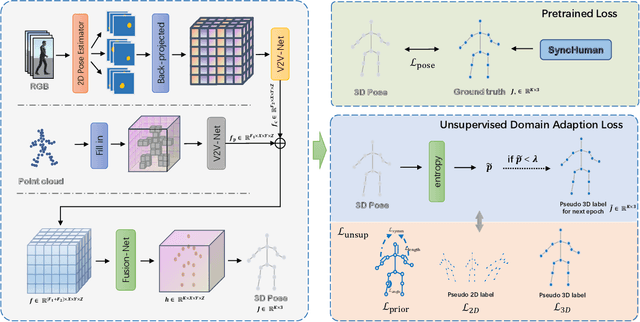
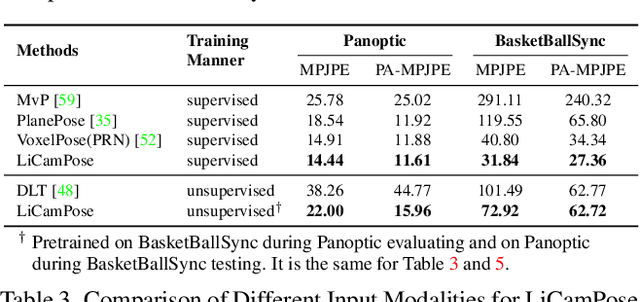
Recently, several methods have been proposed to estimate 3D human pose from multi-view images and achieved impressive performance on public datasets collected in relatively easy scenarios. However, there are limited approaches for extracting 3D human skeletons from multimodal inputs (e.g., RGB and pointcloud) that can enhance the accuracy of predicting 3D poses in challenging situations. We fill this gap by introducing a pipeline called PointVoxel that fuses multi-view RGB and pointcloud inputs to obtain 3D human poses. We demonstrate that volumetric representation is an effective architecture for integrating these different modalities. Moreover, in order to overcome the challenges of annotating 3D human pose labels in difficult scenarios, we develop a synthetic dataset generator for pretraining and design an unsupervised domain adaptation strategy so that we can obtain a well-trained 3D human pose estimator without using any manual annotations. We evaluate our approach on four datasets (two public datasets, one synthetic dataset, and one challenging dataset named BasketBall collected by ourselves), showing promising results. The code and dataset will be released soon.
LiDAR-based Person Re-identification
Dec 11, 2023Camera-based person re-identification (ReID) systems have been widely applied in the field of public security. However, cameras often lack the perception of 3D morphological information of human and are susceptible to various limitations, such as inadequate illumination, complex background, and personal privacy. In this paper, we propose a LiDAR-based ReID framework, ReID3D, that utilizes pre-training strategy to retrieve features of 3D body shape and introduces Graph-based Complementary Enhancement Encoder for extracting comprehensive features. Due to the lack of LiDAR datasets, we build LReID, the first LiDAR-based person ReID dataset, which is collected in several outdoor scenes with variations in natural conditions. Additionally, we introduce LReID-sync, a simulated pedestrian dataset designed for pre-training encoders with tasks of point cloud completion and shape parameter learning. Extensive experiments on LReID show that ReID3D achieves exceptional performance with a rank-1 accuracy of 94.0, highlighting the significant potential of LiDAR in addressing person ReID tasks. To the best of our knowledge, we are the first to propose a solution for LiDAR-based ReID. The code and datasets will be released soon.