 Add to Chrome
 Add to Firefox
 Add to Edge
UoU: A Universal Fingerprint Foundation Model Based on Large-Scale Unsupervised Learning
Jun 16, 2026
Fingerprint recognition is still dominated by task-specific pipelines, where enhancement, structural parsing, alignment, and matching are optimized in isolation. Although effective in narrow settings, this design limits representation reuse across sensors, qualities, and downstream applications. We therefore present UoU, short for ``a \textbf{U}niversal fingerprint foundation model based \textbf{o}n large-scale \textbf{U}nsupervised learning,'' which reframes fingerprint feature extraction as a domain-specific foundation-model problem. UoU is organized around a multi-level representation hierarchy spanning image restoration, structural fields, semantic tokens, point-level biometric entities, and compact global descriptors. Its training recipe combines a supervised cold start on precise annotations, large-scale weakly supervised refinement, and large-scale unsupervised consolidation, with the latter two stages iterated during large-scale training so that weak supervision broadens semantic coverage while unsupervised learning stabilizes correspondences, invariances, and representation geometry. Rather than treating fingerprint imagery as generic texture, UoU exploits domain-specific symmetries and intermediate structure, including orientation flow, periodic ridge patterns, sparse biometric entities, and spatial equivariance. The framework is intentionally architecture-agnostic: while the present study includes an initial transformer-based structured-prediction instantiation, the broader design supports multi-task learning, scalable model configurations, and downstream specialization for matching, alignment, enhancement, registration, and related fingerprint applications. This paper presents the technical motivation, system design, and validation protocol of UoU, and part of the baseline implementation is publicly available at https://github.com/XiongjunGuan/UoU.

Toward the Whole Picture: Accumulative Fingerprint Mapping and Reconstruction for Small-Area Mobile Sensors
Jun 14, 2026Small-area fingerprint sensing on mobile devices creates a fundamental mismatch between acquisition and recognition: each touch captures only a tiny, pose-varying local patch, while reliable biometric matching ultimately requires a stable and sufficiently complete fingerprint representation. Existing pipelines largely cope with this mismatch by treating repeated touches as independent partial templates, which leads to repeated registration, repeated matching, and no guarantee of adequate global coverage. In this paper, we advocate a different formulation, namely \emph{accumulative fingerprint mapping and reconstruction} for small-area mobile sensing. Rather than matching every partial patch separately, the proposed perspective converts a sequence of local observations into a unified fingerprint state that is progressively refined as new touches arrive and can be matched only once after consolidation. As a concrete baseline, we present a classical pipeline that performs patch-wise structural feature extraction, feature-level registration and fusion, fingerprint map construction, and phase-based ridge reconstruction. More importantly, we position this baseline within a broader mobile fingerprint framework that integrates structured token learning, two-stage pose reasoning, and diffusion-based generative reconstruction. This viewpoint reframes mobile fingerprint recognition from multi-capture multi-match processing to accumulative map building, state refinement, and one-shot matching, offering a principled route toward efficient, pose-robust, and deployment-friendly biometrics for small-area mobile platforms. The baseline implementation has been publicly released at https://github.com/XiongjunGuan/FpReconstruction.
GesVLA: Gesture-Aware Vision-Language-Action Model Embedded Representations
May 21, 2026Vision-Language-Action (VLA) models have shown strong potential for general-purpose robot manipulation by unifying perception and action. However, existing VLA systems primarily rely on textual instructions and struggle to resolve spatial ambiguity in complex scenes with multiple similar objects. To address this limitation, we introduce gesture as a parallel instruction modality and propose a Gesture-aware Vision-Language-Action model (GesVLA). Our approach encodes gesture features directly into the latent space, enabling them to participate in both high-level reasoning and low-level action generation, and adopts a dual-VLM architecture to achieve tight coupling between gesture representations and action policies. At the data level, we construct a scalable gesture data generation pipeline by rendering hand models onto real-world scene images. This reduces the sim-to-real visual gap while producing rich data with diverse motion patterns and corresponding pointing annotations. In addition, we employ a two-stage training strategy to equip the model with both gesture perception and action prediction capabilities. We evaluate our approach on multiple real-world robotic tasks, including a controlled block manipulation task for validation and more practical scenarios such as product and produce selection. Experimental results show that incorporating gesture consistently improves target grounding accuracy and human-robot interaction efficiency, especially in complex and cluttered environments. Project page: https://gwxuan.github.io/GesVLA/.
AwareVLN: Reasoning with Self-awareness for Vision-Language Navigation
May 21, 2026Vision-and-Language Navigation (VLN) requires an agent to ground language instructions to its own movement within a visual environment. While state-of-the-art methods leverage the reasoning capabilities of Vision-Language Models (VLMs) for end-to-end action prediction, they often lack an explicit and explainable understanding of the relationships between the agent, the instruction, and the scene. Conversely, explicitly building a scene map for heuristic planning is intuitively appealing but relies on additional 3D sensors and hinders large-scale vision-language pre-training. To bridge this gap, we propose AwareVLN, a novel framework that equips the navigation model with a self-aware reasoning mechanism, enabling it to understand the agent's state and task progress in a fully end-to-end and data-driven manner. Our approach features two key innovations: (1) a structural reasoning module that fosters spatial and task-oriented self-awareness, and (2) an automatic data engine with progress division for effective training. Extensive experiments on various datasets in Habitat simulator show our AwareVLN significantly outperforms previous state-of-the-art vision-language navigation methods. Project page: https://gwxuan.github.io/AwareVLN/.
EgoEMG: A Multimodal Egocentric Dataset with Bilateral EMG and Vision for Hand Pose Estimation
May 07, 2026Surface electromyography (sEMG) records muscle activity during hand movement and can be decoded to recover detailed hand articulation. EMG and egocentric vision are complementary for hand sensing: EMG captures fine-grained finger articulation even under occlusion and poor lighting, while vision provides global hand configuration. However, no existing dataset synchronizes both modalities. We present EgoEMG, a multimodal egocentric dataset for bimanual hand pose estimation. EgoEMG includes bilateral wristband EMG with 16 total channels (8 per wrist) sampled at 2 kHz, 120 Hz IMU, egocentric wide-angle RGB video, external RGB-D video, and mocap-derived hand motion with wrist articulation angles. The dataset covers 41 participants performing 60 gesture classes, including 30 single-hand gestures and 30 bimanual gestures, totaling more than 10 hours of recording. We also introduce a benchmark with three tasks -- EMG-to-pose, vision-to-pose, and EMG+vision fusion -- under a shared joint-angle prediction target and common generalization split axes (cross-gesture, cross-user, and combined). As baselines, we evaluate EMGFormer for EMG-to-pose and generic ResNet/ViT backbones for vision-to-pose. We further study a residual fusion architecture that improves over matched lightweight vision-only baselines. Together, EgoEMG and its benchmark establish a foundation for future research on multimodal hand pose estimation with EMG and vision.
Identity-Consistent Multi-Pose Generation of Contactless Fingerprints
May 05, 2026Contactless fingerprint recognition has gained increasing attention due to its advantages in hygiene and acquisition flexibility. However, the absence of physical contact constraints introduces severe nonlinear geometric distortions caused by free finger poses in 3D space, resulting in a substantial cross-modal domain gap between contactless and conventional contact-based fingerprints. Existing solutions largely rely on explicit geometric correction or image enhancement, which are fragile under extreme pose variations. In this paper, we propose Identity-Consistent Multi-Pose Generation of Contactless Fingerprints (IMPOSE), a physics-inspired framework that synthesizes identity-preserving, multi-pose contactless fingerprint samples to empower recognition models. IMPOSE consists of three stages: (1) rolled fingerprint identity generation via latent diffusion with discrete codebook representations, (2) cross-modal translation from rolled to contactless modality guided by Sauvola-based local adaptive binarization as an identity anchor, and (3) physics-based multi-pose simulation through 3D finger model texture mapping and projection. The generated samples maintain strict identity consistency at the ridge topology level and spatial alignment with standard fingerprint coordinate space. Extensive experiments on the UWA and PolyU CL2CB databases demonstrate that fine-tuning fixed-length dense descriptors (FDD) with IMPOSE-synthesized data achieves state-of-the-art cross-modal matching, reducing EER to 8.74% on UWA and 2.26% on PolyU CL2CB. Synthetic data also yields consistent gains across mainstream representations including DeepPrint and AFRNet, and the hybrid strategy combining synthetic and real data achieves the best overall results. The code and generated samples are available at https://github.com/Yu-Yy/IMPOSE.
Do MLLMs Understand Pointing? Benchmarking and Enhancing Referential Reasoning in Egocentric Vision
Apr 23, 2026Egocentric AI agents, such as smart glasses, rely on pointing gestures to resolve referential ambiguities in natural language commands. However, despite advancements in Multimodal Large Language Models (MLLMs), current systems often fail to precisely ground the spatial semantics of pointing. Instead, they rely on spurious correlations with visual proximity or object saliency, a phenomenon we term "Referential Hallucination." To address this gap, we introduce EgoPoint-Bench, a comprehensive question-answering benchmark designed to evaluate and enhance multimodal pointing reasoning in egocentric views. Comprising over 11k high-fidelity simulated and real-world samples, the benchmark spans five evaluation dimensions and three levels of referential complexity. Extensive experiments demonstrate that while state-of-the-art proprietary and open-source models struggle with egocentric pointing, models fine-tuned on our synthetic data achieve significant performance gains and robust sim-to-real generalization. This work highlights the importance of spatially aware supervision and offers a scalable path toward precise egocentric AI assistants. Project page: https://guyyyug.github.io/EgoPoint-Bench/
Cross-Domain Vessel Segmentation via Latent Similarity Mining and Iterative Co-Optimization
Apr 02, 2026Retinal vessel segmentation serves as a critical prerequisite for automated diagnosis of retinal pathologies. While recent advances in Convolutional Neural Networks (CNNs) have demonstrated promising performance in this task, significant performance degradation occurs when domain shifts exist between training and testing data. To address these limitations, we propose a novel domain transfer framework that leverages latent vascular similarity across domains and iterative co-optimization of generation and segmentation networks. Specifically, we first pre-train generation networks for source and target domains. Subsequently, the pretrained source-domain conditional diffusion model performs deterministic inversion to establish intermediate latent representations of vascular images, creating domain-agnostic prototypes for target synthesis. Finally, we develop an iterative refinement strategy where segmentation network and generative model undergo mutual optimization through cyclic parameter updating. This co-evolution process enables simultaneous enhancement of cross-domain image synthesis quality and segmentation accuracy. Experiments demonstrate that our framework achieves state-of-the-art performance in cross-domain retinal vessel segmentation, particularly in challenging clinical scenarios with significant modality discrepancies.
IGL-Nav: Incremental 3D Gaussian Localization for Image-goal Navigation
Aug 01, 2025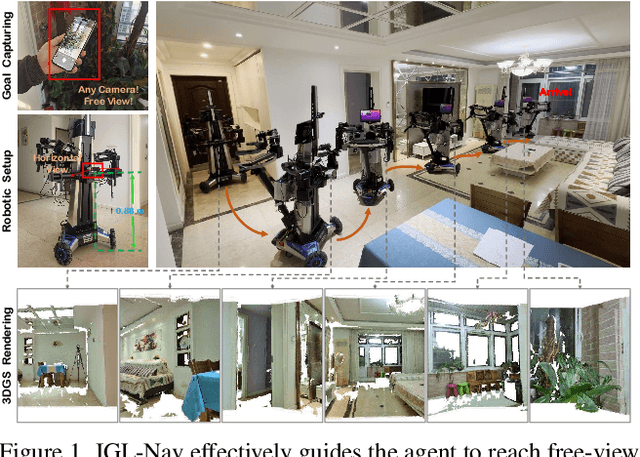
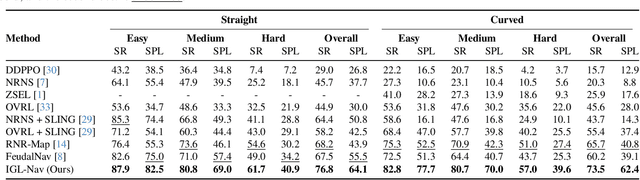
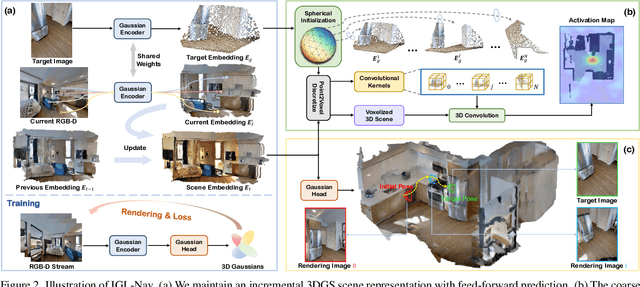
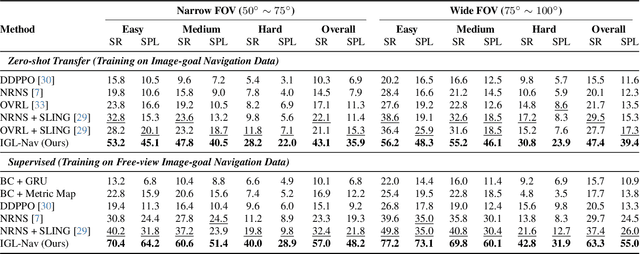
Visual navigation with an image as goal is a fundamental and challenging problem. Conventional methods either rely on end-to-end RL learning or modular-based policy with topological graph or BEV map as memory, which cannot fully model the geometric relationship between the explored 3D environment and the goal image. In order to efficiently and accurately localize the goal image in 3D space, we build our navigation system upon the renderable 3D gaussian (3DGS) representation. However, due to the computational intensity of 3DGS optimization and the large search space of 6-DoF camera pose, directly leveraging 3DGS for image localization during agent exploration process is prohibitively inefficient. To this end, we propose IGL-Nav, an Incremental 3D Gaussian Localization framework for efficient and 3D-aware image-goal navigation. Specifically, we incrementally update the scene representation as new images arrive with feed-forward monocular prediction. Then we coarsely localize the goal by leveraging the geometric information for discrete space matching, which can be equivalent to efficient 3D convolution. When the agent is close to the goal, we finally solve the fine target pose with optimization via differentiable rendering. The proposed IGL-Nav outperforms existing state-of-the-art methods by a large margin across diverse experimental configurations. It can also handle the more challenging free-view image-goal setting and be deployed on real-world robotic platform using a cellphone to capture goal image at arbitrary pose. Project page: https://gwxuan.github.io/IGL-Nav/.
Fixed-Length Dense Fingerprint Representation
May 06, 2025Fixed-length fingerprint representations, which map each fingerprint to a compact and fixed-size feature vector, are computationally efficient and well-suited for large-scale matching. However, designing a robust representation that effectively handles diverse fingerprint modalities, pose variations, and noise interference remains a significant challenge. In this work, we propose a fixed-length dense descriptor of fingerprints, and introduce FLARE-a fingerprint matching framework that integrates the Fixed-Length dense descriptor with pose-based Alignment and Robust Enhancement. This fixed-length representation employs a three-dimensional dense descriptor to effectively capture spatial relationships among fingerprint ridge structures, enabling robust and locally discriminative representations. To ensure consistency within this dense feature space, FLARE incorporates pose-based alignment using complementary estimation methods, along with dual enhancement strategies that refine ridge clarity while preserving the original fingerprint modality. The proposed dense descriptor supports fixed-length representation while maintaining spatial correspondence, enabling fast and accurate similarity computation. Extensive experiments demonstrate that FLARE achieves superior performance across rolled, plain, latent, and contactless fingerprints, significantly outperforming existing methods in cross-modality and low-quality scenarios. Further analysis validates the effectiveness of the dense descriptor design, as well as the impact of alignment and enhancement modules on the accuracy of dense descriptor matching. Experimental results highlight the effectiveness and generalizability of FLARE as a unified and scalable solution for robust fingerprint representation and matching. The implementation and code will be publicly available at https://github.com/Yu-Yy/FLARE.