 Add to Chrome
 Add to Firefox
 Add to Edge
AwareVLN: Reasoning with Self-awareness for Vision-Language Navigation
May 21, 2026
Vision-and-Language Navigation (VLN) requires an agent to ground language instructions to its own movement within a visual environment. While state-of-the-art methods leverage the reasoning capabilities of Vision-Language Models (VLMs) for end-to-end action prediction, they often lack an explicit and explainable understanding of the relationships between the agent, the instruction, and the scene. Conversely, explicitly building a scene map for heuristic planning is intuitively appealing but relies on additional 3D sensors and hinders large-scale vision-language pre-training. To bridge this gap, we propose AwareVLN, a novel framework that equips the navigation model with a self-aware reasoning mechanism, enabling it to understand the agent's state and task progress in a fully end-to-end and data-driven manner. Our approach features two key innovations: (1) a structural reasoning module that fosters spatial and task-oriented self-awareness, and (2) an automatic data engine with progress division for effective training. Extensive experiments on various datasets in Habitat simulator show our AwareVLN significantly outperforms previous state-of-the-art vision-language navigation methods. Project page: https://gwxuan.github.io/AwareVLN/.

GesVLA: Gesture-Aware Vision-Language-Action Model Embedded Representations
May 21, 2026Vision-Language-Action (VLA) models have shown strong potential for general-purpose robot manipulation by unifying perception and action. However, existing VLA systems primarily rely on textual instructions and struggle to resolve spatial ambiguity in complex scenes with multiple similar objects. To address this limitation, we introduce gesture as a parallel instruction modality and propose a Gesture-aware Vision-Language-Action model (GesVLA). Our approach encodes gesture features directly into the latent space, enabling them to participate in both high-level reasoning and low-level action generation, and adopts a dual-VLM architecture to achieve tight coupling between gesture representations and action policies. At the data level, we construct a scalable gesture data generation pipeline by rendering hand models onto real-world scene images. This reduces the sim-to-real visual gap while producing rich data with diverse motion patterns and corresponding pointing annotations. In addition, we employ a two-stage training strategy to equip the model with both gesture perception and action prediction capabilities. We evaluate our approach on multiple real-world robotic tasks, including a controlled block manipulation task for validation and more practical scenarios such as product and produce selection. Experimental results show that incorporating gesture consistently improves target grounding accuracy and human-robot interaction efficiency, especially in complex and cluttered environments. Project page: https://gwxuan.github.io/GesVLA/.
Human face perception reflects inverse-generative and naturalistic discriminative objectives
May 12, 2026The perceptual representations supporting our ability to recognize faces remain a computational mystery. Deep neural networks offer mechanistic hypotheses for human face perception, but theoretically distinct models often make indistinguishable representational predictions for randomly sampled faces. To expose diagnostic differences among these hypotheses, we compared six neural network models sharing an architecture but trained on distinct tasks, using face pairs optimized to elicit contrasting model predictions ("controversial" pairs) alongside randomly sampled pairs. We tested model predictions against face-dissimilarity judgments from 864 human participants across stimulus sets differing in realism and pose variation. Models prioritizing high-level, invariant structures (trained via inverse rendering, face identification, or object classification) most robustly matched human judgments. Furthermore, models trained on natural images typically outperformed synthetic-trained counterparts. Together, these findings suggest that human face perception is shaped by mechanisms that infer latent causes of facial appearance, discount nuisance variation, and are tuned by natural image statistics.
Beyond Next-Token Alignment: Distilling Multimodal Large Language Models via Token Interactions
Feb 10, 2026Multimodal Large Language Models (MLLMs) demonstrate impressive cross-modal capabilities, yet their substantial size poses significant deployment challenges. Knowledge distillation (KD) is a promising solution for compressing these models, but existing methods primarily rely on static next-token alignment, neglecting the dynamic token interactions, which embed essential capabilities for multimodal understanding and generation. To this end, we introduce Align-TI, a novel KD framework designed from the perspective of Token Interactions. Our approach is motivated by the insight that MLLMs rely on two primary interactions: vision-instruction token interactions to extract relevant visual information, and intra-response token interactions for coherent generation. Accordingly, Align-TI introduces two components: IVA enables the student model to imitate the teacher's instruction-relevant visual information extract capability by aligning on salient visual regions. TPA captures the teacher's dynamic generative logic by aligning the sequential token-to-token transition probabilities. Extensive experiments demonstrate Align-TI's superiority. Notably, our approach achieves $2.6\%$ relative improvement over Vanilla KD, and our distilled Align-TI-2B even outperforms LLaVA-1.5-7B (a much larger MLLM) by $7.0\%$, establishing a new state-of-the-art distillation framework for training parameter-efficient MLLMs. Code is available at https://github.com/lchen1019/Align-TI.
IGL-Nav: Incremental 3D Gaussian Localization for Image-goal Navigation
Aug 01, 2025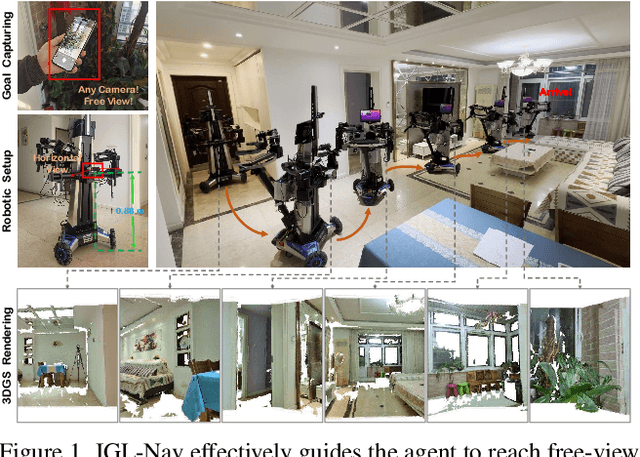
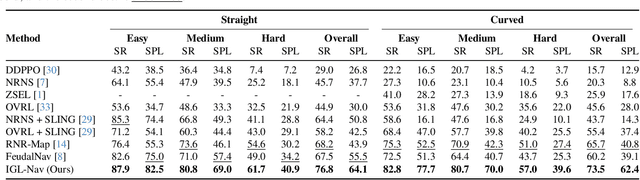
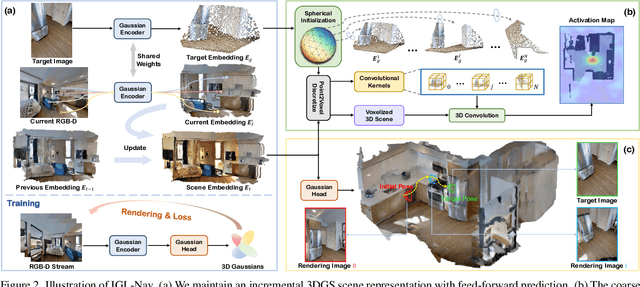
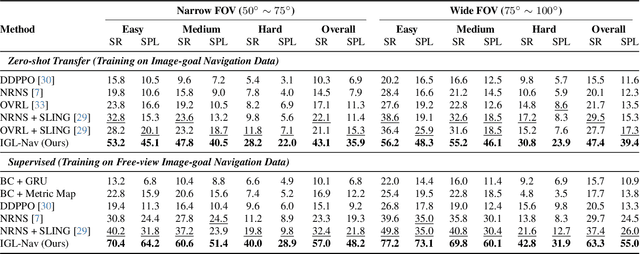
Visual navigation with an image as goal is a fundamental and challenging problem. Conventional methods either rely on end-to-end RL learning or modular-based policy with topological graph or BEV map as memory, which cannot fully model the geometric relationship between the explored 3D environment and the goal image. In order to efficiently and accurately localize the goal image in 3D space, we build our navigation system upon the renderable 3D gaussian (3DGS) representation. However, due to the computational intensity of 3DGS optimization and the large search space of 6-DoF camera pose, directly leveraging 3DGS for image localization during agent exploration process is prohibitively inefficient. To this end, we propose IGL-Nav, an Incremental 3D Gaussian Localization framework for efficient and 3D-aware image-goal navigation. Specifically, we incrementally update the scene representation as new images arrive with feed-forward monocular prediction. Then we coarsely localize the goal by leveraging the geometric information for discrete space matching, which can be equivalent to efficient 3D convolution. When the agent is close to the goal, we finally solve the fine target pose with optimization via differentiable rendering. The proposed IGL-Nav outperforms existing state-of-the-art methods by a large margin across diverse experimental configurations. It can also handle the more challenging free-view image-goal setting and be deployed on real-world robotic platform using a cellphone to capture goal image at arbitrary pose. Project page: https://gwxuan.github.io/IGL-Nav/.
ML-assisted Randomization Tests for Detecting Treatment Effects in A/B Experiments
Jan 13, 2025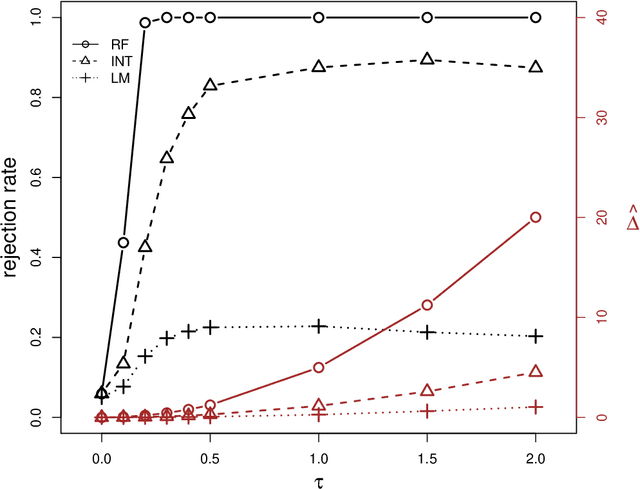
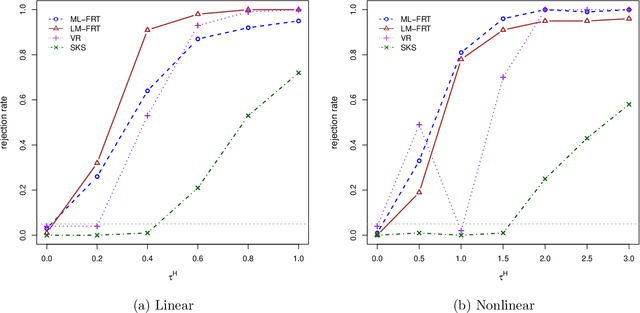
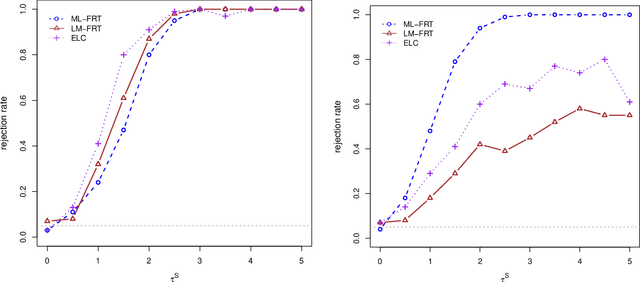
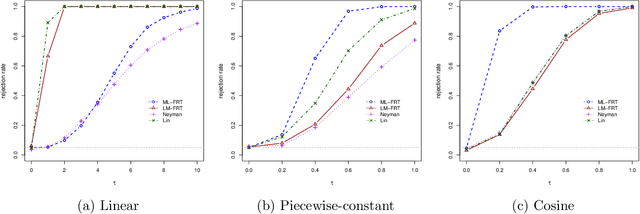
Experimentation is widely utilized for causal inference and data-driven decision-making across disciplines. In an A/B experiment, for example, an online business randomizes two different treatments (e.g., website designs) to their customers and then aims to infer which treatment is better. In this paper, we construct randomization tests for complex treatment effects, including heterogeneity and interference. A key feature of our approach is the use of flexible machine learning (ML) models, where the test statistic is defined as the difference between the cross-validation errors from two ML models, one including the treatment variable and the other without it. This approach combines the predictive power of modern ML tools with the finite-sample validity of randomization procedures, enabling a robust and efficient way to detect complex treatment effects in experimental settings. We demonstrate this combined benefit both theoretically and empirically through applied examples.
Camera-LiDAR Cross-modality Gait Recognition
Jul 03, 2024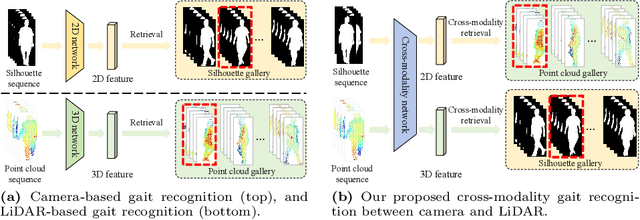
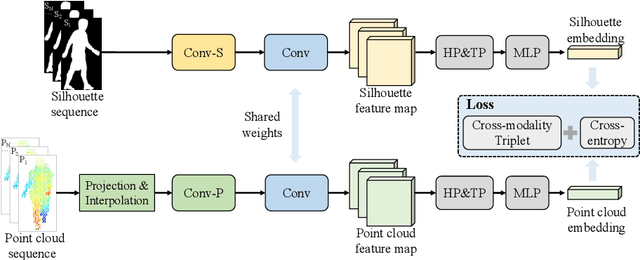
Gait recognition is a crucial biometric identification technique. Camera-based gait recognition has been widely applied in both research and industrial fields. LiDAR-based gait recognition has also begun to evolve most recently, due to the provision of 3D structural information. However, in certain applications, cameras fail to recognize persons, such as in low-light environments and long-distance recognition scenarios, where LiDARs work well. On the other hand, the deployment cost and complexity of LiDAR systems limit its wider application. Therefore, it is essential to consider cross-modality gait recognition between cameras and LiDARs for a broader range of applications. In this work, we propose the first cross-modality gait recognition framework between Camera and LiDAR, namely CL-Gait. It employs a two-stream network for feature embedding of both modalities. This poses a challenging recognition task due to the inherent matching between 3D and 2D data, exhibiting significant modality discrepancy. To align the feature spaces of the two modalities, i.e., camera silhouettes and LiDAR points, we propose a contrastive pre-training strategy to mitigate modality discrepancy. To make up for the absence of paired camera-LiDAR data for pre-training, we also introduce a strategy for generating data on a large scale. This strategy utilizes monocular depth estimated from single RGB images and virtual cameras to generate pseudo point clouds for contrastive pre-training. Extensive experiments show that the cross-modality gait recognition is very challenging but still contains potential and feasibility with our proposed model and pre-training strategy. To the best of our knowledge, this is the first work to address cross-modality gait recognition.
Sports Analysis and VR Viewing System Based on Player Tracking and Pose Estimation with Multimodal and Multiview Sensors
May 02, 2024
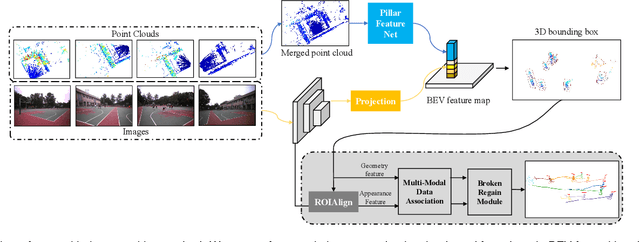
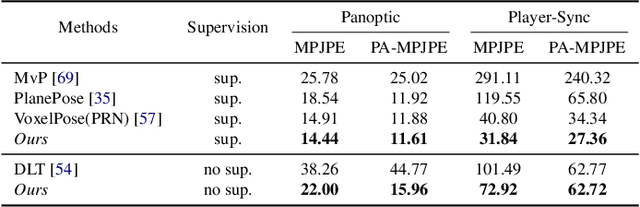
Sports analysis and viewing play a pivotal role in the current sports domain, offering significant value not only to coaches and athletes but also to fans and the media. In recent years, the rapid development of virtual reality (VR) and augmented reality (AR) technologies have introduced a new platform for watching games. Visualization of sports competitions in VR/AR represents a revolutionary technology, providing audiences with a novel immersive viewing experience. However, there is still a lack of related research in this area. In this work, we present for the first time a comprehensive system for sports competition analysis and real-time visualization on VR/AR platforms. First, we utilize multiview LiDARs and cameras to collect multimodal game data. Subsequently, we propose a framework for multi-player tracking and pose estimation based on a limited amount of supervised data, which extracts precise player positions and movements from point clouds and images. Moreover, we perform avatar modeling of players to obtain their 3D models. Ultimately, using these 3D player data, we conduct competition analysis and real-time visualization on VR/AR. Extensive quantitative experiments demonstrate the accuracy and robustness of our multi-player tracking and pose estimation framework. The visualization results showcase the immense potential of our sports visualization system on the domain of watching games on VR/AR devices. The multimodal competition dataset we collected and all related code will be released soon.
Swap-based Deep Reinforcement Learning for Facility Location Problems in Networks
Dec 25, 2023Facility location problems on graphs are ubiquitous in real world and hold significant importance, yet their resolution is often impeded by NP-hardness. Recently, machine learning methods have been proposed to tackle such classical problems, but they are limited to the myopic constructive pattern and only consider the problems in Euclidean space. To overcome these limitations, we propose a general swap-based framework that addresses the p-median problem and the facility relocation problem on graphs and a novel reinforcement learning model demonstrating a keen awareness of complex graph structures. Striking a harmonious balance between solution quality and running time, our method surpasses handcrafted heuristics on intricate graph datasets. Additionally, we introduce a graph generation process to simulate real-world urban road networks with demand, facilitating the construction of large datasets for the classic problem. For the initialization of the locations of facilities, we introduce a physics-inspired strategy for the p-median problem, reaching more stable solutions than the random strategy. The proposed pipeline coupling the classic swap-based method with deep reinforcement learning marks a significant step forward in addressing the practical challenges associated with facility location on graphs.
PointVoxel: A Simple and Effective Pipeline for Multi-View Multi-Modal 3D Human Pose Estimation
Dec 12, 2023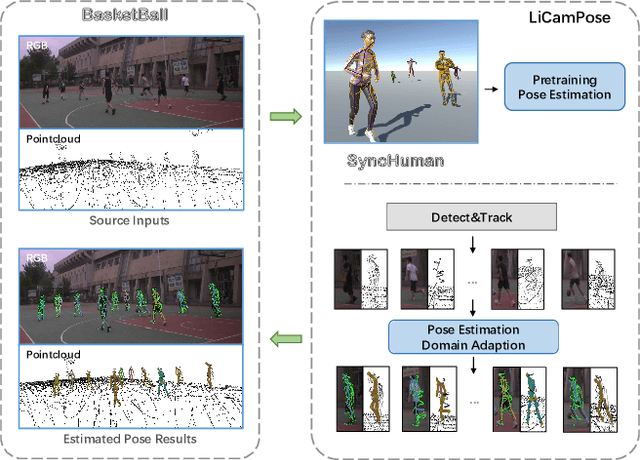
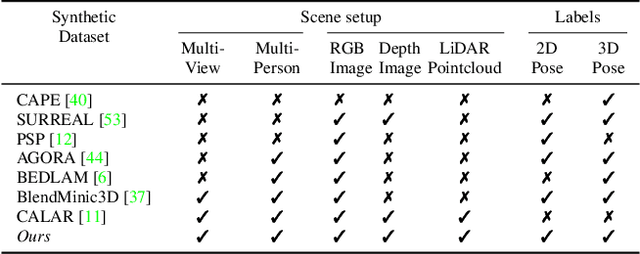
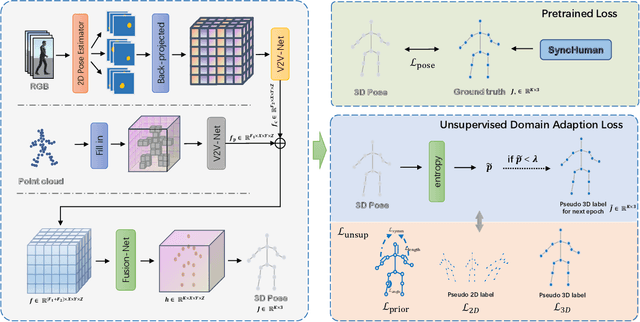
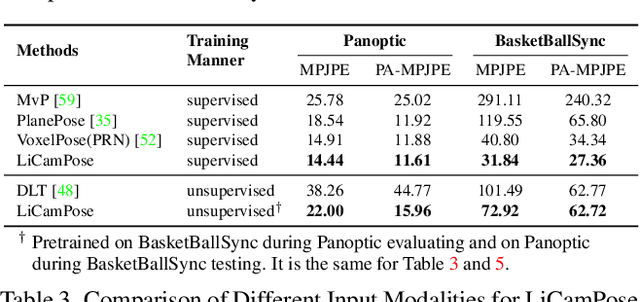
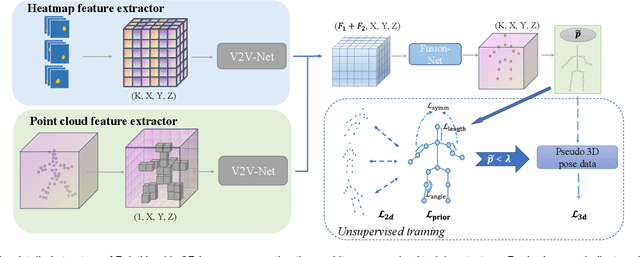
Recently, several methods have been proposed to estimate 3D human pose from multi-view images and achieved impressive performance on public datasets collected in relatively easy scenarios. However, there are limited approaches for extracting 3D human skeletons from multimodal inputs (e.g., RGB and pointcloud) that can enhance the accuracy of predicting 3D poses in challenging situations. We fill this gap by introducing a pipeline called PointVoxel that fuses multi-view RGB and pointcloud inputs to obtain 3D human poses. We demonstrate that volumetric representation is an effective architecture for integrating these different modalities. Moreover, in order to overcome the challenges of annotating 3D human pose labels in difficult scenarios, we develop a synthetic dataset generator for pretraining and design an unsupervised domain adaptation strategy so that we can obtain a well-trained 3D human pose estimator without using any manual annotations. We evaluate our approach on four datasets (two public datasets, one synthetic dataset, and one challenging dataset named BasketBall collected by ourselves), showing promising results. The code and dataset will be released soon.