 Add to Chrome
 Add to Firefox
 Add to Edge
HiSC: Hierarchical Spatial Clustering Token Compression for Efficient 3D Scene Understanding
Aug 05, 2026
3D vision-language models (3D VLMs) enable spatial reasoning over multi-view scenes but suffer from substantial token redundancy due to duplicated observations and large uninformative regions, leading to high computational cost. Although visual token compression has shown promise in accelerating 2D VLMs, it fails to capture the structured nature of 3D scenes and leads to incomplete spatial coverage and loss of fine-grained details. In this paper, we propose \textbf{HiSC}, a training-free framework for hierarchical spatial clustering token compression in 3D VLMs. HiSC lifts token compression from token-level selection to cluster-level processing by organizing tokens into spatially grounded clusters using joint geometric and semantic cues. Specifically, we first introduce a \textbf{spatial graph-based merging (SGraM) strategy} that models cross-view redundancy as spatial connectivity and consolidates physically consistent regions, effectively merging extremely similar redundant tokens prior to LLM inference. We then propose a \textbf{spatial clustering-based pruning (SCluP) paradigm} within LLM inference, which performs hierarchical compression across clusters and within clusters, preserving object instance completeness while retaining fine-grained details for important regions. Extensive experiments on diverse 3D reasoning benchmarks show validate the effectiveness of HiSC, particularly under high visual token pruning ratios. Besides, HiSC achieves over 90\% token reduction with minimal performance degradation. Code is accessible at https://github.com/elecreak/HiSC.

Learning Semantic-Robust Change Detection via Semantic-Invariant Self-Distillation
Jul 21, 2026Change detection aims to identify semantic changes between remote sensing images. However, features from models are easily disturbed by non-semantic variations, such as illumination, shadows, and atmospheric changes, leading to false alarms and limited generalization in real-world scenarios. In this paper, we propose \textbf{SCDistill}, a framework for learning semantic-robust change detection via semantic-invariant self-distillation. First, to strengthen semantic consistency, we introduce a semantic-invariant self-distillation strategy that learns semantic robustness from perturbed yet semantically consistent data, empowering the change detector to extract disturbance-resistant features and achieve more reliable and accurate semantic change identification. Second, to expand paired data with non-semantic variations, we design a diffusion-based perturbation simulation pipeline that synthesizes complex environmental changes, enabling the model to explicitly learn to distinguish semantic changes from appearance-level fluctuations and reduce false alarms caused by non-semantic disturbances. These components promote robustness from data and representation perspectives, leading to synergistic performance gains. Extensive experiments demonstrate that SCDistill achieves state-of-the-art performance on multiple semantic change detection benchmarks and exhibits strong generalization to binary change detection and change captioning tasks. Code is accessible at https://github.com/elecreak/SCDistill.
AquaStereo: Enabling Underwater Stereo Matching via Depth-Conditioned Diffusion and Geometry Self-Distillation
Jul 05, 2026Learning-based stereo matching models struggle in underwater environments due to scarce in-domain data and the difficulty of extracting discriminative correspondences from degraded imagery. In this work, we present $\textbf{AquaStereo}$, a perception-enhanced framework with a data simulation pipeline and a self-distillation strategy that jointly address data scarcity and feature degradation in underwater stereo matching. First, a depth-conditioned diffusion pipeline renders underwater stereo pairs while preserving binocular geometry, with a lightweight left-right consistency module ensuring geometric alignment. Training on this synthetic corpus effectively narrows the terrestrial-underwater gap and improves zero-shot robustness. Second, a frozen binocular teacher trained on clean terrestrial pairs guides a student exposed to rendered underwater pairs with perturbations. A stage-weighted sequence loss is performed to align the student's disparities with the teacher's geometry, while a clean-branch supervision with shared pseudo targets prevents scale drift. To further enhance feature stability under turbidity and low texture, we introduce learnable perception frames, a perception-enhanced feature formulation that constructs robust matching descriptors by fusing temporal cues from two auxiliary views encoded by a video backbone with semantic features extracted by a strong image encoder. Extensive experiments demonstrate that $\textbf{AquaStereo}$ substantially improves robustness and zero-shot generalization in challenging underwater scenarios. The code is available at https://github.com/qz-wei/AquaStereo.
Boosting Text-Driven Video Segmentation via Geometry-Aware Distillation
Jun 23, 2026Text-driven Referring Video Object Segmentation (RVOS) aims to locate and segment target objects in videos given natural language. However, existing models are typically trained on 2D image or video datasets with naive segmentation losses, which overlooks the geometric consistency across frames and leads to weak spatial understanding. In this paper, we propose Geometry-enhanced Language-guided Video segmentation (GeoLaV), a two-stage framework that distills 3D geometric knowledge from images to enhance text-driven video segmentation. In the first stage, we perform monocular geometry pretraining with monocular novel-view synthesis, enabling the model to acquire geometry-consistent visual representations via spatial alignment on large-scale single-image datasets. In the second stage, we introduce geometry-aware distillation and fine-tune the model on video segmentation datasets, transferring 3D structural knowledge from a general 3D prior model. This process reinforces 3D awareness and improves both spatiotemporal coherence and language grounding in segmentation. Extensive experiments show that our method using only image segmentation data already provides notable zero-shot generalization in RVOS. When combined with geometry-aware distillation for fine-tuning on videos, our method achieves state-of-the-art performance across multiple RVOS benchmarks. The code is available at https://github.com/Tony1882880/GeoLaV.
A large-scale nanocrystal database with aligned synthesis and properties enabling generative inverse design
Jan 04, 2026The synthesis of nanocrystals has been highly dependent on trial-and-error, due to the complex correlation between synthesis parameters and physicochemical properties. Although deep learning offers a potential methodology to achieve generative inverse design, it is still hindered by the scarcity of high-quality datasets that align nanocrystal synthesis routes with their properties. Here, we present the construction of a large-scale, aligned Nanocrystal Synthesis-Property (NSP) database and demonstrate its capability for generative inverse design. To extract structured synthesis routes and their corresponding product properties from literature, we develop NanoExtractor, a large language model (LLM) enhanced by well-designed augmentation strategies. NanoExtractor is validated against human experts, achieving a weighted average score of 88% on the test set, significantly outperforming chemistry-specialized (3%) and general-purpose LLMs (38%). The resulting NSP database contains nearly 160,000 aligned entries and serves as training data for our NanoDesigner, an LLM for inverse synthesis design. The generative capability of NanoDesigner is validated through the successful design of viable synthesis routes for both well-established PbSe nanocrystals and rarely reported MgF2 nanocrystals. Notably, the model recommends a counter-intuitive, non-stoichiometric precursor ratio (1:1) for MgF2 nanocrystals, which is experimentally confirmed as critical for suppressing byproducts. Our work bridges the gap between unstructured literature and data-driven synthesis, and also establishes a powerful human-AI collaborative paradigm for accelerating nanocrystal discovery.
RobuSTereo: Robust Zero-Shot Stereo Matching under Adverse Weather
Jul 02, 2025Learning-based stereo matching models struggle in adverse weather conditions due to the scarcity of corresponding training data and the challenges in extracting discriminative features from degraded images. These limitations significantly hinder zero-shot generalization to out-of-distribution weather conditions. In this paper, we propose \textbf{RobuSTereo}, a novel framework that enhances the zero-shot generalization of stereo matching models under adverse weather by addressing both data scarcity and feature extraction challenges. First, we introduce a diffusion-based simulation pipeline with a stereo consistency module, which generates high-quality stereo data tailored for adverse conditions. By training stereo matching models on our synthetic datasets, we reduce the domain gap between clean and degraded images, significantly improving the models' robustness to unseen weather conditions. The stereo consistency module ensures structural alignment across synthesized image pairs, preserving geometric integrity and enhancing depth estimation accuracy. Second, we design a robust feature encoder that combines a specialized ConvNet with a denoising transformer to extract stable and reliable features from degraded images. The ConvNet captures fine-grained local structures, while the denoising transformer refines global representations, effectively mitigating the impact of noise, low visibility, and weather-induced distortions. This enables more accurate disparity estimation even under challenging visual conditions. Extensive experiments demonstrate that \textbf{RobuSTereo} significantly improves the robustness and generalization of stereo matching models across diverse adverse weather scenarios.
Flow-Anything: Learning Real-World Optical Flow Estimation from Large-Scale Single-view Images
Jun 09, 2025Optical flow estimation is a crucial subfield of computer vision, serving as a foundation for video tasks. However, the real-world robustness is limited by animated synthetic datasets for training. This introduces domain gaps when applied to real-world applications and limits the benefits of scaling up datasets. To address these challenges, we propose \textbf{Flow-Anything}, a large-scale data generation framework designed to learn optical flow estimation from any single-view images in the real world. We employ two effective steps to make data scaling-up promising. First, we convert a single-view image into a 3D representation using advanced monocular depth estimation networks. This allows us to render optical flow and novel view images under a virtual camera. Second, we develop an Object-Independent Volume Rendering module and a Depth-Aware Inpainting module to model the dynamic objects in the 3D representation. These two steps allow us to generate realistic datasets for training from large-scale single-view images, namely \textbf{FA-Flow Dataset}. For the first time, we demonstrate the benefits of generating optical flow training data from large-scale real-world images, outperforming the most advanced unsupervised methods and supervised methods on synthetic datasets. Moreover, our models serve as a foundation model and enhance the performance of various downstream video tasks.
Boosting Zero-shot Stereo Matching using Large-scale Mixed Images Sources in the Real World
May 13, 2025Stereo matching methods rely on dense pixel-wise ground truth labels, which are laborious to obtain, especially for real-world datasets. The scarcity of labeled data and domain gaps between synthetic and real-world images also pose notable challenges. In this paper, we propose a novel framework, \textbf{BooSTer}, that leverages both vision foundation models and large-scale mixed image sources, including synthetic, real, and single-view images. First, to fully unleash the potential of large-scale single-view images, we design a data generation strategy combining monocular depth estimation and diffusion models to generate dense stereo matching data from single-view images. Second, to tackle sparse labels in real-world datasets, we transfer knowledge from monocular depth estimation models, using pseudo-mono depth labels and a dynamic scale- and shift-invariant loss for additional supervision. Furthermore, we incorporate vision foundation model as an encoder to extract robust and transferable features, boosting accuracy and generalization. Extensive experiments on benchmark datasets demonstrate the effectiveness of our approach, achieving significant improvements in accuracy over existing methods, particularly in scenarios with limited labeled data and domain shifts.
Relation-Guided Adversarial Learning for Data-free Knowledge Transfer
Dec 16, 2024Data-free knowledge distillation transfers knowledge by recovering training data from a pre-trained model. Despite the recent success of seeking global data diversity, the diversity within each class and the similarity among different classes are largely overlooked, resulting in data homogeneity and limited performance. In this paper, we introduce a novel Relation-Guided Adversarial Learning method with triplet losses, which solves the homogeneity problem from two aspects. To be specific, our method aims to promote both intra-class diversity and inter-class confusion of the generated samples. To this end, we design two phases, an image synthesis phase and a student training phase. In the image synthesis phase, we construct an optimization process to push away samples with the same labels and pull close samples with different labels, leading to intra-class diversity and inter-class confusion, respectively. Then, in the student training phase, we perform an opposite optimization, which adversarially attempts to reduce the distance of samples of the same classes and enlarge the distance of samples of different classes. To mitigate the conflict of seeking high global diversity and keeping inter-class confusing, we propose a focal weighted sampling strategy by selecting the negative in the triplets unevenly within a finite range of distance. RGAL shows significant improvement over previous state-of-the-art methods in accuracy and data efficiency. Besides, RGAL can be inserted into state-of-the-art methods on various data-free knowledge transfer applications. Experiments on various benchmarks demonstrate the effectiveness and generalizability of our proposed method on various tasks, specially data-free knowledge distillation, data-free quantization, and non-exemplar incremental learning. Our code is available at https://github.com/Sharpiless/RGAL.
Deep Learning Models for Colloidal Nanocrystal Synthesis
Dec 14, 2024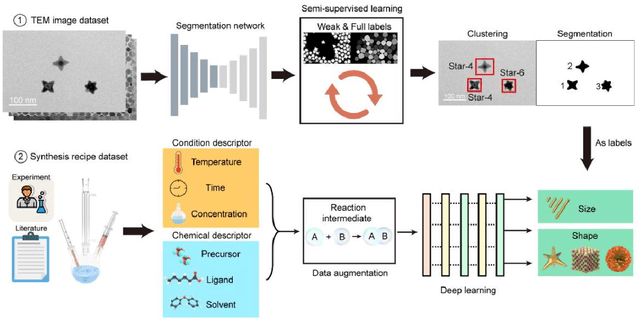
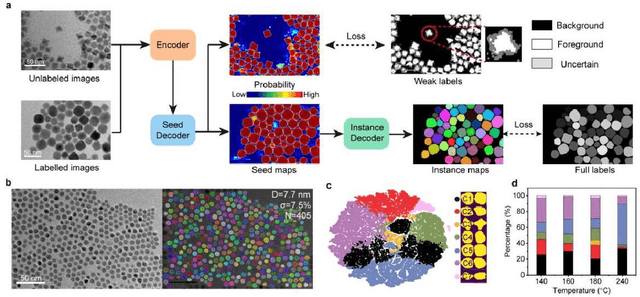
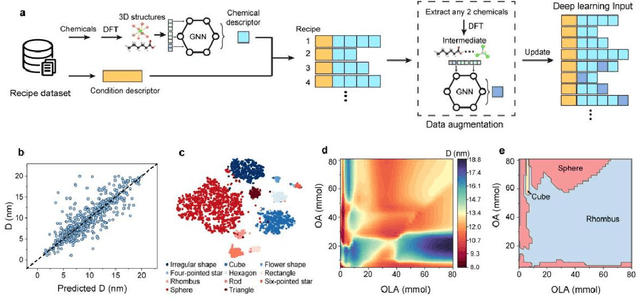
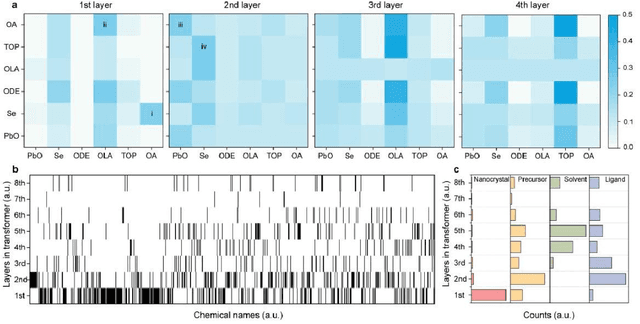
Colloidal synthesis of nanocrystals usually includes complex chemical reactions and multi-step crystallization processes. Despite the great success in the past 30 years, it remains challenging to clarify the correlations between synthetic parameters of chemical reaction and physical properties of nanocrystals. Here, we developed a deep learning-based nanocrystal synthesis model that correlates synthetic parameters with the final size and shape of target nanocrystals, using a dataset of 3500 recipes covering 348 distinct nanocrystal compositions. The size and shape labels were obtained from transmission electron microscope images using a segmentation model trained with a semi-supervised algorithm on a dataset comprising 1.2 million nanocrystals. By applying the reaction intermediate-based data augmentation method and elaborated descriptors, the synthesis model was able to predict nanocrystal's size with a mean absolute error of 1.39 nm, while reaching an 89% average accuracy for shape classification. The synthesis model shows knowledge transfer capabilities across different nanocrystals with inputs of new recipes. With that, the influence of chemicals on the final size of nanocrystals was further evaluated, revealing the importance order of nanocrystal composition, precursor or ligand, and solvent. Overall, the deep learning-based nanocrystal synthesis model offers a powerful tool to expedite the development of high-quality nanocrystals.