 Add to Chrome
 Add to Firefox
 Add to Edge
Deep Richardson-Lucy Deconvolution for Low-Light Image Deblurring
Aug 10, 2023
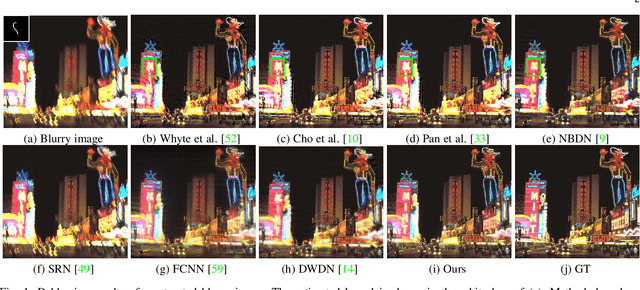

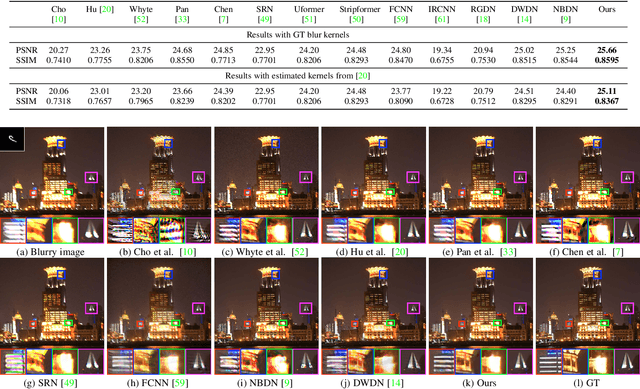
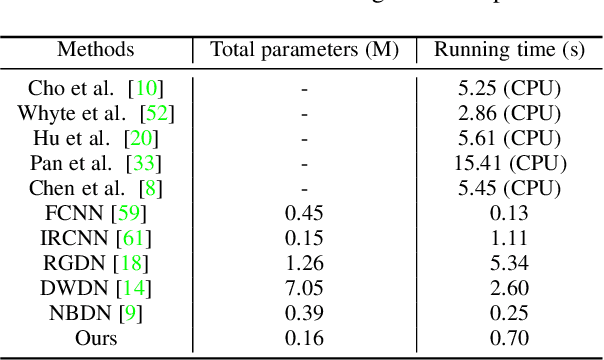
Images taken under the low-light condition often contain blur and saturated pixels at the same time. Deblurring images with saturated pixels is quite challenging. Because of the limited dynamic range, the saturated pixels are usually clipped in the imaging process and thus cannot be modeled by the linear blur model. Previous methods use manually designed smooth functions to approximate the clipping procedure. Their deblurring processes often require empirically defined parameters, which may not be the optimal choices for different images. In this paper, we develop a data-driven approach to model the saturated pixels by a learned latent map. Based on the new model, the non-blind deblurring task can be formulated into a maximum a posterior (MAP) problem, which can be effectively solved by iteratively computing the latent map and the latent image. Specifically, the latent map is computed by learning from a map estimation network (MEN), and the latent image estimation process is implemented by a Richardson-Lucy (RL)-based updating scheme. To estimate high-quality deblurred images without amplified artifacts, we develop a prior estimation network (PEN) to obtain prior information, which is further integrated into the RL scheme. Experimental results demonstrate that the proposed method performs favorably against state-of-the-art algorithms both quantitatively and qualitatively on synthetic and real-world images.

Dual Intents Graph Modeling for User-centric Group Discovery
Aug 10, 2023Online groups have become increasingly prevalent, providing users with space to share experiences and explore interests. Therefore, user-centric group discovery task, i.e., recommending groups to users can help both users' online experiences and platforms' long-term developments. Existing recommender methods can not deal with this task as modeling user-group participation into a bipartite graph overlooks their item-side interests. Although there exist a few works attempting to address this task, they still fall short in fully preserving the social context and ensuring effective interest representation learning. In this paper, we focus on exploring the intents that motivate users to participate in groups, which can be categorized into different types, like the social-intent and the personal interest-intent. The former refers to users joining a group affected by their social links, while the latter relates to users joining groups with like-minded people for self-enjoyment. To comprehend different intents, we propose a novel model, DiRec, that first models each intent separately and then fuses them together for predictions. Specifically, for social-intent, we introduce the hypergraph structure to model the relationship between groups and members, leading to a richer understanding of the social context. As for interest-intent, we employ novel structural refinement on the interactive graph to uncover more intricate user behaviors and group interests, realizing better representation learning of interests. Furthermore, we also observe the intent overlapping in real-world scenarios and devise a novel self-supervised learning loss that encourages such alignment for final recommendations. Extensive experiments on three public datasets show the significant improvement of DiRec over the state-of-the-art methods.
Efficient Region-Aware Neural Radiance Fields for High-Fidelity Talking Portrait Synthesis
Jul 18, 2023This paper presents ER-NeRF, a novel conditional Neural Radiance Fields (NeRF) based architecture for talking portrait synthesis that can concurrently achieve fast convergence, real-time rendering, and state-of-the-art performance with small model size. Our idea is to explicitly exploit the unequal contribution of spatial regions to guide talking portrait modeling. Specifically, to improve the accuracy of dynamic head reconstruction, a compact and expressive NeRF-based Tri-Plane Hash Representation is introduced by pruning empty spatial regions with three planar hash encoders. For speech audio, we propose a Region Attention Module to generate region-aware condition feature via an attention mechanism. Different from existing methods that utilize an MLP-based encoder to learn the cross-modal relation implicitly, the attention mechanism builds an explicit connection between audio features and spatial regions to capture the priors of local motions. Moreover, a direct and fast Adaptive Pose Encoding is introduced to optimize the head-torso separation problem by mapping the complex transformation of the head pose into spatial coordinates. Extensive experiments demonstrate that our method renders better high-fidelity and audio-lips synchronized talking portrait videos, with realistic details and high efficiency compared to previous methods.
A system-on-chip microwave photonic processor solves dynamic RF interference in real time with picosecond latency
Jun 26, 2023Radio-frequency interference is a growing concern as wireless technology advances, with potentially life-threatening consequences like interference between radar altimeters and 5G cellular networks. Mobile transceivers mix signals with varying ratios over time, posing challenges for conventional digital signal processing (DSP) due to its high latency. These challenges will worsen as future wireless technologies adopt higher carrier frequencies and data rates. However, conventional DSPs, already on the brink of their clock frequency limit, are expected to offer only marginal speed advancements. This paper introduces a photonic processor to address dynamic interference through blind source separation (BSS). Our system-on-chip processor employs a fully integrated photonic signal pathway in the analogue domain, enabling rapid demixing of received mixtures and recovering the signal-of-interest in under 15 picoseconds. This reduction in latency surpasses electronic counterparts by more than three orders of magnitude. To complement the photonic processor, electronic peripherals based on field-programmable gate array (FPGA) assess the effectiveness of demixing and continuously update demixing weights at a rate of up to 305 Hz. This compact setup features precise dithering weight control, impedance-controlled circuit board and optical fibre packaging, suitable for handheld and mobile scenarios. We experimentally demonstrate the processor's ability to suppress transmission errors and maintain signal-to-noise ratios in two scenarios, radar altimeters and mobile communications. This work pioneers the real-time adaptability of integrated silicon photonics, enabling online learning and weight adjustments, and showcasing practical operational applications for photonic processing.
Contrastive Hierarchical Discourse Graph for Scientific Document Summarization
May 31, 2023The extended structural context has made scientific paper summarization a challenging task. This paper proposes CHANGES, a contrastive hierarchical graph neural network for extractive scientific paper summarization. CHANGES represents a scientific paper with a hierarchical discourse graph and learns effective sentence representations with dedicated designed hierarchical graph information aggregation. We also propose a graph contrastive learning module to learn global theme-aware sentence representations. Extensive experiments on the PubMed and arXiv benchmark datasets prove the effectiveness of CHANGES and the importance of capturing hierarchical structure information in modeling scientific papers.
SummIt: Iterative Text Summarization via ChatGPT
May 24, 2023
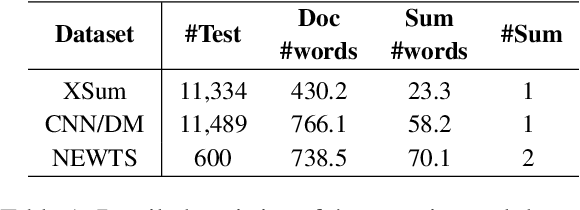
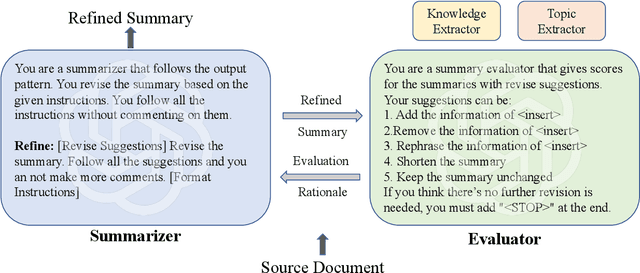
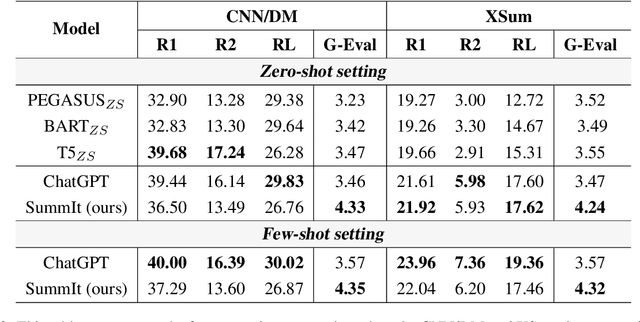
Existing text summarization systems have made significant progress in recent years but typically generates summaries in a single step. The one-shot summarization setting is sometimes inadequate, however, as the generated summary may contain hallucinations or overlook important details related to the reader's interests. In this paper, we address this limitation by proposing SummIt, an iterative text summarization framework based on large language models like ChatGPT. Our framework enables the model to refine the generated summary iteratively through self-evaluation and feedback, closely resembling the iterative process humans undertake when drafting and revising summaries. We also explore using in-context learning to guide the rationale generation and summary refinement. Furthermore, we explore the potential benefits of integrating knowledge and topic extractors into the framework to enhance summary faithfulness and controllability. We evaluate the performance of our framework on three benchmark summarization datasets through empirical and qualitative analyses. We also conduct a human evaluation to validate the effectiveness of the model's refinements and find a potential issue of over-correction. Our code is available at \url{https://github.com/hpzhang94/summ_it}.
DiffuSum: Generation Enhanced Extractive Summarization with Diffusion
May 11, 2023Extractive summarization aims to form a summary by directly extracting sentences from the source document. Existing works mostly formulate it as a sequence labeling problem by making individual sentence label predictions. This paper proposes DiffuSum, a novel paradigm for extractive summarization, by directly generating the desired summary sentence representations with diffusion models and extracting sentences based on sentence representation matching. In addition, DiffuSum jointly optimizes a contrastive sentence encoder with a matching loss for sentence representation alignment and a multi-class contrastive loss for representation diversity. Experimental results show that DiffuSum achieves the new state-of-the-art extractive results on CNN/DailyMail with ROUGE scores of $44.83/22.56/40.56$. Experiments on the other two datasets with different summary lengths also demonstrate the effectiveness of DiffuSum. The strong performance of our framework shows the great potential of adapting generative models for extractive summarization. To encourage more following work in the future, we have released our codes at \url{https://github.com/hpzhang94/DiffuSum}
Graph-ToolFormer: To Empower LLMs with Graph Reasoning Ability via Prompt Augmented by ChatGPT
Apr 24, 2023In this paper, we aim to develop a large language model (LLM) with the reasoning ability on complex graph data. Currently, LLMs have achieved very impressive performance on various natural language learning tasks, extensions of which have also been applied to study the vision tasks with multi-modal data. However, when it comes to the graph learning tasks, existing LLMs present very serious flaws due to their several inherited weaknesses in performing {multi-step logic reasoning}, {precise mathematical calculation} and {perception about the spatial and temporal factors}. To address such challenges, in this paper, we will investigate the principles, methodologies and algorithms to empower existing LLMs with graph reasoning ability, which will have tremendous impacts on the current research of both LLMs and graph learning. Inspired by the latest ChatGPT and Toolformer models, we propose the Graph-ToolFormer (Graph Reasoning oriented Toolformer) framework to teach LLMs themselves with prompts augmented by ChatGPT to use external graph reasoning API tools. Specifically, we will investigate to teach Graph-ToolFormer to handle various graph data reasoning tasks in this paper, including both (1) very basic graph data loading and graph property reasoning tasks, ranging from simple graph order and size to the graph diameter and periphery, and (2) more advanced reasoning tasks on real-world graph data, such as bibliographic networks, protein molecules, sequential recommender systems, social networks and knowledge graphs. To demonstrate the effectiveness of Graph-ToolFormer, we conduct some preliminary experimental studies on various graph reasoning datasets and tasks, and will launch a LLM demo online with various graph reasoning abilities.
Graph Collaborative Signals Denoising and Augmentation for Recommendation
Apr 10, 2023Graph collaborative filtering (GCF) is a popular technique for capturing high-order collaborative signals in recommendation systems. However, GCF's bipartite adjacency matrix, which defines the neighbors being aggregated based on user-item interactions, can be noisy for users/items with abundant interactions and insufficient for users/items with scarce interactions. Additionally, the adjacency matrix ignores user-user and item-item correlations, which can limit the scope of beneficial neighbors being aggregated. In this work, we propose a new graph adjacency matrix that incorporates user-user and item-item correlations, as well as a properly designed user-item interaction matrix that balances the number of interactions across all users. To achieve this, we pre-train a graph-based recommendation method to obtain users/items embeddings, and then enhance the user-item interaction matrix via top-K sampling. We also augment the symmetric user-user and item-item correlation components to the adjacency matrix. Our experiments demonstrate that the enhanced user-item interaction matrix with improved neighbors and lower density leads to significant benefits in graph-based recommendation. Moreover, we show that the inclusion of user-user and item-item correlations can improve recommendations for users with both abundant and insufficient interactions. The code is in \url{https://github.com/zfan20/GraphDA}.
* Short Paper Accepted by SIGIR 2023, 6 pages
Extractive Summarization via ChatGPT for Faithful Summary Generation
Apr 09, 2023Extractive summarization is a crucial task in natural language processing that aims to condense long documents into shorter versions by directly extracting sentences. The recent introduction of ChatGPT has attracted significant interest in the NLP community due to its remarkable performance on a wide range of downstream tasks. However, concerns regarding factuality and faithfulness have hindered its practical applications for summarization systems. This paper first presents a thorough evaluation of ChatGPT's performance on extractive summarization and compares it with traditional fine-tuning methods on various benchmark datasets. Our experimental analysis reveals that ChatGPT's extractive summarization performance is still inferior to existing supervised systems in terms of ROUGE scores. In addition, we explore the effectiveness of in-context learning and chain-of-thought reasoning for enhancing its performance. Furthermore, we find that applying an extract-then-generate pipeline with ChatGPT yields significant performance improvements over abstractive baselines in terms of summary faithfulness. These observations highlight potential directions for enhancing ChatGPT's capabilities for faithful text summarization tasks using two-stage approaches.