 Add to Chrome
 Add to Firefox
 Add to Edge
Beyond Retrieval: Query-Conditioned Reuse of Long-Horizon Agent Trajectories
Aug 13, 2026
Retrieval can identify a past trajectory that may matter, yet it does not specify how an acting agent should use that trajectory after users, entities, constraints, or environment state have changed. We identify this post-retrieval reuse step as a distinct bottleneck for long-horizon trajectory memory and formulate an evaluation framework that holds candidate retrieval, target state, model, decoding, and tool budget fixed while varying the support delivered to the agent. We instantiate the framework with query-conditioned reuse (QCR), a deliberately simple target-bound note that records a reusable procedure, bindings to recover, applicability conditions, and verification requirements. QCR serves to test the reuse hypothesis rather than to claim a universally preferred memory format. Across 2,391 target instances in WebArena, WorkArena, and AppWorld, QCR reaches 62.3% average Success, 10.7 points above Full Trajectory, while using 48.9% fewer online tokens. Summary reranking selects a reusable memory for 94.8% of targets, placing end-task Success within 1.8 points of an oracle reusable selector. Analyses by trajectory length and source--target binding shift show that direct trajectory injection loses much of its utility as traces grow longer or source-specific values change, whereas target-bound support preserves a larger share of the measured gain. The resulting framework separates retrieval quality from the problem of turning retrieved experience into safe, useful support for a new task.

From Patches to Evidence Balls: Class-Conditioned Evidence Retrieval for Few-Shot Whole Slide Image Classification
Aug 02, 2026Whole slide image (WSI) classification is an evidence-driven task, where diagnostic cues are often sparse, spatially organized, and class-dependent. Existing MIL and vision-language methods aggregate a large pool of patch features into a single global slide representation. Under few-shot supervision, limited slide-level labels make it difficult to learn a reliable aggregation mechanism that organizes sparse local cues into compact and coherent diagnostic evidence. Moreover, a shared slide representation compresses evidence supporting a candidate class and its alternatives into the same feature, limiting class-specific reasoning and interpretability. To address these issues, we propose EviBall, a class-conditioned evidence retrieval framework for few-shot WSI classification. EviBall organizes local patches into Evidence Balls through semantic-spatial assignment and center refinement, yielding compact and spatially coherent evidence units under weak supervision. It then uses task-specific class queries, including language-guided queries for morphology-oriented tasks and molecular-guided queries for molecular endpoint prediction, to retrieve supporting evidence balls and produce class-conditioned evidence representations for direct class-wise prediction. By introducing structured evidence units and task-relevant semantic guidance, EviBall reduces the reliance on learning an unconstrained global aggregation mechanism from scarce slide-level labels. It therefore reformulates few-shot WSI classification as structured evidence retrieval and competition among candidate classes. Extensive experiments across four morphology-oriented and molecular endpoint WSI tasks demonstrate that EviBall consistently outperforms conventional and vision-language MIL baselines under diverse few-shot settings, while providing spatially localized and class-specific evidence for each prediction.
PathNavigate: A Training-Free Pathology Agent with Surprise-Guided Scan and Shared Slide Memory for Whole-Slide Image VQA
May 22, 2026Whole-slide image visual question answering (WSI-VQA) frames pathology as an extreme-context search problem: to answer a free-form clinical query, a system must first navigate a gigapixel slide under a strict inspection budget to locate sparse, high-resolution evidence. Existing approaches largely fall into two paradigms: i) supervised pathology multimodal large language models (MLLMs) and agents can absorb localization and reasoning into learned modules, but they often couple navigation to task-specific supervision and retraining, limiting their practicality; ii) training-free pathology agents avoid this cost by keeping core models frozen, but often follow a question-first design, constructing the initial candidate set mainly from query-conditioned relevance. This can miss decisive morphology that is not named in the question, and force heavier inference-time scaffolding. To address this challenge, we introduce PathNavigate, a training-free pathology agent built around a scan-search-readout routine. Before question matching, PathNavigate scans the current slide at low magnification with a shared online memory module over frozen pathology features, producing a slide-specific surprise field that marks an abnormal-region pool. It then applies question-conditioned PLIP relevance only within this pool to select high-magnification search targets. Finally, it extracts local high-magnification evidence and answers with a frozen perceptor-adjudicator stack, using the same online memory as slide-level context. Experiments on WSI-VQA and SlideBench-BCNB show that the proposed scan-search-readout design improves answer accuracy and yields more interpretable evidence-selection trajectories with higher efficiency.The code is available online.
Thinking in Scales: Accelerating Gigapixel Pathology Image Analysis via Adaptive Continuous Reasoning
May 19, 2026Traditional whole slide image (WSI) analysis methods typically rely on the multiple instance learning (MIL) paradigm, which extracts patch-level features at high magnification and aggregates them for slide-level prediction. However, such exhaustive patch-level processing is computationally expensive, severely limiting the efficiency and scalability of WSI analysis. To address this challenge, we propose PathCTM (a Pathology-oriented Continuous Thought Model) that enables token-efficient scale-space continuous reasoning for gigapixel WSIs. PathCTM formulates diagnostic inference as a dynamic sequential information pursuit. It progressively transitions from low-magnification global to high-magnification local inspection, and adaptively terminates inference when sufficient evidence is gathered to effectively bound decision uncertainty. Specifically, it uses conditional computation for dynamic scale switching with attention-guided region pruning, coupled with confidence-aware early stopping. Extensive experiments demonstrate that, compared with standard MIL-based methods, PathCTM reduces the number of required image patches by 95.95% and shortens inference time by approximately 95.62%, while maintaining AUC without degradation. Code is available at https://github.com/JSGe-AI/PathCTM.
NeuroRisk: Physics-Informed Neural Optimization for Risk-Aware Traffic Engineering
May 13, 2026In production Wide-Area Networks (WANs), correlated failures dominate availability losses, forcing operators to reserve large safety margins that leave substantial capacity underutilized. Achieving high utilization under strict availability targets therefore requires risk-aware Traffic Engineering (TE) over dozens to hundreds of probabilistic failure scenarios-yet solving this problem at operational timescales remains elusive. We demonstrate that existing risk-aware formulations can be unified under an embedded Sort-and-Select structure, exposing a fundamental trade-off between expressiveness and tractability: classical optimizers either restrict scenario selection for efficiency or incur prohibitive decomposition costs. While deep learning appears promising, prior Deep TE methods mainly target maximum link utilization and rely on scaling-based feasibility, which fundamentally breaks under explicit capacity constraints and scenario-dependent risk. We present NeuroRisk, a physics-informed deep unrolled optimizer that exploits the structure of Sort-and-Select. NeuroRisk enforces feasibility via gated edge-local reservations and represents scenario sets through permutation-invariant, gradient-aligned cues. Evaluations on production-style WANs show that NeuroRisk achieves small optimality gaps relative to the solver with orders of magnitude speedup $(10^2- 10^5 \times)$ on risk objectives, while outperforming neural baselines on nominal throughput.
Topology-Guided Biomechanical Profiling: A White-Box Framework for Opportunistic Screening of Spinal Instability on Routine CT
Mar 17, 2026Routine oncologic computed tomography (CT) presents an ideal opportunity for screening spinal instability, yet prophylactic stabilization windows are frequently missed due to the complex geometric reasoning required by the Spinal Instability Neoplastic Score (SINS). Automating SINS is fundamentally hindered by metastatic osteolysis, which induces topological ambiguity that confounds standard segmentation and black-box AI. We propose Topology-Guided Biomechanical Profiling (TGBP), an auditable white-box framework decoupling anatomical perception from structural reasoning. TGBP anchors SINS assessment on two deterministic geometric innovations: (i) canal-referenced partitioning to resolve posterolateral boundary ambiguity, and (ii) context-aware morphometric normalization via covariance-based oriented bounding boxes (OBB) to quantify vertebral collapse. Integrated with auxiliary radiomic and large language model (LLM) modules, TGBP provides an end-to-end, interpretable SINS evaluation. Validated on a multi-center, multi-cancer cohort ($N=482$), TGBP achieved 90.2\% accuracy in 3-tier stability triage. In a blinded reader study ($N=30$), TGBP significantly outperformed medical oncologists on complex structural features ($κ=0.857$ vs.\ $0.570$) and prevented compounding errors in Total Score estimation ($κ=0.625$ vs.\ $0.207$), democratizing expert-level opportunistic screening.
CARE: A Molecular-Guided Foundation Model with Adaptive Region Modeling for Whole Slide Image Analysis
Feb 25, 2026Foundation models have recently achieved impressive success in computational pathology, demonstrating strong generalization across diverse histopathology tasks. However, existing models overlook the heterogeneous and non-uniform organization of pathological regions of interest (ROIs) because they rely on natural image backbones not tailored for tissue morphology. Consequently, they often fail to capture the coherent tissue architecture beyond isolated patches, limiting interpretability and clinical relevance. To address these challenges, we present Cross-modal Adaptive Region Encoder (CARE), a foundation model for pathology that automatically partitions WSIs into several morphologically relevant regions. Specifically, CARE employs a two-stage pretraining strategy: (1) a self-supervised unimodal pretraining stage that learns morphological representations from 34,277 whole-slide images (WSIs) without segmentation annotations, and (2) a cross-modal alignment stage that leverages RNA and protein profiles to refine the construction and representation of adaptive regions. This molecular guidance enables CARE to identify biologically relevant patterns and generate irregular yet coherent tissue regions, selecting the most representative area as ROI. CARE supports a broad range of pathology-related tasks, using either the ROI feature or the slide-level feature obtained by aggregating adaptive regions. Based on only one-tenth of the pretraining data typically used by mainstream foundation models, CARE achieves superior average performance across 33 downstream benchmarks, including morphological classification, molecular prediction, and survival analysis, and outperforms other foundation model baselines overall.
The Butterfly Effect in Pathology: Exploring Security in Pathology Foundation Models
May 30, 2025With the widespread adoption of pathology foundation models in both research and clinical decision support systems, exploring their security has become a critical concern. However, despite their growing impact, the vulnerability of these models to adversarial attacks remains largely unexplored. In this work, we present the first systematic investigation into the security of pathology foundation models for whole slide image~(WSI) analysis against adversarial attacks. Specifically, we introduce the principle of \textit{local perturbation with global impact} and propose a label-free attack framework that operates without requiring access to downstream task labels. Under this attack framework, we revise four classical white-box attack methods and redefine the perturbation budget based on the characteristics of WSI. We conduct comprehensive experiments on three representative pathology foundation models across five datasets and six downstream tasks. Despite modifying only 0.1\% of patches per slide with imperceptible noise, our attack leads to downstream accuracy degradation that can reach up to 20\% in the worst cases. Furthermore, we analyze key factors that influence attack success, explore the relationship between patch-level vulnerability and semantic content, and conduct a preliminary investigation into potential defence strategies. These findings lay the groundwork for future research on the adversarial robustness and reliable deployment of pathology foundation models. Our code is publicly available at: https://github.com/Jiashuai-Liu-hmos/Attack-WSI-pathology-foundation-models.
ST-Prompt Guided Histological Hypergraph Learning for Spatial Gene Expression Prediction
Mar 21, 2025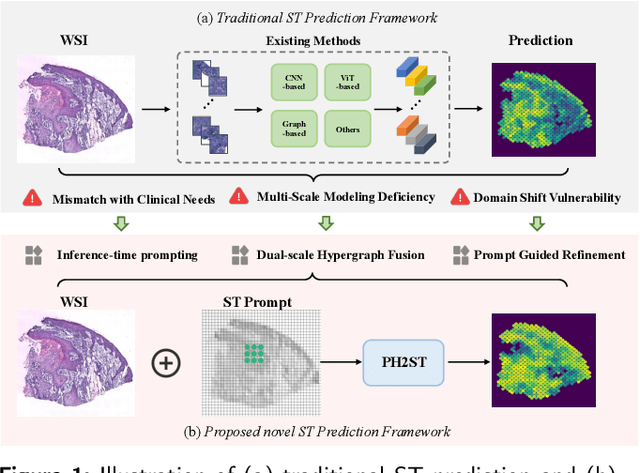
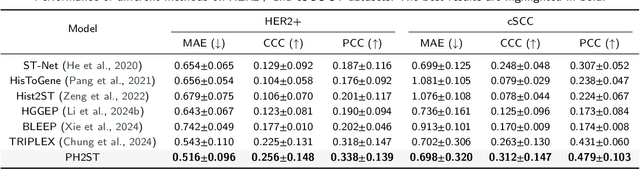
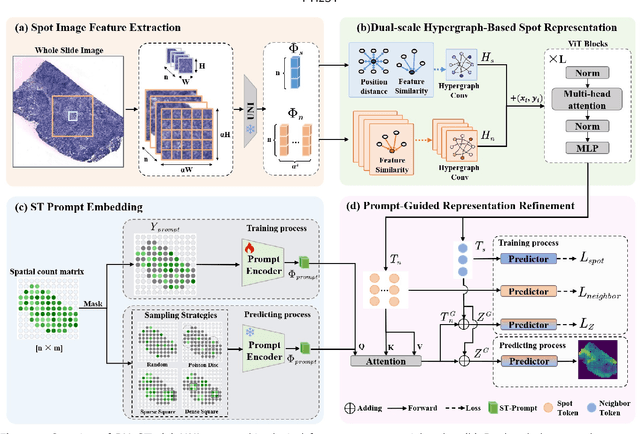
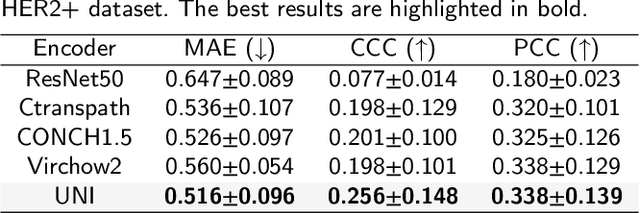
Spatial Transcriptomics (ST) reveals the spatial distribution of gene expression in tissues, offering critical insights into biological processes and disease mechanisms. However, predicting ST from H\&E-stained histology images is challenging due to the heterogeneous relationship between histomorphology and gene expression, which arises from substantial variability across different patients and tissue sections. A more practical and valuable approach is to utilize ST data from a few local regions to predict the spatial transcriptomic landscape across the remaining regions in H&E slides. In response, we propose PHG2ST, an ST-prompt guided histological hypergraph learning framework, which leverages sparse ST signals as prompts to guide histological hypergraph learning for global spatial gene expression prediction. Our framework fuses histological hypergraph representations at multiple scales through a masked ST-prompt encoding mechanism, improving robustness and generalizability. Benchmark evaluations on two public ST datasets demonstrate that PHG2ST outperforms the existing state-of-the-art methods and closely aligns with the ground truth. These results underscore the potential of leveraging sparse local ST data for scalable and cost-effective spatial gene expression mapping in real-world biomedical applications.
Step-Video-TI2V Technical Report: A State-of-the-Art Text-Driven Image-to-Video Generation Model
Mar 14, 2025We present Step-Video-TI2V, a state-of-the-art text-driven image-to-video generation model with 30B parameters, capable of generating videos up to 102 frames based on both text and image inputs. We build Step-Video-TI2V-Eval as a new benchmark for the text-driven image-to-video task and compare Step-Video-TI2V with open-source and commercial TI2V engines using this dataset. Experimental results demonstrate the state-of-the-art performance of Step-Video-TI2V in the image-to-video generation task. Both Step-Video-TI2V and Step-Video-TI2V-Eval are available at https://github.com/stepfun-ai/Step-Video-TI2V.