 Add to Chrome
 Add to Firefox
 Add to Edge
From Patches to Evidence Balls: Class-Conditioned Evidence Retrieval for Few-Shot Whole Slide Image Classification
Aug 02, 2026
Whole slide image (WSI) classification is an evidence-driven task, where diagnostic cues are often sparse, spatially organized, and class-dependent. Existing MIL and vision-language methods aggregate a large pool of patch features into a single global slide representation. Under few-shot supervision, limited slide-level labels make it difficult to learn a reliable aggregation mechanism that organizes sparse local cues into compact and coherent diagnostic evidence. Moreover, a shared slide representation compresses evidence supporting a candidate class and its alternatives into the same feature, limiting class-specific reasoning and interpretability. To address these issues, we propose EviBall, a class-conditioned evidence retrieval framework for few-shot WSI classification. EviBall organizes local patches into Evidence Balls through semantic-spatial assignment and center refinement, yielding compact and spatially coherent evidence units under weak supervision. It then uses task-specific class queries, including language-guided queries for morphology-oriented tasks and molecular-guided queries for molecular endpoint prediction, to retrieve supporting evidence balls and produce class-conditioned evidence representations for direct class-wise prediction. By introducing structured evidence units and task-relevant semantic guidance, EviBall reduces the reliance on learning an unconstrained global aggregation mechanism from scarce slide-level labels. It therefore reformulates few-shot WSI classification as structured evidence retrieval and competition among candidate classes. Extensive experiments across four morphology-oriented and molecular endpoint WSI tasks demonstrate that EviBall consistently outperforms conventional and vision-language MIL baselines under diverse few-shot settings, while providing spatially localized and class-specific evidence for each prediction.

PathNavigate: A Training-Free Pathology Agent with Surprise-Guided Scan and Shared Slide Memory for Whole-Slide Image VQA
May 22, 2026Whole-slide image visual question answering (WSI-VQA) frames pathology as an extreme-context search problem: to answer a free-form clinical query, a system must first navigate a gigapixel slide under a strict inspection budget to locate sparse, high-resolution evidence. Existing approaches largely fall into two paradigms: i) supervised pathology multimodal large language models (MLLMs) and agents can absorb localization and reasoning into learned modules, but they often couple navigation to task-specific supervision and retraining, limiting their practicality; ii) training-free pathology agents avoid this cost by keeping core models frozen, but often follow a question-first design, constructing the initial candidate set mainly from query-conditioned relevance. This can miss decisive morphology that is not named in the question, and force heavier inference-time scaffolding. To address this challenge, we introduce PathNavigate, a training-free pathology agent built around a scan-search-readout routine. Before question matching, PathNavigate scans the current slide at low magnification with a shared online memory module over frozen pathology features, producing a slide-specific surprise field that marks an abnormal-region pool. It then applies question-conditioned PLIP relevance only within this pool to select high-magnification search targets. Finally, it extracts local high-magnification evidence and answers with a frozen perceptor-adjudicator stack, using the same online memory as slide-level context. Experiments on WSI-VQA and SlideBench-BCNB show that the proposed scan-search-readout design improves answer accuracy and yields more interpretable evidence-selection trajectories with higher efficiency.The code is available online.
Thinking in Scales: Accelerating Gigapixel Pathology Image Analysis via Adaptive Continuous Reasoning
May 19, 2026Traditional whole slide image (WSI) analysis methods typically rely on the multiple instance learning (MIL) paradigm, which extracts patch-level features at high magnification and aggregates them for slide-level prediction. However, such exhaustive patch-level processing is computationally expensive, severely limiting the efficiency and scalability of WSI analysis. To address this challenge, we propose PathCTM (a Pathology-oriented Continuous Thought Model) that enables token-efficient scale-space continuous reasoning for gigapixel WSIs. PathCTM formulates diagnostic inference as a dynamic sequential information pursuit. It progressively transitions from low-magnification global to high-magnification local inspection, and adaptively terminates inference when sufficient evidence is gathered to effectively bound decision uncertainty. Specifically, it uses conditional computation for dynamic scale switching with attention-guided region pruning, coupled with confidence-aware early stopping. Extensive experiments demonstrate that, compared with standard MIL-based methods, PathCTM reduces the number of required image patches by 95.95% and shortens inference time by approximately 95.62%, while maintaining AUC without degradation. Code is available at https://github.com/JSGe-AI/PathCTM.
HAAF: Hierarchical Adaptation and Alignment of Foundation Models for Few-Shot Pathology Anomaly Detection
Jan 24, 2026Precision pathology relies on detecting fine-grained morphological abnormalities within specific Regions of Interest (ROIs), as these local, texture-rich cues - rather than global slide contexts - drive expert diagnostic reasoning. While Vision-Language (V-L) models promise data efficiency by leveraging semantic priors, adapting them faces a critical Granularity Mismatch, where generic representations fail to resolve such subtle defects. Current adaptation methods often treat modalities as independent streams, failing to ground semantic prompts in ROI-specific visual contexts. To bridge this gap, we propose the Hierarchical Adaptation and Alignment Framework (HAAF). At its core is a novel Cross-Level Scaled Alignment (CLSA) mechanism that enforces a sequential calibration order: visual features first inject context into text prompts to generate content-adaptive descriptors, which then spatially guide the visual encoder to spotlight anomalies. Additionally, a dual-branch inference strategy integrates semantic scores with geometric prototypes to ensure stability in few-shot settings. Experiments on four benchmarks show HAAF significantly outperforms state-of-the-art methods and effectively scales with domain-specific backbones (e.g., CONCH) in low-resource scenarios.
LitSim: Conflict-aware Policy for Long-term Interactive Traffic Simulation
Mar 07, 2024
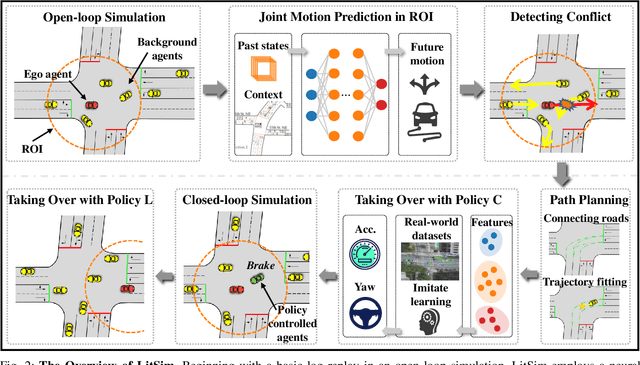


Simulation is pivotal in evaluating the performance of autonomous driving systems due to the advantages in efficiency and cost compared to on-road testing. Realistic multi-agent behavior~(e.g., interactive and long-term) is needed to narrow the gap between the simulation and the reality. The existing work has the following shortcomings in achieving this goal:~(1) log replay offers realistic scenarios but leads to unrealistic collisions due to lacking dynamic interactions, and~(2) model-based and learning-based solutions encourage interactions but often deviate from real-world data in long horizons. In this work, we propose LitSim, a long-term interactive simulation approach that maximizes realism while avoiding unrealistic collisions. Specifically, we replay the log for most scenarios and intervene only when LitSim predicts unrealistic conflicts. We then encourage interactions among the agents and resolve the conflicts, thereby reducing the likelihood of unrealistic collisions. We train and validate our model on the real-world dataset NGSIM, and the experimental results demonstrate that LitSim outperforms the current popular approaches in realism and reactivity.