 Add to Chrome
 Add to Firefox
 Add to Edge
Topology-Guided Biomechanical Profiling: A White-Box Framework for Opportunistic Screening of Spinal Instability on Routine CT
Mar 17, 2026
Routine oncologic computed tomography (CT) presents an ideal opportunity for screening spinal instability, yet prophylactic stabilization windows are frequently missed due to the complex geometric reasoning required by the Spinal Instability Neoplastic Score (SINS). Automating SINS is fundamentally hindered by metastatic osteolysis, which induces topological ambiguity that confounds standard segmentation and black-box AI. We propose Topology-Guided Biomechanical Profiling (TGBP), an auditable white-box framework decoupling anatomical perception from structural reasoning. TGBP anchors SINS assessment on two deterministic geometric innovations: (i) canal-referenced partitioning to resolve posterolateral boundary ambiguity, and (ii) context-aware morphometric normalization via covariance-based oriented bounding boxes (OBB) to quantify vertebral collapse. Integrated with auxiliary radiomic and large language model (LLM) modules, TGBP provides an end-to-end, interpretable SINS evaluation. Validated on a multi-center, multi-cancer cohort ($N=482$), TGBP achieved 90.2\% accuracy in 3-tier stability triage. In a blinded reader study ($N=30$), TGBP significantly outperformed medical oncologists on complex structural features ($κ=0.857$ vs.\ $0.570$) and prevented compounding errors in Total Score estimation ($κ=0.625$ vs.\ $0.207$), democratizing expert-level opportunistic screening.

Unveiling and Bridging the Functional Perception Gap in MLLMs: Atomic Visual Alignment and Hierarchical Evaluation via PET-Bench
Jan 06, 2026While Multimodal Large Language Models (MLLMs) have demonstrated remarkable proficiency in tasks such as abnormality detection and report generation for anatomical modalities, their capability in functional imaging remains largely unexplored. In this work, we identify and quantify a fundamental functional perception gap: the inability of current vision encoders to decode functional tracer biodistribution independent of morphological priors. Identifying Positron Emission Tomography (PET) as the quintessential modality to investigate this disconnect, we introduce PET-Bench, the first large-scale functional imaging benchmark comprising 52,308 hierarchical QA pairs from 9,732 multi-site, multi-tracer PET studies. Extensive evaluation of 19 state-of-the-art MLLMs reveals a critical safety hazard termed the Chain-of-Thought (CoT) hallucination trap. We observe that standard CoT prompting, widely considered to enhance reasoning, paradoxically decouples linguistic generation from visual evidence in PET, producing clinically fluent but factually ungrounded diagnoses. To resolve this, we propose Atomic Visual Alignment (AVA), a simple fine-tuning strategy that enforces the mastery of low-level functional perception prior to high-level diagnostic reasoning. Our results demonstrate that AVA effectively bridges the perception gap, transforming CoT from a source of hallucination into a robust inference tool and improving diagnostic accuracy by up to 14.83%. Code and data are available at https://github.com/yezanting/PET-Bench.
Semi-KAN: KAN Provides an Effective Representation for Semi-Supervised Learning in Medical Image Segmentation
Mar 19, 2025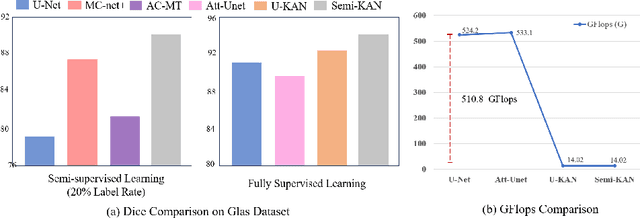
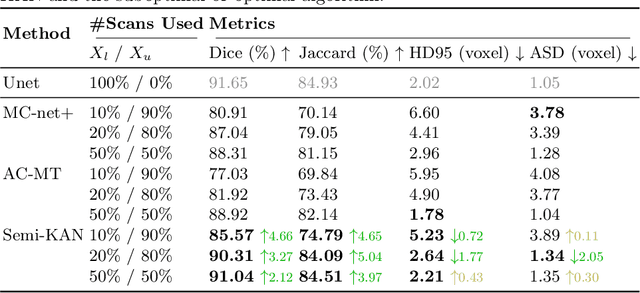
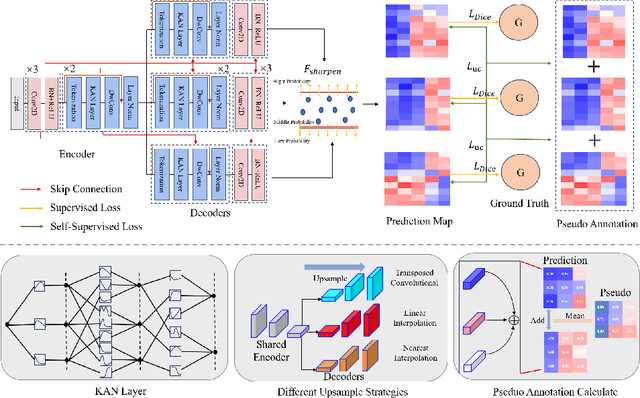
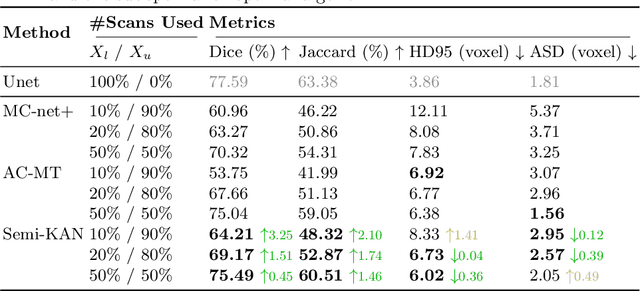
Deep learning-based medical image segmentation has shown remarkable success; however, it typically requires extensive pixel-level annotations, which are both expensive and time-intensive. Semi-supervised medical image segmentation (SSMIS) offers a viable alternative, driven by advancements in CNNs and ViTs. However, these networks often rely on single fixed activation functions and linear modeling patterns, limiting their ability to effectively learn robust representations. Given the limited availability of labeled date, achieving robust representation learning becomes crucial. Inspired by Kolmogorov-Arnold Networks (KANs), we propose Semi-KAN, which leverages the untapped potential of KANs to enhance backbone architectures for representation learning in SSMIS. Our findings indicate that: (1) compared to networks with fixed activation functions, KANs exhibit superior representation learning capabilities with fewer parameters, and (2) KANs excel in high-semantic feature spaces. Building on these insights, we integrate KANs into tokenized intermediate representations, applying them selectively at the encoder's bottleneck and the decoder's top layers within a U-Net pipeline to extract high-level semantic features. Although learnable activation functions improve feature expansion, they introduce significant computational overhead with only marginal performance gains. To mitigate this, we reduce the feature dimensions and employ horizontal scaling to capture multiple pattern representations. Furthermore, we design a multi-branch U-Net architecture with uncertainty estimation to effectively learn diverse pattern representations. Extensive experiments on four public datasets demonstrate that Semi-KAN surpasses baseline networks, utilizing fewer KAN layers and lower computational cost, thereby underscoring the potential of KANs as a promising approach for SSMIS.
Self is the Best Learner: CT-free Ultra-Low-Dose PET Organ Segmentation via Collaborating Denoising and Segmentation Learning
Mar 05, 2025Organ segmentation in Positron Emission Tomography (PET) plays a vital role in cancer quantification. Low-dose PET (LDPET) provides a safer alternative by reducing radiation exposure. However, the inherent noise and blurred boundaries make organ segmentation more challenging. Additionally, existing PET organ segmentation methods rely on co-registered Computed Tomography (CT) annotations, overlooking the problem of modality mismatch. In this study, we propose LDOS, a novel CT-free ultra-LDPET organ segmentation pipeline. Inspired by Masked Autoencoders (MAE), we reinterpret LDPET as a naturally masked version of Full-Dose PET (FDPET). LDOS adopts a simple yet effective architecture: a shared encoder extracts generalized features, while task-specific decoders independently refine outputs for denoising and segmentation. By integrating CT-derived organ annotations into the denoising process, LDOS improves anatomical boundary recognition and alleviates the PET/CT misalignments. Experiments demonstrate that LDOS achieves state-of-the-art performance with mean Dice scores of 73.11% (18F-FDG) and 73.97% (68Ga-FAPI) across 18 organs in 5% dose PET. Our code is publicly available.