 Add to Chrome
 Add to Firefox
 Add to Edge
Plasticine: A Traceable Diffusion Model for Medical Image Translation
Dec 20, 2025
Domain gaps arising from variations in imaging devices and population distributions pose significant challenges for machine learning in medical image analysis. Existing image-to-image translation methods primarily aim to learn mappings between domains, often generating diverse synthetic data with variations in anatomical scale and shape, but they usually overlook spatial correspondence during the translation process. For clinical applications, traceability, defined as the ability to provide pixel-level correspondences between original and translated images, is equally important. This property enhances clinical interpretability but has been largely overlooked in previous approaches. To address this gap, we propose Plasticine, which is, to the best of our knowledge, the first end-to-end image-to-image translation framework explicitly designed with traceability as a core objective. Our method combines intensity translation and spatial transformation within a denoising diffusion framework. This design enables the generation of synthetic images with interpretable intensity transitions and spatially coherent deformations, supporting pixel-wise traceability throughout the translation process.

A Lightweight Transfer Learning-Based State-of-Health Monitoring with Application to Lithium-ion Batteries in Autonomous Air Vehicles
Dec 14, 2025Accurate and rapid state-of-health (SOH) monitoring plays an important role in indicating energy information for lithium-ion battery-powered portable mobile devices. To confront their variable working conditions, transfer learning (TL) emerges as a promising technique for leveraging knowledge from data-rich source working conditions, significantly reducing the training data required for SOH monitoring from target working conditions. However, traditional TL-based SOH monitoring is infeasible when applied in portable mobile devices since substantial computational resources are consumed during the TL stage and unexpectedly reduce the working endurance. To address these challenges, this paper proposes a lightweight TL-based SOH monitoring approach with constructive incremental transfer learning (CITL). First, taking advantage of the unlabeled data in the target domain, a semi-supervised TL mechanism is proposed to minimize the monitoring residual in a constructive way, through iteratively adding network nodes in the CITL. Second, the cross-domain learning ability of node parameters for CITL is comprehensively guaranteed through structural risk minimization, transfer mismatching minimization, and manifold consistency maximization. Moreover, the convergence analysis of the CITL is given, theoretically guaranteeing the efficacy of TL performance and network compactness. Finally, the proposed approach is verified through extensive experiments with a realistic autonomous air vehicles (AAV) battery dataset collected from dozens of flight missions. Specifically, the CITL outperforms SS-TCA, MMD-LSTM-DA, DDAN, BO-CNN-TL, and AS$^3$LSTM, in SOH estimation by 83.73%, 61.15%, 28.24%, 87.70%, and 57.34%, respectively, as evaluated using the index root mean square error.
Instella: Fully Open Language Models with Stellar Performance
Nov 14, 2025Large language models (LLMs) have demonstrated remarkable performance across a wide range of tasks, yet the majority of high-performing models remain closed-source or partially open, limiting transparency and reproducibility. In this work, we introduce Instella, a family of fully open three billion parameter language models trained entirely on openly available data and codebase. Powered by AMD Instinct MI300X GPUs, Instella is developed through large-scale pre-training, general-purpose instruction tuning, and alignment with human preferences. Despite using substantially fewer pre-training tokens than many contemporaries, Instella achieves state-of-the-art results among fully open models and is competitive with leading open-weight models of comparable size. We further release two specialized variants: Instella-Long, capable of handling context lengths up to 128K tokens, and Instella-Math, a reasoning-focused model enhanced through supervised fine-tuning and reinforcement learning on mathematical tasks. Together, these contributions establish Instella as a transparent, performant, and versatile alternative for the community, advancing the goal of open and reproducible language modeling research.
Learning from Online Videos at Inference Time for Computer-Use Agents
Nov 06, 2025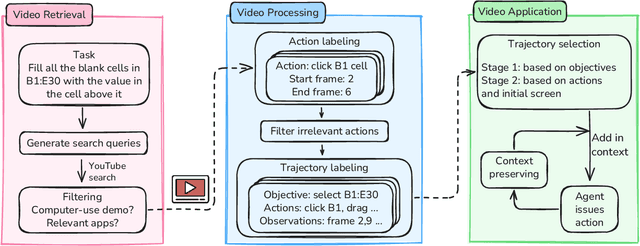
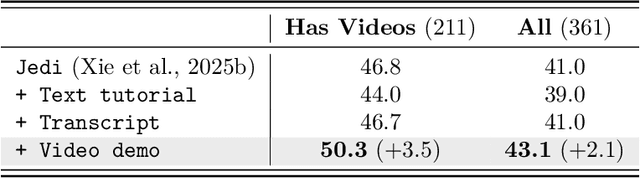

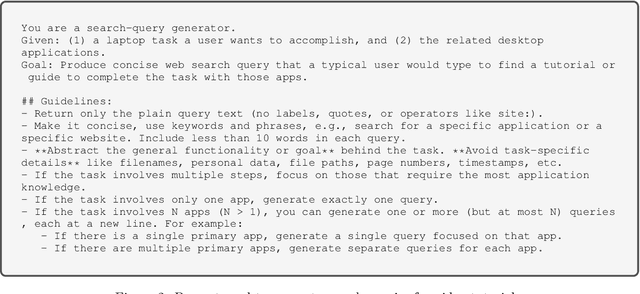
Computer-use agents can operate computers and automate laborious tasks, but despite recent rapid progress, they still lag behind human users, especially when tasks require domain-specific procedural knowledge about particular applications, platforms, and multi-step workflows. Humans can bridge this gap by watching video tutorials: we search, skim, and selectively imitate short segments that match our current subgoal. In this paper, we study how to enable computer-use agents to learn from online videos at inference time effectively. We propose a framework that retrieves and filters tutorial videos, converts them into structured demonstration trajectories, and dynamically selects trajectories as in-context guidance during execution. Particularly, using a VLM, we infer UI actions, segment videos into short subsequences of actions, and assign each subsequence a textual objective. At inference time, a two-stage selection mechanism dynamically chooses a single trajectory to add in context at each step, focusing the agent on the most helpful local guidance for its next decision. Experiments on two widely used benchmarks show that our framework consistently outperforms strong base agents and variants that use only textual tutorials or transcripts. Analyses highlight the importance of trajectory segmentation and selection, action filtering, and visual information, suggesting that abundant online videos can be systematically distilled into actionable guidance that improves computer-use agents at inference time. Our code is available at https://github.com/UCSB-NLP-Chang/video_demo.
Adaptive Confidence-Wise Loss for Improved Lens Structure Segmentation in AS-OCT
Aug 12, 2025Precise lens structure segmentation is essential for the design of intraocular lenses (IOLs) in cataract surgery. Existing deep segmentation networks typically weight all pixels equally under cross-entropy (CE) loss, overlooking the fact that sub-regions of lens structures are inhomogeneous (e.g., some regions perform better than others) and that boundary regions often suffer from poor segmentation calibration at the pixel level. Clinically, experts annotate different sub-regions of lens structures with varying confidence levels, considering factors such as sub-region proportions, ambiguous boundaries, and lens structure shapes. Motivated by this observation, we propose an Adaptive Confidence-Wise (ACW) loss to group each lens structure sub-region into different confidence sub-regions via a confidence threshold from the unique region aspect, aiming to exploit the potential of expert annotation confidence prior. Specifically, ACW clusters each target region into low-confidence and high-confidence groups and then applies a region-weighted loss to reweigh each confidence group. Moreover, we design an adaptive confidence threshold optimization algorithm to adjust the confidence threshold of ACW dynamically. Additionally, to better quantify the miscalibration errors in boundary region segmentation, we propose a new metric, termed Boundary Expected Calibration Error (BECE). Extensive experiments on a clinical lens structure AS-OCT dataset and other multi-structure datasets demonstrate that our ACW significantly outperforms competitive segmentation loss methods across different deep segmentation networks (e.g., MedSAM). Notably, our method surpasses CE with 6.13% IoU gain, 4.33% DSC increase, and 4.79% BECE reduction in lens structure segmentation under U-Net. The code of this paper is available at https://github.com/XiaoLing12138/Adaptive-Confidence-Wise-Loss.
PAE MobiLLM: Privacy-Aware and Efficient LLM Fine-Tuning on the Mobile Device via Additive Side-Tuning
Jul 01, 2025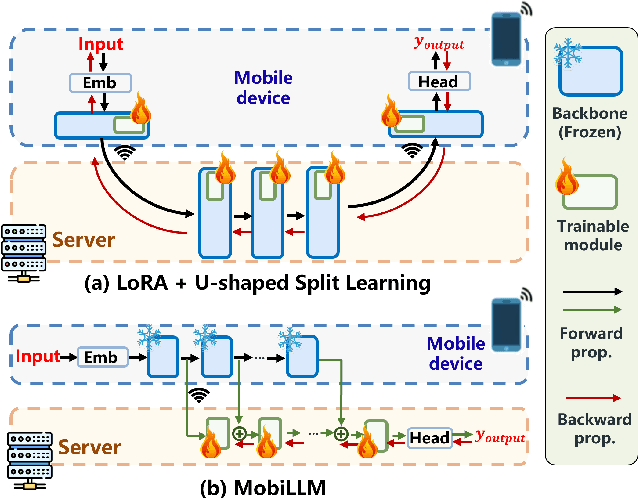
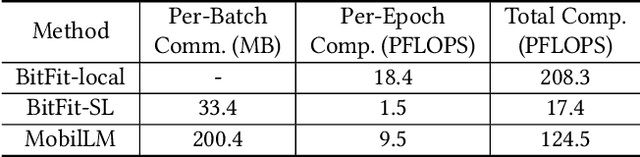
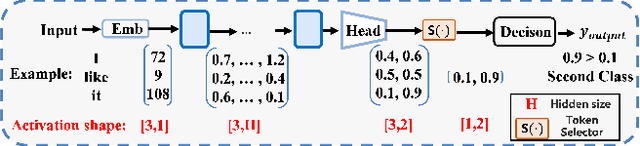
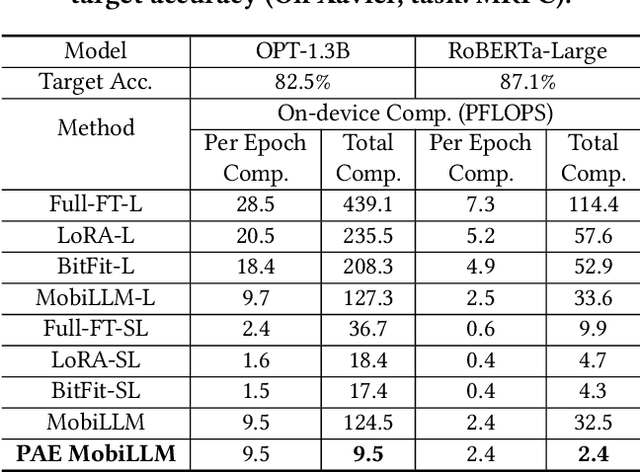
There is a huge gap between numerous intriguing applications fostered by on-device large language model (LLM) fine-tuning (FT) from fresh mobile data and the limited resources of a mobile device. While existing server-assisted methods (e.g., split learning or side-tuning) may enable LLM FT on the local mobile device, they suffer from heavy communication burdens of activation transmissions, and may disclose data, labels or fine-tuned models to the server. To address those issues, we develop PAE MobiLLM, a privacy-aware and efficient LLM FT method which can be deployed on the mobile device via server-assisted additive side-tuning. To further accelerate FT convergence and improve computing efficiency, PAE MobiLLM integrates activation caching on the server side, which allows the server to reuse historical activations and saves the mobile device from repeatedly computing forward passes for the recurring data samples. Besides, to reduce communication cost, PAE MobiLLM develops a one-token (i.e., ``pivot'' token) activation shortcut that transmits only a single activation dimension instead of full activation matrices to guide the side network tuning. Last but not least, PAE MobiLLM introduces the additive adapter side-network design which makes the server train the adapter modules based on device-defined prediction differences rather than raw ground-truth labels. In this way, the server can only assist device-defined side-network computing, and learn nothing about data, labels or fine-tuned models.
Instella-T2I: Pushing the Limits of 1D Discrete Latent Space Image Generation
Jun 26, 2025Image tokenization plays a critical role in reducing the computational demands of modeling high-resolution images, significantly improving the efficiency of image and multimodal understanding and generation. Recent advances in 1D latent spaces have reduced the number of tokens required by eliminating the need for a 2D grid structure. In this paper, we further advance compact discrete image representation by introducing 1D binary image latents. By representing each image as a sequence of binary vectors, rather than using traditional one-hot codebook tokens, our approach preserves high-resolution details while maintaining the compactness of 1D latents. To the best of our knowledge, our text-to-image models are the first to achieve competitive performance in both diffusion and auto-regressive generation using just 128 discrete tokens for images up to 1024x1024, demonstrating up to a 32-fold reduction in token numbers compared to standard VQ-VAEs. The proposed 1D binary latent space, coupled with simple model architectures, achieves marked improvements in speed training and inference speed. Our text-to-image models allow for a global batch size of 4096 on a single GPU node with 8 AMD MI300X GPUs, and the training can be completed within 200 GPU days. Our models achieve competitive performance compared to modern image generation models without any in-house private training data or post-training refinements, offering a scalable and efficient alternative to conventional tokenization methods.
TTT-Bench: A Benchmark for Evaluating Reasoning Ability with Simple and Novel Tic-Tac-Toe-style Games
Jun 11, 2025Large reasoning models (LRMs) have demonstrated impressive reasoning capabilities across a broad range of tasks including Olympiad-level mathematical problems, indicating evidence of their complex reasoning abilities. While many reasoning benchmarks focus on the STEM domain, the ability of LRMs to reason correctly in broader task domains remains underexplored. In this work, we introduce \textbf{TTT-Bench}, a new benchmark that is designed to evaluate basic strategic, spatial, and logical reasoning abilities in LRMs through a suite of four two-player Tic-Tac-Toe-style games that humans can effortlessly solve from a young age. We propose a simple yet scalable programmatic approach for generating verifiable two-player game problems for TTT-Bench. Although these games are trivial for humans, they require reasoning about the intentions of the opponent, as well as the game board's spatial configurations, to ensure a win. We evaluate a diverse set of state-of-the-art LRMs, and \textbf{discover that the models that excel at hard math problems frequently fail at these simple reasoning games}. Further testing reveals that our evaluated reasoning models score on average $\downarrow$ 41\% \& $\downarrow$ 5\% lower on TTT-Bench compared to MATH 500 \& AIME 2024 respectively, with larger models achieving higher performance using shorter reasoning traces, where most of the models struggle on long-term strategic reasoning situations on simple and new TTT-Bench tasks.
Unleashing Hour-Scale Video Training for Long Video-Language Understanding
Jun 05, 2025Recent long-form video-language understanding benchmarks have driven progress in video large multimodal models (Video-LMMs). However, the scarcity of well-annotated long videos has left the training of hour-long Video-LLMs underexplored. To close this gap, we present VideoMarathon, a large-scale hour-long video instruction-following dataset. This dataset includes around 9,700 hours of long videos sourced from diverse domains, ranging from 3 to 60 minutes per video. Specifically, it contains 3.3M high-quality QA pairs, spanning six fundamental topics: temporality, spatiality, object, action, scene, and event. Compared to existing video instruction datasets, VideoMarathon significantly extends training video durations up to 1 hour, and supports 22 diverse tasks requiring both short- and long-term video comprehension. Building on VideoMarathon, we propose Hour-LLaVA, a powerful and efficient Video-LMM for hour-scale video-language modeling. It enables hour-long video training and inference at 1-FPS sampling by leveraging a memory augmentation module, which adaptively integrates user question-relevant and spatiotemporal-informative semantics from a cached full video context. In our experiments, Hour-LLaVA achieves the best performance on multiple long video-language benchmarks, demonstrating the high quality of the VideoMarathon dataset and the superiority of the Hour-LLaVA model.
S3CE-Net: Spike-guided Spatiotemporal Semantic Coupling and Expansion Network for Long Sequence Event Re-Identification
May 30, 2025In this paper, we leverage the advantages of event cameras to resist harsh lighting conditions, reduce background interference, achieve high time resolution, and protect facial information to study the long-sequence event-based person re-identification (Re-ID) task. To this end, we propose a simple and efficient long-sequence event Re-ID model, namely the Spike-guided Spatiotemporal Semantic Coupling and Expansion Network (S3CE-Net). To better handle asynchronous event data, we build S3CE-Net based on spiking neural networks (SNNs). The S3CE-Net incorporates the Spike-guided Spatial-temporal Attention Mechanism (SSAM) and the Spatiotemporal Feature Sampling Strategy (STFS). The SSAM is designed to carry out semantic interaction and association in both spatial and temporal dimensions, leveraging the capabilities of SNNs. The STFS involves sampling spatial feature subsequences and temporal feature subsequences from the spatiotemporal dimensions, driving the Re-ID model to perceive broader and more robust effective semantics. Notably, the STFS introduces no additional parameters and is only utilized during the training stage. Therefore, S3CE-Net is a low-parameter and high-efficiency model for long-sequence event-based person Re-ID. Extensive experiments have verified that our S3CE-Net achieves outstanding performance on many mainstream long-sequence event-based person Re-ID datasets. Code is available at:https://github.com/Mhsunshine/SC3E_Net.