 Add to Chrome
 Add to Firefox
 Add to Edge
Elevator-LIO: Robust LiDAR-Inertial Odometry for Multi-Floor Navigation under Elevator-Induced Non-Inertial Motion
May 23, 2026
This paper presents Elevator-LIO, a LiDAR-inertial odometry framework designed to achieve continuous robot localization during elevator travel, thereby supporting cross-floor robotic tasks. To address the state-estimation problem in non-inertial frames, Elevator-LIO establishes a decoupled state-estimation model that separately models the robot motion relative to the elevator and the elevator motion itself, and embeds it into a mode-dependent iterated error-state Kalman filter framework. This framework degenerates to conventional LIO estimation in ordinary indoor environments, while enabling the propagation and constrained update of elevator-related states in elevator non-inertial environments, thereby achieving continuous and stable localization. An elevator mode manager detects elevator entry and exit events using LiDAR ranging statistics and estimated states, and introduces event-triggered zero-velocity and zero-acceleration updates when the elevator stops to suppress accumulated vertical drift. In addition, this paper adopts an adaptive voxel downsampling strategy to maintain a stable number of effective points under significant environmental scale changes. We conduct extensive experiments on 20 real-world sequences containing 79 elevator rides, including practical challenges such as large-scale spaces, long vertical travel, dynamic pedestrian interference, and mirror reflections. The results show that Elevator-LIO maintains continuous localization accuracy in all sequences, with terminal height error below 1 cm in 17 sequences. In contrast, existing representative localization systems perform poorly on these elevator sequences. Tests on the Hilti 2022/2023 datasets further show that the proposed method remains competitive in standard indoor scenarios. The project page is available at https://xiaofan4122.github.io/Elevator_LIO_Page/.

TravExplorer: Cross-Floor Embodied Exploration via Traversability-Aware 3-D Planning
May 19, 2026Zero-shot Object Navigation (ZSON) has shown promise for open-vocabulary target search in unseen environments, yet most existing systems remain tied to planar representations and single-floor assumptions. These assumptions become inadequate in real buildings, where navigation involves floors, stairs, landings, and vertically overlapping spaces. This article presents TravExplorer, a cross-floor embodied exploration framework that couples zero-shot semantic guidance with traversability-aware 3-D planning. TravExplorer maintains a unified volumetric map that distinguishes occupied structures from robot-reachable support surfaces and extracts traversable frontiers from connected support surfaces, including floors, stairs, and landings. A FOV-aware active perception strategy further resolves incomplete observations during cross-floor traversal. To reduce semantic-reasoning latency, a lightweight guidance module aligns a probabilistic instance map from online open-vocabulary segmentation with a spatial value map from fast image-to-text matching. Based on these geometric and semantic memories, a hierarchical planner performs target-aware frontier touring over object hypotheses, traversable frontiers, and stair landmarks, and generates executable cross-floor motions through foothold-guided 3-D search and vertically constrained local trajectory optimization. Experiments over 4,195 simulated episodes on HM3D and MP3D demonstrate consistent advantages over representative ObjectNav baselines. Fifty real-world trials on a Unitree Go2 further validate open-vocabulary target search across single-floor and cross-floor indoor environments without prior maps or human intervention. The code will be released at https://github.com/wuyi2121/TravExplorer.
Edge Intelligence Optimization for Large Language Model Inference with Batching and Quantization
May 12, 2024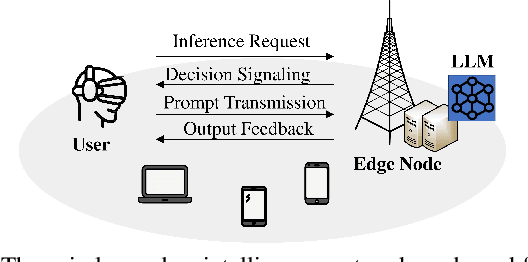
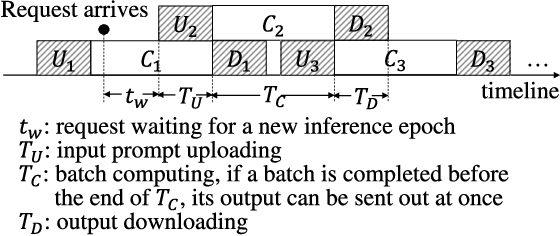
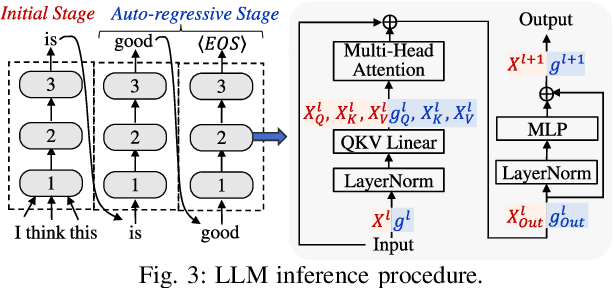
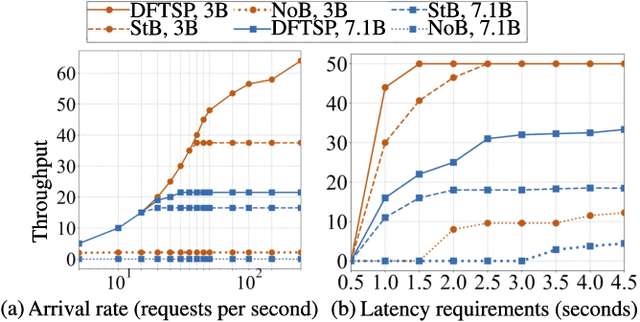
Generative Artificial Intelligence (GAI) is taking the world by storm with its unparalleled content creation ability. Large Language Models (LLMs) are at the forefront of this movement. However, the significant resource demands of LLMs often require cloud hosting, which raises issues regarding privacy, latency, and usage limitations. Although edge intelligence has long been utilized to solve these challenges by enabling real-time AI computation on ubiquitous edge resources close to data sources, most research has focused on traditional AI models and has left a gap in addressing the unique characteristics of LLM inference, such as considerable model size, auto-regressive processes, and self-attention mechanisms. In this paper, we present an edge intelligence optimization problem tailored for LLM inference. Specifically, with the deployment of the batching technique and model quantization on resource-limited edge devices, we formulate an inference model for transformer decoder-based LLMs. Furthermore, our approach aims to maximize the inference throughput via batch scheduling and joint allocation of communication and computation resources, while also considering edge resource constraints and varying user requirements of latency and accuracy. To address this NP-hard problem, we develop an optimal Depth-First Tree-Searching algorithm with online tree-Pruning (DFTSP) that operates within a feasible time complexity. Simulation results indicate that DFTSP surpasses other batching benchmarks in throughput across diverse user settings and quantization techniques, and it reduces time complexity by over 45% compared to the brute-force searching method.