 Add to Chrome
 Add to Firefox
 Add to Edge
VEGAS: Human-Aligned Video Caption Evaluation via Gaze
Jul 09, 2026
Vision-language models excel at video captioning, yet typically generate descriptions that fail to capture individual viewers' attention. We propose VEGAS (Video caption Evaluation via GAze Score), a training-free metric that leverages test-time gaze to sample personalized, attention-aligned text. It is a cross-modal, information-theoretic metric that quantifies how well a candidate caption matches a viewer's focus. To evaluate VEGAS, we curate a dataset of egocentric activities and instructional slides paired with synchronized gaze and reference annotations. We then select captions based on VEGAS via rejection sampling without model retraining. Experiments show that VEGAS-selected captions align significantly better with human focus and improve downstream caption-to-video retrieval, demonstrating the practical utility of incorporating viewer attention during inference.

Stabilizing Efficient Reasoning with Step-Level Advantage Selection
Apr 27, 2026Large language models (LLMs) achieve strong reasoning performance by allocating substantial computation at inference time, often generating long and verbose reasoning traces. While recent work on efficient reasoning reduces this overhead through length-based rewards or pruning, many approaches are post-trained under a much shorter context window than base-model training, a factor whose effect has not been systematically isolated. We first show that short-context post-training alone, using standard GRPO without any length-aware objective, already induces substantial reasoning compression-but at the cost of increasingly unstable training dynamics and accuracy degradation. To address this, we propose Step-level Advantage Selection (SAS), which operates at the reasoning-step level and assigns a zero advantage to low-confidence steps in correct rollouts and to high-confidence steps in verifier-failed rollouts, where failures often arise from truncation or verifier issues rather than incorrect reasoning. Across diverse mathematical and general reasoning benchmarks, SAS improves average Pass@1 accuracy by 0.86 points over the strongest length-aware baseline while reducing average reasoning length by 16.3%, yielding a better accuracy-efficiency trade-off.
VideoSeek: Long-Horizon Video Agent with Tool-Guided Seeking
Mar 20, 2026Video agentic models have advanced challenging video-language tasks. However, most agentic approaches still heavily rely on greedy parsing over densely sampled video frames, resulting in high computational cost. We present VideoSeek, a long-horizon video agent that leverages video logic flow to actively seek answer-critical evidence instead of exhaustively parsing the full video. This insight allows the model to use far fewer frames while maintaining, or even improving, its video understanding capability. VideoSeek operates in a think-act-observe loop with a well-designed toolkit for collecting multi-granular video observations. This design enables query-aware exploration over accumulated observations and supports practical video understanding and reasoning. Experiments on four challenging video understanding and reasoning benchmarks demonstrate that VideoSeek achieves strong accuracy while using far fewer frames than prior video agents and standalone LMMs. Notably, VideoSeek achieves a 10.2 absolute points improvement on LVBench over its base model, GPT-5, while using 93% fewer frames. Further analysis highlights the significance of leveraging video logic flow, strong reasoning capability, and the complementary roles of toolkit design.
TermiGen: High-Fidelity Environment and Robust Trajectory Synthesis for Terminal Agents
Feb 06, 2026Executing complex terminal tasks remains a significant challenge for open-weight LLMs, constrained by two fundamental limitations. First, high-fidelity, executable training environments are scarce: environments synthesized from real-world repositories are not diverse and scalable, while trajectories synthesized by LLMs suffer from hallucinations. Second, standard instruction tuning uses expert trajectories that rarely exhibit simple mistakes common to smaller models. This creates a distributional mismatch, leaving student models ill-equipped to recover from their own runtime failures. To bridge these gaps, we introduce TermiGen, an end-to-end pipeline for synthesizing verifiable environments and resilient expert trajectories. Termi-Gen first generates functionally valid tasks and Docker containers via an iterative multi-agent refinement loop. Subsequently, we employ a Generator-Critic protocol that actively injects errors during trajectory collection, synthesizing data rich in error-correction cycles. Fine-tuned on this TermiGen-generated dataset, our TermiGen-Qwen2.5-Coder-32B achieves a 31.3% pass rate on TerminalBench. This establishes a new open-weights state-of-the-art, outperforming existing baselines and notably surpassing capable proprietary models such as o4-mini. Dataset is avaiable at https://github.com/ucsb-mlsec/terminal-bench-env.
Reliable Use of Lemmas via Eligibility Reasoning and Section$-$Aware Reinforcement Learning
Feb 01, 2026Recent large language models (LLMs) perform strongly on mathematical benchmarks yet often misapply lemmas, importing conclusions without validating assumptions. We formalize lemma$-$judging as a structured prediction task: given a statement and a candidate lemma, the model must output a precondition check and a conclusion$-$utility check, from which a usefulness decision is derived. We present RULES, which encodes this specification via a two$-$section output and trains with reinforcement learning plus section$-$aware loss masking to assign penalty to the section responsible for errors. Training and evaluation draw on diverse natural language and formal proof corpora; robustness is assessed with a held$-$out perturbation suite; and end$-$to$-$end evaluation spans competition$-$style, perturbation$-$aligned, and theorem$-$based problems across various LLMs. Results show consistent in$-$domain gains over both a vanilla model and a single$-$label RL baseline, larger improvements on applicability$-$breaking perturbations, and parity or modest gains on end$-$to$-$end tasks; ablations indicate that the two$-$section outputs and section$-$aware reinforcement are both necessary for robustness.
CD4LM: Consistency Distillation and aDaptive Decoding for Diffusion Language Models
Jan 05, 2026Autoregressive large language models achieve strong results on many benchmarks, but decoding remains fundamentally latency-limited by sequential dependence on previously generated tokens. Diffusion language models (DLMs) promise parallel generation but suffer from a fundamental static-to-dynamic misalignment: Training optimizes local transitions under fixed schedules, whereas efficient inference requires adaptive "long-jump" refinements through unseen states. Our goal is to enable highly parallel decoding for DLMs with low number of function evaluations while preserving generation quality. To achieve this, we propose CD4LM, a framework that decouples training from inference via Discrete-Space Consistency Distillation (DSCD) and Confidence-Adaptive Decoding (CAD). Unlike standard objectives, DSCD trains a student to be trajectory-invariant, mapping diverse noisy states directly to the clean distribution. This intrinsic robustness enables CAD to dynamically allocate compute resources based on token confidence, aggressively skipping steps without the quality collapse typical of heuristic acceleration. On GSM8K, CD4LM matches the LLaDA baseline with a 5.18x wall-clock speedup; across code and math benchmarks, it strictly dominates the accuracy-efficiency Pareto frontier, achieving a 3.62x mean speedup while improving average accuracy. Code is available at https://github.com/yihao-liang/CDLM
Instella: Fully Open Language Models with Stellar Performance
Nov 14, 2025Large language models (LLMs) have demonstrated remarkable performance across a wide range of tasks, yet the majority of high-performing models remain closed-source or partially open, limiting transparency and reproducibility. In this work, we introduce Instella, a family of fully open three billion parameter language models trained entirely on openly available data and codebase. Powered by AMD Instinct MI300X GPUs, Instella is developed through large-scale pre-training, general-purpose instruction tuning, and alignment with human preferences. Despite using substantially fewer pre-training tokens than many contemporaries, Instella achieves state-of-the-art results among fully open models and is competitive with leading open-weight models of comparable size. We further release two specialized variants: Instella-Long, capable of handling context lengths up to 128K tokens, and Instella-Math, a reasoning-focused model enhanced through supervised fine-tuning and reinforcement learning on mathematical tasks. Together, these contributions establish Instella as a transparent, performant, and versatile alternative for the community, advancing the goal of open and reproducible language modeling research.
Learning from Online Videos at Inference Time for Computer-Use Agents
Nov 06, 2025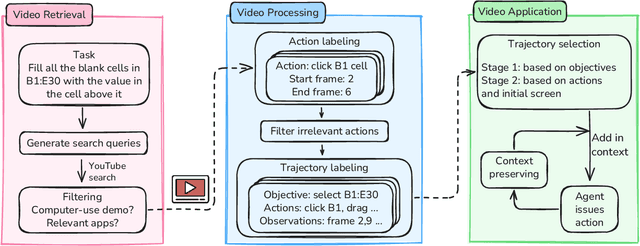
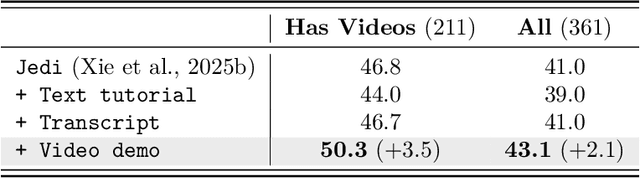

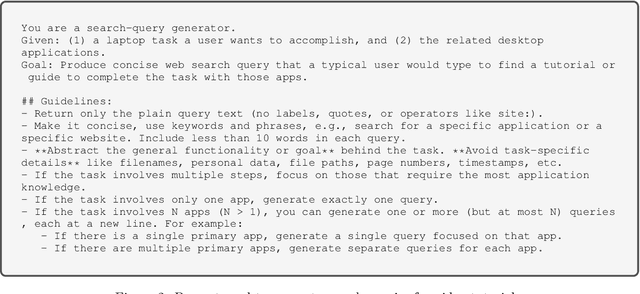
Computer-use agents can operate computers and automate laborious tasks, but despite recent rapid progress, they still lag behind human users, especially when tasks require domain-specific procedural knowledge about particular applications, platforms, and multi-step workflows. Humans can bridge this gap by watching video tutorials: we search, skim, and selectively imitate short segments that match our current subgoal. In this paper, we study how to enable computer-use agents to learn from online videos at inference time effectively. We propose a framework that retrieves and filters tutorial videos, converts them into structured demonstration trajectories, and dynamically selects trajectories as in-context guidance during execution. Particularly, using a VLM, we infer UI actions, segment videos into short subsequences of actions, and assign each subsequence a textual objective. At inference time, a two-stage selection mechanism dynamically chooses a single trajectory to add in context at each step, focusing the agent on the most helpful local guidance for its next decision. Experiments on two widely used benchmarks show that our framework consistently outperforms strong base agents and variants that use only textual tutorials or transcripts. Analyses highlight the importance of trajectory segmentation and selection, action filtering, and visual information, suggesting that abundant online videos can be systematically distilled into actionable guidance that improves computer-use agents at inference time. Our code is available at https://github.com/UCSB-NLP-Chang/video_demo.
Instella-T2I: Pushing the Limits of 1D Discrete Latent Space Image Generation
Jun 26, 2025Image tokenization plays a critical role in reducing the computational demands of modeling high-resolution images, significantly improving the efficiency of image and multimodal understanding and generation. Recent advances in 1D latent spaces have reduced the number of tokens required by eliminating the need for a 2D grid structure. In this paper, we further advance compact discrete image representation by introducing 1D binary image latents. By representing each image as a sequence of binary vectors, rather than using traditional one-hot codebook tokens, our approach preserves high-resolution details while maintaining the compactness of 1D latents. To the best of our knowledge, our text-to-image models are the first to achieve competitive performance in both diffusion and auto-regressive generation using just 128 discrete tokens for images up to 1024x1024, demonstrating up to a 32-fold reduction in token numbers compared to standard VQ-VAEs. The proposed 1D binary latent space, coupled with simple model architectures, achieves marked improvements in speed training and inference speed. Our text-to-image models allow for a global batch size of 4096 on a single GPU node with 8 AMD MI300X GPUs, and the training can be completed within 200 GPU days. Our models achieve competitive performance compared to modern image generation models without any in-house private training data or post-training refinements, offering a scalable and efficient alternative to conventional tokenization methods.
Unleashing Hour-Scale Video Training for Long Video-Language Understanding
Jun 05, 2025Recent long-form video-language understanding benchmarks have driven progress in video large multimodal models (Video-LMMs). However, the scarcity of well-annotated long videos has left the training of hour-long Video-LLMs underexplored. To close this gap, we present VideoMarathon, a large-scale hour-long video instruction-following dataset. This dataset includes around 9,700 hours of long videos sourced from diverse domains, ranging from 3 to 60 minutes per video. Specifically, it contains 3.3M high-quality QA pairs, spanning six fundamental topics: temporality, spatiality, object, action, scene, and event. Compared to existing video instruction datasets, VideoMarathon significantly extends training video durations up to 1 hour, and supports 22 diverse tasks requiring both short- and long-term video comprehension. Building on VideoMarathon, we propose Hour-LLaVA, a powerful and efficient Video-LMM for hour-scale video-language modeling. It enables hour-long video training and inference at 1-FPS sampling by leveraging a memory augmentation module, which adaptively integrates user question-relevant and spatiotemporal-informative semantics from a cached full video context. In our experiments, Hour-LLaVA achieves the best performance on multiple long video-language benchmarks, demonstrating the high quality of the VideoMarathon dataset and the superiority of the Hour-LLaVA model.