 Add to Chrome
 Add to Firefox
 Add to Edge
Beyond Reproduction: A Paired-Task Framework for Assessing LLM Comprehension and Creativity in Literary Translation
Apr 20, 2026
Large language models (LLMs) are increasingly used for creative tasks such as literary translation. Yet translational creativity remains underexplored and is rarely evaluated at scale, while source-text comprehension is typically studied in isolation, despite the fact that, in professional translation, comprehension and creativity are tightly intertwined. We address these gaps with a paired-task framework applied to literary excerpts from 11 books. Task 1 assesses source-text comprehension, and Task 2 evaluates translational creativity through Units of Creative Potential (UCPs), such as metaphors and wordplay. Using a scalable evaluation setup that combines expert human annotations with UCP-based automatic scoring, we benchmark 23 models and four creativity-oriented prompts. Our findings show that strong comprehension does not translate into human-level creativity: models often produce literal or contextually inappropriate renderings, with particularly large gaps for the more distant English-Chinese language pair. Creativity-oriented prompts yield only modest gains, and only one model, Mistral-Large, comes close to human-level creativity (0.167 vs. 0.246). Across all model-prompt combinations, only three exceed a creativity score of 0.1, while the rest remain at or near zero.

Ran Score: a LLM-based Evaluation Score for Radiology Report Generation
Mar 24, 2026Chest X-ray report generation and automated evaluation are limited by poor recognition of low-prevalence abnormalities and inadequate handling of clinically important language, including negation and ambiguity. We develop a clinician-guided framework combining human expertise and large language models for multi-label finding extraction from free-text chest X-ray reports and use it to define Ran Score, a finding-level metric for report evaluation. Using three non-overlapping MIMIC-CXR-EN cohorts from a public chest X-ray dataset and an independent ChestX-CN validation cohort, we optimize prompts, establish radiologist-derived reference labels and evaluate report generation models. The optimized framework improves the macro-averaged score from 0.753 to 0.956 on the MIMIC-CXR-EN development cohort, exceeds the CheXbert benchmark by 15.7 percentage points on directly comparable labels, and shows robust generalization on the ChestX-CN validation cohort. Here we show that clinician-guided prompt optimization improves agreement with a radiologist-derived reference standard and that Ran Score enables finding-level evaluation of report fidelity, particularly for low-prevalence abnormalities.
ShotVerse: Advancing Cinematic Camera Control for Text-Driven Multi-Shot Video Creation
Mar 12, 2026Text-driven video generation has democratized film creation, but camera control in cinematic multi-shot scenarios remains a significant block. Implicit textual prompts lack precision, while explicit trajectory conditioning imposes prohibitive manual overhead and often triggers execution failures in current models. To overcome this bottleneck, we propose a data-centric paradigm shift, positing that aligned (Caption, Trajectory, Video) triplets form an inherent joint distribution that can connect automated plotting and precise execution. Guided by this insight, we present ShotVerse, a "Plan-then-Control" framework that decouples generation into two collaborative agents: a VLM (Vision-Language Model)-based Planner that leverages spatial priors to obtain cinematic, globally aligned trajectories from text, and a Controller that renders these trajectories into multi-shot video content via a camera adapter. Central to our approach is the construction of a data foundation: we design an automated multi-shot camera calibration pipeline aligns disjoint single-shot trajectories into a unified global coordinate system. This facilitates the curation of ShotVerse-Bench, a high-fidelity cinematic dataset with a three-track evaluation protocol that serves as the bedrock for our framework. Extensive experiments demonstrate that ShotVerse effectively bridges the gap between unreliable textual control and labor-intensive manual plotting, achieving superior cinematic aesthetics and generating multi-shot videos that are both camera-accurate and cross-shot consistent.
Hybrid Fusion: One-Minute Efficient Training for Zero-Shot Cross-Domain Image Fusion
Feb 24, 2026Image fusion seeks to integrate complementary information from multiple sources into a single, superior image. While traditional methods are fast, they lack adaptability and performance. Conversely, deep learning approaches achieve state-of-the-art (SOTA) results but suffer from critical inefficiencies: their reliance on slow, resource-intensive, patch-based training introduces a significant gap with full-resolution inference. We propose a novel hybrid framework that resolves this trade-off. Our method utilizes a learnable U-Net to generate a dynamic guidance map that directs a classic, fixed Laplacian pyramid fusion kernel. This decoupling of policy learning from pixel synthesis enables remarkably efficient full-resolution training, eliminating the train-inference gap. Consequently, our model achieves SOTA-comparable performance in about one minute on a RTX 4090 or two minutes on a consumer laptop GPU from scratch without any external model and demonstrates powerful zero-shot generalization across diverse tasks, from infrared-visible to medical imaging. By design, the fused output is linearly constructed solely from source information, ensuring high faithfulness for critical applications. The codes are available at https://github.com/Zirconium233/HybridFusion
Puzzle Curriculum GRPO for Vision-Centric Reasoning
Dec 16, 2025Recent reinforcement learning (RL) approaches like outcome-supervised GRPO have advanced chain-of-thought reasoning in Vision Language Models (VLMs), yet key issues linger: (i) reliance on costly and noisy hand-curated annotations or external verifiers; (ii) flat and sparse reward schemes in GRPO; and (iii) logical inconsistency between a chain's reasoning and its final answer. We present Puzzle Curriculum GRPO (PC-GRPO), a supervision-free recipe for RL with Verifiable Rewards (RLVR) that strengthens visual reasoning in VLMs without annotations or external verifiers. PC-GRPO replaces labels with three self-supervised puzzle environments: PatchFit, Rotation (with binary rewards) and Jigsaw (with graded partial credit mitigating reward sparsity). To counter flat rewards and vanishing group-relative advantages, we introduce a difficulty-aware curriculum that dynamically weights samples and peaks at medium difficulty. We further monitor Reasoning-Answer Consistency (RAC) during post-training: mirroring reports for vanilla GRPO in LLMs, RAC typically rises early then degrades; our curriculum delays this decline, and consistency-enforcing reward schemes further boost RAC. RAC correlates with downstream accuracy. Across diverse benchmarks and on Qwen-7B and Qwen-3B backbones, PC-GRPO improves reasoning quality, training stability, and end-task accuracy, offering a practical path to scalable, verifiable, and interpretable RL post-training for VLMs.
Modular Neural Image Signal Processing
Dec 09, 2025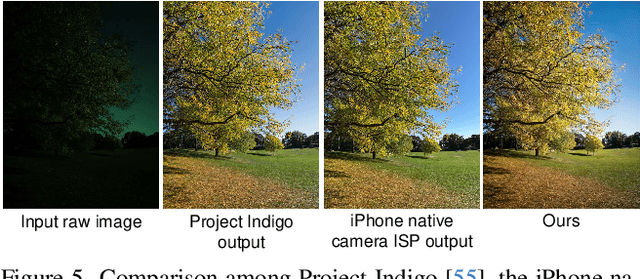
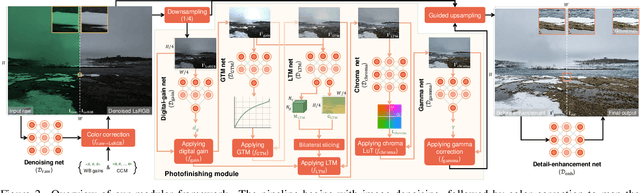
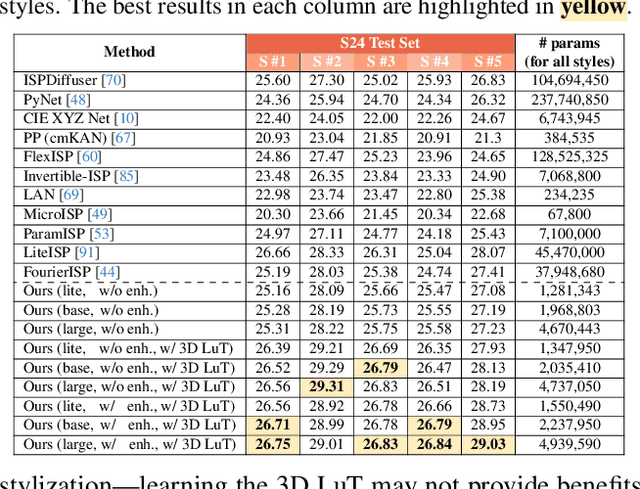
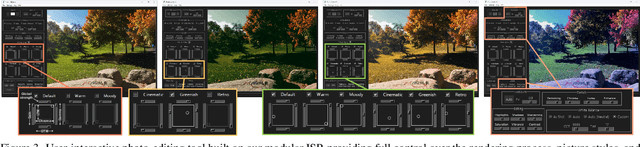
This paper presents a modular neural image signal processing (ISP) framework that processes raw inputs and renders high-quality display-referred images. Unlike prior neural ISP designs, our method introduces a high degree of modularity, providing full control over multiple intermediate stages of the rendering process.~This modular design not only achieves high rendering accuracy but also improves scalability, debuggability, generalization to unseen cameras, and flexibility to match different user-preference styles. To demonstrate the advantages of this design, we built a user-interactive photo-editing tool that leverages our neural ISP to support diverse editing operations and picture styles. The tool is carefully engineered to take advantage of the high-quality rendering of our neural ISP and to enable unlimited post-editable re-rendering. Our method is a fully learning-based framework with variants of different capacities, all of moderate size (ranging from ~0.5 M to ~3.9 M parameters for the entire pipeline), and consistently delivers competitive qualitative and quantitative results across multiple test sets. Watch the supplemental video at: https://youtu.be/ByhQjQSjxVM
Data-to-Dashboard: Multi-Agent LLM Framework for Insightful Visualization in Enterprise Analytics
May 29, 2025
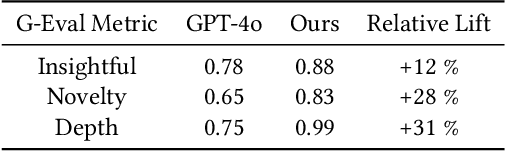
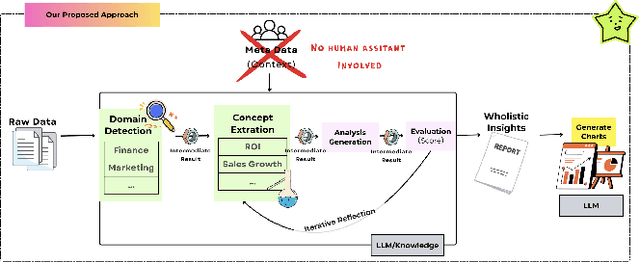
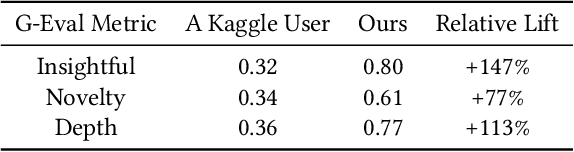
The rapid advancement of LLMs has led to the creation of diverse agentic systems in data analysis, utilizing LLMs' capabilities to improve insight generation and visualization. In this paper, we present an agentic system that automates the data-to-dashboard pipeline through modular LLM agents capable of domain detection, concept extraction, multi-perspective analysis generation, and iterative self-reflection. Unlike existing chart QA systems, our framework simulates the analytical reasoning process of business analysts by retrieving domain-relevant knowledge and adapting to diverse datasets without relying on closed ontologies or question templates. We evaluate our system on three datasets across different domains. Benchmarked against GPT-4o with a single-prompt baseline, our approach shows improved insightfulness, domain relevance, and analytical depth, as measured by tailored evaluation metrics and qualitative human assessment. This work contributes a novel modular pipeline to bridge the path from raw data to visualization, and opens new opportunities for human-in-the-loop validation by domain experts in business analytics. All code can be found here: https://github.com/77luvC/D2D_Data2Dashboard
LiTransProQA: an LLM-based Literary Translation evaluation metric with Professional Question Answering
May 09, 2025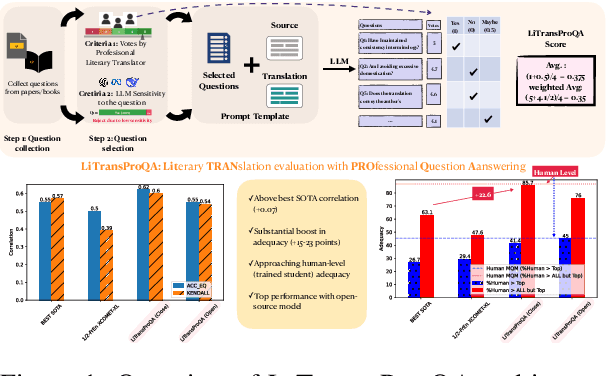
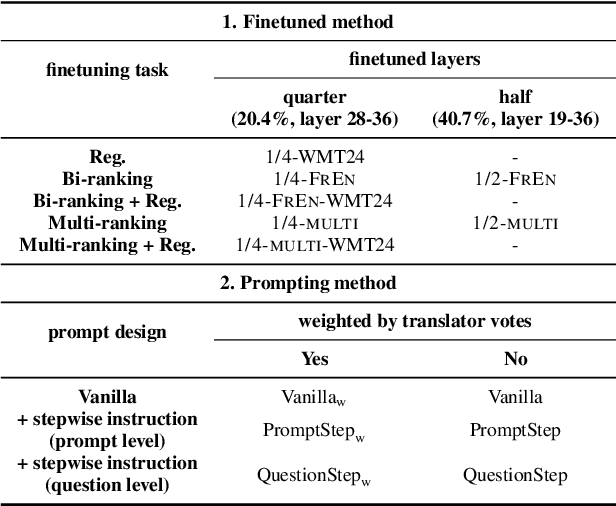
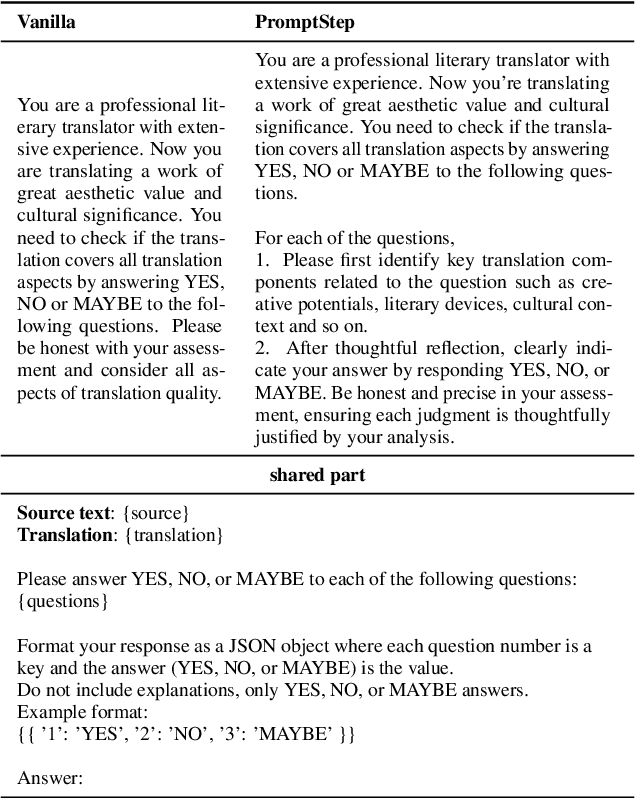
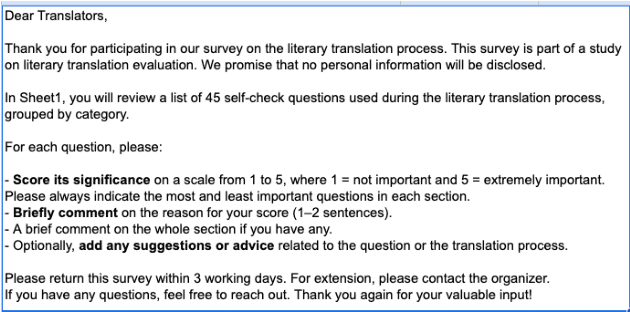
The impact of Large Language Models (LLMs) has extended into literary domains. However, existing evaluation metrics prioritize mechanical accuracy over artistic expression and tend to overrate machine translation (MT) as being superior to experienced professional human translation. In the long run, this bias could result in a permanent decline in translation quality and cultural authenticity. In response to the urgent need for a specialized literary evaluation metric, we introduce LiTransProQA, a novel, reference-free, LLM-based question-answering framework designed specifically for literary translation evaluation. LiTransProQA uniquely integrates insights from professional literary translators and researchers, focusing on critical elements in literary quality assessment such as literary devices, cultural understanding, and authorial voice. Our extensive evaluation shows that while literary-finetuned XCOMET-XL yields marginal gains, LiTransProQA substantially outperforms current metrics, achieving up to 0.07 gain in correlation (ACC-EQ and Kendall's tau) and surpassing the best state-of-the-art metrics by over 15 points in adequacy assessments. Incorporating professional translator insights as weights further improves performance, highlighting the value of translator inputs. Notably, LiTransProQA approaches human-level evaluation performance comparable to trained linguistic annotators. It demonstrates broad applicability to open-source models such as LLaMA3.3-70b and Qwen2.5-32b, indicating its potential as an accessible and training-free literary evaluation metric and a valuable tool for evaluating texts that require local processing due to copyright or ethical considerations.
TransProQA: an LLM-based literary Translation evaluation metric with Professional Question Answering
May 08, 2025The impact of Large Language Models (LLMs) has extended into literary domains. However, existing evaluation metrics prioritize mechanical accuracy over artistic expression and tend to overrate machine translation (MT) as being superior to experienced professional human translation. In the long run, this bias could result in a permanent decline in translation quality and cultural authenticity. In response to the urgent need for a specialized literary evaluation metric, we introduce TransProQA, a novel, reference-free, LLM-based question-answering (QA) framework designed specifically for literary translation evaluation. TransProQA uniquely integrates insights from professional literary translators and researchers, focusing on critical elements in literary quality assessment such as literary devices, cultural understanding, and authorial voice. Our extensive evaluation shows that while literary-finetuned XCOMET-XL yields marginal gains, TransProQA substantially outperforms current metrics, achieving up to 0.07 gain in correlation (ACC-EQ and Kendall's tau) and surpassing the best state-of-the-art (SOTA) metrics by over 15 points in adequacy assessments. Incorporating professional translator insights as weights further improves performance, highlighting the value of translator inputs. Notably, TransProQA approaches human-level evaluation performance comparable to trained linguistic annotators. It demonstrates broad applicability to open-source models such as LLaMA3.3-70b and Qwen2.5-32b, indicating its potential as an accessible and training-free literary evaluation metric and a valuable tool for evaluating texts that require local processing due to copyright or ethical considerations.
Bayesian Reasoning Enabled by Spin-Orbit Torque Magnetic Tunnel Junctions
Apr 11, 2025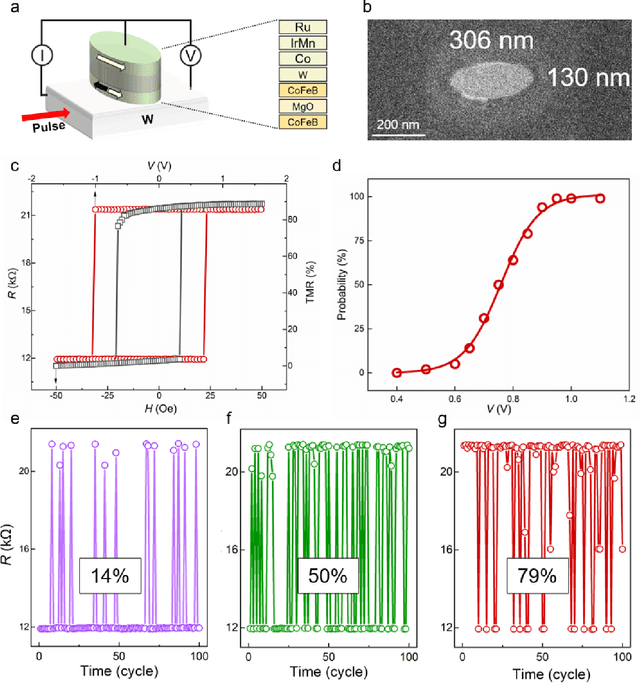
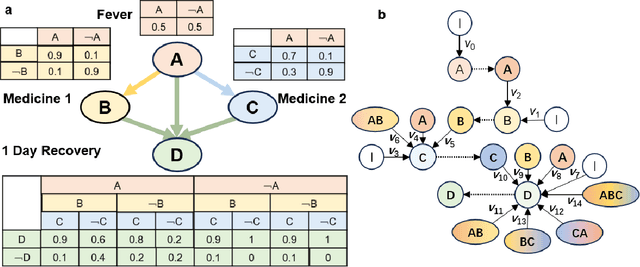
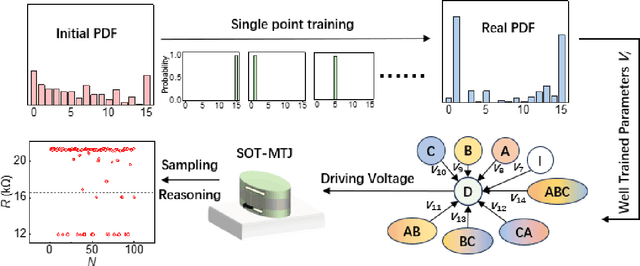
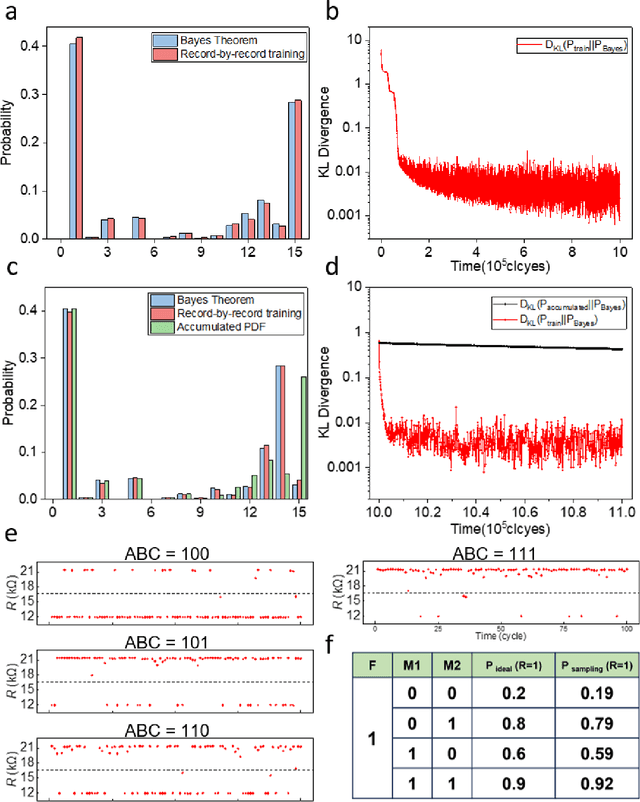
Bayesian networks play an increasingly important role in data mining, inference, and reasoning with the rapid development of artificial intelligence. In this paper, we present proof-of-concept experiments demonstrating the use of spin-orbit torque magnetic tunnel junctions (SOT-MTJs) in Bayesian network reasoning. Not only can the target probability distribution function (PDF) of a Bayesian network be precisely formulated by a conditional probability table as usual but also quantitatively parameterized by a probabilistic forward propagating neuron network. Moreover, the parameters of the network can also approach the optimum through a simple point-by point training algorithm, by leveraging which we do not need to memorize all historical data nor statistically summarize conditional probabilities behind them, significantly improving storage efficiency and economizing data pretreatment. Furthermore, we developed a simple medical diagnostic system using the SOT-MTJ as a random number generator and sampler, showcasing the application of SOT-MTJ-based Bayesian reasoning. This SOT-MTJ-based Bayesian reasoning shows great promise in the field of artificial probabilistic neural network, broadening the scope of spintronic device applications and providing an efficient and low-storage solution for complex reasoning tasks.