 Add to Chrome
 Add to Firefox
 Add to Edge
D$^3$-Subsidy: Online and Sequential Driver Subsidy Decision-Making for Large-Scale Ride-Hailing Market
May 21, 2026
Ride-hailing platforms like DiDi Chuxing operate in highly dynamic environments where balancing driver supply and passenger demand is critical. Although driver-side subsidies serve as a primary lever to align these forces and improve key KPIs like completed rides (\texttt{Rides}) and gross merchandise value (\texttt{GMV}), optimizing them in production requires simultaneously meeting three constraints: (i) responsiveness to stochastic shocks, (ii) strict subsidy-rate caps, and (iii) low-latency execution at city scale. These requirements rule out expensive per-order optimization, calling for a forward-looking, constraint-aware city-level controller for online sequential decision making. To meet these requirements, we introduce D$^3$-Subsidy (Dynamic Driver-side Diffusion-based Subsidy), a hierarchical diffusion-based framework for deployable city-wide subsidy control. To bridge the train-inference gap, D$^3$-Subsidy employs a prefix-conditioned diffusion model that samples plausible future trajectories from immutable historical observations, ensuring the training protocol aligns with the fixed-history nature of online deployment. These generated plans are then decoded by a context-conditioned inverse module into low-dimensional city-level control signals. For scalable execution, we bridge the gap between city-level planning and fine-grained dispatch via a Lagrangian-dual-derived mapping, which embeds subsidy-rate caps directly into order-driver incentives without iterative optimization. Additionally, a multi-city pretraining strategy with parameter-efficient fine-tuning enables robust transfer across heterogeneous cities. Extensive offline evaluations demonstrate that D$^3$-Subsidy improves \texttt{Rides} and \texttt{GMV} while enhancing cap compliance, and a real-world A/B test confirms significant uplift while keeping budget-related violation metrics within operational thresholds.

Attention Drift: What Autoregressive Speculative Decoding Models Learn
May 11, 2026Speculative decoding accelerates LLM inference by drafting future tokens with a small model, but drafter models degrade sharply under template perturbation and long-context inputs. We identify a previously-unreported phenomenon we call \textbf{attention drift}: as the drafter generates successive tokens within a speculation chain, attention progressively moves from the prompt onto its own recently-generated tokens. We observe this across both \emph{EAGLE3} drafters and \emph{MTP heads}, suggesting drift is a property of drafter designs. We trace this to the un-normalized residual path between chain steps: the drafter's hidden state magnitude grows monotonically with chain depth, which exhibits dynamics consistent with additional pre-norm transformer layers stacked on the target rather than as a standalone autoregressive predictor. In order to limit the growth, we propose two architectural changes: Post-norm on the drafter hidden states and per-hidden-state RMSNorm after capturing target hidden states. Our interventions improve acceptance length over the current leading model, pre-norm EAGLE3, by up to $2\times$ under template perturbation, $1.18\times$ on long-context tasks, and $1.10\times$ on seven standard benchmarks spanning multi-turn chat, math, and coding. Our changes also allow shorter train-time-test depths to generalize over longer drafting sequences.
MPerS: Dynamic MLLM MixExperts Perception-Guided Remote Sensing Scene Segmentation
May 11, 2026The multimodal fusion of images and scene captions has been extensively explored and applied in various fields. However, when dealing with complex remote sensing (RS) scenes, existing studies have predominantly concentrated on architectural optimizations for integrating textual semantic information with visual features, while largely neglecting the generation of high-quality RS captions and the investigation of their effectiveness in multimodal semantic fusion.In this context, we propose the Dynamic MLLM Mixture-of-Experts Perception-Guided Remote Sensing Scene Segmentation, referred to as MPerS.We design multiple prompts for MLLMs to generate high-quality RS captions, enabling MLLMs to perceive RS scenes from diverse expert perspectives. DINOv3 is employed to extract dense visual representations of land-covers.We design a Dynamic MixExperts module that adaptively integrates the most effective textual semantics. Linguistic Query Guided Attention is constructed to utilize textual semantic information to guide visual features for precise segmentation. The MLLMs include LLaVA, ChatGPT, and Qwen. Our method achieves superior performance on three public semantic segmentation RS datasets.
GeoLink: A 3D-Aware Framework Towards Better Generalization in Cross-View Geo-Localization
Apr 16, 2026Generalizable cross-view geo-localization aims to match the same location across views in unseen regions and conditions without GPS supervision. Its core difficulty lies in severe semantic inconsistency caused by viewpoint variation and poor generalization under domain shift. Existing methods mainly rely on 2D correspondence, but they are easily distracted by redundant shared information across views, leading to less transferable representations. To address this, we propose GeoLink, a 3D-aware semantic-consistent framework for Generalizable cross-view geo-localization. Specifically, we offline reconstruct scene point clouds from multi-view drone images using VGGT, providing stable structural priors. Based on these 3D anchors, we improve 2D representation learning in two complementary ways. A Geometric-aware Semantic Refinement module mitigates potentially redundant and view-biased dependencies in 2D features under 3D guidance. In addition, a Unified View Relation Distillation module transfers 3D structural relations to 2D features, improving cross-view alignment while preserving a 2D-only inference pipeline. Extensive experiments on multiple benchmarks show that GeoLink consistently outperforms state-of-the-art methods and achieves superior generalization across unseen domains and diverse weather environments.
ERNIE 5.0 Technical Report
Feb 04, 2026In this report, we introduce ERNIE 5.0, a natively autoregressive foundation model desinged for unified multimodal understanding and generation across text, image, video, and audio. All modalities are trained from scratch under a unified next-group-of-tokens prediction objective, based on an ultra-sparse mixture-of-experts (MoE) architecture with modality-agnostic expert routing. To address practical challenges in large-scale deployment under diverse resource constraints, ERNIE 5.0 adopts a novel elastic training paradigm. Within a single pre-training run, the model learns a family of sub-models with varying depths, expert capacities, and routing sparsity, enabling flexible trade-offs among performance, model size, and inference latency in memory- or time-constrained scenarios. Moreover, we systematically address the challenges of scaling reinforcement learning to unified foundation models, thereby guaranteeing efficient and stable post-training under ultra-sparse MoE architectures and diverse multimodal settings. Extensive experiments demonstrate that ERNIE 5.0 achieves strong and balanced performance across multiple modalities. To the best of our knowledge, among publicly disclosed models, ERNIE 5.0 represents the first production-scale realization of a trillion-parameter unified autoregressive model that supports both multimodal understanding and generation. To facilitate further research, we present detailed visualizations of modality-agnostic expert routing in the unified model, alongside comprehensive empirical analysis of elastic training, aiming to offer profound insights to the community.
MedAD-R1: Eliciting Consistent Reasoning in Interpretible Medical Anomaly Detection via Consistency-Reinforced Policy Optimization
Feb 01, 2026Medical Anomaly Detection (MedAD) presents a significant opportunity to enhance diagnostic accuracy using Large Multimodal Models (LMMs) to interpret and answer questions based on medical images. However, the reliance on Supervised Fine-Tuning (SFT) on simplistic and fragmented datasets has hindered the development of models capable of plausible reasoning and robust multimodal generalization. To overcome this, we introduce MedAD-38K, the first large-scale, multi-modal, and multi-center benchmark for MedAD featuring diagnostic Chain-of-Thought (CoT) annotations alongside structured Visual Question-Answering (VQA) pairs. On this foundation, we propose a two-stage training framework. The first stage, Cognitive Injection, uses SFT to instill foundational medical knowledge and align the model with a structured think-then-answer paradigm. Given that standard policy optimization can produce reasoning that is disconnected from the final answer, the second stage incorporates Consistency Group Relative Policy Optimization (Con-GRPO). This novel algorithm incorporates a crucial consistency reward to ensure the generated reasoning process is relevant and logically coherent with the final diagnosis. Our proposed model, MedAD-R1, achieves state-of-the-art (SOTA) performance on the MedAD-38K benchmark, outperforming strong baselines by more than 10\%. This superior performance stems from its ability to generate transparent and logically consistent reasoning pathways, offering a promising approach to enhancing the trustworthiness and interpretability of AI for clinical decision support.
Animate Any Character in Any World
Dec 18, 2025Recent advances in world models have greatly enhanced interactive environment simulation. Existing methods mainly fall into two categories: (1) static world generation models, which construct 3D environments without active agents, and (2) controllable-entity models, which allow a single entity to perform limited actions in an otherwise uncontrollable environment. In this work, we introduce AniX, leveraging the realism and structural grounding of static world generation while extending controllable-entity models to support user-specified characters capable of performing open-ended actions. Users can provide a 3DGS scene and a character, then direct the character through natural language to perform diverse behaviors from basic locomotion to object-centric interactions while freely exploring the environment. AniX synthesizes temporally coherent video clips that preserve visual fidelity with the provided scene and character, formulated as a conditional autoregressive video generation problem. Built upon a pre-trained video generator, our training strategy significantly enhances motion dynamics while maintaining generalization across actions and characters. Our evaluation covers a broad range of aspects, including visual quality, character consistency, action controllability, and long-horizon coherence.
Spatia: Video Generation with Updatable Spatial Memory
Dec 17, 2025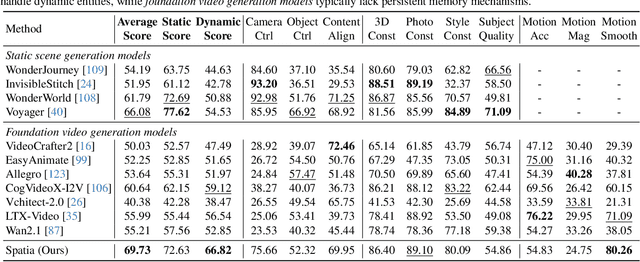
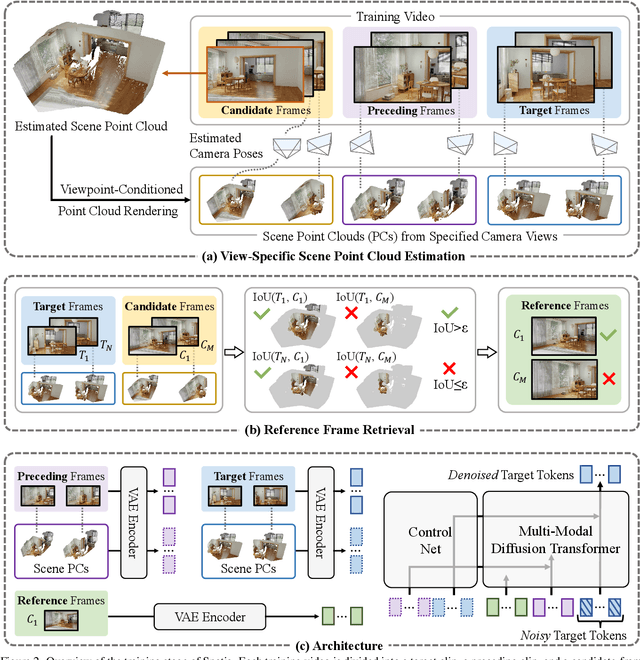
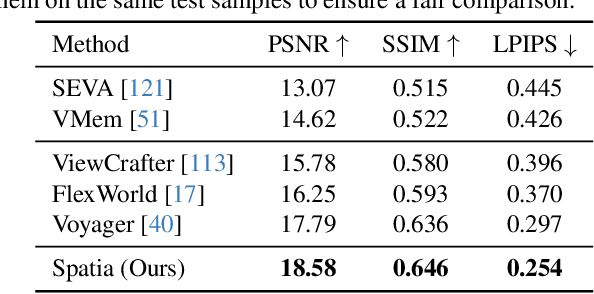
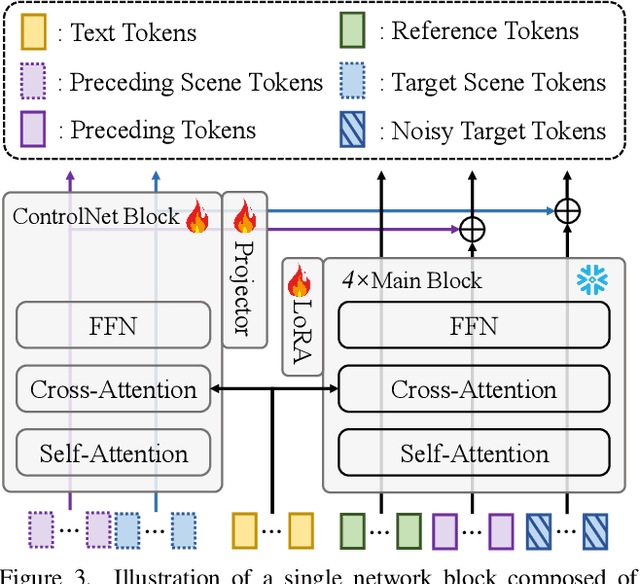
Existing video generation models struggle to maintain long-term spatial and temporal consistency due to the dense, high-dimensional nature of video signals. To overcome this limitation, we propose Spatia, a spatial memory-aware video generation framework that explicitly preserves a 3D scene point cloud as persistent spatial memory. Spatia iteratively generates video clips conditioned on this spatial memory and continuously updates it through visual SLAM. This dynamic-static disentanglement design enhances spatial consistency throughout the generation process while preserving the model's ability to produce realistic dynamic entities. Furthermore, Spatia enables applications such as explicit camera control and 3D-aware interactive editing, providing a geometrically grounded framework for scalable, memory-driven video generation.
From Virtual Games to Real-World Play
Jun 23, 2025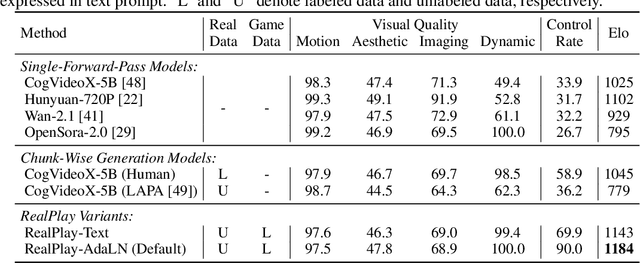
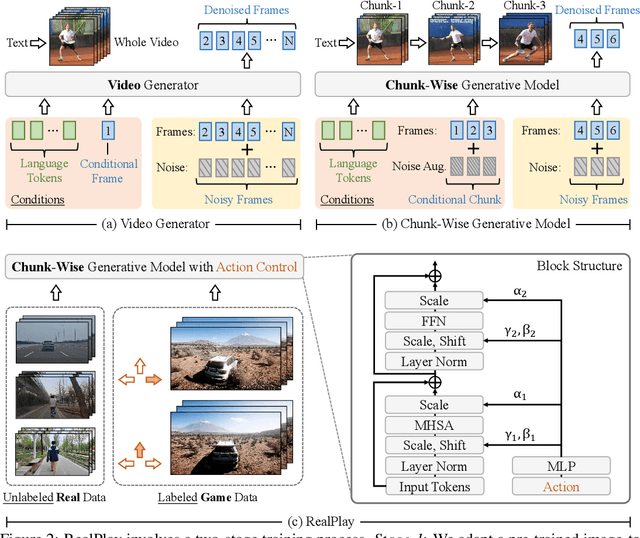
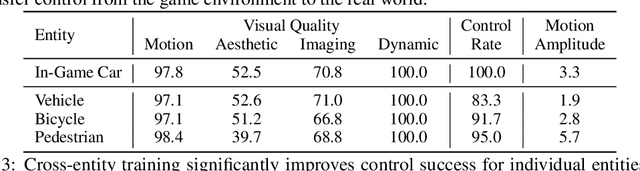
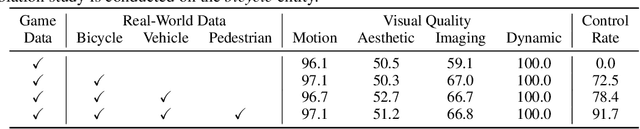
We introduce RealPlay, a neural network-based real-world game engine that enables interactive video generation from user control signals. Unlike prior works focused on game-style visuals, RealPlay aims to produce photorealistic, temporally consistent video sequences that resemble real-world footage. It operates in an interactive loop: users observe a generated scene, issue a control command, and receive a short video chunk in response. To enable such realistic and responsive generation, we address key challenges including iterative chunk-wise prediction for low-latency feedback, temporal consistency across iterations, and accurate control response. RealPlay is trained on a combination of labeled game data and unlabeled real-world videos, without requiring real-world action annotations. Notably, we observe two forms of generalization: (1) control transfer-RealPlay effectively maps control signals from virtual to real-world scenarios; and (2) entity transfer-although training labels originate solely from a car racing game, RealPlay generalizes to control diverse real-world entities, including bicycles and pedestrians, beyond vehicles. Project page can be found: https://wenqsun.github.io/RealPlay/
Prediction of Halo Coronal Mass Ejections Using SDO/HMI Vector Magnetic Data Products and a Transformer Model
Mar 05, 2025We present a transformer model, named DeepHalo, to predict the occurrence of halo coronal mass ejections (CMEs). Our model takes as input an active region (AR) and a profile, where the profile contains a time series of data samples in the AR that are collected 24 hours before the beginning of a day, and predicts whether the AR would produce a halo CME during that day. Each data sample contains physical parameters, or features, derived from photospheric vector magnetic field data taken by the Helioseismic and Magnetic Imager (HMI) on board the Solar Dynamics Observatory (SDO). We survey and match CME events in the Space Weather Database Of Notification, Knowledge, Information (DONKI) and Large Angle and Spectrometric Coronagraph (LASCO) CME Catalog, and compile a list of CMEs including halo CMEs and non-halo CMEs associated with ARs in the period between November 2010 and August 2023. We use the information gathered above to build the labels (positive versus negative) of the data samples and profiles at hand, where the labels are needed for machine learning. Experimental results show that DeepHalo with a true skill statistics (TSS) score of 0.907 outperforms a closely related long short-term memory network with a TSS score of 0.821. To our knowledge, this is the first time that the transformer model has been used for halo CME prediction.