 Add to Chrome
 Add to Firefox
 Add to Edge
Decentralized LLM-Driven Coordination of Acoustic Robots for Contactless Object Manipulation
May 28, 2026
Natural language interfaces can simplify interaction with multi-robot systems, especially when non-expert users need to issue high-level commands. Acoustic manipulation using ultrasonic phased arrays also enables contactless object handling for applications such as healthcare, laboratory automation, and precision transport. However, combining large language models (LLMs) with distributed acoustic mobile robots remains underexplored. This paper presents a decentralized framework for natural language-driven coordination of acoustic robots for contactless object manipulation. The system converts spoken instructions into executable multi-robot task plans using Whisper-based speech recognition, LLM-based semantic parsing, structured JSON task representation, and distributed scheduling. The JSON schema encodes robot assignments, temporal dependencies, spatial constraints, and synchronization requirements for sequential, parallel, and synchronized execution. The system is implemented on two TurtleBot3-based acoustic robots, each equipped with an ultrasonic phased array for contactless object transport. Experiments were conducted in three scenarios: sequential execution, parallel multi-robot transport, and synchronized cooperative manipulation. The system achieved task success rates of 96 percent for sequential tasks, 86 percent for parallel execution, and 70 percent for synchronized collaborative transport. These results show that natural language commands can be transformed into distributed robot actions for contactless manipulation, highlighting the potential of LLM-driven automation for human-robot interaction in distributed robotic systems.

Cross-Scale Pansharpening via ScaleFormer and the PanScale Benchmark
Feb 28, 2026Pansharpening aims to generate high-resolution multi-spectral images by fusing the spatial detail of panchromatic images with the spectral richness of low-resolution MS data. However, most existing methods are evaluated under limited, low-resolution settings, limiting their generalization to real-world, high-resolution scenarios. To bridge this gap, we systematically investigate the data, algorithmic, and computational challenges of cross-scale pansharpening. We first introduce PanScale, the first large-scale, cross-scale pansharpening dataset, accompanied by PanScale-Bench, a comprehensive benchmark for evaluating generalization across varying resolutions and scales. To realize scale generalization, we propose ScaleFormer, a novel architecture designed for multi-scale pansharpening. ScaleFormer reframes generalization across image resolutions as generalization across sequence lengths: it tokenizes images into patch sequences of the same resolution but variable length proportional to image scale. A Scale-Aware Patchify module enables training for such variations from fixed-size crops. ScaleFormer then decouples intra-patch spatial feature learning from inter-patch sequential dependency modeling, incorporating Rotary Positional Encoding to enhance extrapolation to unseen scales. Extensive experiments show that our approach outperforms SOTA methods in fusion quality and cross-scale generalization. The datasets and source code are available upon acceptance.
MedAD-R1: Eliciting Consistent Reasoning in Interpretible Medical Anomaly Detection via Consistency-Reinforced Policy Optimization
Feb 01, 2026Medical Anomaly Detection (MedAD) presents a significant opportunity to enhance diagnostic accuracy using Large Multimodal Models (LMMs) to interpret and answer questions based on medical images. However, the reliance on Supervised Fine-Tuning (SFT) on simplistic and fragmented datasets has hindered the development of models capable of plausible reasoning and robust multimodal generalization. To overcome this, we introduce MedAD-38K, the first large-scale, multi-modal, and multi-center benchmark for MedAD featuring diagnostic Chain-of-Thought (CoT) annotations alongside structured Visual Question-Answering (VQA) pairs. On this foundation, we propose a two-stage training framework. The first stage, Cognitive Injection, uses SFT to instill foundational medical knowledge and align the model with a structured think-then-answer paradigm. Given that standard policy optimization can produce reasoning that is disconnected from the final answer, the second stage incorporates Consistency Group Relative Policy Optimization (Con-GRPO). This novel algorithm incorporates a crucial consistency reward to ensure the generated reasoning process is relevant and logically coherent with the final diagnosis. Our proposed model, MedAD-R1, achieves state-of-the-art (SOTA) performance on the MedAD-38K benchmark, outperforming strong baselines by more than 10\%. This superior performance stems from its ability to generate transparent and logically consistent reasoning pathways, offering a promising approach to enhancing the trustworthiness and interpretability of AI for clinical decision support.
Self-supervised Multiplex Consensus Mamba for General Image Fusion
Dec 24, 2025Image fusion integrates complementary information from different modalities to generate high-quality fused images, thereby enhancing downstream tasks such as object detection and semantic segmentation. Unlike task-specific techniques that primarily focus on consolidating inter-modal information, general image fusion needs to address a wide range of tasks while improving performance without increasing complexity. To achieve this, we propose SMC-Mamba, a Self-supervised Multiplex Consensus Mamba framework for general image fusion. Specifically, the Modality-Agnostic Feature Enhancement (MAFE) module preserves fine details through adaptive gating and enhances global representations via spatial-channel and frequency-rotational scanning. The Multiplex Consensus Cross-modal Mamba (MCCM) module enables dynamic collaboration among experts, reaching a consensus to efficiently integrate complementary information from multiple modalities. The cross-modal scanning within MCCM further strengthens feature interactions across modalities, facilitating seamless integration of critical information from both sources. Additionally, we introduce a Bi-level Self-supervised Contrastive Learning Loss (BSCL), which preserves high-frequency information without increasing computational overhead while simultaneously boosting performance in downstream tasks. Extensive experiments demonstrate that our approach outperforms state-of-the-art (SOTA) image fusion algorithms in tasks such as infrared-visible, medical, multi-focus, and multi-exposure fusion, as well as downstream visual tasks.
MMMamba: A Versatile Cross-Modal In Context Fusion Framework for Pan-Sharpening and Zero-Shot Image Enhancement
Dec 17, 2025Pan-sharpening aims to generate high-resolution multispectral (HRMS) images by integrating a high-resolution panchromatic (PAN) image with its corresponding low-resolution multispectral (MS) image. To achieve effective fusion, it is crucial to fully exploit the complementary information between the two modalities. Traditional CNN-based methods typically rely on channel-wise concatenation with fixed convolutional operators, which limits their adaptability to diverse spatial and spectral variations. While cross-attention mechanisms enable global interactions, they are computationally inefficient and may dilute fine-grained correspondences, making it difficult to capture complex semantic relationships. Recent advances in the Multimodal Diffusion Transformer (MMDiT) architecture have demonstrated impressive success in image generation and editing tasks. Unlike cross-attention, MMDiT employs in-context conditioning to facilitate more direct and efficient cross-modal information exchange. In this paper, we propose MMMamba, a cross-modal in-context fusion framework for pan-sharpening, with the flexibility to support image super-resolution in a zero-shot manner. Built upon the Mamba architecture, our design ensures linear computational complexity while maintaining strong cross-modal interaction capacity. Furthermore, we introduce a novel multimodal interleaved (MI) scanning mechanism that facilitates effective information exchange between the PAN and MS modalities. Extensive experiments demonstrate the superior performance of our method compared to existing state-of-the-art (SOTA) techniques across multiple tasks and benchmarks.
Understanding the Representation of Older Adults in Motion Capture Locomotion Datasets
Nov 12, 2025The Internet of Things (IoT) sensors have been widely employed to capture human locomotions to enable applications such as activity recognition, human pose estimation, and fall detection. Motion capture (MoCap) systems are frequently used to generate ground truth annotations for human poses when training models with data from wearable or ambient sensors, and have been shown to be effective to synthesize data in these modalities. However, the representation of older adults, an increasingly important demographic in healthcare, in existing MoCap locomotion datasets has not been thoroughly examined. This work surveyed 41 publicly available datasets, identifying eight that include older adult motions and four that contain motions performed by younger actors annotated as old style. Older adults represent a small portion of participants overall, and few datasets provide full-body motion data for this group. To assess the fidelity of old-style walking motions, quantitative metrics are introduced, defining high fidelity as the ability to capture age-related differences relative to normative walking. Using gait parameters that are age-sensitive, robust to noise, and resilient to data scarcity, we found that old-style walking motions often exhibit overly controlled patterns and fail to faithfully characterize aging. These findings highlight the need for improved representation of older adults in motion datasets and establish a method to quantitatively evaluate the quality of old-style walking motions.
PCMamba: Physics-Informed Cross-Modal State Space Model for Dual-Camera Compressive Hyperspectral Imaging
May 22, 2025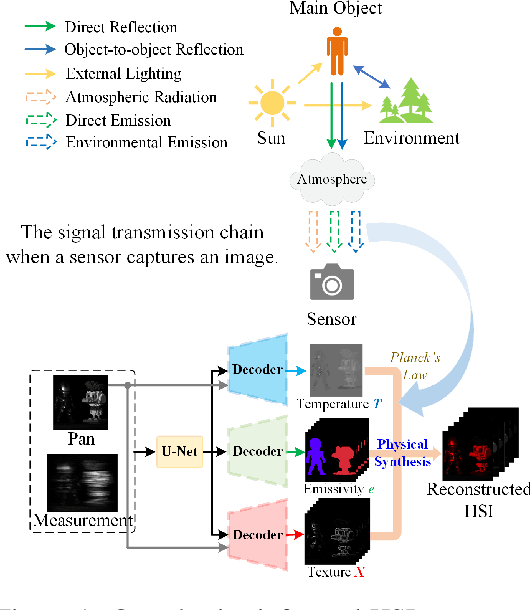
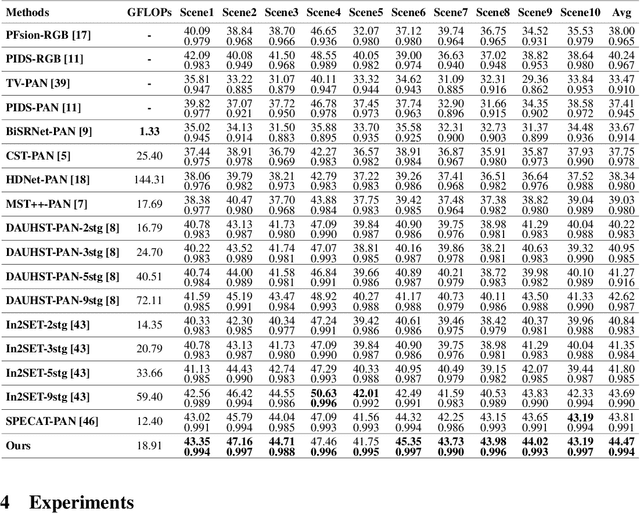
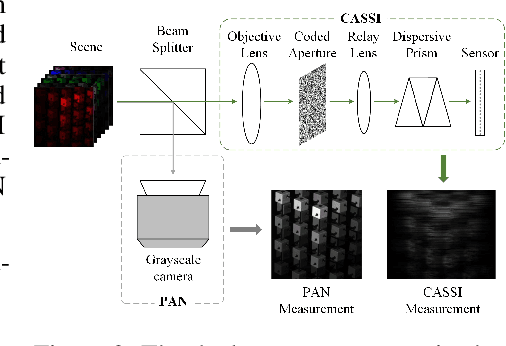
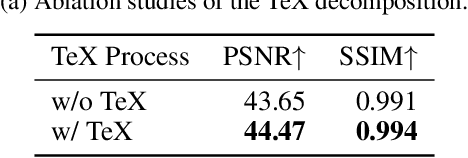
Panchromatic (PAN) -assisted Dual-Camera Compressive Hyperspectral Imaging (DCCHI) is a key technology in snapshot hyperspectral imaging. Existing research primarily focuses on exploring spectral information from 2D compressive measurements and spatial information from PAN images in an explicit manner, leading to a bottleneck in HSI reconstruction. Various physical factors, such as temperature, emissivity, and multiple reflections between objects, play a critical role in the process of a sensor acquiring hyperspectral thermal signals. Inspired by this, we attempt to investigate the interrelationships between physical properties to provide deeper theoretical insights for HSI reconstruction. In this paper, we propose a Physics-Informed Cross-Modal State Space Model Network (PCMamba) for DCCHI, which incorporates the forward physical imaging process of HSI into the linear complexity of Mamba to facilitate lightweight and high-quality HSI reconstruction. Specifically, we analyze the imaging process of hyperspectral thermal signals to enable the network to disentangle the three key physical properties-temperature, emissivity, and texture. By fully exploiting the potential information embedded in 2D measurements and PAN images, the HSIs are reconstructed through a physics-driven synthesis process. Furthermore, we design a Cross-Modal Scanning Mamba Block (CSMB) that introduces inter-modal pixel-wise interaction with positional inductive bias by cross-scanning the backbone features and PAN features. Extensive experiments conducted on both real and simulated datasets demonstrate that our method significantly outperforms SOTA methods in both quantitative and qualitative metrics.
FRN: Fractal-Based Recursive Spectral Reconstruction Network
May 21, 2025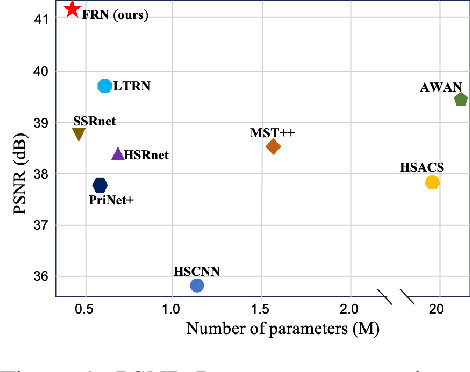
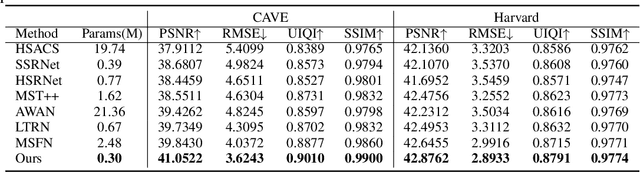
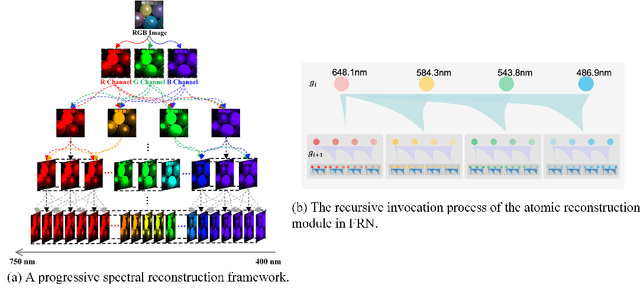
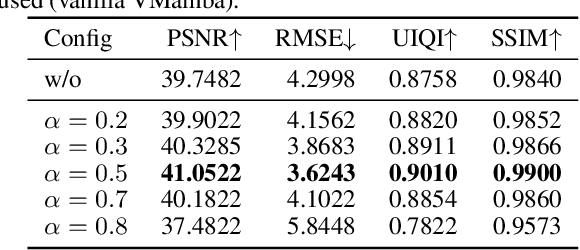
Generating hyperspectral images (HSIs) from RGB images through spectral reconstruction can significantly reduce the cost of HSI acquisition. In this paper, we propose a Fractal-Based Recursive Spectral Reconstruction Network (FRN), which differs from existing paradigms that attempt to directly integrate the full-spectrum information from the R, G, and B channels in a one-shot manner. Instead, it treats spectral reconstruction as a progressive process, predicting from broad to narrow bands or employing a coarse-to-fine approach for predicting the next wavelength. Inspired by fractals in mathematics, FRN establishes a novel spectral reconstruction paradigm by recursively invoking an atomic reconstruction module. In each invocation, only the spectral information from neighboring bands is used to provide clues for the generation of the image at the next wavelength, which follows the low-rank property of spectral data. Moreover, we design a band-aware state space model that employs a pixel-differentiated scanning strategy at different stages of the generation process, further suppressing interference from low-correlation regions caused by reflectance differences. Through extensive experimentation across different datasets, FRN achieves superior reconstruction performance compared to state-of-the-art methods in both quantitative and qualitative evaluations.
EMRModel: A Large Language Model for Extracting Medical Consultation Dialogues into Structured Medical Records
Apr 23, 2025Medical consultation dialogues contain critical clinical information, yet their unstructured nature hinders effective utilization in diagnosis and treatment. Traditional methods, relying on rule-based or shallow machine learning techniques, struggle to capture deep and implicit semantics. Recently, large pre-trained language models and Low-Rank Adaptation (LoRA), a lightweight fine-tuning method, have shown promise for structured information extraction. We propose EMRModel, a novel approach that integrates LoRA-based fine-tuning with code-style prompt design, aiming to efficiently convert medical consultation dialogues into structured electronic medical records (EMRs). Additionally, we construct a high-quality, realistically grounded dataset of medical consultation dialogues with detailed annotations. Furthermore, we introduce a fine-grained evaluation benchmark for medical consultation information extraction and provide a systematic evaluation methodology, advancing the optimization of medical natural language processing (NLP) models. Experimental results show EMRModel achieves an F1 score of 88.1%, improving by49.5% over standard pre-trained models. Compared to traditional LoRA fine-tuning methods, our model shows superior performance, highlighting its effectiveness in structured medical record extraction tasks.
Pan-LUT: Efficient Pan-sharpening via Learnable Look-Up Tables
Mar 31, 2025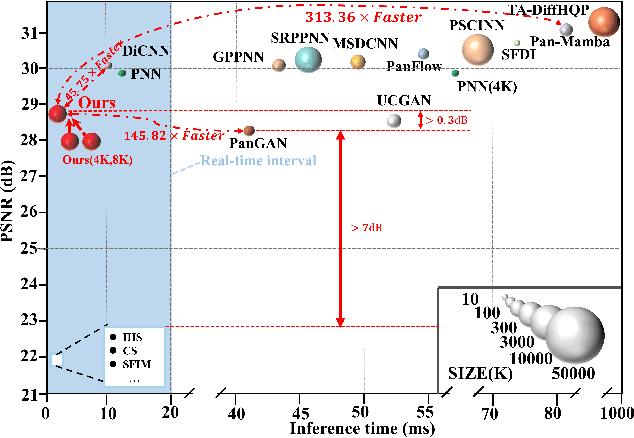
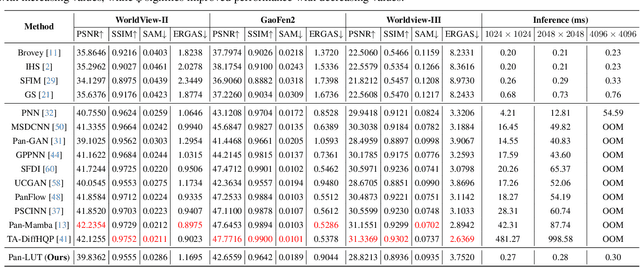
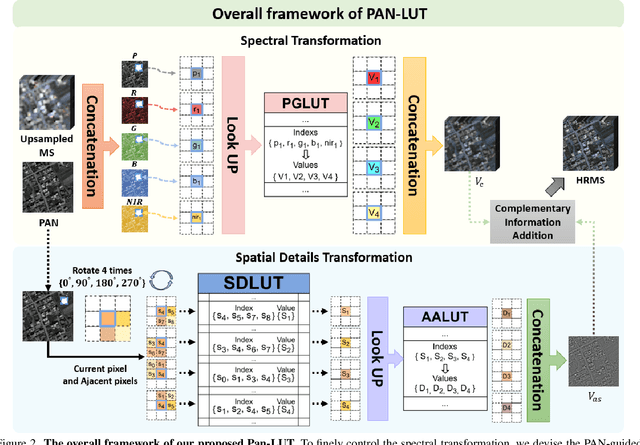
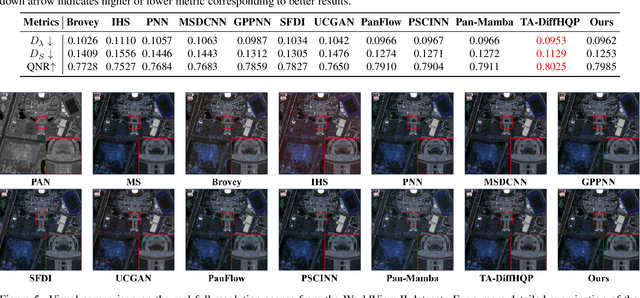
Recently, deep learning-based pan-sharpening algorithms have achieved notable advancements over traditional methods. However, many deep learning-based approaches incur substantial computational overhead during inference, especially with high-resolution images. This excessive computational demand limits the applicability of these methods in real-world scenarios, particularly in the absence of dedicated computing devices such as GPUs and TPUs. To address these challenges, we propose Pan-LUT, a novel learnable look-up table (LUT) framework for pan-sharpening that strikes a balance between performance and computational efficiency for high-resolution remote sensing images. To finely control the spectral transformation, we devise the PAN-guided look-up table (PGLUT) for channel-wise spectral mapping. To effectively capture fine-grained spatial details and adaptively learn local contexts, we introduce the spatial details look-up table (SDLUT) and adaptive aggregation look-up table (AALUT). Our proposed method contains fewer than 300K parameters and processes a 8K resolution image in under 1 ms using a single NVIDIA GeForce RTX 2080 Ti GPU, demonstrating significantly faster performance compared to other methods. Experiments reveal that Pan-LUT efficiently processes large remote sensing images in a lightweight manner, bridging the gap to real-world applications. Furthermore, our model surpasses SOTA methods in full-resolution scenes under real-world conditions, highlighting its effectiveness and efficiency.