 Add to Chrome
 Add to Firefox
 Add to Edge
ReSkill: Reconciling Skill Creation with Policy Optimization in Agentic RL
Jun 01, 2026
Agentic reinforcement learning (RL) enables LLM agents to improve continuously from environment rewards, yet the resulting policies do not systematically accumulate reusable strategies that generalize across tasks. Modular skills can provide such reusable strategies, yet existing skill-augmented RL methods decouple skill creation from policy optimization, risking adopting skills that conflict with the evolving policy. Inspired by Anthropic's Skill Creator, we introduce ReSkill, an RL-in-the-loop skill creation framework that reconciles skill evolution with policy learning. ReSkill exploits the group-wise structure of GRPO to naturally embed three mechanisms with only marginal additional overhead: (1) an assertion-driven skill creator that diagnoses failures from past experience and proposes conditional, trigger-based skill revisions; (2) within-group rollout sampling that enables controlled comparison of skill versions, capturing which version best supports the policy's ongoing learning; and (3) Thompson Sampling with adaptive discounting to balance exploration and exploitation in skill version selection as the policy evolves. Across several domains, ReSkill consistently outperforms existing memory and skill-based RL methods, with the largest gains on unseen tasks. Analysis of the skill lifecycle shows skills being automatically created, tested, refined, and pruned as the policy improves, demonstrating reconciled skill-policy co-evolution.

SenTSR-Bench: Thinking with Injected Knowledge for Time-Series Reasoning
Feb 23, 2026Time-series diagnostic reasoning is essential for many applications, yet existing solutions face a persistent gap: general reasoning large language models (GRLMs) possess strong reasoning skills but lack the domain-specific knowledge to understand complex time-series patterns. Conversely, fine-tuned time-series LLMs (TSLMs) understand these patterns but lack the capacity to generalize reasoning for more complicated questions. To bridge this gap, we propose a hybrid knowledge-injection framework that injects TSLM-generated insights directly into GRLM's reasoning trace, thereby achieving strong time-series reasoning with in-domain knowledge. As collecting data for knowledge injection fine-tuning is costly, we further leverage a reinforcement learning-based approach with verifiable rewards (RLVR) to elicit knowledge-rich traces without human supervision, then transfer such an in-domain thinking trace into GRLM for efficient knowledge injection. We further release SenTSR-Bench, a multivariate time-series-based diagnostic reasoning benchmark collected from real-world industrial operations. Across SenTSR-Bench and other public datasets, our method consistently surpasses TSLMs by 9.1%-26.1% and GRLMs by 7.9%-22.4%, delivering robust, context-aware time-series diagnostic insights.
Efficient Table Retrieval and Understanding with Multimodal Large Language Models
Feb 07, 2026Tabular data is frequently captured in image form across a wide range of real-world scenarios such as financial reports, handwritten records, and document scans. These visual representations pose unique challenges for machine understanding, as they combine both structural and visual complexities. While recent advances in Multimodal Large Language Models (MLLMs) show promising results in table understanding, they typically assume the relevant table is readily available. However, a more practical scenario involves identifying and reasoning over relevant tables from large-scale collections to answer user queries. To address this gap, we propose TabRAG, a framework that enables MLLMs to answer queries over large collections of table images. Our approach first retrieves candidate tables using jointly trained visual-text foundation models, then leverages MLLMs to perform fine-grained reranking of these candidates, and finally employs MLLMs to reason over the selected tables for answer generation. Through extensive experiments on a newly constructed dataset comprising 88,161 training and 9,819 testing samples across 8 benchmarks with 48,504 unique tables, we demonstrate that our framework significantly outperforms existing methods by 7.0% in retrieval recall and 6.1% in answer accuracy, offering a practical solution for real-world table understanding tasks.
Understanding the Implicit Biases of Design Choices for Time Series Foundation Models
Oct 22, 2025Time series foundation models (TSFMs) are a class of potentially powerful, general-purpose tools for time series forecasting and related temporal tasks, but their behavior is strongly shaped by subtle inductive biases in their design. Rather than developing a new model and claiming that it is better than existing TSFMs, e.g., by winning on existing well-established benchmarks, our objective is to understand how the various ``knobs'' of the training process affect model quality. Using a mix of theory and controlled empirical evaluation, we identify several design choices (patch size, embedding choice, training objective, etc.) and show how they lead to implicit biases in fundamental model properties (temporal behavior, geometric structure, how aggressively or not the model regresses to the mean, etc.); and we show how these biases can be intuitive or very counterintuitive, depending on properties of the model and data. We also illustrate in a case study on outlier handling how multiple biases can interact in complex ways; and we discuss implications of our results for learning the bitter lesson and building TSFMs.
CrEst: Credibility Estimation for Contexts in LLMs via Weak Supervision
Jun 17, 2025The integration of contextual information has significantly enhanced the performance of large language models (LLMs) on knowledge-intensive tasks. However, existing methods often overlook a critical challenge: the credibility of context documents can vary widely, potentially leading to the propagation of unreliable information. In this paper, we introduce CrEst, a novel weakly supervised framework for assessing the credibility of context documents during LLM inference--without requiring manual annotations. Our approach is grounded in the insight that credible documents tend to exhibit higher semantic coherence with other credible documents, enabling automated credibility estimation through inter-document agreement. To incorporate credibility into LLM inference, we propose two integration strategies: a black-box approach for models without access to internal weights or activations, and a white-box method that directly modifies attention mechanisms. Extensive experiments across three model architectures and five datasets demonstrate that CrEst consistently outperforms strong baselines, achieving up to a 26.86% improvement in accuracy and a 3.49% increase in F1 score. Further analysis shows that CrEst maintains robust performance even under high-noise conditions.
MLZero: A Multi-Agent System for End-to-end Machine Learning Automation
May 20, 2025Existing AutoML systems have advanced the automation of machine learning (ML); however, they still require substantial manual configuration and expert input, particularly when handling multimodal data. We introduce MLZero, a novel multi-agent framework powered by Large Language Models (LLMs) that enables end-to-end ML automation across diverse data modalities with minimal human intervention. A cognitive perception module is first employed, transforming raw multimodal inputs into perceptual context that effectively guides the subsequent workflow. To address key limitations of LLMs, such as hallucinated code generation and outdated API knowledge, we enhance the iterative code generation process with semantic and episodic memory. MLZero demonstrates superior performance on MLE-Bench Lite, outperforming all competitors in both success rate and solution quality, securing six gold medals. Additionally, when evaluated on our Multimodal AutoML Agent Benchmark, which includes 25 more challenging tasks spanning diverse data modalities, MLZero outperforms the competing methods by a large margin with a success rate of 0.92 (+263.6\%) and an average rank of 2.28. Our approach maintains its robust effectiveness even with a compact 8B LLM, outperforming full-size systems from existing solutions.
Visual Instruction Tuning with Chain of Region-of-Interest
May 11, 2025High-resolution (HR) images are pivotal for enhancing the recognition and understanding capabilities of multimodal large language models (MLLMs). However, directly increasing image resolution can significantly escalate computational demands. In this study, we propose a method called Chain of Region-of-Interest (CoRoI) for Visual Instruction Tuning, aimed at alleviating the computational burden associated with high-resolution images for MLLMs. Drawing inspiration from the selective nature of the human visual system, we recognize that not all regions within high-resolution images carry equal importance. CoRoI seeks to identify and prioritize the most informative regions, thereby enhancing multimodal visual comprehension and recognition while circumventing the need for processing lengthy HR image tokens. Through extensive experiments on 11 benchmarks, we validate the efficacy of CoRoI across varying sizes, ranging from 7B to 34B in parameters. Our models consistently demonstrate superior performance across diverse multimodal benchmarks and tasks. Notably, our method outperforms LLaVA-NeXT on almost all benchmarks and our finetuned 34B model surpasses proprietary methods like Gemini Pro 1.0 on six benchmarks, as well as outperforming GPT-4V on MMB, SEED-I, and MME.
Adapting to Online Distribution Shifts in Deep Learning: A Black-Box Approach
Apr 09, 2025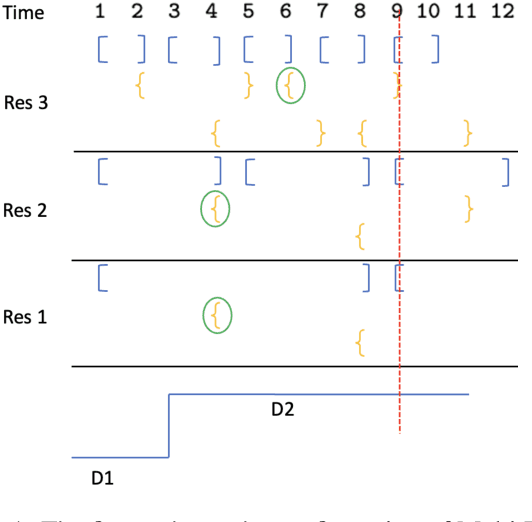
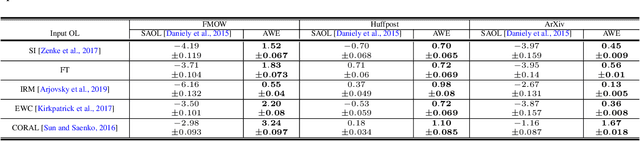
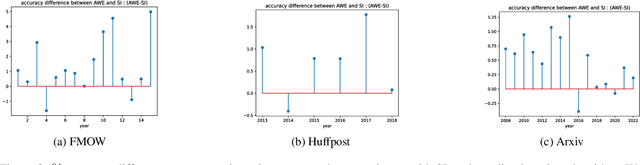
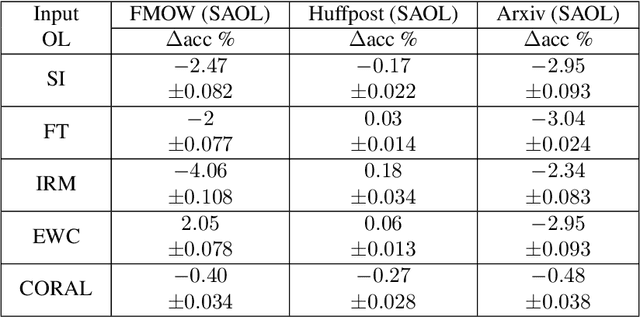
We study the well-motivated problem of online distribution shift in which the data arrive in batches and the distribution of each batch can change arbitrarily over time. Since the shifts can be large or small, abrupt or gradual, the length of the relevant historical data to learn from may vary over time, which poses a major challenge in designing algorithms that can automatically adapt to the best ``attention span'' while remaining computationally efficient. We propose a meta-algorithm that takes any network architecture and any Online Learner (OL) algorithm as input and produces a new algorithm which provably enhances the performance of the given OL under non-stationarity. Our algorithm is efficient (it requires maintaining only $O(\log(T))$ OL instances) and adaptive (it automatically chooses OL instances with the ideal ``attention'' length at every timestamp). Experiments on various real-world datasets across text and image modalities show that our method consistently improves the accuracy of user specified OL algorithms for classification tasks. Key novel algorithmic ingredients include a \emph{multi-resolution instance} design inspired by wavelet theory and a cross-validation-through-time technique. Both could be of independent interest.
Effectively Steer LLM To Follow Preference via Building Confident Directions
Mar 04, 2025Having an LLM that aligns with human preferences is essential for accommodating individual needs, such as maintaining writing style or generating specific topics of interest. The majority of current alignment methods rely on fine-tuning or prompting, which can be either costly or difficult to control. Model steering algorithms, which modify the model output by constructing specific steering directions, are typically easy to implement and optimization-free. However, their capabilities are typically limited to steering the model into one of the two directions (i.e., bidirectional steering), and there has been no theoretical understanding to guarantee their performance. In this work, we propose a theoretical framework to understand and quantify the model steering methods. Inspired by the framework, we propose a confident direction steering method (CONFST) that steers LLMs via modifying their activations at inference time. More specifically, CONFST builds a confident direction that is closely aligned with users' preferences, and this direction is then added to the activations of the LLMs to effectively steer the model output. Our approach offers three key advantages over popular bidirectional model steering methods: 1) It is more powerful, since multiple (i.e. more than two) users' preferences can be aligned simultaneously; 2) It is simple to implement, since there is no need to determine which layer to add the steering vector to; 3) No explicit user instruction is required. We validate our method on GPT-2 XL (1.5B), Mistral (7B) and Gemma-it (9B) models for tasks that require shifting the output of LLMs across various topics and styles, achieving superior performance over competing methods.
Enhancing Foundation Models for Time Series Forecasting via Wavelet-based Tokenization
Dec 06, 2024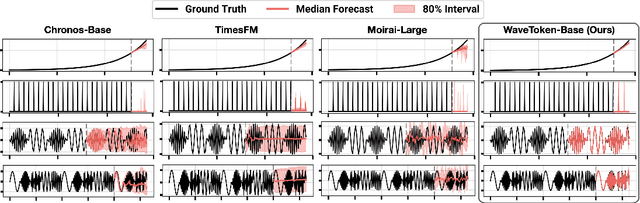
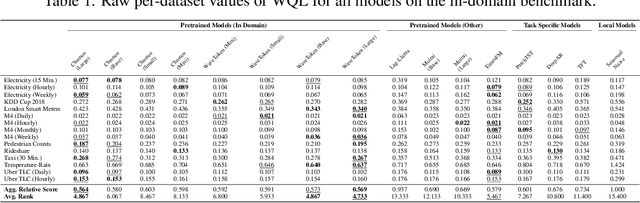
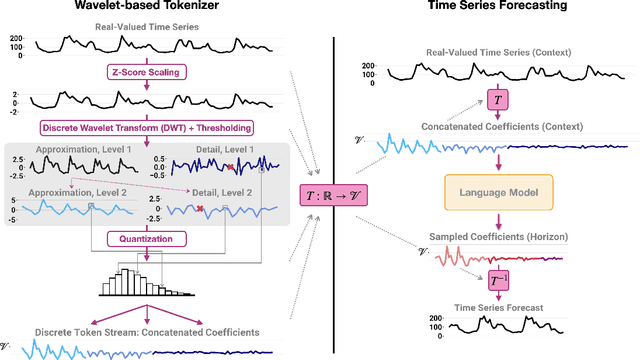
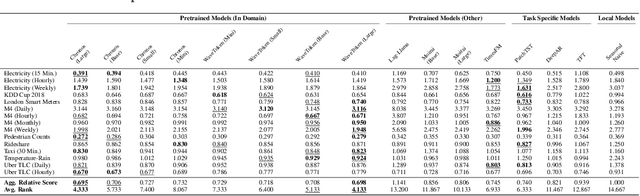
How to best develop foundational models for time series forecasting remains an important open question. Tokenization is a crucial consideration in this effort: what is an effective discrete vocabulary for a real-valued sequential input? To address this question, we develop WaveToken, a wavelet-based tokenizer that allows models to learn complex representations directly in the space of time-localized frequencies. Our method first scales and decomposes the input time series, then thresholds and quantizes the wavelet coefficients, and finally pre-trains an autoregressive model to forecast coefficients for the forecast horizon. By decomposing coarse and fine structures in the inputs, wavelets provide an eloquent and compact language for time series forecasting that simplifies learning. Empirical results on a comprehensive benchmark, including 42 datasets for both in-domain and zero-shot settings, show that WaveToken: i) provides better accuracy than recently proposed foundation models for forecasting while using a much smaller vocabulary (1024 tokens), and performs on par or better than modern deep learning models trained specifically on each dataset; and ii) exhibits superior generalization capabilities, achieving the best average rank across all datasets for three complementary metrics. In addition, we show that our method can easily capture complex temporal patterns of practical relevance that are challenging for other recent pre-trained models, including trends, sparse spikes, and non-stationary time series with varying frequencies evolving over time.