 Add to Chrome
 Add to Firefox
 Add to Edge
SenTSR-Bench: Thinking with Injected Knowledge for Time-Series Reasoning
Feb 23, 2026
Time-series diagnostic reasoning is essential for many applications, yet existing solutions face a persistent gap: general reasoning large language models (GRLMs) possess strong reasoning skills but lack the domain-specific knowledge to understand complex time-series patterns. Conversely, fine-tuned time-series LLMs (TSLMs) understand these patterns but lack the capacity to generalize reasoning for more complicated questions. To bridge this gap, we propose a hybrid knowledge-injection framework that injects TSLM-generated insights directly into GRLM's reasoning trace, thereby achieving strong time-series reasoning with in-domain knowledge. As collecting data for knowledge injection fine-tuning is costly, we further leverage a reinforcement learning-based approach with verifiable rewards (RLVR) to elicit knowledge-rich traces without human supervision, then transfer such an in-domain thinking trace into GRLM for efficient knowledge injection. We further release SenTSR-Bench, a multivariate time-series-based diagnostic reasoning benchmark collected from real-world industrial operations. Across SenTSR-Bench and other public datasets, our method consistently surpasses TSLMs by 9.1%-26.1% and GRLMs by 7.9%-22.4%, delivering robust, context-aware time-series diagnostic insights.

M$^2$AD: Multi-Sensor Multi-System Anomaly Detection through Global Scoring and Calibrated Thresholding
Apr 21, 2025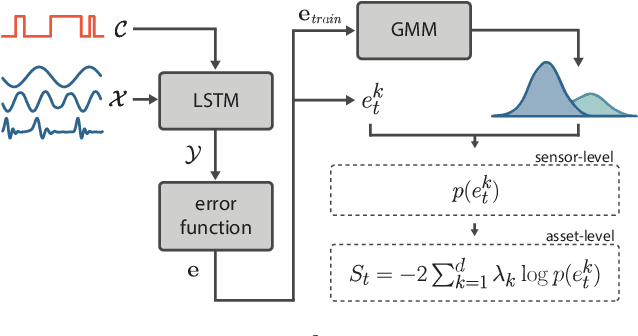
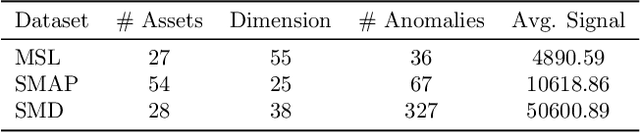
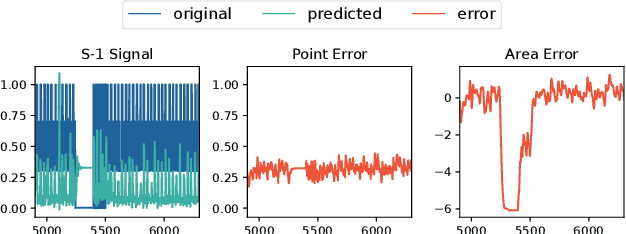
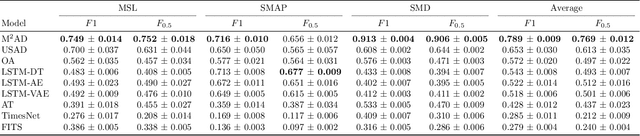
With the widespread availability of sensor data across industrial and operational systems, we frequently encounter heterogeneous time series from multiple systems. Anomaly detection is crucial for such systems to facilitate predictive maintenance. However, most existing anomaly detection methods are designed for either univariate or single-system multivariate data, making them insufficient for these complex scenarios. To address this, we introduce M$^2$AD, a framework for unsupervised anomaly detection in multivariate time series data from multiple systems. M$^2$AD employs deep models to capture expected behavior under normal conditions, using the residuals as indicators of potential anomalies. These residuals are then aggregated into a global anomaly score through a Gaussian Mixture Model and Gamma calibration. We theoretically demonstrate that this framework can effectively address heterogeneity and dependencies across sensors and systems. Empirically, M$^2$AD outperforms existing methods in extensive evaluations by 21% on average, and its effectiveness is demonstrated on a large-scale real-world case study on 130 assets in Amazon Fulfillment Centers. Our code and results are available at https://github.com/sarahmish/M2AD.