 Add to Chrome
 Add to Firefox
 Add to Edge
TurnOPD: Making On-Policy Distillation Turn-Aware for Efficient Long-Horizon Agent Training
Jul 07, 2026
On-policy distillation (OPD) trains a student policy by matching a stronger teacher on the student's own trajectories, offering a promising framework for language agent training. However, its application to long-horizon agentic tasks remains insufficiently explored. We identify two key inefficiencies in vanilla agent OPD: (1) full-horizon rollouts often waste wall-clock resources on tail turns that provide weak and noisy KL supervision, and (2) trajectory-level KL objectives concentrate most of the loss on shallow tokens, leaving deeper decision turns under-trained once initial behaviors are aligned. To address these challenges, we propose TurnOPD, a turn-level budgeting strategy for efficient on-policy distillation of long-horizon agents. TurnOPD consists of two budget controllers: adaptive rollout-depth budgeting, which uses probe-based turn statistics to determine rollout length, and progressive turn-normalized loss budgeting, which gradually shifts KL weighting from token-level to turn-balanced supervision. Experiments on ALFWorld, WebShop, and Multi-Hop Search with task-specialized teacher models show that TurnOPD achieves superior validation accuracy under equal wall-clock training budgets and advances the accuracy--time frontier beyond vanilla OPD.

VeriEvol: Scaling Multimodal Mathematical Reasoning via Verifiable Evol-Instruct
Jun 22, 2026Scaling reinforcement learning for visual mathematical reasoning requires more than generating harder questions: as data volume grows, the reward labels themselves must remain reliable. Yet existing data pipelines scale supervision while trusting the labeller, and policy-side methods assume the underlying answers are already correct. We instead treat scaling as a verifiable data-construction problem and decouple two axes before any policy update: prompt difficulty, expanded by route-specific evolution operators, and answer reliability, enforced by offline hypothesis-test falsification. We instantiate this as VeriEvol, an iterative framework with two extensible components: a type-aware evolution module that rewrites low-difficulty image-question seeds into harder, image-grounded prompts; and HTV-Agent, a verifier that accepts an answer only after multi-source counter-evidence has failed to refute it. The resulting verified data scales in volume, extends by adding evolution routes or verifier channels, and plugs directly into existing GRPO-style RL recipes. On a five-benchmark visual-math suite, scaling evolved SFT data from 10K to 250K samples raises the mean accuracy from 35.42 to 54.73; then, with backbone, SFT initialization, and GRPO recipe held fixed, VeriEvol adds a cumulative +3.88 over an un-evolved RL baseline, of which +1.82 comes from evolved prompts and +2.06 from the HTV-Agent verifier. We release the prompts, data, models, code, and the full verifier trace of every sample, so that downstream work can scale and audit the pipeline rather than only inspect its outputs.
X-Coder: Advancing Competitive Programming with Fully Synthetic Tasks, Solutions, and Tests
Jan 11, 2026Competitive programming presents great challenges for Code LLMs due to its intensive reasoning demands and high logical complexity. However, current Code LLMs still rely heavily on real-world data, which limits their scalability. In this paper, we explore a fully synthetic approach: training Code LLMs with entirely generated tasks, solutions, and test cases, to empower code reasoning models without relying on real-world data. To support this, we leverage feature-based synthesis to propose a novel data synthesis pipeline called SynthSmith. SynthSmith shows strong potential in producing diverse and challenging tasks, along with verified solutions and tests, supporting both supervised fine-tuning and reinforcement learning. Based on the proposed synthetic SFT and RL datasets, we introduce the X-Coder model series, which achieves a notable pass rate of 62.9 avg@8 on LiveCodeBench v5 and 55.8 on v6, outperforming DeepCoder-14B-Preview and AReal-boba2-14B despite having only 7B parameters. In-depth analysis reveals that scaling laws hold on our synthetic dataset, and we explore which dimensions are more effective to scale. We further provide insights into code-centric reinforcement learning and highlight the key factors that shape performance through detailed ablations and analysis. Our findings demonstrate that scaling high-quality synthetic data and adopting staged training can greatly advance code reasoning, while mitigating reliance on real-world coding data.
A.S.E: A Repository-Level Benchmark for Evaluating Security in AI-Generated Code
Aug 25, 2025The increasing adoption of large language models (LLMs) in software engineering necessitates rigorous security evaluation of their generated code. However, existing benchmarks are inadequate, as they focus on isolated code snippets, employ unstable evaluation methods that lack reproducibility, and fail to connect the quality of input context with the security of the output. To address these gaps, we introduce A.S.E (AI Code Generation Security Evaluation), a benchmark for repository-level secure code generation. A.S.E constructs tasks from real-world repositories with documented CVEs, preserving full repository context like build systems and cross-file dependencies. Its reproducible, containerized evaluation framework uses expert-defined rules to provide stable, auditable assessments of security, build quality, and generation stability. Our evaluation of leading LLMs on A.S.E reveals three key findings: (1) Claude-3.7-Sonnet achieves the best overall performance. (2) The security gap between proprietary and open-source models is narrow; Qwen3-235B-A22B-Instruct attains the top security score. (3) Concise, ``fast-thinking'' decoding strategies consistently outperform complex, ``slow-thinking'' reasoning for security patching.
PeRL: Permutation-Enhanced Reinforcement Learning for Interleaved Vision-Language Reasoning
Jun 17, 2025Inspired by the impressive reasoning capabilities demonstrated by reinforcement learning approaches like DeepSeek-R1, recent emerging research has begun exploring the use of reinforcement learning (RL) to enhance vision-language models (VLMs) for multimodal reasoning tasks. However, most existing multimodal reinforcement learning approaches remain limited to spatial reasoning within single-image contexts, yet still struggle to generalize to more complex and real-world scenarios involving multi-image positional reasoning, where understanding the relationships across images is crucial. To address this challenge, we propose a general reinforcement learning approach PeRL tailored for interleaved multimodal tasks, and a multi-stage strategy designed to enhance the exploration-exploitation trade-off, thereby improving learning efficiency and task performance. Specifically, we introduce permutation of image sequences to simulate varied positional relationships to explore more spatial and positional diversity. Furthermore, we design a rollout filtering mechanism for resampling to focus on trajectories that contribute most to learning optimal behaviors to exploit learned policies effectively. We evaluate our model on 5 widely-used multi-image benchmarks and 3 single-image benchmarks. Our experiments confirm that PeRL trained model consistently surpasses R1-related and interleaved VLM baselines by a large margin, achieving state-of-the-art performance on multi-image benchmarks, while preserving comparable performance on single-image tasks.
Zero-P-to-3: Zero-Shot Partial-View Images to 3D Object
May 29, 2025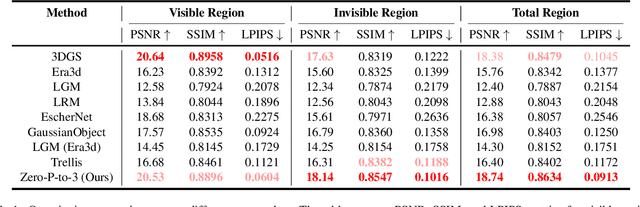
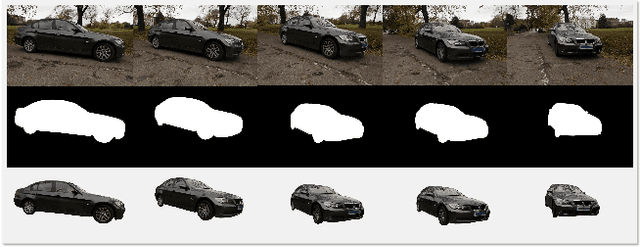
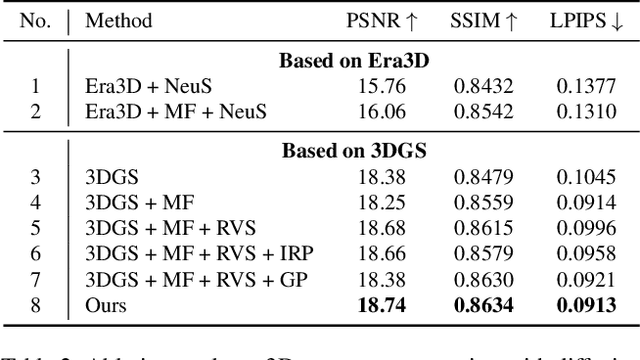
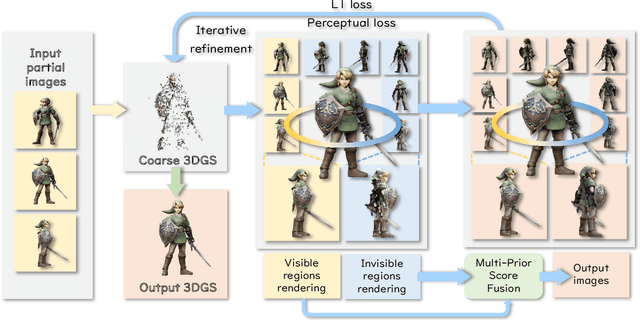
Generative 3D reconstruction shows strong potential in incomplete observations. While sparse-view and single-image reconstruction are well-researched, partial observation remains underexplored. In this context, dense views are accessible only from a specific angular range, with other perspectives remaining inaccessible. This task presents two main challenges: (i) limited View Range: observations confined to a narrow angular scope prevent effective traditional interpolation techniques that require evenly distributed perspectives. (ii) inconsistent Generation: views created for invisible regions often lack coherence with both visible regions and each other, compromising reconstruction consistency. To address these challenges, we propose \method, a novel training-free approach that integrates the local dense observations and multi-source priors for reconstruction. Our method introduces a fusion-based strategy to effectively align these priors in DDIM sampling, thereby generating multi-view consistent images to supervise invisible views. We further design an iterative refinement strategy, which uses the geometric structures of the object to enhance reconstruction quality. Extensive experiments on multiple datasets show the superiority of our method over SOTAs, especially in invisible regions.
IterPref: Focal Preference Learning for Code Generation via Iterative Debugging
Mar 04, 2025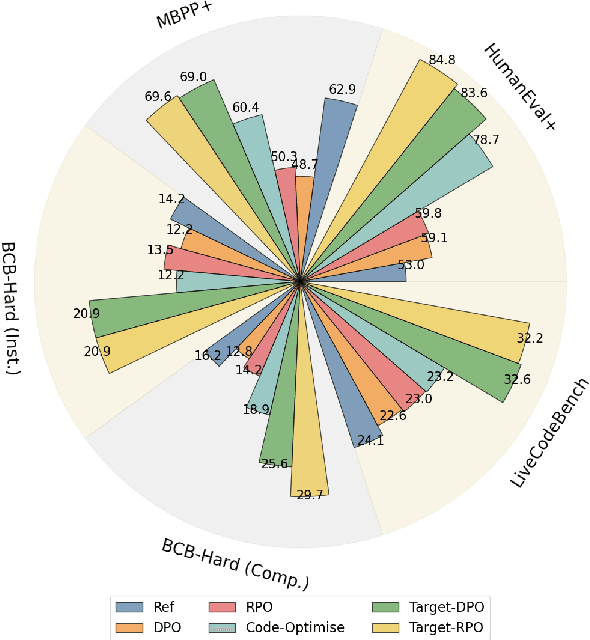
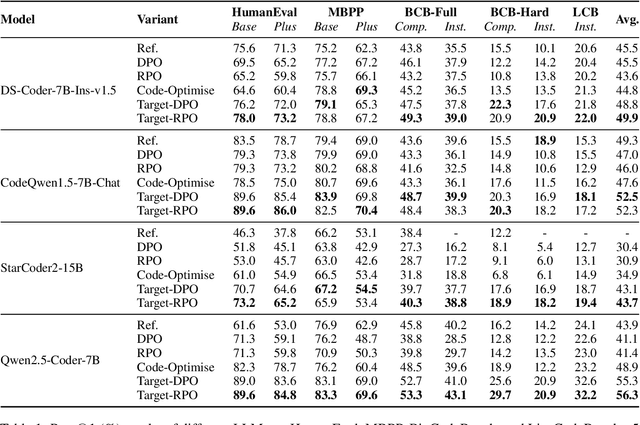
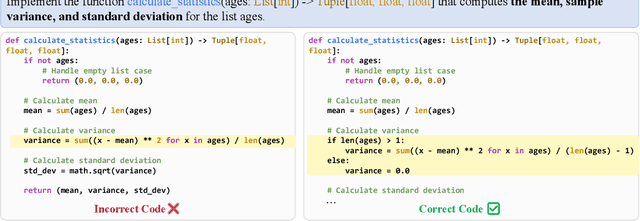

Preference learning enhances Code LLMs beyond supervised fine-tuning by leveraging relative quality comparisons. Existing methods construct preference pairs from candidates based on test case success, treating the higher pass rate sample as positive and the lower as negative. However, this approach does not pinpoint specific errors in the code, which prevents the model from learning more informative error correction patterns, as aligning failing code as a whole lacks the granularity needed to capture meaningful error-resolution relationships. To address these issues, we propose IterPref, a new preference alignment framework that mimics human iterative debugging to refine Code LLMs. IterPref explicitly locates error regions and aligns the corresponding tokens via a tailored DPO algorithm. To generate informative pairs, we introduce the CodeFlow dataset, where samples are iteratively refined until passing tests, with modifications capturing error corrections. Extensive experiments show that a diverse suite of Code LLMs equipped with IterPref achieves significant performance gains in code generation and improves on challenging tasks like BigCodeBench. In-depth analysis reveals that IterPref yields fewer errors. Our code and data will be made publicaly available.
EpiCoder: Encompassing Diversity and Complexity in Code Generation
Jan 08, 2025Effective instruction tuning is indispensable for optimizing code LLMs, aligning model behavior with user expectations and enhancing model performance in real-world applications. However, most existing methods focus on code snippets, which are limited to specific functionalities and rigid structures, restricting the complexity and diversity of the synthesized data. To address these limitations, we introduce a novel feature tree-based synthesis framework inspired by Abstract Syntax Trees (AST). Unlike AST, which captures syntactic structure of code, our framework models semantic relationships between code elements, enabling the generation of more nuanced and diverse data. The feature tree is constructed from raw data and refined iteratively to increase the quantity and diversity of the extracted features. This process enables the identification of more complex patterns and relationships within the code. By sampling subtrees with controlled depth and breadth, our framework allows precise adjustments to the complexity of the generated code, supporting a wide range of tasks from simple function-level operations to intricate multi-file scenarios. We fine-tuned widely-used base models to create the EpiCoder series, achieving state-of-the-art performance at both the function and file levels across multiple benchmarks. Notably, empirical evidence indicates that our approach shows significant potential in synthesizing highly complex repository-level code data. Further analysis elucidates the merits of this approach by rigorously assessing data complexity and diversity through software engineering principles and LLM-as-a-judge method.
Velocitune: A Velocity-based Dynamic Domain Reweighting Method for Continual Pre-training
Nov 21, 2024
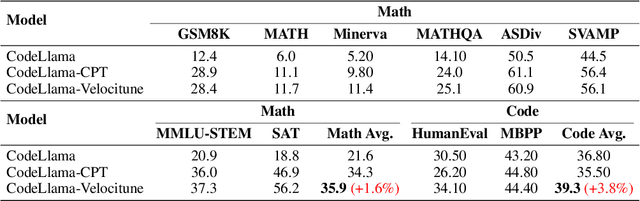


It is well-known that a diverse corpus is critical for training large language models, which are typically constructed from a mixture of various domains. In general, previous efforts resort to sampling training data from different domains with static proportions, as well as adjusting data proportions during training. However, few methods have addressed the complexities of domain-adaptive continual pre-training. To fill this gap, we propose Velocitune, a novel framework dynamically assesses learning velocity and adjusts data proportions accordingly, favoring slower-learning domains while shunning faster-learning ones, which is guided by a scaling law to indicate the desired learning goal for each domain with less associated cost. To evaluate the effectiveness of Velocitune, we conduct experiments in a reasoning-focused dataset with CodeLlama, as well as in a corpus specialised for system command generation with Llama3 and Mistral. Velocitune achieves performance gains in both math and code reasoning tasks and command-line generation benchmarks. Further analysis reveals that key factors driving Velocitune's effectiveness include target loss prediction and data ordering.
On the Evaluation Consistency of Attribution-based Explanations
Jul 28, 2024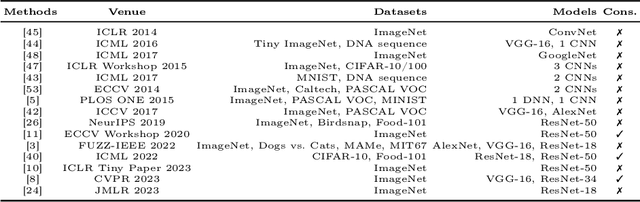
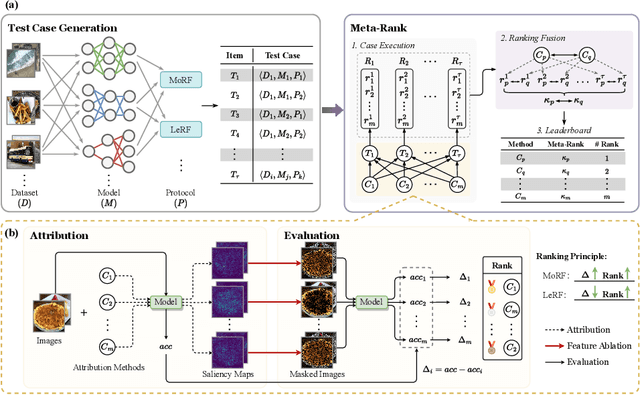
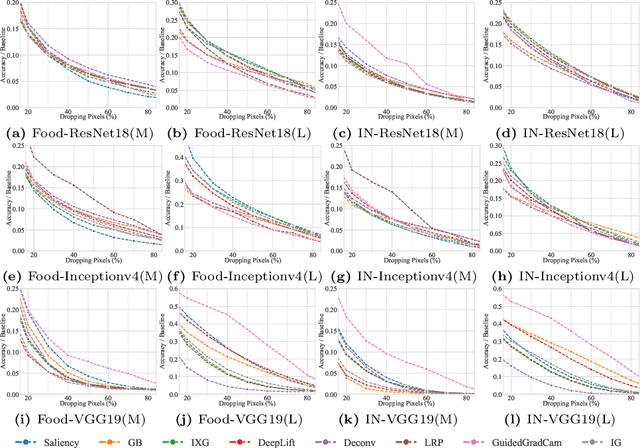
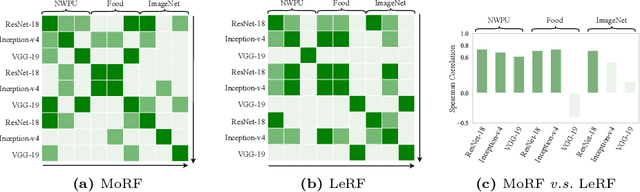
Attribution-based explanations are garnering increasing attention recently and have emerged as the predominant approach towards \textit{eXplanable Artificial Intelligence}~(XAI). However, the absence of consistent configurations and systematic investigations in prior literature impedes comprehensive evaluations of existing methodologies. In this work, we introduce {Meta-Rank}, an open platform for benchmarking attribution methods in the image domain. Presently, Meta-Rank assesses eight exemplary attribution methods using six renowned model architectures on four diverse datasets, employing both the \textit{Most Relevant First} (MoRF) and \textit{Least Relevant First} (LeRF) evaluation protocols. Through extensive experimentation, our benchmark reveals three insights in attribution evaluation endeavors: 1) evaluating attribution methods under disparate settings can yield divergent performance rankings; 2) although inconsistent across numerous cases, the performance rankings exhibit remarkable consistency across distinct checkpoints along the same training trajectory; 3) prior attempts at consistent evaluation fare no better than baselines when extended to more heterogeneous models and datasets. Our findings underscore the necessity for future research in this domain to conduct rigorous evaluations encompassing a broader range of models and datasets, and to reassess the assumptions underlying the empirical success of different attribution methods. Our code is publicly available at \url{https://github.com/TreeThree-R/Meta-Rank}.