 Add to Chrome
 Add to Firefox
 Add to Edge
TestExplora: Benchmarking LLMs for Proactive Bug Discovery via Repository-Level Test Generation
Feb 11, 2026
Given that Large Language Models (LLMs) are increasingly applied to automate software development, comprehensive software assurance spans three distinct goals: regression prevention, reactive reproduction, and proactive discovery. Current evaluations systematically overlook the third goal. Specifically, they either treat existing code as ground truth (a compliance trap) for regression prevention, or depend on post-failure artifacts (e.g., issue reports) for bug reproduction-so they rarely surface defects before failures. To bridge this gap, we present TestExplora, a benchmark designed to evaluate LLMs as proactive testers within full-scale, realistic repository environments. TestExplora contains 2,389 tasks from 482 repositories and hides all defect-related signals. Models must proactively find bugs by comparing implementations against documentation-derived intent, using documentation as the oracle. Furthermore, to keep evaluation sustainable and reduce leakage, we propose continuous, time-aware data collection. Our evaluation reveals a significant capability gap: state-of-the-art models achieve a maximum Fail-to-Pass (F2P) rate of only 16.06%. Further analysis indicates that navigating complex cross-module interactions and leveraging agentic exploration are critical to advancing LLMs toward autonomous software quality assurance. Consistent with this, SWEAgent instantiated with GPT-5-mini achieves an F2P of 17.27% and an F2P@5 of 29.7%, highlighting the effectiveness and promise of agentic exploration in proactive bug discovery tasks.

Closing the Loop: Universal Repository Representation with RPG-Encoder
Feb 03, 2026Current repository agents encounter a reasoning disconnect due to fragmented representations, as existing methods rely on isolated API documentation or dependency graphs that lack semantic depth. We consider repository comprehension and generation to be inverse processes within a unified cycle: generation expands intent into implementation, while comprehension compresses implementation back into intent. To address this, we propose RPG-Encoder, a framework that generalizes the Repository Planning Graph (RPG) from a static generative blueprint into a unified, high-fidelity representation. RPG-Encoder closes the reasoning loop through three mechanisms: (1) Encoding raw code into the RPG that combines lifted semantic features with code dependencies; (2) Evolving the topology incrementally to decouple maintenance costs from repository scale, reducing overhead by 95.7%; and (3) Operating as a unified interface for structure-aware navigation. In evaluations, RPG-Encoder establishes state-of-the-art localization performance on SWE-bench Verified with 93.7% Acc@5 and exceeds the best baseline by over 10% in localization accuracy on SWE-bench Live Lite. These results highlight our superior fine-grained precision in complex codebases. Furthermore, it achieves 98.5% reconstruction coverage on RepoCraft, confirming RPG's high-fidelity capacity to mirror the original codebase and closing the loop between intent and implementation.
X-Coder: Advancing Competitive Programming with Fully Synthetic Tasks, Solutions, and Tests
Jan 11, 2026Competitive programming presents great challenges for Code LLMs due to its intensive reasoning demands and high logical complexity. However, current Code LLMs still rely heavily on real-world data, which limits their scalability. In this paper, we explore a fully synthetic approach: training Code LLMs with entirely generated tasks, solutions, and test cases, to empower code reasoning models without relying on real-world data. To support this, we leverage feature-based synthesis to propose a novel data synthesis pipeline called SynthSmith. SynthSmith shows strong potential in producing diverse and challenging tasks, along with verified solutions and tests, supporting both supervised fine-tuning and reinforcement learning. Based on the proposed synthetic SFT and RL datasets, we introduce the X-Coder model series, which achieves a notable pass rate of 62.9 avg@8 on LiveCodeBench v5 and 55.8 on v6, outperforming DeepCoder-14B-Preview and AReal-boba2-14B despite having only 7B parameters. In-depth analysis reveals that scaling laws hold on our synthetic dataset, and we explore which dimensions are more effective to scale. We further provide insights into code-centric reinforcement learning and highlight the key factors that shape performance through detailed ablations and analysis. Our findings demonstrate that scaling high-quality synthetic data and adopting staged training can greatly advance code reasoning, while mitigating reliance on real-world coding data.
RPG: A Repository Planning Graph for Unified and Scalable Codebase Generation
Sep 19, 2025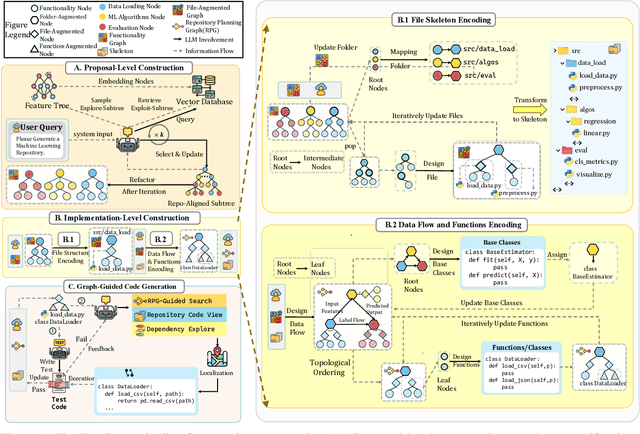
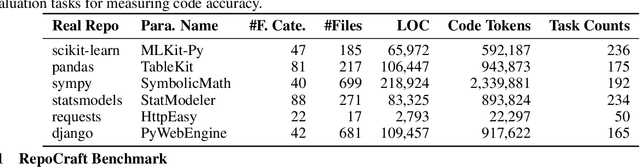
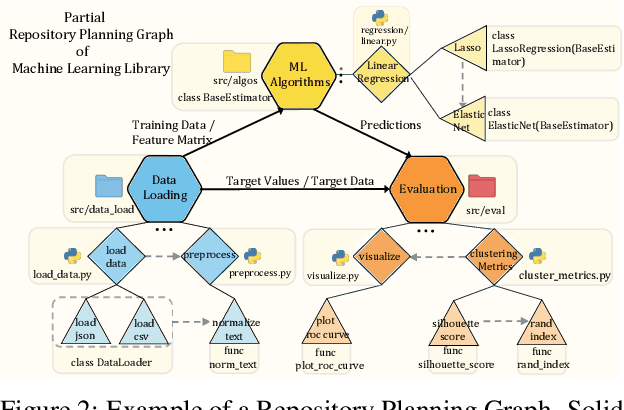
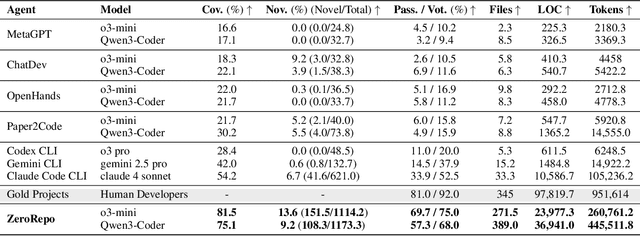
Large language models excel at function- and file-level code generation, yet generating complete repositories from scratch remains a fundamental challenge. This process demands coherent and reliable planning across proposal- and implementation-level stages, while natural language, due to its ambiguity and verbosity, is ill-suited for faithfully representing complex software structures. To address this, we introduce the Repository Planning Graph (RPG), a persistent representation that unifies proposal- and implementation-level planning by encoding capabilities, file structures, data flows, and functions in one graph. RPG replaces ambiguous natural language with an explicit blueprint, enabling long-horizon planning and scalable repository generation. Building on RPG, we develop ZeroRepo, a graph-driven framework for repository generation from scratch. It operates in three stages: proposal-level planning and implementation-level refinement to construct the graph, followed by graph-guided code generation with test validation. To evaluate this setting, we construct RepoCraft, a benchmark of six real-world projects with 1,052 tasks. On RepoCraft, ZeroRepo produces repositories averaging nearly 36K LOC, roughly 3.9$\times$ the strongest baseline (Claude Code) and about 64$\times$ other baselines. It attains 81.5% functional coverage and a 69.7% pass rate, exceeding Claude Code by 27.3 and 35.8 percentage points, respectively. Further analysis shows that RPG models complex dependencies, enables progressively more sophisticated planning through near-linear scaling, and enhances LLM understanding of repositories, thereby accelerating agent localization.