 Add to Chrome
 Add to Firefox
 Add to Edge
ResearchStudio-Reel: Automate the Last Mile of Research from Paper to Poster, Video, and Blog
Jul 05, 2026
Research dissemination, turning a paper into a poster, a talk video, and a blog post, is still a manual last mile. Prior automation treats each artifact in isolation that each re-extract the paper from scratch, usually ship one-way renders the author cannot reopen in PowerPoint or Word, and gates quality on soft VLM-preference scores that plateau while load-bearing sections still read as empty. We argue this last mile is best built as a composition of skills: thin agent-readable contracts that share one upstream extractor and wrap deterministic primitives in a measured-fill loop whose exits are hard pass/fail render gates. We instantiate this as ResearchStudio-Reel, five Claude Code and Codex skills organized into one shared extractor (Paper2Assets), three editable generators (Paper2Poster, Paper2Video, Paper2Blog), and one interactive convergence layer (Paper2Reel). Paper2Assets extracts each paper once into a shared bundle that can be reused by every downstream skill; The three generators produce a print-ready poster, a synchronized talk video, and a bilingual blog that stay factually consistent and round-trip through PowerPoint or Word; Paper2Reel then binds all three into a self-contained HTML viewer whose section-level clicks jump the video, slides, captions, and blog to matching content. On the Paper2Poster benchmark, our posters lead every aesthetic and information sub-criterion against both prior automated systems and single-shot frontier LLMs, surpassing the authors' own on aesthetics under two held-out VLM judges and winning overall on 84% to 93% of papers; capability audits further show that, by uniquely pairing narration-aligned on-slide highlights with a bilingual blog gated by layout-aware DOCX repair, ResearchStudio-Reel is the only pipeline to ship all three editable artifacts. Project is available at https://aka.ms/ResearchStudio

ResearchStudio-Idea: An Evidence-Grounded Research-Ideation Skill Suite from ML Conference Outcomes
Jul 05, 2026Large language models have made research ideation increasingly accessible, yet effective idea development requires more than generating candidate directions. Researchers must ground a problem in current literature, identify meaningful bottlenecks, differentiate from existing solutions, and evaluate risks before committing to implementation. We present ResearchStudio-Idea as a reusable skill suite for this first mile of research ideation. The suite includes Paper-Search, a standalone multi-source literature search skill; Scoop-Check, a standalone prior-art collision checker for novelty claims; and IdeaSpark, the end-to-end skill that composes evidence grounding, pattern-guided generation, collision retrieval, audit, and idea-card rendering into one workflow. IdeaSpark is constructed from a corpus of 1,947 machine learning conference papers collected from ICLR, ICML, and NeurIPS between 2021 and 2025, including Oral papers, a separately tracked high-citation subset, and rejected submissions. Analysis of these outcomes reveals 31 recurring ideation sub-patterns, consolidated into 15 reusable ideation patterns. Each pattern is operationalized as a structured card containing research contexts, bottleneck types, differentiation strategies, supporting precedents, and common failure modes. Given a research problem and an evidence bundle, IdeaSpark evaluates evidence readiness, reconstructs the surrounding research context, identifies unresolved bottlenecks, selects relevant patterns, instantiates one candidate direction, retrieves potentially conflicting prior work, and performs outcome-informed auditing. This workflow transforms reusable ideation patterns into traceable research proposals. Blind automated-judge evaluations show that IdeaSpark consistently produces stronger research proposals than no-skill and generic-skill baselines while maintaining competitive novelty.
Demystifying Data Organization for Enhanced LLM Training
May 28, 2026Large Language Models (LLMs) have revolutionized various fields, yet their training efficiency is heavily reliant on effective data curation. While data selection has been widely studied, the strategic data organization for enhanced training remains an underexplored area, particularly since current LLMs are often trained for only one or a few epochs. This paper systematically explores the influence of data organization on LLM training by reusing pre-computed sample-level scores originally generated for data efficiency, thereby incurring minimal additional computational overhead. We identify and formalize four key guidelines for optimizing data organization: Boundary Sharpening, Cyclic Scheduling, Curriculum Continuity, and Local Diversity. Guided by them, we introduce two novel data ordering methods termed STR and SAW. Extensive experiments across different model scales and data sizes, encompassing both pre-training and SFT stages, validate the effectiveness of our summarized guidelines. They also demonstrate the robustness of our proposed data ordering methods in enhancing the stability and performance of LLM training. Github Link: https://github.com/microsoft/data-efficacy/
TestExplora: Benchmarking LLMs for Proactive Bug Discovery via Repository-Level Test Generation
Feb 11, 2026Given that Large Language Models (LLMs) are increasingly applied to automate software development, comprehensive software assurance spans three distinct goals: regression prevention, reactive reproduction, and proactive discovery. Current evaluations systematically overlook the third goal. Specifically, they either treat existing code as ground truth (a compliance trap) for regression prevention, or depend on post-failure artifacts (e.g., issue reports) for bug reproduction-so they rarely surface defects before failures. To bridge this gap, we present TestExplora, a benchmark designed to evaluate LLMs as proactive testers within full-scale, realistic repository environments. TestExplora contains 2,389 tasks from 482 repositories and hides all defect-related signals. Models must proactively find bugs by comparing implementations against documentation-derived intent, using documentation as the oracle. Furthermore, to keep evaluation sustainable and reduce leakage, we propose continuous, time-aware data collection. Our evaluation reveals a significant capability gap: state-of-the-art models achieve a maximum Fail-to-Pass (F2P) rate of only 16.06%. Further analysis indicates that navigating complex cross-module interactions and leveraging agentic exploration are critical to advancing LLMs toward autonomous software quality assurance. Consistent with this, SWEAgent instantiated with GPT-5-mini achieves an F2P of 17.27% and an F2P@5 of 29.7%, highlighting the effectiveness and promise of agentic exploration in proactive bug discovery tasks.
Closing the Loop: Universal Repository Representation with RPG-Encoder
Feb 03, 2026Current repository agents encounter a reasoning disconnect due to fragmented representations, as existing methods rely on isolated API documentation or dependency graphs that lack semantic depth. We consider repository comprehension and generation to be inverse processes within a unified cycle: generation expands intent into implementation, while comprehension compresses implementation back into intent. To address this, we propose RPG-Encoder, a framework that generalizes the Repository Planning Graph (RPG) from a static generative blueprint into a unified, high-fidelity representation. RPG-Encoder closes the reasoning loop through three mechanisms: (1) Encoding raw code into the RPG that combines lifted semantic features with code dependencies; (2) Evolving the topology incrementally to decouple maintenance costs from repository scale, reducing overhead by 95.7%; and (3) Operating as a unified interface for structure-aware navigation. In evaluations, RPG-Encoder establishes state-of-the-art localization performance on SWE-bench Verified with 93.7% Acc@5 and exceeds the best baseline by over 10% in localization accuracy on SWE-bench Live Lite. These results highlight our superior fine-grained precision in complex codebases. Furthermore, it achieves 98.5% reconstruction coverage on RepoCraft, confirming RPG's high-fidelity capacity to mirror the original codebase and closing the loop between intent and implementation.
MuseAgent-1: Interactive Grounded Multimodal Understanding of Music Scores and Performance Audio
Jan 17, 2026Despite recent advances in multimodal large language models (MLLMs), their ability to understand and interact with music remains limited. Music understanding requires grounded reasoning over symbolic scores and expressive performance audio, which general-purpose MLLMs often fail to handle due to insufficient perceptual grounding. We introduce MuseAgent, a music-centric multimodal agent that augments language models with structured symbolic representations derived from sheet music images and performance audio. By integrating optical music recognition and automatic music transcription modules, MuseAgent enables multi-step reasoning and interaction over fine-grained musical content. To systematically evaluate music understanding capabilities, we further propose MuseBench, a benchmark covering music theory reasoning, score interpretation, and performance-level analysis across text, image, and audio modalities. Experiments show that existing MLLMs perform poorly on these tasks, while MuseAgent achieves substantial improvements, highlighting the importance of structured multimodal grounding for interactive music understanding.
X-Coder: Advancing Competitive Programming with Fully Synthetic Tasks, Solutions, and Tests
Jan 11, 2026Competitive programming presents great challenges for Code LLMs due to its intensive reasoning demands and high logical complexity. However, current Code LLMs still rely heavily on real-world data, which limits their scalability. In this paper, we explore a fully synthetic approach: training Code LLMs with entirely generated tasks, solutions, and test cases, to empower code reasoning models without relying on real-world data. To support this, we leverage feature-based synthesis to propose a novel data synthesis pipeline called SynthSmith. SynthSmith shows strong potential in producing diverse and challenging tasks, along with verified solutions and tests, supporting both supervised fine-tuning and reinforcement learning. Based on the proposed synthetic SFT and RL datasets, we introduce the X-Coder model series, which achieves a notable pass rate of 62.9 avg@8 on LiveCodeBench v5 and 55.8 on v6, outperforming DeepCoder-14B-Preview and AReal-boba2-14B despite having only 7B parameters. In-depth analysis reveals that scaling laws hold on our synthetic dataset, and we explore which dimensions are more effective to scale. We further provide insights into code-centric reinforcement learning and highlight the key factors that shape performance through detailed ablations and analysis. Our findings demonstrate that scaling high-quality synthetic data and adopting staged training can greatly advance code reasoning, while mitigating reliance on real-world coding data.
RPG: A Repository Planning Graph for Unified and Scalable Codebase Generation
Sep 19, 2025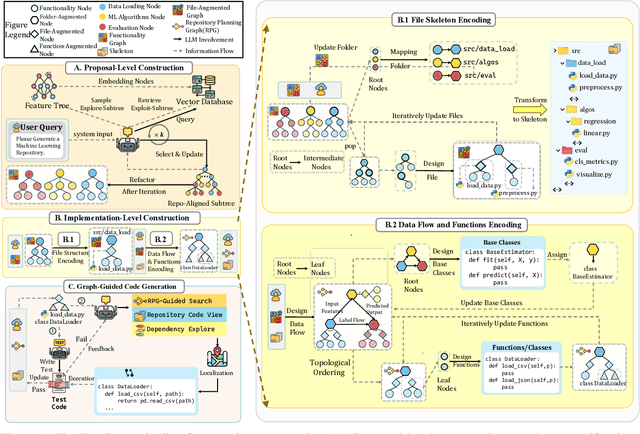
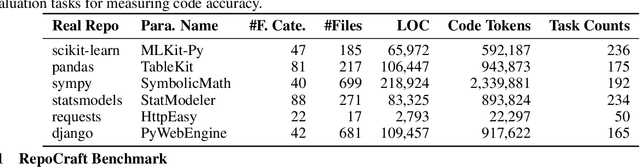
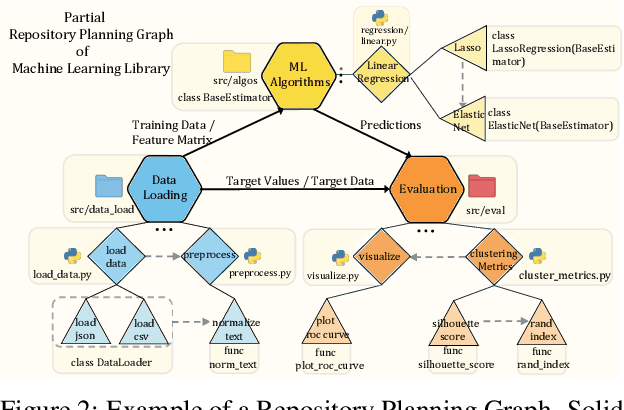
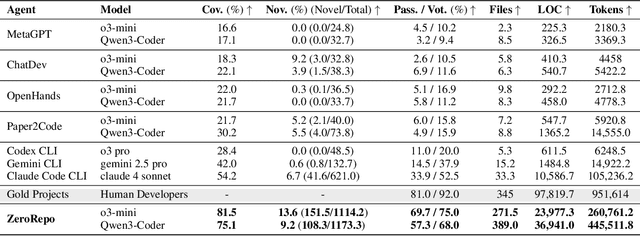
Large language models excel at function- and file-level code generation, yet generating complete repositories from scratch remains a fundamental challenge. This process demands coherent and reliable planning across proposal- and implementation-level stages, while natural language, due to its ambiguity and verbosity, is ill-suited for faithfully representing complex software structures. To address this, we introduce the Repository Planning Graph (RPG), a persistent representation that unifies proposal- and implementation-level planning by encoding capabilities, file structures, data flows, and functions in one graph. RPG replaces ambiguous natural language with an explicit blueprint, enabling long-horizon planning and scalable repository generation. Building on RPG, we develop ZeroRepo, a graph-driven framework for repository generation from scratch. It operates in three stages: proposal-level planning and implementation-level refinement to construct the graph, followed by graph-guided code generation with test validation. To evaluate this setting, we construct RepoCraft, a benchmark of six real-world projects with 1,052 tasks. On RepoCraft, ZeroRepo produces repositories averaging nearly 36K LOC, roughly 3.9$\times$ the strongest baseline (Claude Code) and about 64$\times$ other baselines. It attains 81.5% functional coverage and a 69.7% pass rate, exceeding Claude Code by 27.3 and 35.8 percentage points, respectively. Further analysis shows that RPG models complex dependencies, enables progressively more sophisticated planning through near-linear scaling, and enhances LLM understanding of repositories, thereby accelerating agent localization.
Data Efficacy for Language Model Training
Jun 26, 2025Data is fundamental to the training of language models (LM). Recent research has been dedicated to data efficiency, which aims to maximize performance by selecting a minimal or optimal subset of training data. Techniques such as data filtering, sampling, and selection play a crucial role in this area. To complement it, we define Data Efficacy, which focuses on maximizing performance by optimizing the organization of training data and remains relatively underexplored. This work introduces a general paradigm, DELT, for considering data efficacy in LM training, which highlights the significance of training data organization. DELT comprises three components: Data Scoring, Data Selection, and Data Ordering. Among these components, we design Learnability-Quality Scoring (LQS), as a new instance of Data Scoring, which considers both the learnability and quality of each data sample from the gradient consistency perspective. We also devise Folding Ordering (FO), as a novel instance of Data Ordering, which addresses issues such as model forgetting and data distribution bias. Comprehensive experiments validate the data efficacy in LM training, which demonstrates the following: Firstly, various instances of the proposed DELT enhance LM performance to varying degrees without increasing the data scale and model size. Secondly, among these instances, the combination of our proposed LQS for data scoring and Folding for data ordering achieves the most significant improvement. Lastly, data efficacy can be achieved together with data efficiency by applying data selection. Therefore, we believe that data efficacy is a promising foundational area in LM training.
FEA-Bench: A Benchmark for Evaluating Repository-Level Code Generation for Feature Implementation
Mar 09, 2025Implementing new features in repository-level codebases is a crucial application of code generation models. However, current benchmarks lack a dedicated evaluation framework for this capability. To fill this gap, we introduce FEA-Bench, a benchmark designed to assess the ability of large language models (LLMs) to perform incremental development within code repositories. We collect pull requests from 83 GitHub repositories and use rule-based and intent-based filtering to construct task instances focused on new feature development. Each task instance containing code changes is paired with relevant unit test files to ensure that the solution can be verified. The feature implementation requires LLMs to simultaneously possess code completion capabilities for new components and code editing abilities for other relevant parts in the code repository, providing a more comprehensive evaluation method of LLMs' automated software engineering capabilities. Experimental results show that LLMs perform significantly worse in the FEA-Bench, highlighting considerable challenges in such repository-level incremental code development.