 Add to Chrome
 Add to Firefox
 Add to Edge
BiNSGPS: Geometry Problem Solving via Bidirectional Neuro-Symbolic Interaction
Jun 03, 2026
Geometry problem solving poses distinct challenges in artificial intelligence. Existing approaches typically fall into two paradigms: symbolic methods, which exhibit limited adaptability, and neural methods, which are prone to hallucinations. Recent neuro-symbolic hybrids predominantly rely on a unidirectional pipeline where neural outputs are fed into solvers without feedback, making system brittle to early-stage errors. To break this unidirectional bottleneck, we propose BiNSGPS, a framework that establishes Bidirectional Neuro-Symbolic Interaction (BiNS) between a MLLM Adviser and a Symbolic Solver. MLLM Adviser actively incorporates feedback from the symbolic solver to dynamically rectify inconsistent formal representations or propose auxiliary hypotheses, resolving symbolic conflicts and facilitating complex deductions.

Geoparsing: Diagram Parsing for Plane and Solid Geometry with a Unified Formal Language
Apr 13, 2026Multimodal Large Language Models (MLLMs) have achieved remarkable progress but continue to struggle with geometric reasoning, primarily due to the perception bottleneck regarding fine-grained visual elements. While formal languages have aided plane geometry understanding, solid geometry which requires spatial understanding remains largely unexplored. In this paper, we address this challenge by designing a unified formal language that integrates plane and solid geometry, comprehensively covering geometric structures and semantic relations. We construct GDP-29K, a large-scale dataset comprising 20k plane and 9k solid geometry samples collected from diverse real-world sources, each paired with its ground-truth formal description. To ensure syntactic correctness and geometric consistency, we propose a training paradigm that combines Supervised Fine-Tuning with Reinforcement Learning via Verifiable Rewards. Experiments show that our approach achieves state-of-the-art parsing performance. Furthermore, we demonstrate that our parsed formal descriptions serve as a critical cognitive scaffold, significantly boosting MLLMs' capabilities for downstream geometry reasoning tasks. Our data and code are available at Geoparsing.
VLM-Loc: Localization in Point Cloud Maps via Vision-Language Models
Mar 10, 2026Text-to-point-cloud (T2P) localization aims to infer precise spatial positions within 3D point cloud maps from natural language descriptions, reflecting how humans perceive and communicate spatial layouts through language. However, existing methods largely rely on shallow text-point cloud correspondence without effective spatial reasoning, limiting their accuracy in complex environments. To address this limitation, we propose VLM-Loc, a framework that leverages the spatial reasoning capability of large vision-language models (VLMs) for T2P localization. Specifically, we transform point clouds into bird's-eye-view (BEV) images and scene graphs that jointly encode geometric and semantic context, providing structured inputs for the VLM to learn cross-modal representations bridging linguistic and spatial semantics. On top of these representations, we introduce a partial node assignment mechanism that explicitly associates textual cues with scene graph nodes, enabling interpretable spatial reasoning for accurate localization. To facilitate systematic evaluation across diverse scenes, we present CityLoc, a benchmark built from multi-source point clouds for fine-grained T2P localization. Experiments on CityLoc demonstrate VLM-Loc achieves superior accuracy and robustness compared to state-of-the-art methods. Our code, model, and dataset are available at \href{https://github.com/MCG-NKU/nku-3d-vision}{repository}.
Do MLLMs Really Understand Space? A Mathematical Reasoning Evaluation
Feb 12, 2026Multimodal large language models (MLLMs) have achieved strong performance on perception-oriented tasks, yet their ability to perform mathematical spatial reasoning, defined as the capacity to parse and manipulate two- and three-dimensional relations, remains unclear. Humans easily solve textbook-style spatial reasoning problems with over 95\% accuracy, but we find that most leading MLLMs fail to reach even 60\% on the same tasks. This striking gap highlights spatial reasoning as a fundamental weakness of current models. To investigate this gap, we present MathSpatial, a unified framework for evaluating and improving spatial reasoning in MLLMs. MathSpatial includes three complementary components: (i) MathSpatial-Bench, a benchmark of 2K problems across three categories and eleven subtypes, designed to isolate reasoning difficulty from perceptual noise; (ii) MathSpatial-Corpus, a training dataset of 8K additional problems with verified solutions; and (iii) MathSpatial-SRT, which models reasoning as structured traces composed of three atomic operations--Correlate, Constrain, and Infer. Experiments show that fine-tuning Qwen2.5-VL-7B on MathSpatial achieves competitive accuracy while reducing tokens by 25\%. MathSpatial provides the first large-scale resource that disentangles perception from reasoning, enabling precise measurement and comprehensive understanding of mathematical spatial reasoning in MLLMs.
PeRL: Permutation-Enhanced Reinforcement Learning for Interleaved Vision-Language Reasoning
Jun 17, 2025Inspired by the impressive reasoning capabilities demonstrated by reinforcement learning approaches like DeepSeek-R1, recent emerging research has begun exploring the use of reinforcement learning (RL) to enhance vision-language models (VLMs) for multimodal reasoning tasks. However, most existing multimodal reinforcement learning approaches remain limited to spatial reasoning within single-image contexts, yet still struggle to generalize to more complex and real-world scenarios involving multi-image positional reasoning, where understanding the relationships across images is crucial. To address this challenge, we propose a general reinforcement learning approach PeRL tailored for interleaved multimodal tasks, and a multi-stage strategy designed to enhance the exploration-exploitation trade-off, thereby improving learning efficiency and task performance. Specifically, we introduce permutation of image sequences to simulate varied positional relationships to explore more spatial and positional diversity. Furthermore, we design a rollout filtering mechanism for resampling to focus on trajectories that contribute most to learning optimal behaviors to exploit learned policies effectively. We evaluate our model on 5 widely-used multi-image benchmarks and 3 single-image benchmarks. Our experiments confirm that PeRL trained model consistently surpasses R1-related and interleaved VLM baselines by a large margin, achieving state-of-the-art performance on multi-image benchmarks, while preserving comparable performance on single-image tasks.
Multimodal Agricultural Agent Architecture (MA3): A New Paradigm for Intelligent Agricultural Decision-Making
Apr 07, 2025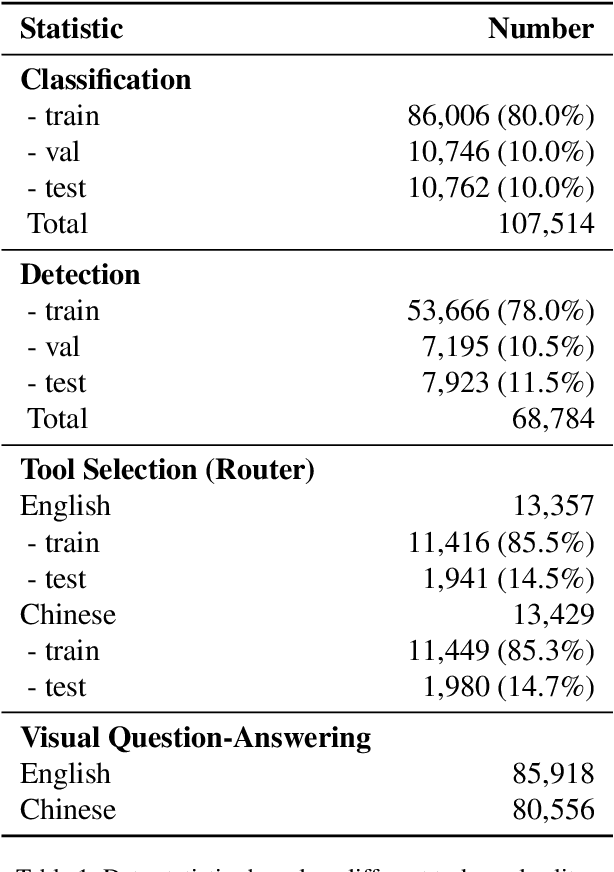
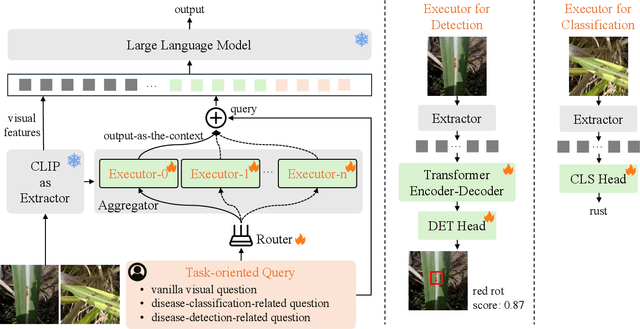

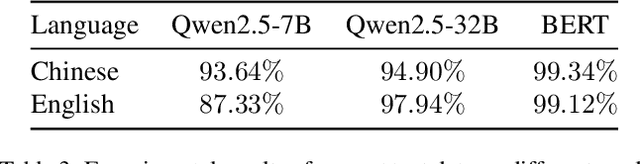
As a strategic pillar industry for human survival and development, modern agriculture faces dual challenges: optimizing production efficiency and achieving sustainable development. Against the backdrop of intensified climate change leading to frequent extreme weather events, the uncertainty risks in agricultural production systems are increasing exponentially. To address these challenges, this study proposes an innovative \textbf{M}ultimodal \textbf{A}gricultural \textbf{A}gent \textbf{A}rchitecture (\textbf{MA3}), which leverages cross-modal information fusion and task collaboration mechanisms to achieve intelligent agricultural decision-making. This study constructs a multimodal agricultural agent dataset encompassing five major tasks: classification, detection, Visual Question Answering (VQA), tool selection, and agent evaluation. We propose a unified backbone for sugarcane disease classification and detection tools, as well as a sugarcane disease expert model. By integrating an innovative tool selection module, we develop a multimodal agricultural agent capable of effectively performing tasks in classification, detection, and VQA. Furthermore, we introduce a multi-dimensional quantitative evaluation framework and conduct a comprehensive assessment of the entire architecture over our evaluation dataset, thereby verifying the practicality and robustness of MA3 in agricultural scenarios. This study provides new insights and methodologies for the development of agricultural agents, holding significant theoretical and practical implications. Our source code and dataset will be made publicly available upon acceptance.
MV-MATH: Evaluating Multimodal Math Reasoning in Multi-Visual Contexts
Feb 28, 2025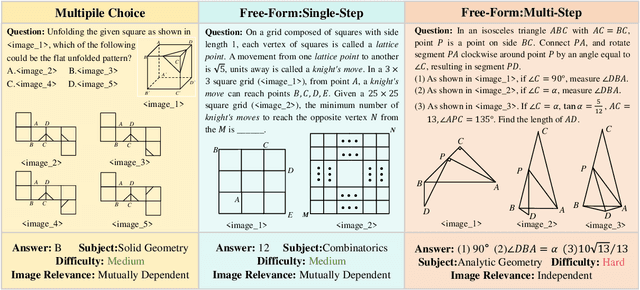
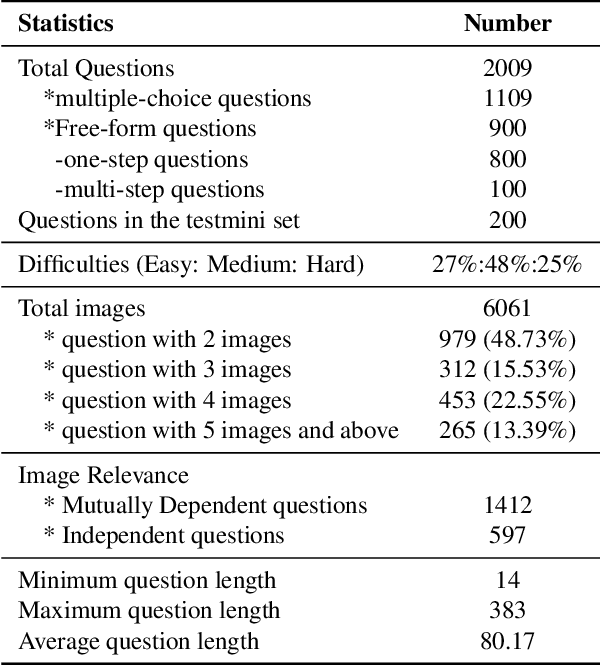
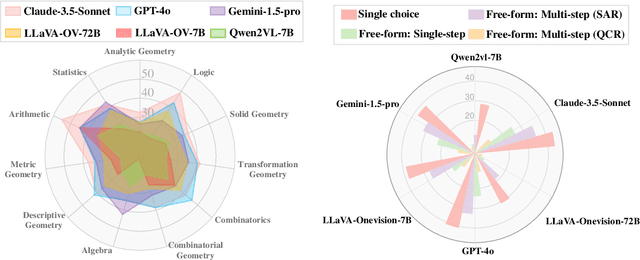
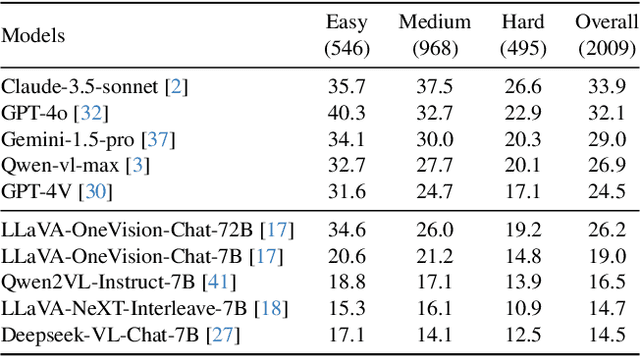
Multimodal Large Language Models (MLLMs) have shown promising capabilities in mathematical reasoning within visual contexts across various datasets. However, most existing multimodal math benchmarks are limited to single-visual contexts, which diverges from the multi-visual scenarios commonly encountered in real-world mathematical applications. To address this gap, we introduce MV-MATH: a meticulously curated dataset of 2,009 high-quality mathematical problems. Each problem integrates multiple images interleaved with text, derived from authentic K-12 scenarios, and enriched with detailed annotations. MV-MATH includes multiple-choice, free-form, and multi-step questions, covering 11 subject areas across 3 difficulty levels, and serves as a comprehensive and rigorous benchmark for assessing MLLMs' mathematical reasoning in multi-visual contexts. Through extensive experimentation, we observe that MLLMs encounter substantial challenges in multi-visual math tasks, with a considerable performance gap relative to human capabilities on MV-MATH. Furthermore, we analyze the performance and error patterns of various models, providing insights into MLLMs' mathematical reasoning capabilities within multi-visual settings.
LongDocURL: a Comprehensive Multimodal Long Document Benchmark Integrating Understanding, Reasoning, and Locating
Dec 24, 2024Large vision language models (LVLMs) have improved the document understanding capabilities remarkably, enabling the handling of complex document elements, longer contexts, and a wider range of tasks. However, existing document understanding benchmarks have been limited to handling only a small number of pages and fail to provide a comprehensive analysis of layout elements locating. In this paper, we first define three primary task categories: Long Document Understanding, numerical Reasoning, and cross-element Locating, and then propose a comprehensive benchmark, LongDocURL, integrating above three primary tasks and comprising 20 sub-tasks categorized based on different primary tasks and answer evidences. Furthermore, we develop a semi-automated construction pipeline and collect 2,325 high-quality question-answering pairs, covering more than 33,000 pages of documents, significantly outperforming existing benchmarks. Subsequently, we conduct comprehensive evaluation experiments on both open-source and closed-source models across 26 different configurations, revealing critical performance gaps in this field.