 Add to Chrome
 Add to Firefox
 Add to Edge
EasyHeC: Accurate and Automatic Hand-eye Calibration via Differentiable Rendering and Space Exploration
May 02, 2023
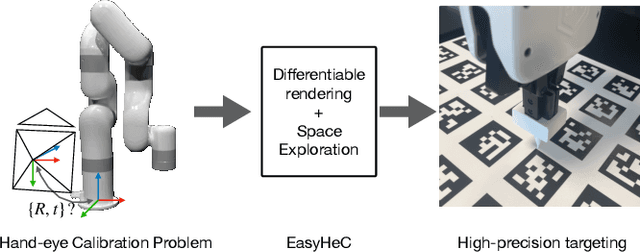
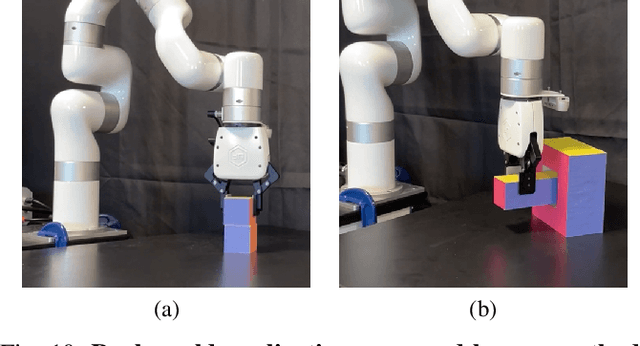
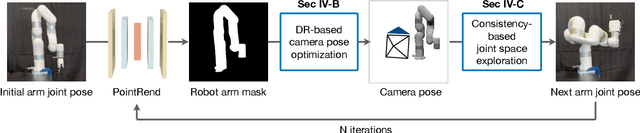
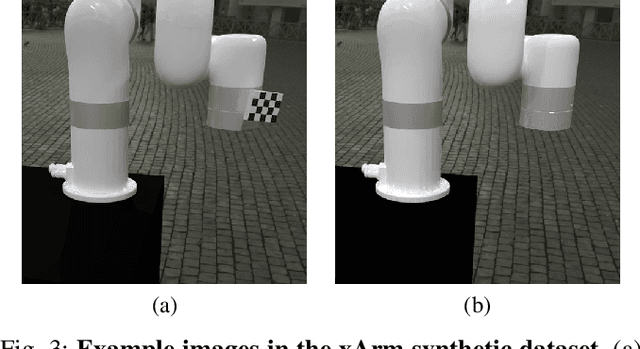
Hand-eye calibration is a critical task in robotics, as it directly affects the efficacy of critical operations such as manipulation and grasping. Traditional methods for achieving this objective necessitate the careful design of joint poses and the use of specialized calibration markers, while most recent learning-based approaches using solely pose regression are limited in their abilities to diagnose inaccuracies. In this work, we introduce a new approach to hand-eye calibration called EasyHeC, which is markerless, white-box, and offers comprehensive coverage of positioning accuracy across the entire robot configuration space. We introduce two key technologies: differentiable rendering-based camera pose optimization and consistency-based joint space exploration, which enables accurate end-to-end optimization of the calibration process and eliminates the need for the laborious manual design of robot joint poses. Our evaluation demonstrates superior performance in synthetic and real-world datasets, enhancing downstream manipulation tasks by providing precise camera poses for locating and interacting with objects. The code is available at the project page: https://ootts.github.io/easyhec.

TensoIR: Tensorial Inverse Rendering
Apr 24, 2023We propose TensoIR, a novel inverse rendering approach based on tensor factorization and neural fields. Unlike previous works that use purely MLP-based neural fields, thus suffering from low capacity and high computation costs, we extend TensoRF, a state-of-the-art approach for radiance field modeling, to estimate scene geometry, surface reflectance, and environment illumination from multi-view images captured under unknown lighting conditions. Our approach jointly achieves radiance field reconstruction and physically-based model estimation, leading to photo-realistic novel view synthesis and relighting results. Benefiting from the efficiency and extensibility of the TensoRF-based representation, our method can accurately model secondary shading effects (like shadows and indirect lighting) and generally support input images captured under single or multiple unknown lighting conditions. The low-rank tensor representation allows us to not only achieve fast and compact reconstruction but also better exploit shared information under an arbitrary number of capturing lighting conditions. We demonstrate the superiority of our method to baseline methods qualitatively and quantitatively on various challenging synthetic and real-world scenes.
Single-Stage Diffusion NeRF: A Unified Approach to 3D Generation and Reconstruction
Apr 17, 2023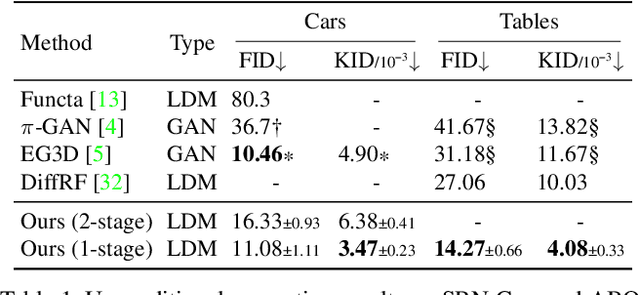
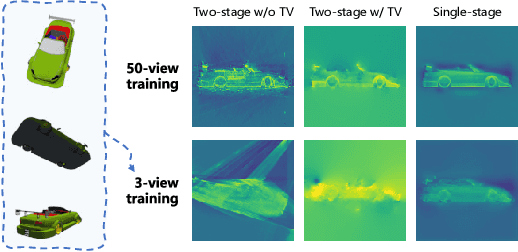
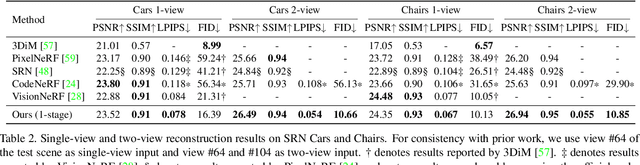
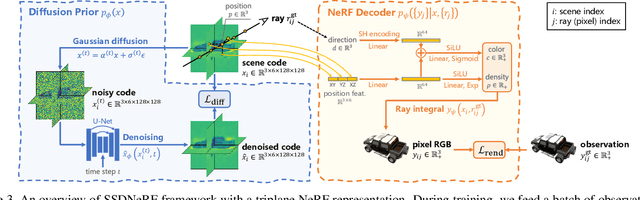
3D-aware image synthesis encompasses a variety of tasks, such as scene generation and novel view synthesis from images. Despite numerous task-specific methods, developing a comprehensive model remains challenging. In this paper, we present SSDNeRF, a unified approach that employs an expressive diffusion model to learn a generalizable prior of neural radiance fields (NeRF) from multi-view images of diverse objects. Previous studies have used two-stage approaches that rely on pretrained NeRFs as real data to train diffusion models. In contrast, we propose a new single-stage training paradigm with an end-to-end objective that jointly optimizes a NeRF auto-decoder and a latent diffusion model, enabling simultaneous 3D reconstruction and prior learning, even from sparsely available views. At test time, we can directly sample the diffusion prior for unconditional generation, or combine it with arbitrary observations of unseen objects for NeRF reconstruction. SSDNeRF demonstrates robust results comparable to or better than leading task-specific methods in unconditional generation and single/sparse-view 3D reconstruction.
Chain-of-Thought Predictive Control
Apr 03, 2023
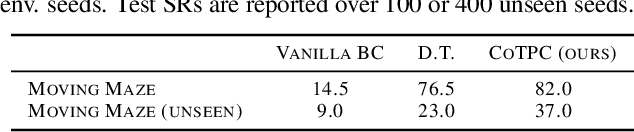


We study generalizable policy learning from demonstrations for complex low-level control tasks (e.g., contact-rich object manipulations). We propose an imitation learning method that incorporates the idea of temporal abstraction and the planning capabilities from Hierarchical RL (HRL) in a novel and effective manner. As a step towards decision foundation models, our design can utilize scalable, albeit highly sub-optimal, demonstrations. Specifically, we find certain short subsequences of the demos, i.e. the chain-of-thought (CoT), reflect their hierarchical structures by marking the completion of subgoals in the tasks. Our model learns to dynamically predict the entire CoT as coherent and structured long-term action guidance and consistently outperforms typical two-stage subgoal-conditioned policies. On the other hand, such CoT facilitates generalizable policy learning as they exemplify the decision patterns shared among demos (even those with heavy noises and randomness). Our method, Chain-of-Thought Predictive Control (CoTPC), significantly outperforms existing ones on challenging low-level manipulation tasks from scalable yet highly sub-optimal demos.
Boosting Reinforcement Learning and Planning with Demonstrations: A Survey
Mar 27, 2023Although reinforcement learning has seen tremendous success recently, this kind of trial-and-error learning can be impractical or inefficient in complex environments. The use of demonstrations, on the other hand, enables agents to benefit from expert knowledge rather than having to discover the best action to take through exploration. In this survey, we discuss the advantages of using demonstrations in sequential decision making, various ways to apply demonstrations in learning-based decision making paradigms (for example, reinforcement learning and planning in the learned models), and how to collect the demonstrations in various scenarios. Additionally, we exemplify a practical pipeline for generating and utilizing demonstrations in the recently proposed ManiSkill robot learning benchmark.
DexDeform: Dexterous Deformable Object Manipulation with Human Demonstrations and Differentiable Physics
Mar 27, 2023
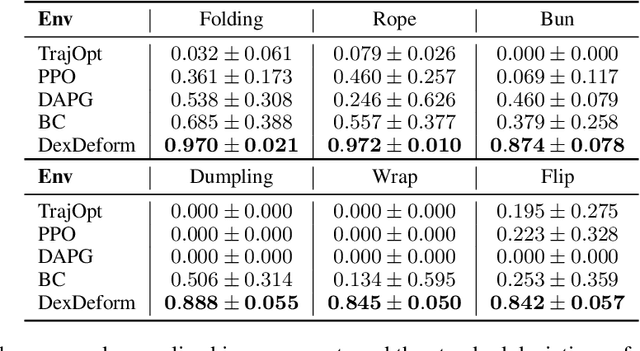

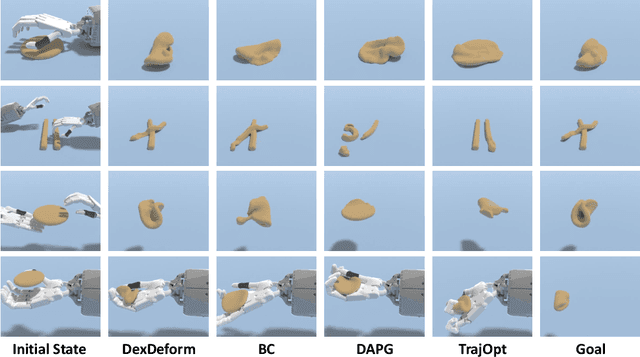
In this work, we aim to learn dexterous manipulation of deformable objects using multi-fingered hands. Reinforcement learning approaches for dexterous rigid object manipulation would struggle in this setting due to the complexity of physics interaction with deformable objects. At the same time, previous trajectory optimization approaches with differentiable physics for deformable manipulation would suffer from local optima caused by the explosion of contact modes from hand-object interactions. To address these challenges, we propose DexDeform, a principled framework that abstracts dexterous manipulation skills from human demonstration and refines the learned skills with differentiable physics. Concretely, we first collect a small set of human demonstrations using teleoperation. And we then train a skill model using demonstrations for planning over action abstractions in imagination. To explore the goal space, we further apply augmentations to the existing deformable shapes in demonstrations and use a gradient optimizer to refine the actions planned by the skill model. Finally, we adopt the refined trajectories as new demonstrations for finetuning the skill model. To evaluate the effectiveness of our approach, we introduce a suite of six challenging dexterous deformable object manipulation tasks. Compared with baselines, DexDeform is able to better explore and generalize across novel goals unseen in the initial human demonstrations.
Nerflets: Local Radiance Fields for Efficient Structure-Aware 3D Scene Representation from 2D Supervision
Mar 10, 2023We address efficient and structure-aware 3D scene representation from images. Nerflets are our key contribution -- a set of local neural radiance fields that together represent a scene. Each nerflet maintains its own spatial position, orientation, and extent, within which it contributes to panoptic, density, and radiance reconstructions. By leveraging only photometric and inferred panoptic image supervision, we can directly and jointly optimize the parameters of a set of nerflets so as to form a decomposed representation of the scene, where each object instance is represented by a group of nerflets. During experiments with indoor and outdoor environments, we find that nerflets: (1) fit and approximate the scene more efficiently than traditional global NeRFs, (2) allow the extraction of panoptic and photometric renderings from arbitrary views, and (3) enable tasks rare for NeRFs, such as 3D panoptic segmentation and interactive editing.
MovingParts: Motion-based 3D Part Discovery in Dynamic Radiance Field
Mar 10, 2023We present MovingParts, a NeRF-based method for dynamic scene reconstruction and part discovery. We consider motion as an important cue for identifying parts, that all particles on the same part share the common motion pattern. From the perspective of fluid simulation, existing deformation-based methods for dynamic NeRF can be seen as parameterizing the scene motion under the Eulerian view, i.e., focusing on specific locations in space through which the fluid flows as time passes. However, it is intractable to extract the motion of constituting objects or parts using the Eulerian view representation. In this work, we introduce the dual Lagrangian view and enforce representations under the Eulerian/Lagrangian views to be cycle-consistent. Under the Lagrangian view, we parameterize the scene motion by tracking the trajectory of particles on objects. The Lagrangian view makes it convenient to discover parts by factorizing the scene motion as a composition of part-level rigid motions. Experimentally, our method can achieve fast and high-quality dynamic scene reconstruction from even a single moving camera, and the induced part-based representation allows direct applications of part tracking, animation, 3D scene editing, etc.
ManiSkill2: A Unified Benchmark for Generalizable Manipulation Skills
Feb 09, 2023Generalizable manipulation skills, which can be composed to tackle long-horizon and complex daily chores, are one of the cornerstones of Embodied AI. However, existing benchmarks, mostly composed of a suite of simulatable environments, are insufficient to push cutting-edge research works because they lack object-level topological and geometric variations, are not based on fully dynamic simulation, or are short of native support for multiple types of manipulation tasks. To this end, we present ManiSkill2, the next generation of the SAPIEN ManiSkill benchmark, to address critical pain points often encountered by researchers when using benchmarks for generalizable manipulation skills. ManiSkill2 includes 20 manipulation task families with 2000+ object models and 4M+ demonstration frames, which cover stationary/mobile-base, single/dual-arm, and rigid/soft-body manipulation tasks with 2D/3D-input data simulated by fully dynamic engines. It defines a unified interface and evaluation protocol to support a wide range of algorithms (e.g., classic sense-plan-act, RL, IL), visual observations (point cloud, RGBD), and controllers (e.g., action type and parameterization). Moreover, it empowers fast visual input learning algorithms so that a CNN-based policy can collect samples at about 2000 FPS with 1 GPU and 16 processes on a regular workstation. It implements a render server infrastructure to allow sharing rendering resources across all environments, thereby significantly reducing memory usage. We open-source all codes of our benchmark (simulator, environments, and baselines) and host an online challenge open to interdisciplinary researchers.
Factor Fields: A Unified Framework for Neural Fields and Beyond
Feb 02, 2023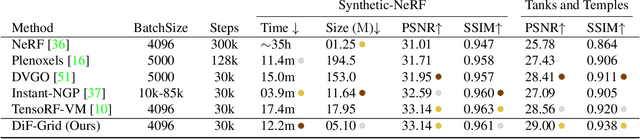
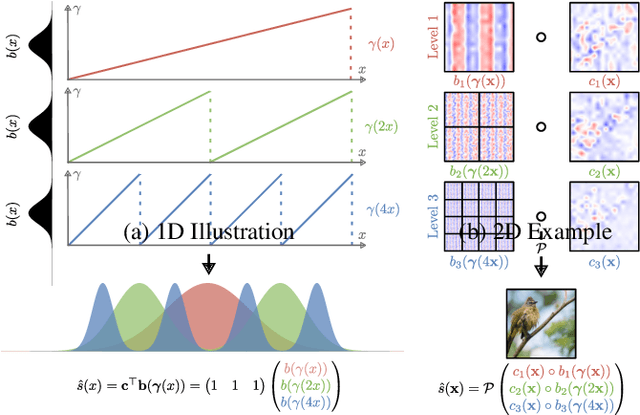
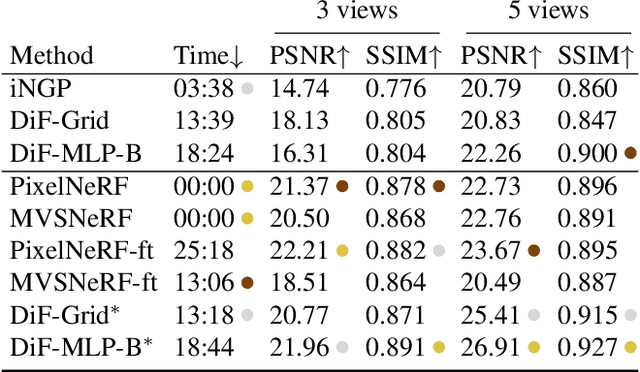
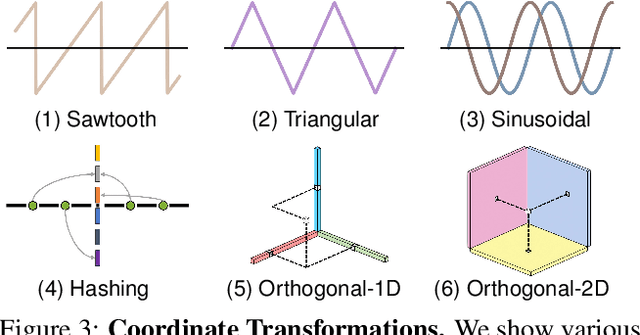
We present Factor Fields, a novel framework for modeling and representing signals. Factor Fields decomposes a signal into a product of factors, each of which is represented by a neural or regular field representation operating on a coordinate transformed input signal. We show that this decomposition yields a unified framework that generalizes several recent signal representations including NeRF, PlenOxels, EG3D, Instant-NGP, and TensoRF. Moreover, the framework allows for the creation of powerful new signal representations, such as the Coefficient-Basis Factorization (CoBaFa) which we propose in this paper. As evidenced by our experiments, CoBaFa leads to improvements over previous fast reconstruction methods in terms of the three critical goals in neural signal representation: approximation quality, compactness and efficiency. Experimentally, we demonstrate that our representation achieves better image approximation quality on 2D image regression tasks, higher geometric quality when reconstructing 3D signed distance fields and higher compactness for radiance field reconstruction tasks compared to previous fast reconstruction methods. Besides, our CoBaFa representation enables generalization by sharing the basis across signals during training, enabling generalization tasks such as image regression with sparse observations and few-shot radiance field reconstruction.