 Add to Chrome
 Add to Firefox
 Add to Edge
Enjoy Your Talk: A Human-Centered Benchmark for Multi-Turn Dialogue with Decoupled User Simulation, Target Modeling, and Judging
Jul 11, 2026
Evaluating large language models (LLMs) as multi-turn conversational partners requires probing capabilities that single-turn benchmarks miss: persona consistency, evolving intent tracking, emotional dynamics, and goal completion. We introduce EYT-Bench, a human-centered benchmark built around a three-party decoupled design: a persona-grounded user simulator, a target model that separates intent perception from response generation, and an independent third-party LLM judge with optional multi-judge ensembling. Personas are sampled from public human-curated corpora, Nemotron-Personas-USA and PersonaMem-v2, rather than synthesized, reducing LLM-induced persona bias. EYT-Bench also introduces two trajectory-level metrics: embedding-based intent drift and final-intent completion rate (FICR), inspired by tau-bench. In a 17-target x 200-dialogue evaluation, EYT-Bench reveals four findings: (i) state-of-the-art closed- and open-source models are statistically close on subjective dimensions (empathy / persona / anthropomorphism vary within <= 0.3), but differ by up to 9x on objective intent tracking; (ii) reasoning ("thinking on") sharply improves objective tracking on long-context personas (+0.47-0.50 latent-intent accuracy on Gemma-4) while leaving subjective scores nearly unchanged; (iii) persona format dominates trajectory spread, with FICR saturating above 0.95 on Nemotron-USA but spreading from 0.53 to 0.88 on PersonaMem-v2; and (iv) the warm-up effect is robust on 16/17 models (one outlier, GPT-5.5, reverses the effect), with stable rankings across alpha in [0.05, 0.15]. A cross-judge ablation using deepseek-v4-pro confirms that target rankings and final-intent satisfaction are preserved across judges.

MER-R1: Multimodal Emotion Reasoning via Slow-Fast Thinking Synergy
Jun 26, 2026We find that explicit reasoning does not necessarily translate into better multimodal emotion recognition (MER) accuracy, even though it makes predictions more interpretable. Specifically, for reasoning-based MLLMs, fast thinking by triggering direct answers often outperforms slow thinking after deliberative reasoning. Our empirical analyses show that fast thinking improves recall with broader and more confident predictions, whereas slow thinking favors precision through conservative filtering of incorrect categories. Building on these insights, we propose MER-R1, a reinforcement learning framework that turns slow-fast complementarity into explicit optimization. Dual-objective disentanglement separates recall and precision into two optimization signals, allowing them to be jointly optimized rather than traded off against each other. Slow-fast confidence calibration further aligns the final slow-thinking answer with fast-thinking intuition, strengthening correct emotions while suppressing incorrect ones. In this way, MER-R1 unifies the recall-oriented intuition of fast thinking with the precision-oriented selectivity of slow thinking. We further provide theoretical justification for this synergy, showing that it mitigates variance-induced interference during optimization. Extensive experiments on MER-UniBench and MME-Emotion show that MER-R1 achieves state-of-the-art performance and makes reasoning genuinely benefit emotion recognition.
SenseNova-MARS: Empowering Multimodal Agentic Reasoning and Search via Reinforcement Learning
Dec 30, 2025While Vision-Language Models (VLMs) can solve complex tasks through agentic reasoning, their capabilities remain largely constrained to text-oriented chain-of-thought or isolated tool invocation. They fail to exhibit the human-like proficiency required to seamlessly interleave dynamic tool manipulation with continuous reasoning, particularly in knowledge-intensive and visually complex scenarios that demand coordinated external tools such as search and image cropping. In this work, we introduce SenseNova-MARS, a novel Multimodal Agentic Reasoning and Search framework that empowers VLMs with interleaved visual reasoning and tool-use capabilities via reinforcement learning (RL). Specifically, SenseNova-MARS dynamically integrates the image search, text search, and image crop tools to tackle fine-grained and knowledge-intensive visual understanding challenges. In the RL stage, we propose the Batch-Normalized Group Sequence Policy Optimization (BN-GSPO) algorithm to improve the training stability and advance the model's ability to invoke tools and reason effectively. To comprehensively evaluate the agentic VLMs on complex visual tasks, we introduce the HR-MMSearch benchmark, the first search-oriented benchmark composed of high-resolution images with knowledge-intensive and search-driven questions. Experiments demonstrate that SenseNova-MARS achieves state-of-the-art performance on open-source search and fine-grained image understanding benchmarks. Specifically, on search-oriented benchmarks, SenseNova-MARS-8B scores 67.84 on MMSearch and 41.64 on HR-MMSearch, surpassing proprietary models such as Gemini-3-Flash and GPT-5. SenseNova-MARS represents a promising step toward agentic VLMs by providing effective and robust tool-use capabilities. To facilitate further research in this field, we will release all code, models, and datasets.
How Far Are We to GPT-4V? Closing the Gap to Commercial Multimodal Models with Open-Source Suites
Apr 29, 2024
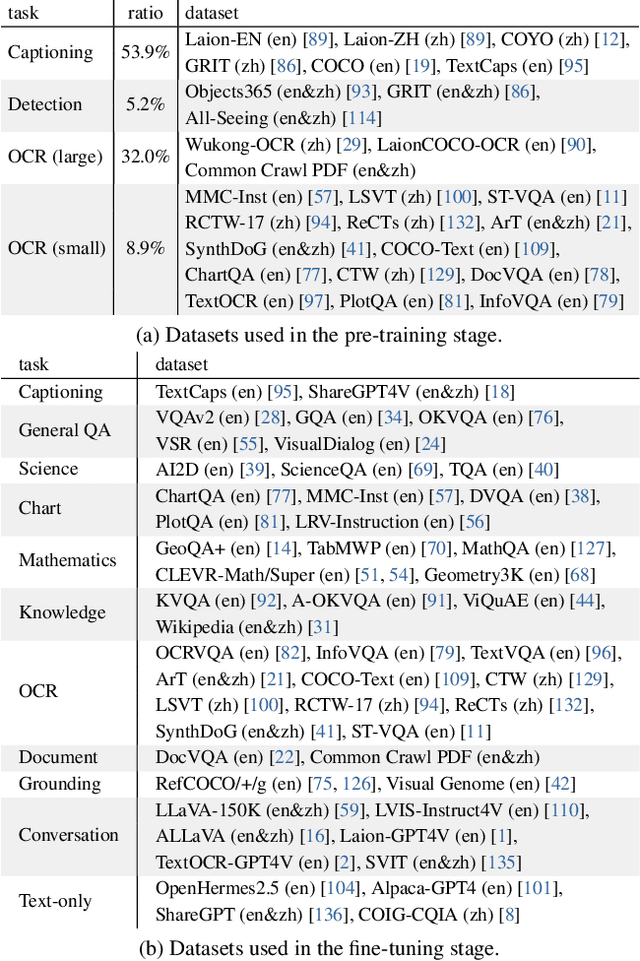
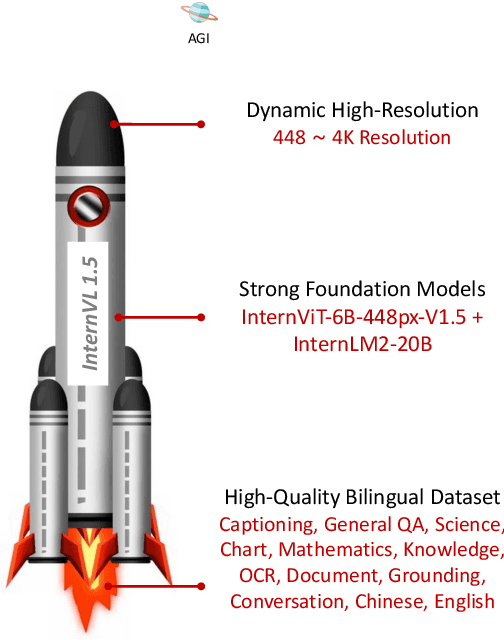
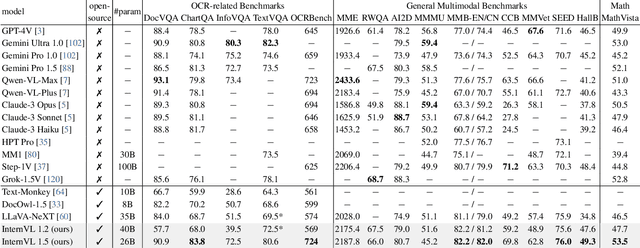
In this report, we introduce InternVL 1.5, an open-source multimodal large language model (MLLM) to bridge the capability gap between open-source and proprietary commercial models in multimodal understanding. We introduce three simple improvements: (1) Strong Vision Encoder: we explored a continuous learning strategy for the large-scale vision foundation model -- InternViT-6B, boosting its visual understanding capabilities, and making it can be transferred and reused in different LLMs. (2) Dynamic High-Resolution: we divide images into tiles ranging from 1 to 40 of 448$\times$448 pixels according to the aspect ratio and resolution of the input images, which supports up to 4K resolution input. (3) High-Quality Bilingual Dataset: we carefully collected a high-quality bilingual dataset that covers common scenes, document images, and annotated them with English and Chinese question-answer pairs, significantly enhancing performance in OCR- and Chinese-related tasks. We evaluate InternVL 1.5 through a series of benchmarks and comparative studies. Compared to both open-source and proprietary models, InternVL 1.5 shows competitive performance, achieving state-of-the-art results in 8 of 18 benchmarks. Code has been released at https://github.com/OpenGVLab/InternVL.
Unsupervised Domain Adaptation GAN Inversion for Image Editing
Nov 22, 2022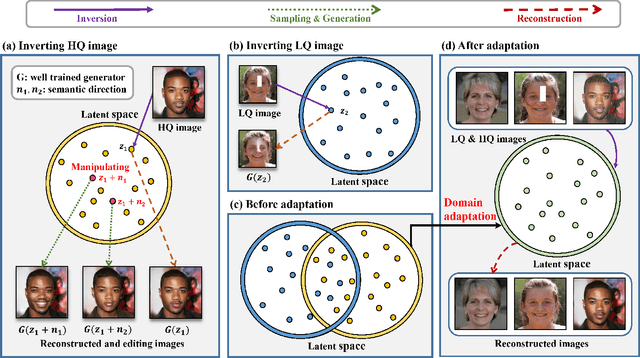
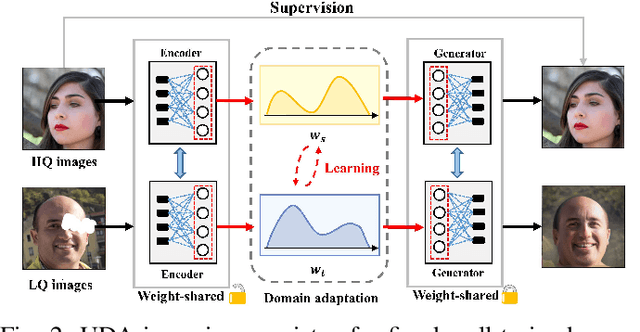
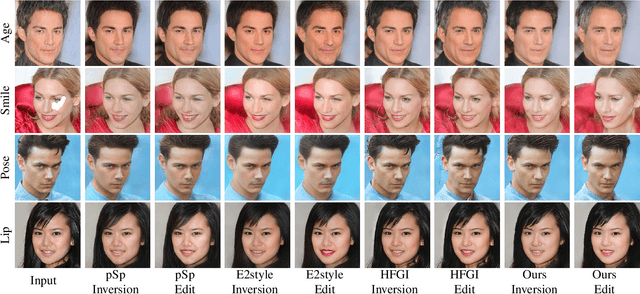
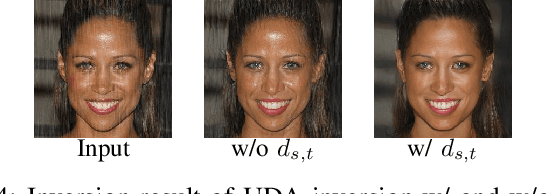
Existing GAN inversion methods work brilliantly for high-quality image reconstruction and editing while struggling with finding the corresponding high-quality images for low-quality inputs. Therefore, recent works are directed toward leveraging the supervision of paired high-quality and low-quality images for inversion. However, these methods are infeasible in real-world scenarios and further hinder performance improvement. In this paper, we resolve this problem by introducing Unsupervised Domain Adaptation (UDA) into the Inversion process, namely UDA-Inversion, for both high-quality and low-quality image inversion and editing. Particularly, UDA-Inversion first regards the high-quality and low-quality images as the source domain and unlabeled target domain, respectively. Then, a discrepancy function is presented to measure the difference between two domains, after which we minimize the source error and the discrepancy between the distributions of two domains in the latent space to obtain accurate latent codes for low-quality images. Without direct supervision, constructive representations of high-quality images can be spontaneously learned and transformed into low-quality images based on unsupervised domain adaptation. Experimental results indicate that UDA-inversion is the first that achieves a comparable level of performance with supervised methods in low-quality images across multiple domain datasets. We hope this work provides a unique inspiration for latent embedding distributions in image process tasks.