 Add to Chrome
 Add to Firefox
 Add to Edge
SPARGen: Unifying Spatial Perception and Reasoning through Native Multimodal Generation
Aug 14, 2026
Spatial perception and reasoning from visual observations require recovering geometric structure, establishing correspondences, and understanding spatial relations. Existing approaches typically address these capabilities separately using task-specific architectures or external geometric modules, limiting knowledge transfer among complementary representations of the same physical scene. We introduce SPARGen, a unified multimodal framework that casts 3D reconstruction, dense correspondence, and spatial reasoning as instruction-conditioned generation tasks. SPARGen serializes compact structured and linguistic outputs as token sequences while generating dense geometric fields in image-aligned forms, enabling spatial supervision to jointly shape shared representations within a native multimodal generative model. Experiments across benchmarks for 3D reconstruction, correspondence, and spatial reasoning show that SPARGen achieves competitive performance across heterogeneous spatial tasks within a single native multimodal generative framework.

Vision as Unified Multimodal Generation
Jul 07, 2026We formulate computer vision as unified multimodal generation, where heterogeneous visual tasks are expressed in the native text and image generation spaces of a unified multimodal model, without task-specific architectures. Under this formulation, SenseNova-Vision uses natural-language instructions and optional visual prompts to specify tasks, target regions or views, and decoding conventions, and generates responses as text for symbolic outputs, images for dense spatial predictions, or mixed text-and-image outputs for compositional tasks. To support large-scale training, we convert diverse computer vision annotations into instruction-response examples compatible with these generation spaces, resulting in the SenseNova-Vision Corpus, a computer-vision instruction-response corpus spanning text, image, and mixed targets. Starting from an off-the-shelf pretrained unified multimodal model, SenseNova-Vision is trained primarily on this corpus, with auxiliary multimodal data used as a capability-preserving mixture, and requires no task-specific prediction heads or architectural modifications. The resulting model covers a broad range of vision tasks, including detection, OCR, keypoint estimation, segmentation, depth estimation, surface normal prediction, point maps, and camera pose estimation, while supporting language-defined variants that combine category, color, region, and other visual cues. Experiments show that a single unified model can match leading task-specialized systems across structured visual understanding, dense geometric prediction, segmentation, and multi-view visual geometry. These results suggest unified multimodal generation as a scalable route for integrating computer vision capabilities into general-purpose foundation models. The model and corpus are publicly available.
SenseNova-U1: Unifying Multimodal Understanding and Generation with NEO-unify Architecture
May 12, 2026Recent large vision-language models (VLMs) remain fundamentally constrained by a persistent dichotomy: understanding and generation are treated as distinct problems, leading to fragmented architectures, cascaded pipelines, and misaligned representation spaces. We argue that this divide is not merely an engineering artifact, but a structural limitation that hinders the emergence of native multimodal intelligence. Hence, we introduce SenseNova-U1, a native unified multimodal paradigm built upon NEO-unify, in which understanding and generation evolve as synergistic views of a single underlying process. We launch two native unified variants, SenseNova-U1-8B-MoT and SenseNova-U1-A3B-MoT, built on dense (8B) and mixture-of-experts (30B-A3B) understanding baselines, respectively. Designed from first principles, they rival top-tier understanding-only VLMs across text understanding, vision-language perception, knowledge reasoning, agentic decision-making, and spatial intelligence. Meanwhile, they deliver strong semantic consistency and visual fidelity, excelling in conventional or knowledge-intensive any-to-image (X2I) synthesis, complex text-rich infographic generation, and interleaved vision-language generation, with or without think patterns. Beyond performance, we show detailed model design, data preprocessing, pre-/post-training, and inference strategies to support community research. Last but not least, preliminary evidence demonstrates that our models extend beyond perception and generation, performing strongly in vision-language-action (VLA) and world model (WM) scenarios. This points toward a broader roadmap where models do not translate between modalities, but think and act across them in a native manner. Multimodal AI is no longer about connecting separate systems, but about building a unified one and trusting the necessary capabilities to emerge from within.
Scaling Spatial Intelligence with Multimodal Foundation Models
Nov 17, 2025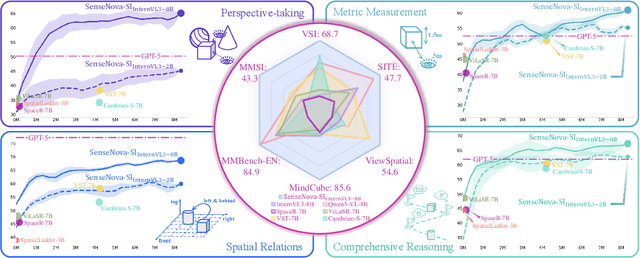
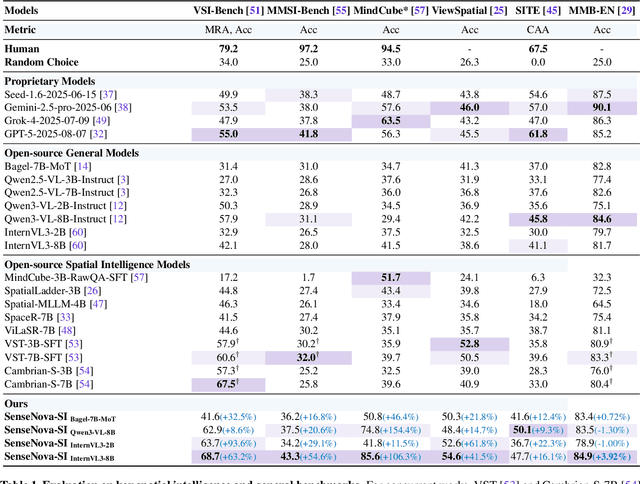
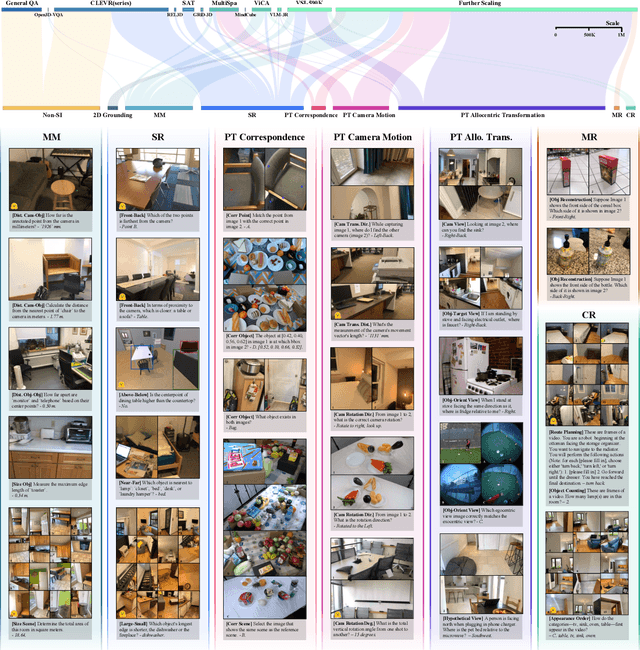
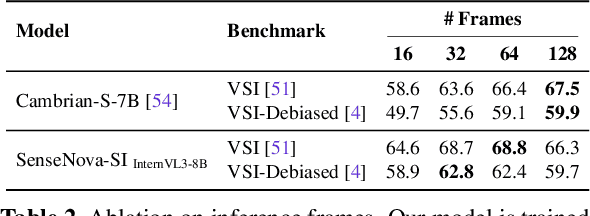
Despite remarkable progress, multimodal foundation models still exhibit surprising deficiencies in spatial intelligence. In this work, we explore scaling up multimodal foundation models to cultivate spatial intelligence within the SenseNova-SI family, built upon established multimodal foundations including visual understanding models (i.e., Qwen3-VL and InternVL3) and unified understanding and generation models (i.e., Bagel). We take a principled approach to constructing high-performing and robust spatial intelligence by systematically curating SenseNova-SI-8M: eight million diverse data samples under a rigorous taxonomy of spatial capabilities. SenseNova-SI demonstrates unprecedented performance across a broad range of spatial intelligence benchmarks: 68.7% on VSI-Bench, 43.3% on MMSI, 85.6% on MindCube, 54.6% on ViewSpatial, and 50.1% on SITE, while maintaining strong general multimodal understanding (e.g., 84.9% on MMBench-En). More importantly, we analyze the impact of data scaling, discuss early signs of emergent generalization capabilities enabled by diverse data training, analyze the risk of overfitting and language shortcuts, present a preliminary study on spatial chain-of-thought reasoning, and validate the potential downstream application. SenseNova-SI is an ongoing project, and this report will be updated continuously. All newly trained multimodal foundation models are publicly released to facilitate further research in this direction.
Has GPT-5 Achieved Spatial Intelligence? An Empirical Study
Aug 18, 2025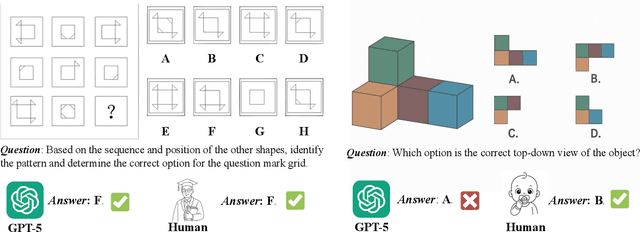
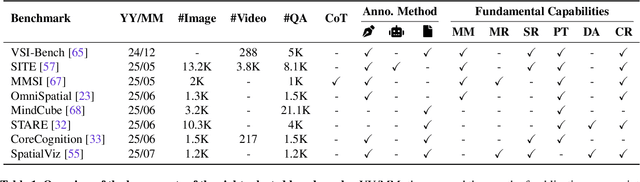
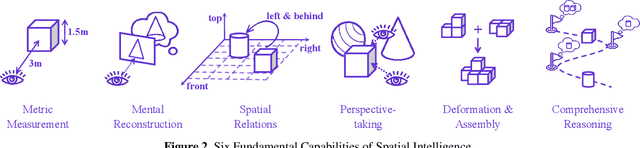
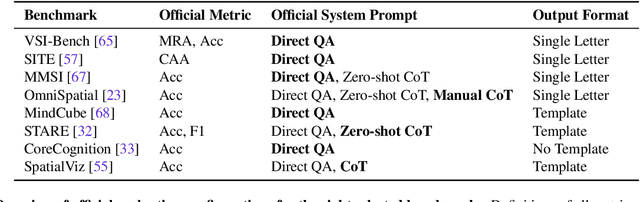
Multi-modal models have achieved remarkable progress in recent years. Nevertheless, they continue to exhibit notable limitations in spatial understanding and reasoning, which are fundamental capabilities to achieving artificial general intelligence. With the recent release of GPT-5, allegedly the most powerful AI model to date, it is timely to examine where the leading models stand on the path toward spatial intelligence. First, we propose a comprehensive taxonomy of spatial tasks that unifies existing benchmarks and discuss the challenges in ensuring fair evaluation. We then evaluate state-of-the-art proprietary and open-source models on eight key benchmarks, at a cost exceeding one billion total tokens. Our empirical study reveals that (1) GPT-5 demonstrates unprecedented strength in spatial intelligence, yet (2) still falls short of human performance across a broad spectrum of tasks. Moreover, we (3) identify the more challenging spatial intelligence problems for multi-modal models, and (4) proprietary models do not exhibit a decisive advantage when facing the most difficult problems. In addition, we conduct a qualitative evaluation across a diverse set of scenarios that are intuitive for humans yet fail even the most advanced multi-modal models.