 Add to Chrome
 Add to Firefox
 Add to Edge
Verifiable Memory: Learning Unified Memory Management with Local and Global Verifiers for Large Language Model Agents
Aug 04, 2026
Large language model (LLM) agents must retain reusable information, control a bounded active context, and recover earlier evidence during long-horizon interaction. Existing methods commonly optimize long-term memory (LTM) and short-term memory (STM) separately, while unified policies are often trained primarily with trajectory-level feedback, which provides weak credit for individual memory decisions. We present Verifiable Memory (VerMem), a framework that represents LTM, active context, and episodic history as distinct states and controls them with one memory operation policy. Seven atomic operations let the policy add, revise, or soft-delete LTM entries; retrieve LTM into the active context; filter or summarize the active context; and restore selected episodic fragments. VerMem is initialized by supervised fine-tuning and trained with a three-stage reinforcement-learning curriculum. The local verifier scores executable memory transitions, and a global verifier assesses evidence coherence and terminal-memory consistency after task completion. These scores are combined with programmatically computed task, evidence-recall, efficiency, and constraint signals through hierarchical credit assignment. The verifiers are used only during training. Across five benchmarks and two LLM backbones, VerMem achieves the best result on the vast majority of reported metrics and consistently outperforms strong memory baselines. Under controlled online-token budgets on three interactive benchmarks, it also achieves the strongest efficiency--performance frontier among the compared methods. Code is available at https://github.com/Sun-SYSU-24/VerMem.

RynnWorld-Teleop: An Action-Conditioned World Model for Digital Teleoperation
Jul 07, 2026Scaling robot learning requires massive, diverse trajectory data, yet collection is currently bottlenecked by physical teleoperation, where every demonstration binds operator time to specific hardware and workspaces. We introduce digital teleoperation, a paradigm that decouples data collection from physical constraints by replacing the real robot with a generative world model. In this framework, an operator's hand-pose stream drives a robot-centric generative world model to synthesize high-fidelity egocentric videos from a single reference image. The recorded pose stream serves as an embodiment-agnostic action label transferable to any target robot via standard retargeting, yielding complete state-action trajectories for imitation learning independent of physical hardware. We instantiate this paradigm in RynnWorld-Teleop, a system that integrates depth-aware skeletal conditioning, progressive human-to-robot training on a video Diffusion Transformer, and streaming autoregressive distillation. This pipeline compresses the generative process into a single-pass inference, enabling 40+ FPS, real-time interactive generation on a single H100 GPU. Policies trained exclusively on RynnWorld-Teleop-generated data achieve effective zero-shot Sim2Real transfer across dexterous and diverse bimanual tasks. Moreover, augmenting real-world datasets with our digitally teleoperated data consistently improves success rates, demonstrating that RynnWorld-Teleop serves as a high-fidelity, scalable data engine for the next generation of robotic agents.
PRPO: Perception-Reinforced Policy Optimization via Token-Level Dynamic Advantage Reshaping
Jun 07, 2026Reinforcement Learning with Verifiable Rewards (RLVR) has become an effective paradigm for improving the reasoning capability of Large Vision-Language Models (LVLMs). However, existing RLVR methods primarily rely on trajectory-level outcome rewards, which assign identical learning signals across all generated tokens. This coarse-grained credit assignment is fundamentally mismatched to multimodal reasoning, where only a sparse subset of tokens is causally grounded in visual evidence. Consequently, these pivotal perceptual tokens receive weak supervision and are often overwhelmed by language priors or reasoning-template tokens. To address this limitation, we propose Perception-Reinforced Policy Optimization (PRPO), a token-level reinforcement learning framework that explicitly identifies and reinforces pivotal perceptual tokens within long-horizon multimodal reasoning trajectories. PRPO introduces Robust Visual Dependency (RVD), a principled metric that identifies tokens whose predictions are both visually grounded and perturbation-stable, filtering out brittle or noisy visual tokens. Based on RVD, we further propose Perceptual Advantage Reshaping (PAR), a token-level credit assignment technique that amplifies perceptually informative tokens while preserving stable gradients for non-perceptual tokens. Extensive experiments on seven multimodal reasoning benchmarks demonstrate that PRPO consistently outperforms strong LVLM baselines across both 3B and 7B model scales, achieving average gains of 23.3% and 21.1%, respectively. PRPO achieves state-of-the-art performance with improved training efficiency and stronger cross-task generalization. Our findings highlight the importance of fine-grained credit assignment for scalable multimodal reinforcement learning.
V2I Work Zone Geometry Reconstruction with Pose-Conditioned UWB Range Denoising
May 28, 2026Reliable work zone mapping is important for connected and autonomous vehicles (CAVs) to navigate safely and smoothly through work zone areas. Cone-mounted ultra-wideband (UWB) roadside units (RSU) offer a cost-effective way for work zone layout inference, as roadside anchors and vehicle tags provide direct vehicle-to-infrastructure (V2I) range constraints for work zone geometry reconstruction. However, UWB range estimation is degraded by bursty outliers, non-line-of-sight (NLOS) errors, arbitrary anchor-ordering issues, and vehicle pose uncertainties in practical field deployments. To address these challenges, this study proposes a pose-conditioned, permutation-equivariant predictive denoiser for multi-anchor UWB ranging. The model employs shared anchor-wise temporal prediction to capture range dynamics, symmetric set aggregation to handle unordered and missing anchors, and pose-conditioned residual decoding to incorporate vehicle motion as a geometric prior. A two-stage training strategy first learns prediction from observed ranges, and then fine-tunes the denoiser with NLOS-weighted supervision. The method is evaluated on rare real-world V2I UWB field data collected with a CAV, as well as on controlled large-scale simulation benchmarks for ablative insights. Results show that the proposed method substantially improves range accuracy, cone localization, and work zone geometry reconstruction in challenging NLOS-dominated regimes, remains robust to anchor re-indexing and moderate anchor dropout, and reduces measurement-weighted field MSE by 66.9% relative to the raw input.
RefProtoFL: Communication-Efficient Federated Learning via External-Referenced Prototype Alignment
Jan 21, 2026Federated learning (FL) enables collaborative model training without sharing raw data in edge environments, but is constrained by limited communication bandwidth and heterogeneous client data distributions. Prototype-based FL mitigates this issue by exchanging class-wise feature prototypes instead of full model parameters; however, existing methods still suffer from suboptimal generalization under severe communication constraints. In this paper, we propose RefProtoFL, a communication-efficient FL framework that integrates External-Referenced Prototype Alignment (ERPA) for representation consistency with Adaptive Probabilistic Update Dropping (APUD) for communication efficiency. Specifically, we decompose the model into a private backbone and a lightweight shared adapter, and restrict federated communication to the adapter parameters only. To further reduce uplink cost, APUD performs magnitude-aware Top-K sparsification, transmitting only the most significant adapter updates for server-side aggregation. To address representation inconsistency across heterogeneous clients, ERPA leverages a small server-held public dataset to construct external reference prototypes that serve as shared semantic anchors. For classes covered by public data, clients directly align local representations to public-induced prototypes, whereas for uncovered classes, alignment relies on server-aggregated global reference prototypes via weighted averaging. Extensive experiments on standard benchmarks demonstrate that RefProtoFL attains higher classification accuracy than state-of-the-art prototype-based FL baselines.
CATS-V2V: A Real-World Vehicle-to-Vehicle Cooperative Perception Dataset with Complex Adverse Traffic Scenarios
Nov 14, 2025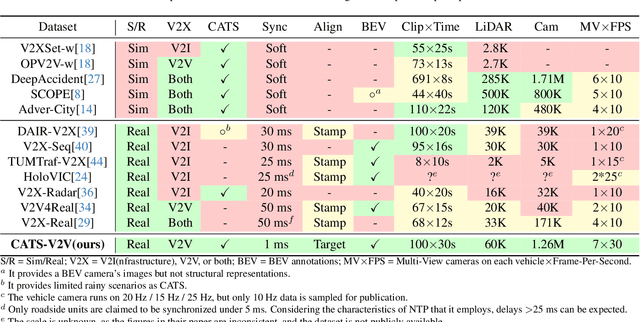
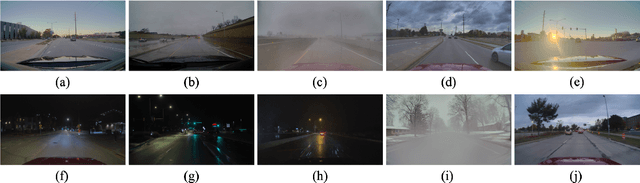
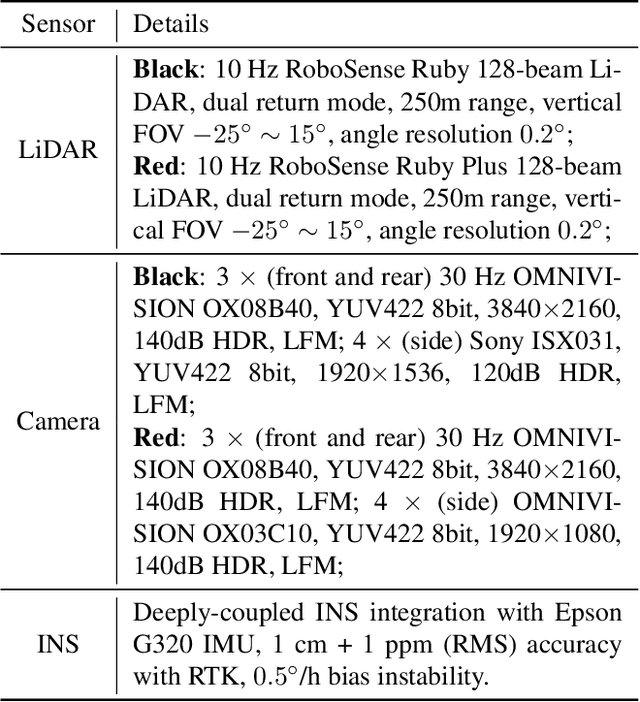
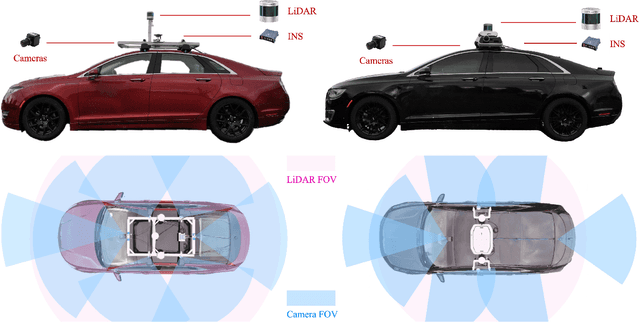
Vehicle-to-Vehicle (V2V) cooperative perception has great potential to enhance autonomous driving performance by overcoming perception limitations in complex adverse traffic scenarios (CATS). Meanwhile, data serves as the fundamental infrastructure for modern autonomous driving AI. However, due to stringent data collection requirements, existing datasets focus primarily on ordinary traffic scenarios, constraining the benefits of cooperative perception. To address this challenge, we introduce CATS-V2V, the first-of-its-kind real-world dataset for V2V cooperative perception under complex adverse traffic scenarios. The dataset was collected by two hardware time-synchronized vehicles, covering 10 weather and lighting conditions across 10 diverse locations. The 100-clip dataset includes 60K frames of 10 Hz LiDAR point clouds and 1.26M multi-view 30 Hz camera images, along with 750K anonymized yet high-precision RTK-fixed GNSS and IMU records. Correspondingly, we provide time-consistent 3D bounding box annotations for objects, as well as static scenes to construct a 4D BEV representation. On this basis, we propose a target-based temporal alignment method, ensuring that all objects are precisely aligned across all sensor modalities. We hope that CATS-V2V, the largest-scale, most supportive, and highest-quality dataset of its kind to date, will benefit the autonomous driving community in related tasks.
Efficient Federated Learning with Encrypted Data Sharing for Data-Heterogeneous Edge Devices
Jun 25, 2025As privacy protection gains increasing importance, more models are being trained on edge devices and subsequently merged into the central server through Federated Learning (FL). However, current research overlooks the impact of network topology, physical distance, and data heterogeneity on edge devices, leading to issues such as increased latency and degraded model performance. To address these issues, we propose a new federated learning scheme on edge devices that called Federated Learning with Encrypted Data Sharing(FedEDS). FedEDS uses the client model and the model's stochastic layer to train the data encryptor. The data encryptor generates encrypted data and shares it with other clients. The client uses the corresponding client's stochastic layer and encrypted data to train and adjust the local model. FedEDS uses the client's local private data and encrypted shared data from other clients to train the model. This approach accelerates the convergence speed of federated learning training and mitigates the negative impact of data heterogeneity, making it suitable for application services deployed on edge devices requiring rapid convergence. Experiments results show the efficacy of FedEDS in promoting model performance.
Reverse Preference Optimization for Complex Instruction Following
May 28, 2025Instruction following (IF) is a critical capability for large language models (LLMs). However, handling complex instructions with multiple constraints remains challenging. Previous methods typically select preference pairs based on the number of constraints they satisfy, introducing noise where chosen examples may fail to follow some constraints and rejected examples may excel in certain respects over the chosen ones. To address the challenge of aligning with multiple preferences, we propose a simple yet effective method called Reverse Preference Optimization (RPO). It mitigates noise in preference pairs by dynamically reversing the constraints within the instruction to ensure the chosen response is perfect, alleviating the burden of extensive sampling and filtering to collect perfect responses. Besides, reversal also enlarges the gap between chosen and rejected responses, thereby clarifying the optimization direction and making it more robust to noise. We evaluate RPO on two multi-turn IF benchmarks, Sysbench and Multi-IF, demonstrating average improvements over the DPO baseline of 4.6 and 2.5 points (on Llama-3.1 8B), respectively. Moreover, RPO scales effectively across model sizes (8B to 70B parameters), with the 70B RPO model surpassing GPT-4o.
TeleOpBench: A Simulator-Centric Benchmark for Dual-Arm Dexterous Teleoperation
May 19, 2025Teleoperation is a cornerstone of embodied-robot learning, and bimanual dexterous teleoperation in particular provides rich demonstrations that are difficult to obtain with fully autonomous systems. While recent studies have proposed diverse hardware pipelines-ranging from inertial motion-capture gloves to exoskeletons and vision-based interfaces-there is still no unified benchmark that enables fair, reproducible comparison of these systems. In this paper, we introduce TeleOpBench, a simulator-centric benchmark tailored to bimanual dexterous teleoperation. TeleOpBench contains 30 high-fidelity task environments that span pick-and-place, tool use, and collaborative manipulation, covering a broad spectrum of kinematic and force-interaction difficulty. Within this benchmark we implement four representative teleoperation modalities-(i) MoCap, (ii) VR device, (iii) arm-hand exoskeletons, and (iv) monocular vision tracking-and evaluate them with a common protocol and metric suite. To validate that performance in simulation is predictive of real-world behavior, we conduct mirrored experiments on a physical dual-arm platform equipped with two 6-DoF dexterous hands. Across 10 held-out tasks we observe a strong correlation between simulator and hardware performance, confirming the external validity of TeleOpBench. TeleOpBench establishes a common yardstick for teleoperation research and provides an extensible platform for future algorithmic and hardware innovation.
VMBench: A Benchmark for Perception-Aligned Video Motion Generation
Mar 13, 2025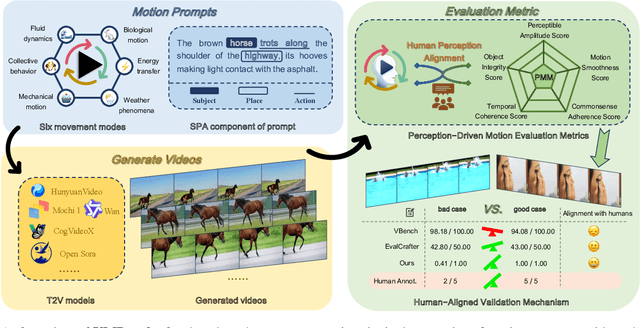
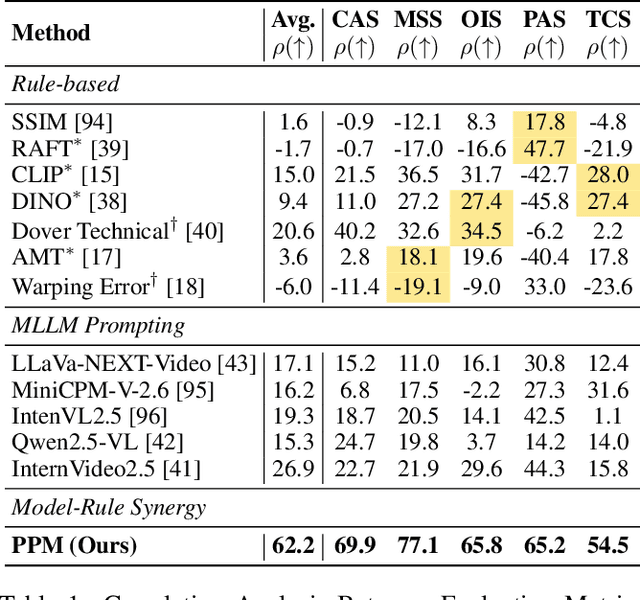
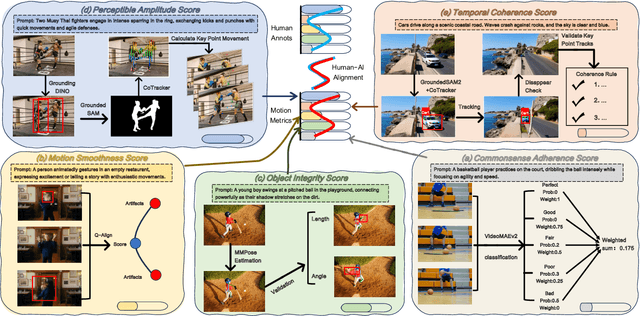
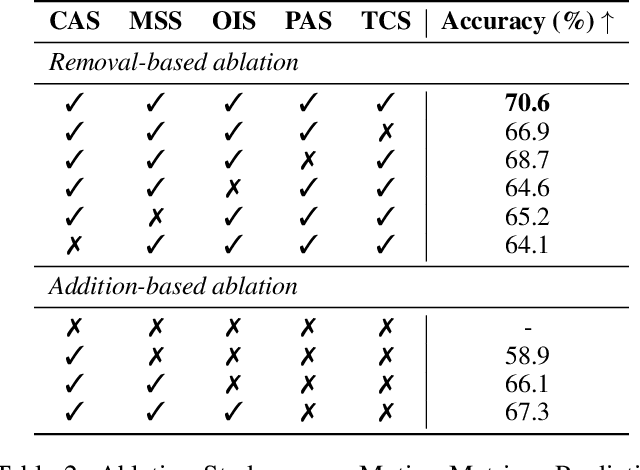
Video generation has advanced rapidly, improving evaluation methods, yet assessing video's motion remains a major challenge. Specifically, there are two key issues: 1) current motion metrics do not fully align with human perceptions; 2) the existing motion prompts are limited. Based on these findings, we introduce VMBench--a comprehensive Video Motion Benchmark that has perception-aligned motion metrics and features the most diverse types of motion. VMBench has several appealing properties: 1) Perception-Driven Motion Evaluation Metrics, we identify five dimensions based on human perception in motion video assessment and develop fine-grained evaluation metrics, providing deeper insights into models' strengths and weaknesses in motion quality. 2) Meta-Guided Motion Prompt Generation, a structured method that extracts meta-information, generates diverse motion prompts with LLMs, and refines them through human-AI validation, resulting in a multi-level prompt library covering six key dynamic scene dimensions. 3) Human-Aligned Validation Mechanism, we provide human preference annotations to validate our benchmarks, with our metrics achieving an average 35.3% improvement in Spearman's correlation over baseline methods. This is the first time that the quality of motion in videos has been evaluated from the perspective of human perception alignment. Additionally, we will soon release VMBench at https://github.com/GD-AIGC/VMBench, setting a new standard for evaluating and advancing motion generation models.