 Add to Chrome
 Add to Firefox
 Add to Edge
Geometry-Aware Infrastructure-Anchored Denoiser for UWB Sensing and Work-Zone Reconstruction
Jul 05, 2026
Accurate work-zone geometry perception is critical for intelligent transportation systems, and ultra-wideband sensing offers a low-cost approach for infrastructure-aided reconstruction. However, outdoor UWB ranging is often degraded by non-line-of-sight propagation, burst noise, and long-tail errors, which can distort downstream spatial reconstruction. We present GAIA, a geometry-aware, infrastructure-anchored learning framework that couples temporal range modeling with latent anchor-layout estimation and deterministic distance projection. GAIA preserves range denoising as the supervised task while orienting the learned distances toward boundary-consistent reconstruction. We evaluate GAIA on a real-world outdoor UWB dataset with synchronized UWB, GNSS, and IMU measurements, and further test robustness using a real-data-calibrated stress-test simulator. GAIA achieves the lowest overall range MSE and highest polygon IoU among evaluated filtering-based and learning-based baselines, reducing MSE by 18.4% and improving polygon IoU by 15.5% over PoseMLP. These results show that geometry-aware range denoising provides an effective path toward spatially coherent work-zone reconstruction.

From Failure Taxonomy to Intervention: A Diagnostic Methodology for Industry-Scale AVLM in Video and Live-Streaming Platform Moderation
Jun 29, 2026Industry-scale video and live-streaming moderation imposes requirements that are difficult to satisfy with generic pretrained public models or external APIs, including adaptation to platform-specific data distributions, policy-specific objectives, and product-level safety constraints. As a result, platforms must undertake internal model development, naturally turning to shared public research for guidance. However, existing multimodal foundation-model studies primarily report architectures, training recipes, data scaling strategies, and benchmark results, but provide less systematic guidance on how failures should be localized and translated into targeted model-development interventions. Interventions are essential because deployment failures are rarely self-explanatory. Similar failures can originate from different causes. Without targeted interventions, improvement reduces to heuristic trial-and-error, where benchmark improvements are weakly attributable, and failures are difficult to trace to their underlying causes. To address this gap, we present a diagnostic methodology for industry-scale Audio-Visual-Language Models AVLM development. The methodology maps model failures into a taxonomy of observable failure signatures and links each class of failure to an intervention space. We instantiate this methodology across the development and alignment lifecycle of an AVLM foundation model for a large-scale video and live-streaming platform. The resulting system supports over 100 regions and is designed for noisy, ambiguous, and highly diverse content drawn from global platform traffic.
Maturing Markov Decision Processes: Decision Making under Increasing Information and Shrinking Action Sets
Jun 17, 2026Sequential decision problems often exhibit an asymmetric evolution of information and decision flexibility: as a decision cycle unfolds, the agent receives richer information while feasible actions expire due to operational cutoffs, commitments, or resource constraints. Standard MDP formulations typically flatten this structure into stage-dependent state descriptions and action masks, thereby obscuring the nested information--action asymmetry that determines which decisions are urgent and which can be deferred. We introduce Maturing Markov Decision Processes (MMDPs), a formulation built around this information--action asymmetry. We characterize one of its key consequences through an expiring-action priority principle, which identifies the actions that must be resolved before the next stage. Motivated by this structure, we develop a structure-aware reinforcement learning framework with stage-aware policy design, expiring-action abstraction, and search-augmented learning with distillation. Experiments on a controlled multi-supplier replenishment problem, simplified cash-management environments of increasing complexity, and a production-scale simulator show that explicitly modeling this asymmetry improves learning efficiency and becomes increasingly valuable as decision problems scale.
V2I Work Zone Geometry Reconstruction with Pose-Conditioned UWB Range Denoising
May 28, 2026Reliable work zone mapping is important for connected and autonomous vehicles (CAVs) to navigate safely and smoothly through work zone areas. Cone-mounted ultra-wideband (UWB) roadside units (RSU) offer a cost-effective way for work zone layout inference, as roadside anchors and vehicle tags provide direct vehicle-to-infrastructure (V2I) range constraints for work zone geometry reconstruction. However, UWB range estimation is degraded by bursty outliers, non-line-of-sight (NLOS) errors, arbitrary anchor-ordering issues, and vehicle pose uncertainties in practical field deployments. To address these challenges, this study proposes a pose-conditioned, permutation-equivariant predictive denoiser for multi-anchor UWB ranging. The model employs shared anchor-wise temporal prediction to capture range dynamics, symmetric set aggregation to handle unordered and missing anchors, and pose-conditioned residual decoding to incorporate vehicle motion as a geometric prior. A two-stage training strategy first learns prediction from observed ranges, and then fine-tunes the denoiser with NLOS-weighted supervision. The method is evaluated on rare real-world V2I UWB field data collected with a CAV, as well as on controlled large-scale simulation benchmarks for ablative insights. Results show that the proposed method substantially improves range accuracy, cone localization, and work zone geometry reconstruction in challenging NLOS-dominated regimes, remains robust to anchor re-indexing and moderate anchor dropout, and reduces measurement-weighted field MSE by 66.9% relative to the raw input.
V2X-QA: A Comprehensive Reasoning Dataset and Benchmark for Multimodal Large Language Models in Autonomous Driving Across Ego, Infrastructure, and Cooperative Views
Apr 03, 2026Multimodal large language models (MLLMs) have shown strong potential for autonomous driving, yet existing benchmarks remain largely ego-centric and therefore cannot systematically assess model performance in infrastructure-centric and cooperative driving conditions. In this work, we introduce V2X-QA, a real-world dataset and benchmark for evaluating MLLMs across vehicle-side, infrastructure-side, and cooperative viewpoints. V2X-QA is built around a view-decoupled evaluation protocol that enables controlled comparison under vehicle-only, infrastructure-only, and cooperative driving conditions within a unified multiple-choice question answering (MCQA) framework. The benchmark is organized into a twelve-task taxonomy spanning perception, prediction, and reasoning and planning, and is constructed through expert-verified MCQA annotation to enable fine-grained diagnosis of viewpoint-dependent capabilities. Benchmark results across ten representative state-of-the-art proprietary and open-source models show that viewpoint accessibility substantially affects performance, and infrastructure-side reasoning supports meaningful macroscopic traffic understanding. Results also indicate that cooperative reasoning remains challenging since it requires cross-view alignment and evidence integration rather than simply additional visual input. To address these challenges, we introduce V2X-MoE, a benchmark-aligned baseline with explicit view routing and viewpoint-specific LoRA experts. The strong performance of V2X-MoE further suggests that explicit viewpoint specialization is a promising direction for multi-view reasoning in autonomous driving. Overall, V2X-QA provides a foundation for studying multi-perspective reasoning, reliability, and cooperative physical intelligence in connected autonomous driving. The dataset and V2X-MoE resources are publicly available at: https://github.com/junwei0001/V2X-QA.
DeepStock: Reinforcement Learning with Policy Regularizations for Inventory Management
Mar 20, 2026Deep Reinforcement Learning (DRL) provides a general-purpose methodology for training inventory policies that can leverage big data and compute. However, off-the-shelf implementations of DRL have seen mixed success, often plagued by high sensitivity to the hyperparameters used during training. In this paper, we show that by imposing policy regularizations, grounded in classical inventory concepts such as "Base Stock", we can significantly accelerate hyperparameter tuning and improve the final performance of several DRL methods. We report details from a 100% deployment of DRL with policy regularizations on Alibaba's e-commerce platform, Tmall. We also include extensive synthetic experiments, which show that policy regularizations reshape the narrative on what is the best DRL method for inventory management.
TodoEvolve: Learning to Architect Agent Planning Systems
Feb 08, 2026Planning has become a central capability for contemporary agent systems in navigating complex, long-horizon tasks, yet existing approaches predominantly rely on fixed, hand-crafted planning structures that lack the flexibility to adapt to the structural diversity of open-ended problems. To address this limitation, we introduce TodoEvolve, a meta-planning paradigm that autonomously synthesizes and dynamically revises task-specific planning architectures. Specifically, we first construct PlanFactory, a modular design space that standardizes diverse planning paradigms within a unified codebase encompassing topology, initialization, adaptation, and navigation, thereby providing a common interface for heterogeneous planning patterns. Leveraging PlanFactory, we collect high-quality planning trajectories and train Todo-14B via \textit{Impedance-Guided Preference Optimization} (IGPO), a multi-objective reinforcement learning objective that encourages the generation of planning systems that are performant, stable, and token-efficient across arbitrary tasks and agent backbones. Empirical evaluations on five agentic benchmarks demonstrate that TodoEvolve consistently surpasses carefully engineered planning modules while maintaining economical API costs and runtime overhead.
HERMES: A Holistic End-to-End Risk-Aware Multimodal Embodied System with Vision-Language Models for Long-Tail Autonomous Driving
Feb 01, 2026End-to-end autonomous driving models increasingly benefit from large vision--language models for semantic understanding, yet ensuring safe and accurate operation under long-tail conditions remains challenging. These challenges are particularly prominent in long-tail mixed-traffic scenarios, where autonomous vehicles must interact with heterogeneous road users, including human-driven vehicles and vulnerable road users, under complex and uncertain conditions. This paper proposes HERMES, a holistic risk-aware end-to-end multimodal driving framework designed to inject explicit long-tail risk cues into trajectory planning. HERMES employs a foundation-model-assisted annotation pipeline to produce structured Long-Tail Scene Context and Long-Tail Planning Context, capturing hazard-centric cues together with maneuver intent and safety preference, and uses these signals to guide end-to-end planning. HERMES further introduces a Tri-Modal Driving Module that fuses multi-view perception, historical motion cues, and semantic guidance, ensuring risk-aware accurate trajectory planning under long-tail scenarios. Experiments on the real-world long-tail dataset demonstrate that HERMES consistently outperforms representative end-to-end and VLM-driven baselines under long-tail mixed-traffic scenarios. Ablation studies verify the complementary contributions of key components.
Towards Practical Large-scale Dynamical Heterogeneous Graph Embedding: Cold-start Resilient Recommendation
Dec 15, 2025Deploying dynamic heterogeneous graph embeddings in production faces key challenges of scalability, data freshness, and cold-start. This paper introduces a practical, two-stage solution that balances deep graph representation with low-latency incremental updates. Our framework combines HetSGFormer, a scalable graph transformer for static learning, with Incremental Locally Linear Embedding (ILLE), a lightweight, CPU-based algorithm for real-time updates. HetSGFormer captures global structure with linear scalability, while ILLE provides rapid, targeted updates to incorporate new data, thus avoiding costly full retraining. This dual approach is cold-start resilient, leveraging the graph to create meaningful embeddings from sparse data. On billion-scale graphs, A/B tests show HetSGFormer achieved up to a 6.11% lift in Advertiser Value over previous methods, while the ILLE module added another 3.22% lift and improved embedding refresh timeliness by 83.2%. Our work provides a validated framework for deploying dynamic graph learning in production environments.
CATS-V2V: A Real-World Vehicle-to-Vehicle Cooperative Perception Dataset with Complex Adverse Traffic Scenarios
Nov 14, 2025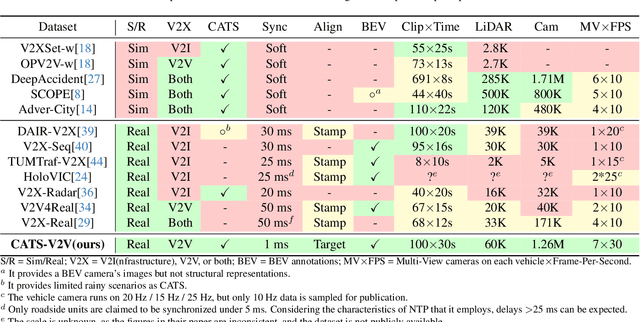
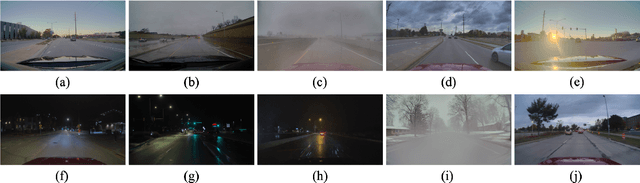
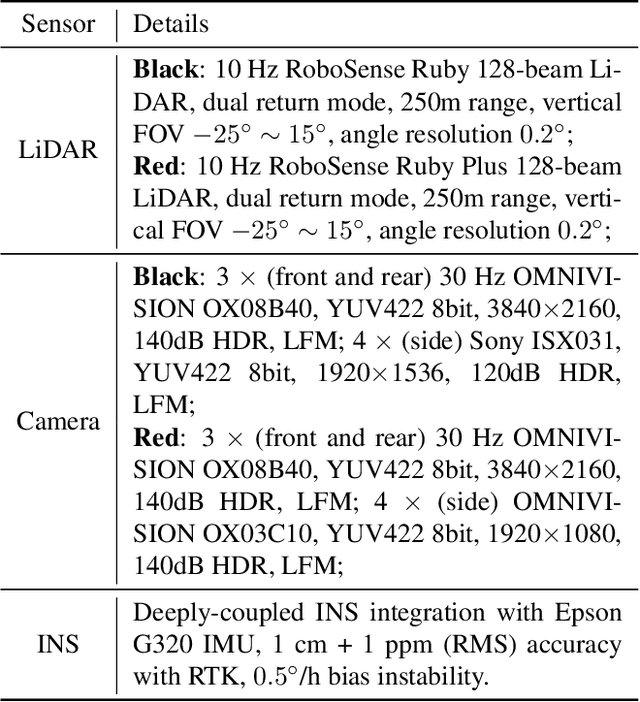
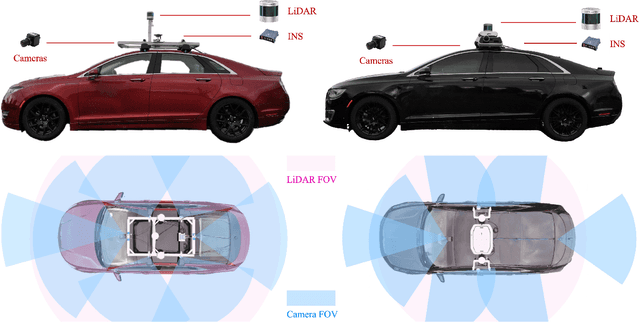
Vehicle-to-Vehicle (V2V) cooperative perception has great potential to enhance autonomous driving performance by overcoming perception limitations in complex adverse traffic scenarios (CATS). Meanwhile, data serves as the fundamental infrastructure for modern autonomous driving AI. However, due to stringent data collection requirements, existing datasets focus primarily on ordinary traffic scenarios, constraining the benefits of cooperative perception. To address this challenge, we introduce CATS-V2V, the first-of-its-kind real-world dataset for V2V cooperative perception under complex adverse traffic scenarios. The dataset was collected by two hardware time-synchronized vehicles, covering 10 weather and lighting conditions across 10 diverse locations. The 100-clip dataset includes 60K frames of 10 Hz LiDAR point clouds and 1.26M multi-view 30 Hz camera images, along with 750K anonymized yet high-precision RTK-fixed GNSS and IMU records. Correspondingly, we provide time-consistent 3D bounding box annotations for objects, as well as static scenes to construct a 4D BEV representation. On this basis, we propose a target-based temporal alignment method, ensuring that all objects are precisely aligned across all sensor modalities. We hope that CATS-V2V, the largest-scale, most supportive, and highest-quality dataset of its kind to date, will benefit the autonomous driving community in related tasks.