 Add to Chrome
 Add to Firefox
 Add to Edge
SrDetection: A Self-Referential Framework for Data Leakage Detection in Code Large Language Models
Jun 29, 2026
Evaluating code large language models (Code LLMs) requires reliable detection of data leakage, where benchmark performance is artificially inflated by exposure to benchmark data during pre-training. Existing approaches either assume access to proprietary training corpora, rely on brittle heuristics such as timestamp filtering, or use external reference sets with manually tuned, non-generalizable thresholds. To address these limitations, we introduce \textbf{SrDetection}, a unified \textbf{s}elf-\textbf{r}eferential leakage detection framework for both gray-box (access to model logits) and black-box (access to model outputs) settings. SrDetection generates semantically equivalent variants of a benchmark sample and detects leakage by contrasting the model's behavior on the original versus its variants, flagging cases where the original is disproportionately easier for the model. We further design a controlled leakage detection testbed and evaluate SrDetection in this environment. Across different models and training stages, SrDetection improves average F1 by 21.52 points in the gray-box setting and 14.46 points in the black-box setting over strong baselines, demonstrating robust, threshold-independent leakage detection. Finally, a gray-box study of 15 widely used Code LLMs on four popular benchmarks reveals benchmark-specific leakage patterns beyond prior overlap-based analyses\footnote{\footnotesize Source code and data are available at https://github.com/SMinL/SrDetectionCode

PLOT: Enhancing Preference Learning via Optimal Transport
Apr 02, 2026Preference learning in Large Language Models (LLMs) has advanced significantly, yet existing methods remain limited by modest performance gains, high computational costs, hyperparameter sensitivity, and insufficient modeling of global token-level relationships. We introduce PLOT, which enhances Preference Learning in fine-tuning-based alignment through a token-level loss derived from Optimal Transport. By formulating preference learning as an Optimal Transport Problem, PLOT aligns model outputs with human preferences while preserving the original distribution of LLMs, ensuring stability and robustness. Furthermore, PLOT leverages token embeddings to capture semantic relationships, enabling globally informed optimization. Experiments across two preference categories - Human Values and Logic & Problem Solving - spanning seven subpreferences demonstrate that PLOT consistently improves alignment performance while maintaining fluency and coherence. These results substantiate optimal transport as a principled methodology for preference learning, establishing a theoretically grounded framework that provides new insights for preference learning of LLMs.
DEFT: Distribution-guided Efficient Fine-Tuning for Human Alignment
Apr 02, 2026Reinforcement Learning from Human Feedback (RLHF), using algorithms like Proximal Policy Optimization (PPO), aligns Large Language Models (LLMs) with human values but is costly and unstable. Alternatives have been proposed to replace PPO or integrate Supervised Fine-Tuning (SFT) and contrastive learning for direct fine-tuning and value alignment. However, these methods still require voluminous data to learn preferences and may weaken the generalization ability of LLMs. To further enhance alignment efficiency and performance while mitigating the loss of generalization ability, this paper introduces Distribution-guided Efficient Fine-Tuning (DEFT), an efficient alignment framework incorporating data filtering and distributional guidance by calculating the differential distribution reward based on the output distribution of language model and the discrepancy distribution of preference data. A small yet high-quality subset is filtered from the raw data using a differential distribution reward, which is then incorporated into existing alignment methods to guide the model's output distribution. Experimental results demonstrate that the methods enhanced by DEFT outperform the original methods in both alignment capability and generalization ability, with significantly reduced training time.
Beyond Quantity: Trajectory Diversity Scaling for Code Agents
Feb 03, 2026As code large language models (LLMs) evolve into tool-interactive agents via the Model Context Protocol (MCP), their generalization is increasingly limited by low-quality synthetic data and the diminishing returns of quantity scaling. Moreover, quantity-centric scaling exhibits an early bottleneck that underutilizes trajectory data. We propose TDScaling, a Trajectory Diversity Scaling-based data synthesis framework for code agents that scales performance through diversity rather than raw volume. Under a fixed training budget, increasing trajectory diversity yields larger gains than adding more trajectories, improving the performance-cost trade-off for agent training. TDScaling integrates four innovations: (1) a Business Cluster mechanism that captures real-service logical dependencies; (2) a blueprint-driven multi-agent paradigm that enforces trajectory coherence; (3) an adaptive evolution mechanism that steers synthesis toward long-tail scenarios using Domain Entropy, Reasoning Mode Entropy, and Cumulative Action Complexity to prevent mode collapse; and (4) a sandboxed code tool that mitigates catastrophic forgetting of intrinsic coding capabilities. Experiments on general tool-use benchmarks (BFCL, tau^2-Bench) and code agent tasks (RebenchT, CodeCI, BIRD) demonstrate a win-win outcome: TDScaling improves both tool-use generalization and inherent coding proficiency. We plan to release the full codebase and the synthesized dataset (including 30,000+ tool clusters) upon publication.
CPO: Addressing Reward Ambiguity in Role-playing Dialogue via Comparative Policy Optimization
Aug 12, 2025Reinforcement Learning Fine-Tuning (RLFT) has achieved notable success in tasks with objectively verifiable answers (e.g., code generation, mathematical reasoning), yet struggles with open-ended subjective tasks like role-playing dialogue. Traditional reward modeling approaches, which rely on independent sample-wise scoring, face dual challenges: subjective evaluation criteria and unstable reward signals.Motivated by the insight that human evaluation inherently combines explicit criteria with implicit comparative judgments, we propose Comparative Policy Optimization (CPO). CPO redefines the reward evaluation paradigm by shifting from sample-wise scoring to comparative group-wise scoring.Building on the same principle, we introduce the CharacterArena evaluation framework, which comprises two stages:(1) Contextualized Multi-turn Role-playing Simulation, and (2) Trajectory-level Comparative Evaluation. By operationalizing subjective scoring via objective trajectory comparisons, CharacterArena minimizes contextual bias and enables more robust and fair performance evaluation. Empirical results on CharacterEval, CharacterBench, and CharacterArena confirm that CPO effectively mitigates reward ambiguity and leads to substantial improvements in dialogue quality.
ChARM: Character-based Act-adaptive Reward Modeling for Advanced Role-Playing Language Agents
May 29, 2025
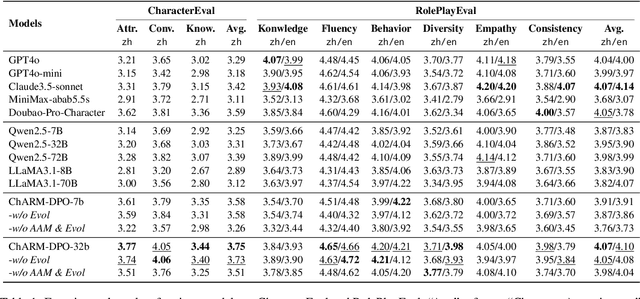
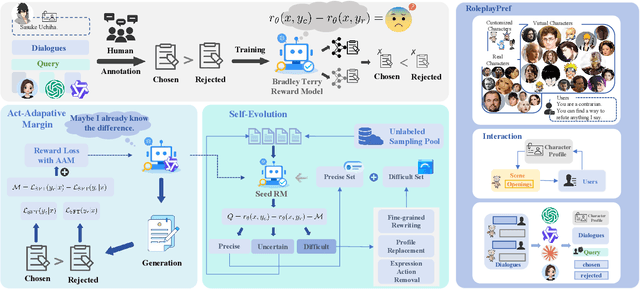
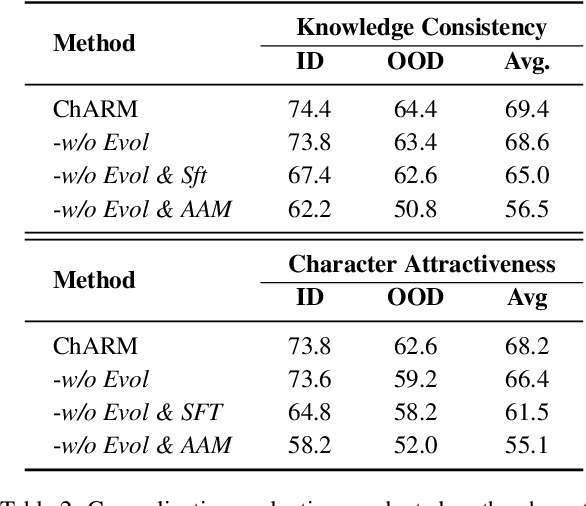
Role-Playing Language Agents (RPLAs) aim to simulate characters for realistic and engaging human-computer interactions. However, traditional reward models often struggle with scalability and adapting to subjective conversational preferences. We propose ChARM, a Character-based Act-adaptive Reward Model, addressing these challenges through two innovations: (1) an act-adaptive margin that significantly enhances learning efficiency and generalizability, and (2) a self-evolution mechanism leveraging large-scale unlabeled data to improve training coverage. Additionally, we introduce RoleplayPref, the first large-scale preference dataset specifically for RPLAs, featuring 1,108 characters, 13 subcategories, and 16,888 bilingual dialogues, alongside RoleplayEval, a dedicated evaluation benchmark. Experimental results show a 13% improvement over the conventional Bradley-Terry model in preference rankings. Furthermore, applying ChARM-generated rewards to preference learning techniques (e.g., direct preference optimization) achieves state-of-the-art results on CharacterEval and RoleplayEval. Code and dataset are available at https://github.com/calubkk/ChARM.
Reverse Preference Optimization for Complex Instruction Following
May 28, 2025Instruction following (IF) is a critical capability for large language models (LLMs). However, handling complex instructions with multiple constraints remains challenging. Previous methods typically select preference pairs based on the number of constraints they satisfy, introducing noise where chosen examples may fail to follow some constraints and rejected examples may excel in certain respects over the chosen ones. To address the challenge of aligning with multiple preferences, we propose a simple yet effective method called Reverse Preference Optimization (RPO). It mitigates noise in preference pairs by dynamically reversing the constraints within the instruction to ensure the chosen response is perfect, alleviating the burden of extensive sampling and filtering to collect perfect responses. Besides, reversal also enlarges the gap between chosen and rejected responses, thereby clarifying the optimization direction and making it more robust to noise. We evaluate RPO on two multi-turn IF benchmarks, Sysbench and Multi-IF, demonstrating average improvements over the DPO baseline of 4.6 and 2.5 points (on Llama-3.1 8B), respectively. Moreover, RPO scales effectively across model sizes (8B to 70B parameters), with the 70B RPO model surpassing GPT-4o.
OmniCharacter: Towards Immersive Role-Playing Agents with Seamless Speech-Language Personality Interaction
May 26, 2025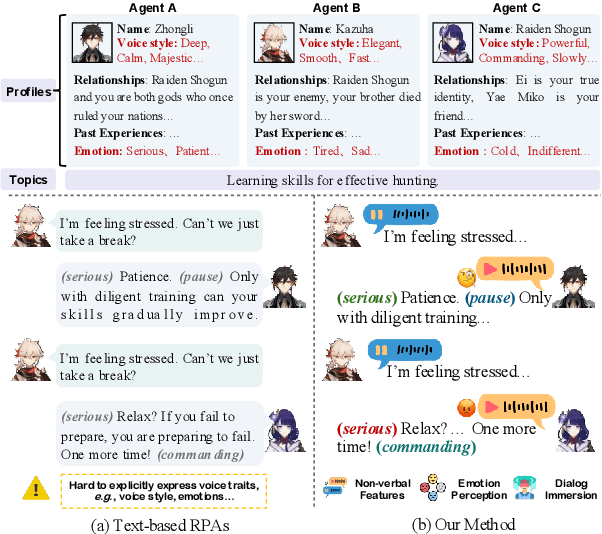

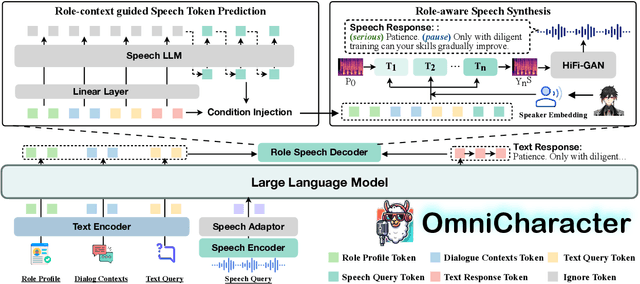
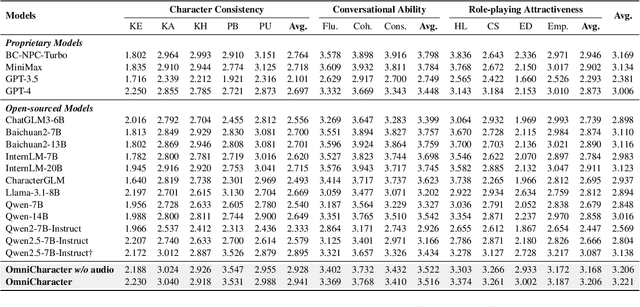
Role-Playing Agents (RPAs), benefiting from large language models, is an emerging interactive AI system that simulates roles or characters with diverse personalities. However, existing methods primarily focus on mimicking dialogues among roles in textual form, neglecting the role's voice traits (e.g., voice style and emotions) as playing a crucial effect in interaction, which tends to be more immersive experiences in realistic scenarios. Towards this goal, we propose OmniCharacter, a first seamless speech-language personality interaction model to achieve immersive RPAs with low latency. Specifically, OmniCharacter enables agents to consistently exhibit role-specific personality traits and vocal traits throughout the interaction, enabling a mixture of speech and language responses. To align the model with speech-language scenarios, we construct a dataset named OmniCharacter-10K, which involves more distinctive characters (20), richly contextualized multi-round dialogue (10K), and dynamic speech response (135K). Experimental results showcase that our method yields better responses in terms of both content and style compared to existing RPAs and mainstream speech-language models, with a response latency as low as 289ms. Code and dataset are available at https://github.com/AlibabaResearch/DAMO-ConvAI/tree/main/OmniCharacter.
Can MLLMs Understand the Deep Implication Behind Chinese Images?
Oct 17, 2024
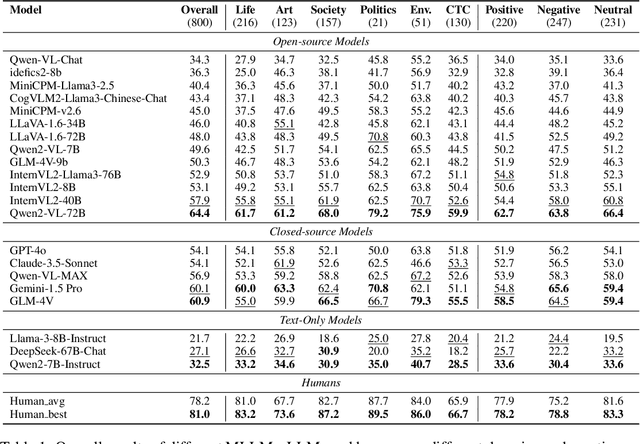
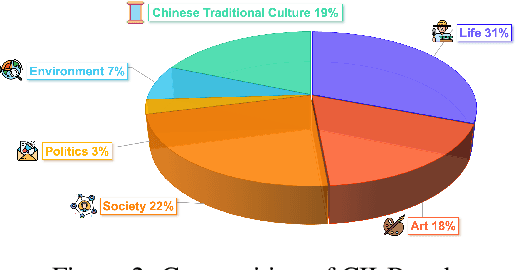
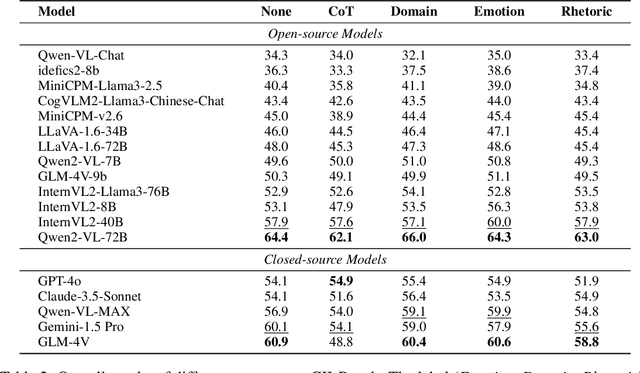
As the capabilities of Multimodal Large Language Models (MLLMs) continue to improve, the need for higher-order capability evaluation of MLLMs is increasing. However, there is a lack of work evaluating MLLM for higher-order perception and understanding of Chinese visual content. To fill the gap, we introduce the **C**hinese **I**mage **I**mplication understanding **Bench**mark, **CII-Bench**, which aims to assess the higher-order perception and understanding capabilities of MLLMs for Chinese images. CII-Bench stands out in several ways compared to existing benchmarks. Firstly, to ensure the authenticity of the Chinese context, images in CII-Bench are sourced from the Chinese Internet and manually reviewed, with corresponding answers also manually crafted. Additionally, CII-Bench incorporates images that represent Chinese traditional culture, such as famous Chinese traditional paintings, which can deeply reflect the model's understanding of Chinese traditional culture. Through extensive experiments on CII-Bench across multiple MLLMs, we have made significant findings. Initially, a substantial gap is observed between the performance of MLLMs and humans on CII-Bench. The highest accuracy of MLLMs attains 64.4%, where as human accuracy averages 78.2%, peaking at an impressive 81.0%. Subsequently, MLLMs perform worse on Chinese traditional culture images, suggesting limitations in their ability to understand high-level semantics and lack a deep knowledge base of Chinese traditional culture. Finally, it is observed that most models exhibit enhanced accuracy when image emotion hints are incorporated into the prompts. We believe that CII-Bench will enable MLLMs to gain a better understanding of Chinese semantics and Chinese-specific images, advancing the journey towards expert artificial general intelligence (AGI). Our project is publicly available at https://cii-bench.github.io/.
LIME-M: Less Is More for Evaluation of MLLMs
Sep 10, 2024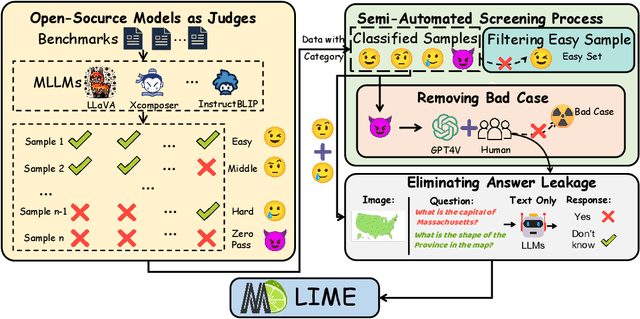
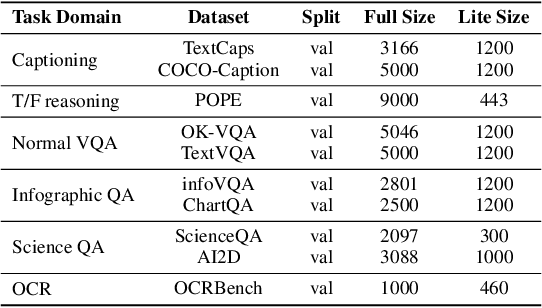
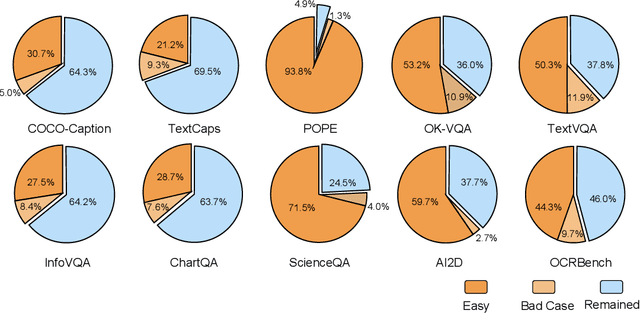
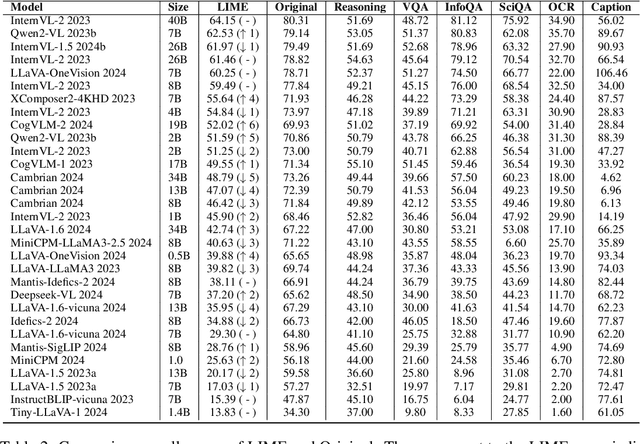
With the remarkable success achieved by Multimodal Large Language Models (MLLMs), numerous benchmarks have been designed to assess MLLMs' ability to guide their development in image perception tasks (e.g., image captioning and visual question answering). However, the existence of numerous benchmarks results in a substantial computational burden when evaluating model performance across all of them. Moreover, these benchmarks contain many overly simple problems or challenging samples, which do not effectively differentiate the capabilities among various MLLMs. To address these challenges, we propose a pipeline to process the existing benchmarks, which consists of two modules: (1) Semi-Automated Screening Process and (2) Eliminating Answer Leakage. The Semi-Automated Screening Process filters out samples that cannot distinguish the model's capabilities by synthesizing various MLLMs and manually evaluating them. The Eliminate Answer Leakage module filters samples whose answers can be inferred without images. Finally, we curate the LIME-M: Less Is More for Evaluation of Multimodal LLMs, a lightweight Multimodal benchmark that can more effectively evaluate the performance of different models. Our experiments demonstrate that: LIME-M can better distinguish the performance of different MLLMs with fewer samples (24% of the original) and reduced time (23% of the original); LIME-M eliminates answer leakage, focusing mainly on the information within images; The current automatic metric (i.e., CIDEr) is insufficient for evaluating MLLMs' capabilities in captioning. Moreover, removing the caption task score when calculating the overall score provides a more accurate reflection of model performance differences. All our codes and data are released at https://github.com/kangreen0210/LIME-M.