 Add to Chrome
 Add to Firefox
 Add to Edge
LJ-Bench: Ontology-Based Benchmark for U.S. Crime
Mar 21, 2026
The potential of Large Language Models (LLMs) to provide harmful information remains a significant concern due to the vast breadth of illegal queries they may encounter. Unfortunately, existing benchmarks only focus on a handful types of illegal activities, and are not grounded in legal works. In this work, we introduce an ontology of crime-related concepts grounded in the legal frameworks of Model Panel Code, which serves as an influential reference for criminal law and has been adopted by many U.S. states, and instantiated using Californian Law. This structured knowledge forms the foundation for LJ-Bench, the first comprehensive benchmark designed to evaluate LLM robustness against a wide range of illegal activities. Spanning 76 distinct crime types organized taxonomically, LJ-Bench enables systematic assessment of diverse attacks, revealing valuable insights into LLM vulnerabilities across various crime categories: LLMs exhibit heightened susceptibility to attacks targeting societal harm rather than those directly impacting individuals. Our benchmark aims to facilitate the development of more robust and trustworthy LLMs. The LJ-Bench benchmark and LJ-Ontology, along with experiments implementation for reproducibility are publicly available at https://github.com/AndreaTseng/LJ-Bench.

CATS-V2V: A Real-World Vehicle-to-Vehicle Cooperative Perception Dataset with Complex Adverse Traffic Scenarios
Nov 14, 2025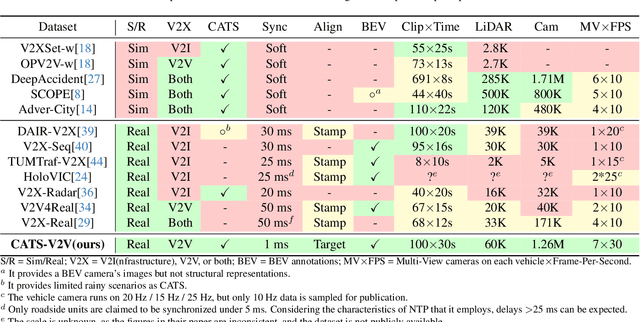
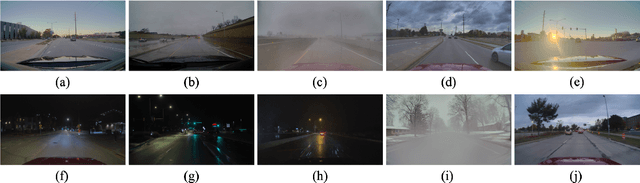
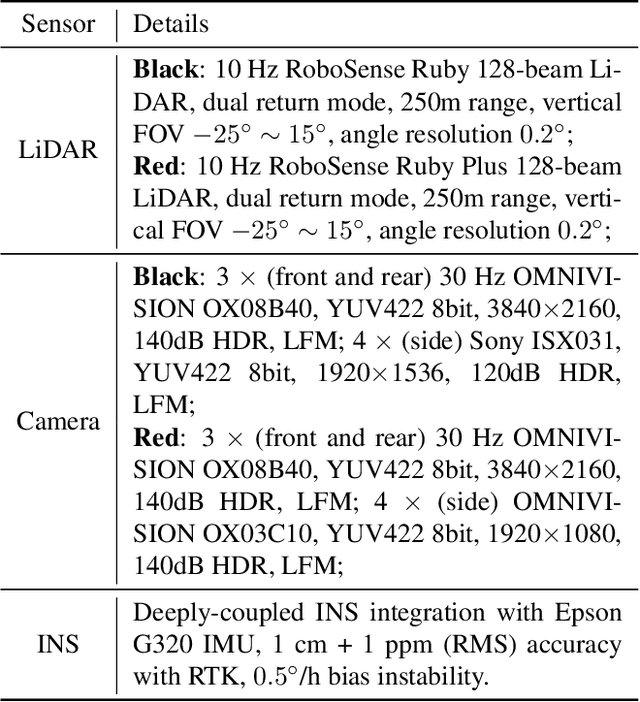
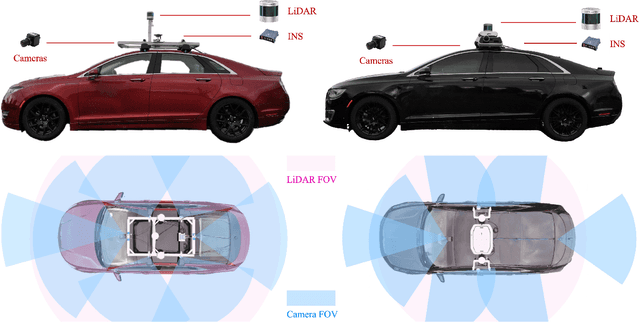
Vehicle-to-Vehicle (V2V) cooperative perception has great potential to enhance autonomous driving performance by overcoming perception limitations in complex adverse traffic scenarios (CATS). Meanwhile, data serves as the fundamental infrastructure for modern autonomous driving AI. However, due to stringent data collection requirements, existing datasets focus primarily on ordinary traffic scenarios, constraining the benefits of cooperative perception. To address this challenge, we introduce CATS-V2V, the first-of-its-kind real-world dataset for V2V cooperative perception under complex adverse traffic scenarios. The dataset was collected by two hardware time-synchronized vehicles, covering 10 weather and lighting conditions across 10 diverse locations. The 100-clip dataset includes 60K frames of 10 Hz LiDAR point clouds and 1.26M multi-view 30 Hz camera images, along with 750K anonymized yet high-precision RTK-fixed GNSS and IMU records. Correspondingly, we provide time-consistent 3D bounding box annotations for objects, as well as static scenes to construct a 4D BEV representation. On this basis, we propose a target-based temporal alignment method, ensuring that all objects are precisely aligned across all sensor modalities. We hope that CATS-V2V, the largest-scale, most supportive, and highest-quality dataset of its kind to date, will benefit the autonomous driving community in related tasks.