 Add to Chrome
 Add to Firefox
 Add to Edge
Explaining Context Length Scaling and Bounds for Language Models
Feb 03, 2025
Long Context Language Models have drawn great attention in the past few years. There has been work discussing the impact of long context on Language Model performance: some find that long irrelevant context could harm performance, while some experimentally summarize loss reduction by relevant long context as Scaling Laws. This calls for a more thorough understanding on how long context impact Language Modeling. In this work, we (1) propose a clean and effective theoretical framework on explaining the impact of context length to Language Modeling, from an Intrinsic Space perspective; and (2) conduct experiments on natural language and synthetic data, validating our proposed theoretical assumptions and deductions. Our theoretical framework can provide practical insights such as establishing that training dataset size dictates an optimal context length and bounds context length scaling for certain case. We hope our work may inspire new long context Language Models, as well as future work studying Physics for Language Models. Code for our experiments is available at this url: https://github.com/JingzheShi/NLPCtlScalingAndBounds.

VR-Robo: A Real-to-Sim-to-Real Framework for Visual Robot Navigation and Locomotion
Feb 03, 2025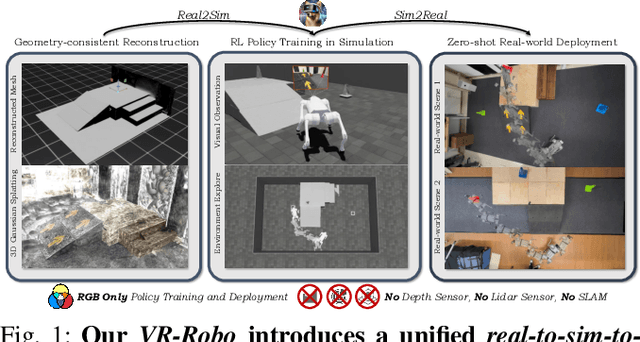
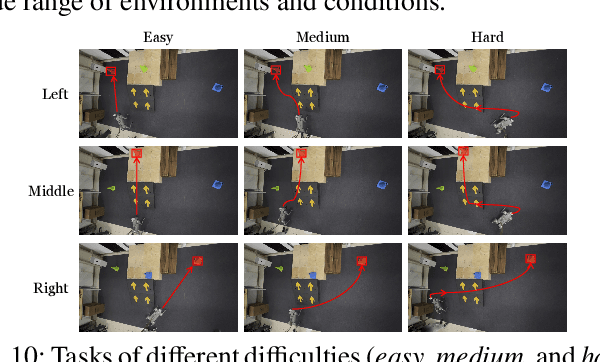
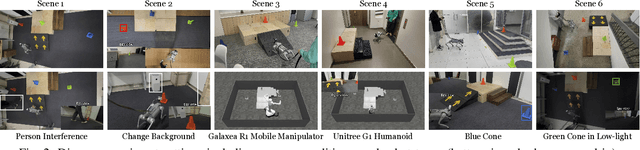
Recent success in legged robot locomotion is attributed to the integration of reinforcement learning and physical simulators. However, these policies often encounter challenges when deployed in real-world environments due to sim-to-real gaps, as simulators typically fail to replicate visual realism and complex real-world geometry. Moreover, the lack of realistic visual rendering limits the ability of these policies to support high-level tasks requiring RGB-based perception like ego-centric navigation. This paper presents a Real-to-Sim-to-Real framework that generates photorealistic and physically interactive "digital twin" simulation environments for visual navigation and locomotion learning. Our approach leverages 3D Gaussian Splatting (3DGS) based scene reconstruction from multi-view images and integrates these environments into simulations that support ego-centric visual perception and mesh-based physical interactions. To demonstrate its effectiveness, we train a reinforcement learning policy within the simulator to perform a visual goal-tracking task. Extensive experiments show that our framework achieves RGB-only sim-to-real policy transfer. Additionally, our framework facilitates the rapid adaptation of robot policies with effective exploration capability in complex new environments, highlighting its potential for applications in households and factories.
Advancing Single- and Multi-task Text Classification through Large Language Model Fine-tuning
Dec 11, 2024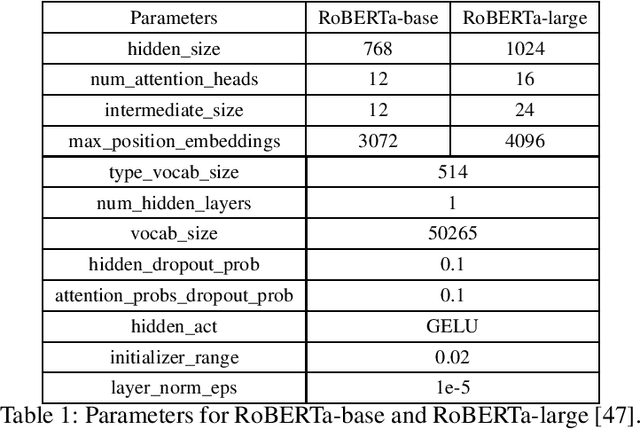
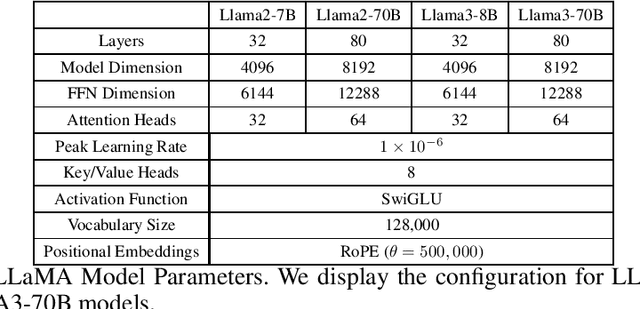
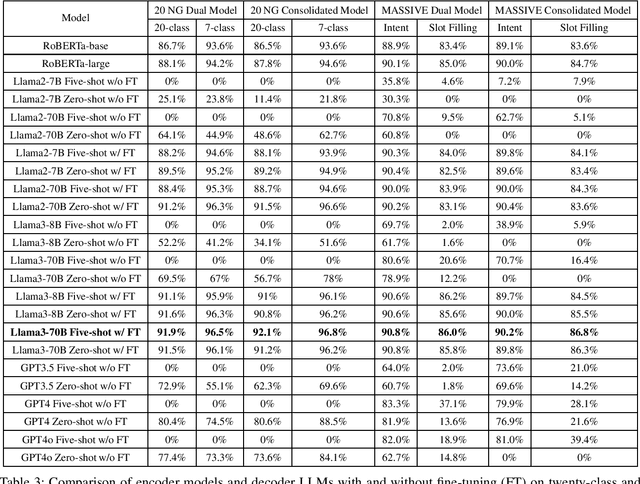
Both encoder-only models (e.g., BERT, RoBERTa) and large language models (LLMs, e.g., Llama3) have been widely used for text classification tasks. However, there is a lack of systematic studies comparing the performance of encoder-based models and LLMs in text classification, particularly when fine-tuning is involved. This study employed a diverse range of models and methods, varying in size and architecture, and including both fine-tuned and pre-trained approaches. We first assessed the performances of these LLMs on the 20 Newsgroups (20NG) and MASSIVE datasets, comparing them to encoder-only RoBERTa models. Additionally, we explored the multi-task capabilities of both model types by combining multiple classification tasks, including intent detection and slot-filling, into a single model using data from both datasets. Our results indicate that fully fine-tuned Llama3-70B models outperform RoBERTa-large and other decoder LLMs across various classification tasks and datasets. Moreover, the consolidated multi-task fine-tuned LLMs matched the performance of dual-model setups in both tasks across both datasets. Overall, our study provides a comprehensive benchmark of encoder-only and LLM models on text classification tasks and demonstrates a method to combine two or more fully fine-tuned decoder LLMs for reduced latency and equivalent performance.
Can Open-source LLMs Enhance Data Synthesis for Toxic Detection?: An Experimental Study
Dec 03, 2024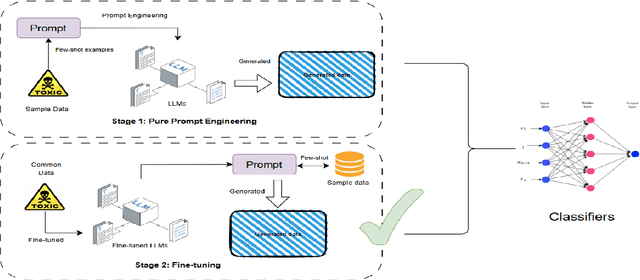
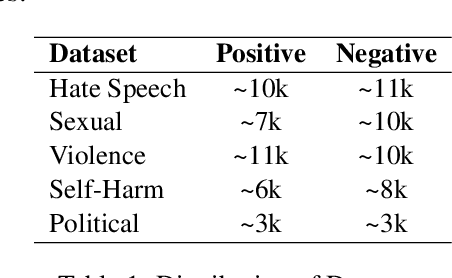
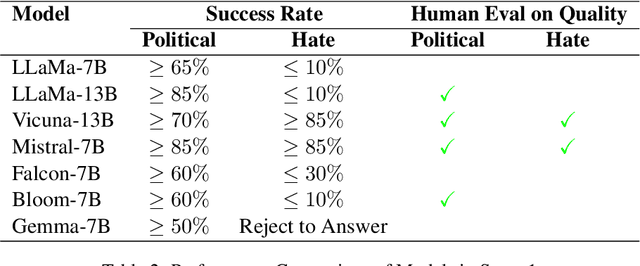
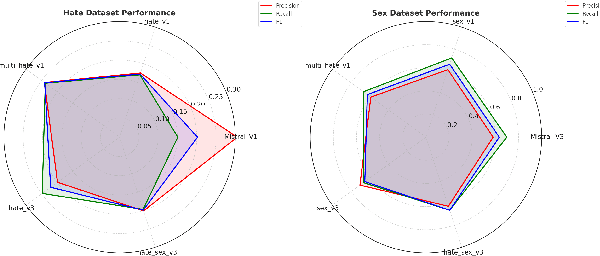
Effective toxic content detection relies heavily on high-quality and diverse data, which serves as the foundation for robust content moderation models. This study explores the potential of open-source LLMs for harmful data synthesis, utilizing prompt engineering and fine-tuning techniques to enhance data quality and diversity. In a two-stage evaluation, we first examine the capabilities of six open-source LLMs in generating harmful data across multiple datasets using prompt engineering. In the second stage, we fine-tune these models to improve data generation while addressing challenges such as hallucination, data duplication, and overfitting. Our findings reveal that Mistral excels in generating high-quality and diverse harmful data with minimal hallucination. Furthermore, fine-tuning enhances data quality, offering scalable and cost-effective solutions for augmenting datasets for specific toxic content detection tasks. These results emphasize the significance of data synthesis in building robust, standalone detection models and highlight the potential of open-source LLMs to advance smaller downstream content moderation systems. We implemented this approach in real-world industrial settings, demonstrating the feasibility and efficiency of fine-tuned open-source LLMs for harmful data synthesis.
Can Open-source LLMs Enhance Data Augmentation for Toxic Detection?: An Experimental Study
Nov 18, 2024High-quality, diverse harmful data is essential to addressing real-time applications in content moderation. Current state-of-the-art approaches to toxic content detection using GPT series models are costly and lack explainability. This paper investigates the use of prompt engineering and fine-tuning techniques on open-source LLMs to enhance harmful data augmentation specifically for toxic content detection. We conduct a two-stage empirical study, with stage 1 evaluating six open-source LLMs across multiple datasets using only prompt engineering and stage 2 focusing on fine-tuning. Our findings indicate that Mistral can excel in generating harmful data with minimal hallucination. While fine-tuning these models improves data quality and diversity, challenges such as data duplication and overfitting persist. Our experimental results highlight scalable, cost-effective strategies for enhancing toxic content detection systems. These findings not only demonstrate the potential of open-source LLMs in creating robust content moderation tools. The application of this method in real industrial scenarios further proves the feasibility and efficiency of the fine-tuned open-source LLMs for data augmentation. We hope our study will aid in understanding the capabilities and limitations of current models in toxic content detection and drive further advancements in this field.
Generalizing Motion Planners with Mixture of Experts for Autonomous Driving
Oct 21, 2024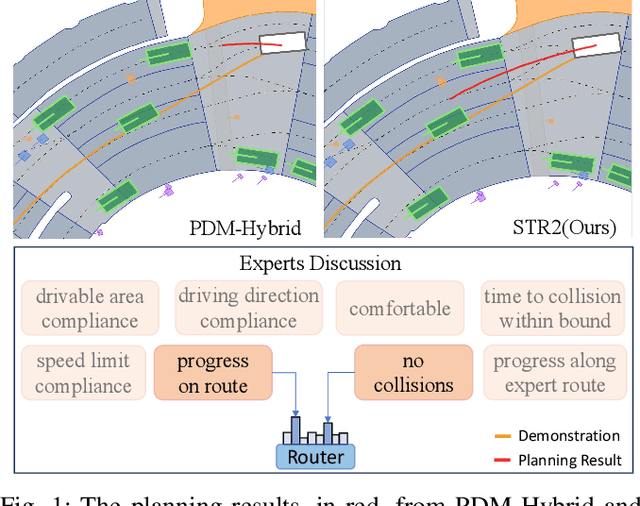
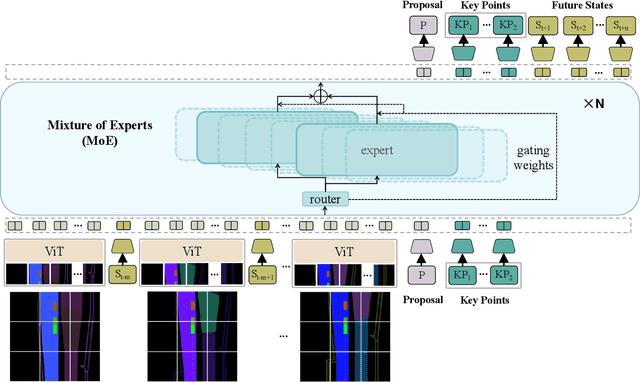
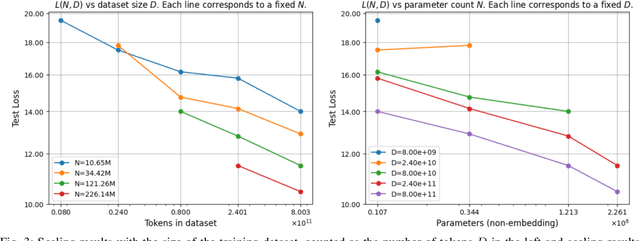
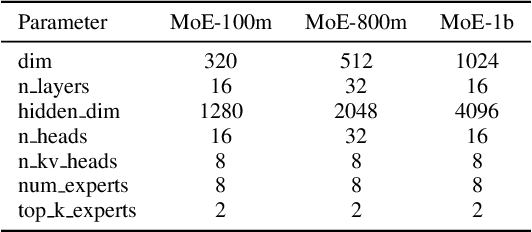
Large real-world driving datasets have sparked significant research into various aspects of data-driven motion planners for autonomous driving. These include data augmentation, model architecture, reward design, training strategies, and planner pipelines. These planners promise better generalizations on complicated and few-shot cases than previous methods. However, experiment results show that many of these approaches produce limited generalization abilities in planning performance due to overly complex designs or training paradigms. In this paper, we review and benchmark previous methods focusing on generalizations. The experimental results indicate that as models are appropriately scaled, many design elements become redundant. We introduce StateTransformer-2 (STR2), a scalable, decoder-only motion planner that uses a Vision Transformer (ViT) encoder and a mixture-of-experts (MoE) causal Transformer architecture. The MoE backbone addresses modality collapse and reward balancing by expert routing during training. Extensive experiments on the NuPlan dataset show that our method generalizes better than previous approaches across different test sets and closed-loop simulations. Furthermore, we assess its scalability on billions of real-world urban driving scenarios, demonstrating consistent accuracy improvements as both data and model size grow.
Playful DoggyBot: Learning Agile and Precise Quadrupedal Locomotion
Sep 30, 2024Quadrupedal animals have the ability to perform agile while accurate tasks: a trained dog can chase and catch a flying frisbee before it touches the ground; a cat alone at home can jump and grab the door handle accurately. However, agility and precision are usually a trade-off in robotics problems. Recent works in quadruped robots either focus on agile but not-so-accurate tasks, such as locomotion in challenging terrain, or accurate but not-so-fast tasks, such as using an additional manipulator to interact with objects. In this work, we aim at an accurate and agile task, catching a small object hanging above the robot. We mount a passive gripper in front of the robot chassis, so that the robot has to jump and catch the object with extreme precision. Our experiment shows that our system is able to jump and successfully catch the ball at 1.05m high in simulation and 0.8m high in the real world, while the robot is 0.3m high when standing.
Seed-Music: A Unified Framework for High Quality and Controlled Music Generation
Sep 13, 2024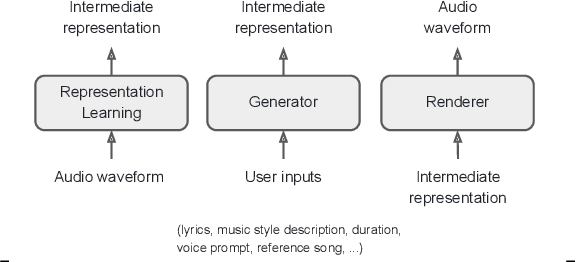

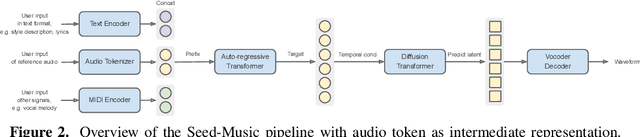

We introduce Seed-Music, a suite of music generation systems capable of producing high-quality music with fine-grained style control. Our unified framework leverages both auto-regressive language modeling and diffusion approaches to support two key music creation workflows: \textit{controlled music generation} and \textit{post-production editing}. For controlled music generation, our system enables vocal music generation with performance controls from multi-modal inputs, including style descriptions, audio references, musical scores, and voice prompts. For post-production editing, it offers interactive tools for editing lyrics and vocal melodies directly in the generated audio. We encourage readers to listen to demo audio examples at https://team.doubao.com/seed-music .
Robust Robot Walker: Learning Agile Locomotion over Tiny Traps
Sep 12, 2024
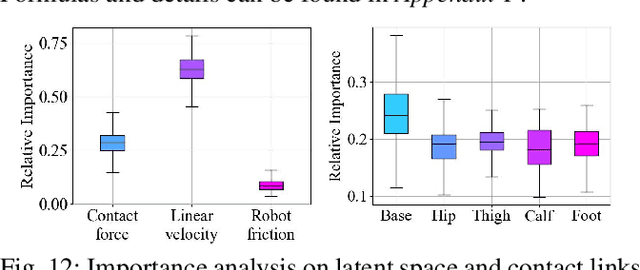
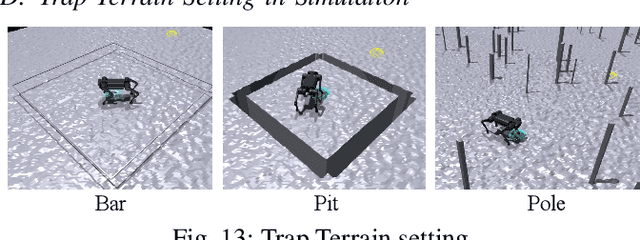
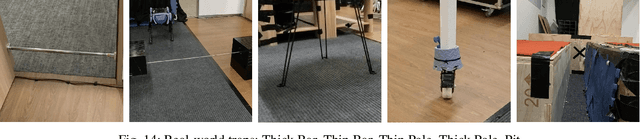
Quadruped robots must exhibit robust walking capabilities in practical applications. In this work, we propose a novel approach that enables quadruped robots to pass various small obstacles, or "tiny traps". Existing methods often rely on exteroceptive sensors, which can be unreliable for detecting such tiny traps. To overcome this limitation, our approach focuses solely on proprioceptive inputs. We introduce a two-stage training framework incorporating a contact encoder and a classification head to learn implicit representations of different traps. Additionally, we design a set of tailored reward functions to improve both the stability of training and the ease of deployment for goal-tracking tasks. To benefit further research, we design a new benchmark for tiny trap task. Extensive experiments in both simulation and real-world settings demonstrate the effectiveness and robustness of our method. Project Page: https://robust-robot-walker.github.io/
Cross Anything: General Quadruped Robot Navigation through Complex Terrains
Jul 23, 2024The application of vision-language models (VLMs) has achieved impressive success in various robotics tasks, but there are few explorations for foundation models used in quadruped robot navigation. We introduce Cross Anything System (CAS), an innovative system composed of a high-level reasoning module and a low-level control policy, enabling the robot to navigate across complex 3D terrains and reach the goal position. For high-level reasoning and motion planning, we propose a novel algorithmic system taking advantage of a VLM, with a design of task decomposition and a closed-loop sub-task execution mechanism. For low-level locomotion control, we utilize the Probability Annealing Selection (PAS) method to train a control policy by reinforcement learning. Numerous experiments show that our whole system can accurately and robustly navigate across complex 3D terrains, and its strong generalization ability ensures the applications in diverse indoor and outdoor scenarios and terrains. Project page: https://cross-anything.github.io/