 Add to Chrome
 Add to Firefox
 Add to Edge
Active Real-World Factor-Based Evaluation for Generalist Robot Policies
Jul 16, 2026
Generalist robot manipulation policies trained on large, diverse datasets have shown remarkable promise across a wide range of tasks. However, rigorously evaluating these policies remains a fundamental challenge. Real-world performance depends on a large combinatorial space of task factors including object poses and camera viewpoints, making full, exhaustive evaluation intractable. Additionally, real hardware evaluation is slow and resource-intensive, so current practice is to use narrow test suites that can miss critical failure modes and misrepresent true deployment readiness. We propose an active evaluation framework that addresses this challenge by treating policy evaluation as a sequential experimental design problem. Our approach fits a probabilistic surrogate model over a structured space of task factors and adaptively selects evaluation configurations to maximize information gain over the policy's performance distribution, allowing for sample-efficient characterization of policy behavior across unseen conditions and a systematic identification of failure-prone regions. We conduct 2331 real-world evaluations across 3 tasks with 3 factor variations and find that our approach typically saves the evaluator at least 20-40% of trials compared to typical random testing.

DREAMSTEER: Latent World Models Can Steer VLA Policies During Deployment Without Any Finetuning
Jul 03, 2026Pretrained vision-language-action (VLA) policies show promising zero-shot generalization, but often fail under deployment-time distribution shift, leading to decreased robustness and inconsistent instruction following. While prior work commonly tackles this by finetuning on in-distribution data, it assumes demonstrations collected on tasks in the target environment. In this work, we propose DREAMSTEER, a deployment-time steering framework for pretrained VLAs without any finetuning or parameter modifications. The key insight in DREAMSTEER is to leverage a latent world model and a value model to steer pretrained VLA policies. During deployment, DREAMSTEER samples candidate action chunks from a VLA policy and predefined motion primitives, imagines their outcomes using an action-conditioned latent world model, and ranks the imagined trajectories with a language-conditioned value model. Across four real-world manipulation benchmarks with unseen objects, DREAMSTEER improves task success rate from 23.75% to 66.25% and instruction-following accuracy from 38.75% to 56.25% over the base VLA policy.
A Universal Semantic-Geometric Representation for Robotic Manipulation
Jun 18, 2023
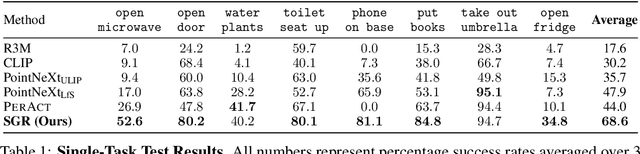
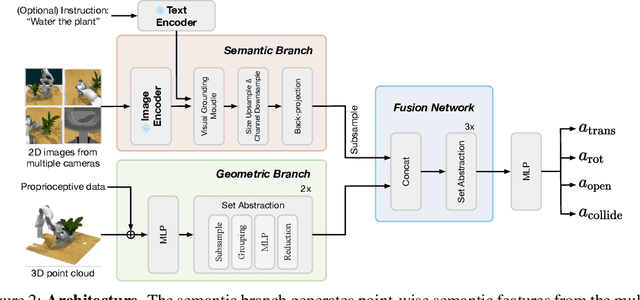
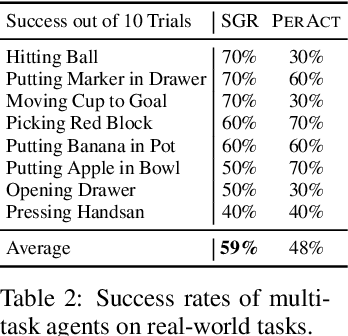
Robots rely heavily on sensors, especially RGB and depth cameras, to perceive and interact with the world. RGB cameras record 2D images with rich semantic information while missing precise spatial information. On the other side, depth cameras offer critical 3D geometry data but capture limited semantics. Therefore, integrating both modalities is crucial for learning representations for robotic perception and control. However, current research predominantly focuses on only one of these modalities, neglecting the benefits of incorporating both. To this end, we present Semantic-Geometric Representation (SGR), a universal perception module for robotics that leverages the rich semantic information of large-scale pre-trained 2D models and inherits the merits of 3D spatial reasoning. Our experiments demonstrate that SGR empowers the agent to successfully complete a diverse range of simulated and real-world robotic manipulation tasks, outperforming state-of-the-art methods significantly in both single-task and multi-task settings. Furthermore, SGR possesses the unique capability to generalize to novel semantic attributes, setting it apart from the other methods.