 Add to Chrome
 Add to Firefox
 Add to Edge
ORACLE-SWE: Quantifying the Contribution of Oracle Information Signals on SWE Agents
Apr 09, 2026
Recent advances in language model (LM) agents have significantly improved automated software engineering (SWE). Prior work has proposed various agentic workflows and training strategies as well as analyzed failure modes of agentic systems on SWE tasks, focusing on several contextual information signals: Reproduction Test, Regression Test, Edit Location, Execution Context, and API Usage. However, the individual contribution of each signal to overall success remains underexplored, particularly their ideal contribution when intermediate information is perfectly obtained. To address this gap, we introduce Oracle-SWE, a unified method to isolate and extract oracle information signals from SWE benchmarks and quantify the impact of each signal on agent performance. To further validate the pattern, we evaluate the performance gain of signals extracted by strong LMs when provided to a base agent, approximating real-world task-resolution settings. These evaluations aim to guide research prioritization for autonomous coding systems.

Complet4R: Geometric Complete 4D Reconstruction
Mar 28, 2026We introduce Complet4R, a novel end-to-end framework for Geometric Complete 4D Reconstruction, which aims to recover temporally coherent and geometrically complete reconstruction for dynamic scenes. Our method formalizes the task of Geometric Complete 4D Reconstruction as a unified framework of reconstruction and completion, by directly accumulating full contexts onto each frame. Unlike previous approaches that rely on pairwise reconstruction or local motion estimation, Complet4R utilizes a decoder-only transformer to operate all context globally directly from sequential video input, reconstructing a complete geometry for every single timestamp, including occluded regions visible in other frames. Our method demonstrates the state-of-the-art performance on our proposed benchmark for Geometric Complete 4D Reconstruction and the 3D Point Tracking task. Code will be released to support future research.
RepoLaunch: Automating Build&Test Pipeline of Code Repositories on ANY Language and ANY Platform
Mar 05, 2026Building software repositories typically requires significant manual effort. Recent advances in large language model (LLM) agents have accelerated automation in software engineering (SWE). We introduce RepoLaunch, the first agent capable of automatically resolving dependencies, compiling source code, and extracting test results for repositories across arbitrary programming languages and operating systems. To demonstrate its utility, we further propose a fully automated pipeline for SWE dataset creation, where task design is the only human intervention. RepoLaunch automates the remaining steps, enabling scalable benchmarking and training of coding agents and LLMs. Notably, several works on agentic benchmarking and training have recently adopted RepoLaunch for automated task generation.
ChemBART: A Pre-trained BART Model Assisting Organic Chemistry Analysis
Jan 06, 2026Recent advances in large language models (LLMs) have demonstrated transformative potential across diverse fields. While LLMs have been applied to molecular simplified molecular input line entry system (SMILES) in computer-aided synthesis planning (CASP), existing methodologies typically address single tasks, such as precursor prediction. We introduce ChemBART, a SMILES-based LLM pre-trained on chemical reactions, which enables a unified model for multiple downstream chemical tasks--achieving the paradigm of "one model, one pre-training, multiple tasks." By leveraging outputs from a mask-filling pre-training task on reaction expressions, ChemBART effectively solves a variety of chemical problems, including precursor/reagent generation, temperature-yield regression, molecular property classification, and optimizing the policy and value functions within a reinforcement learning framework, integrated with Monte Carlo tree search for multi-step synthesis route design. Unlike single-molecule pre-trained LLMs constrained to specific applications, ChemBART addresses broader chemical challenges and integrates them for comprehensive synthesis planning. Crucially, ChemBART-designed multi-step synthesis routes and reaction conditions directly inspired wet-lab validation, which confirmed shorter pathways with ~30% yield improvement over literature benchmarks. Our work validates the power of reaction-focused pre-training and showcases the broad utility of ChemBART in advancing the complete synthesis planning cycle.
TrackOcc: Camera-based 4D Panoptic Occupancy Tracking
Mar 11, 2025Comprehensive and consistent dynamic scene understanding from camera input is essential for advanced autonomous systems. Traditional camera-based perception tasks like 3D object tracking and semantic occupancy prediction lack either spatial comprehensiveness or temporal consistency. In this work, we introduce a brand-new task, Camera-based 4D Panoptic Occupancy Tracking, which simultaneously addresses panoptic occupancy segmentation and object tracking from camera-only input. Furthermore, we propose TrackOcc, a cutting-edge approach that processes image inputs in a streaming, end-to-end manner with 4D panoptic queries to address the proposed task. Leveraging the localization-aware loss, TrackOcc enhances the accuracy of 4D panoptic occupancy tracking without bells and whistles. Experimental results demonstrate that our method achieves state-of-the-art performance on the Waymo dataset. The source code will be released at https://github.com/Tsinghua-MARS-Lab/TrackOcc.
SSCBench: A Large-Scale 3D Semantic Scene Completion Benchmark for Autonomous Driving
Jun 15, 2023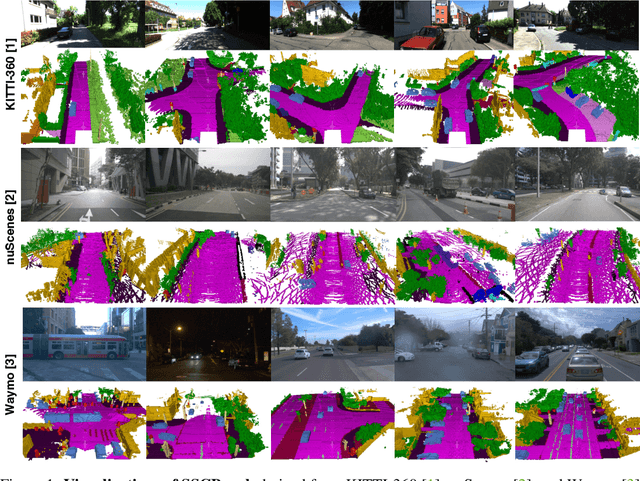
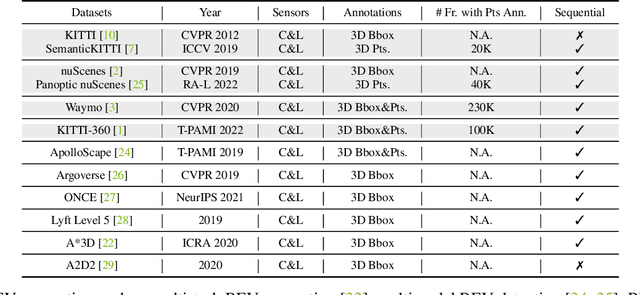
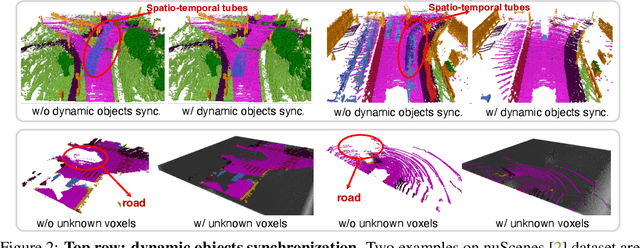
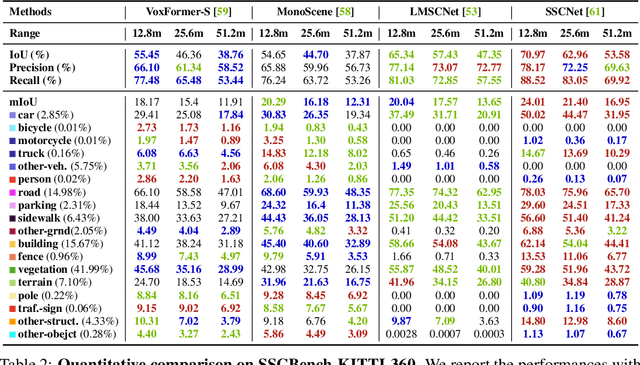
Semantic scene completion (SSC) is crucial for holistic 3D scene understanding by jointly estimating semantics and geometry from sparse observations. However, progress in SSC, particularly in autonomous driving scenarios, is hindered by the scarcity of high-quality datasets. To overcome this challenge, we introduce SSCBench, a comprehensive benchmark that integrates scenes from widely-used automotive datasets (e.g., KITTI-360, nuScenes, and Waymo). SSCBench follows an established setup and format in the community, facilitating the easy exploration of the camera- and LiDAR-based SSC across various real-world scenarios. We present quantitative and qualitative evaluations of state-of-the-art algorithms on SSCBench and commit to continuously incorporating novel automotive datasets and SSC algorithms to drive further advancements in this field. Our resources are released on https://github.com/ai4ce/SSCBench.