 Add to Chrome
 Add to Firefox
 Add to Edge
Streamable Neural Video Compression: A Mixed Precision Approach for Cross-Platform Deployment
Aug 01, 2026
Neural Video Codecs (NVCs) offer unprecedented rate-distortion performance, making them highly attractive for bandwidth-constrained environments like 5G cellular networks and emerging satellite direct-to-cell (D2C) links. However, deploying NVCs in real-world streaming applications is severely hindered by cross-platform floating-point non-determinism, which causes arithmetic entropy coders to desynchronize and crash across different GPU architectures. While recent integer-based quantization methods address this, they incur either massive degradation in compression efficiency (INT8) or severe computational bottlenecks by bypassing hardware acceleration (INT16). In this paper, we propose a streamable, client-server NVC architecture featuring a novel Mixed Precision (FP16/FP32) strategy. By strategically executing P-frames in hardware-accelerated FP16 for real-time throughput, while forcing I-frames and periodic feature-adapter resets to IEEE-754 compliant FP32, we guarantee deterministic synchronization at critical boundaries. Through extensive cross-encode/decode evaluations across 12 GPUs spanning four architectural generations, we demonstrate that our approach successfully eliminates intra-generation fragmentation and substantially broadens cross-die interoperability, achieving seamless cross-generation decodability for recent architectures at 1080p. Crucially, this is achieved with a negligible impact on compression efficiency. Furthermore, we evaluate the system's end-to-end latency across diverse real-world networks, including Wi-Fi 6, 5G NR (FDD/TDD), and Starlink D2C, proving the practical viability of streamable learned video compression while highlighting unique challenges in Non-Terrestrial Networks.

Wavefront Parallelization for Efficient Learned Image Compression
Jul 21, 2026Autoregressive context models are foundational for learned image compression,but they suffer from slow serial inference. Existing acceleration methods such as checkerboard context require architectural changes and retraining, thus are inapplicable to pre-trained models. We propose a completely training-free inference-time acceleration algorithm inspired by wavefront parallelism in video coding standards. Our method reorganizes inference into an optimal ``staggered'' wavefront order, minimizing sequential steps while maintaining exact autoregressive dependencies. Experimental results show our approach accelerates pre-trained autoregressive models (e.g., Cheng et al.) by more than $13\times$ while preserving the original rate-distortion performance. We also demonstrate that faster decoding is possible by trading off precise context dependencies. Source code will be available at https://github.com/tokkiwa/compressai-wavefront.
Performance Analysis of Hardware-Accelerated 10-Bit 4:2:2 Encoding with Split-Frame Encoding for High-Fidelity V-PCC Streaming
Jun 28, 2026Video-based Point Cloud Compression (V-PCC) encodes volumetric data by projecting 3D geometry and texture onto 2D video frames. To prevent spatial distortion and color bleeding during 3D reconstruction, this process requires 10-bit color depth and 4:2:2 chroma subsampling, rather than the standard 8-bit 4:2:0 format. Additionally, capturing high-density dynamic point clouds requires demanding encoding parameters, such as 8K resolution at framerates up to 120 fps. Historically, the lack of 4:2:2 chroma support in older GPU hardware encoders restricted real-time V-PCC to custom Application-Specific Integrated Circuits (ASICs). However, the recent introduction of NVIDIA's Blackwell GPU architecture, featuring on-chip hardware encoders with 10-bit 4:2:2 support, presents an opportunity to shift this workload to general-purpose hardware. This paper investigates the feasibility of such an approach. Using a commercially available Blackwell GPU equipped with four parallel on-die hardware encoders as a testbed, we evaluate the throughput, rate-distortion (RD) performance, and power consumption of 8K 10-bit 4:2:2 HEVC across various Split-Frame Encoding (SFE) configurations. Our results demonstrate that 4-way SFE achieves an encoding throughput of 122 fps, successfully meeting the strict real-time constraints of high-density V-PCC. Although the inability to exploit spatial redundancies across slice boundaries results in a BD-Rate penalty of up to 5%, the measured throughput and power efficiency establish standard, commercial off-the-shelf GPUs as a highly viable baseline for real-time volumetric video streaming.
Real-time Video Prediction With Fast Video Interpolation Model and Prediction Training
Mar 29, 2025Transmission latency significantly affects users' quality of experience in real-time interaction and actuation. As latency is principally inevitable, video prediction can be utilized to mitigate the latency and ultimately enable zero-latency transmission. However, most of the existing video prediction methods are computationally expensive and impractical for real-time applications. In this work, we therefore propose real-time video prediction towards the zero-latency interaction over networks, called IFRVP (Intermediate Feature Refinement Video Prediction). Firstly, we propose three training methods for video prediction that extend frame interpolation models, where we utilize a simple convolution-only frame interpolation network based on IFRNet. Secondly, we introduce ELAN-based residual blocks into the prediction models to improve both inference speed and accuracy. Our evaluations show that our proposed models perform efficiently and achieve the best trade-off between prediction accuracy and computational speed among the existing video prediction methods. A demonstration movie is also provided at http://bit.ly/IFRVPDemo.
Performance Analysis of 5G FR2 (mmWave) Downlink 256QAM on Commercial 5G Networks
Feb 05, 2025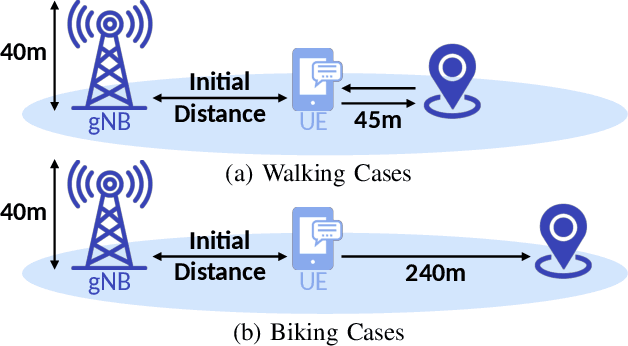
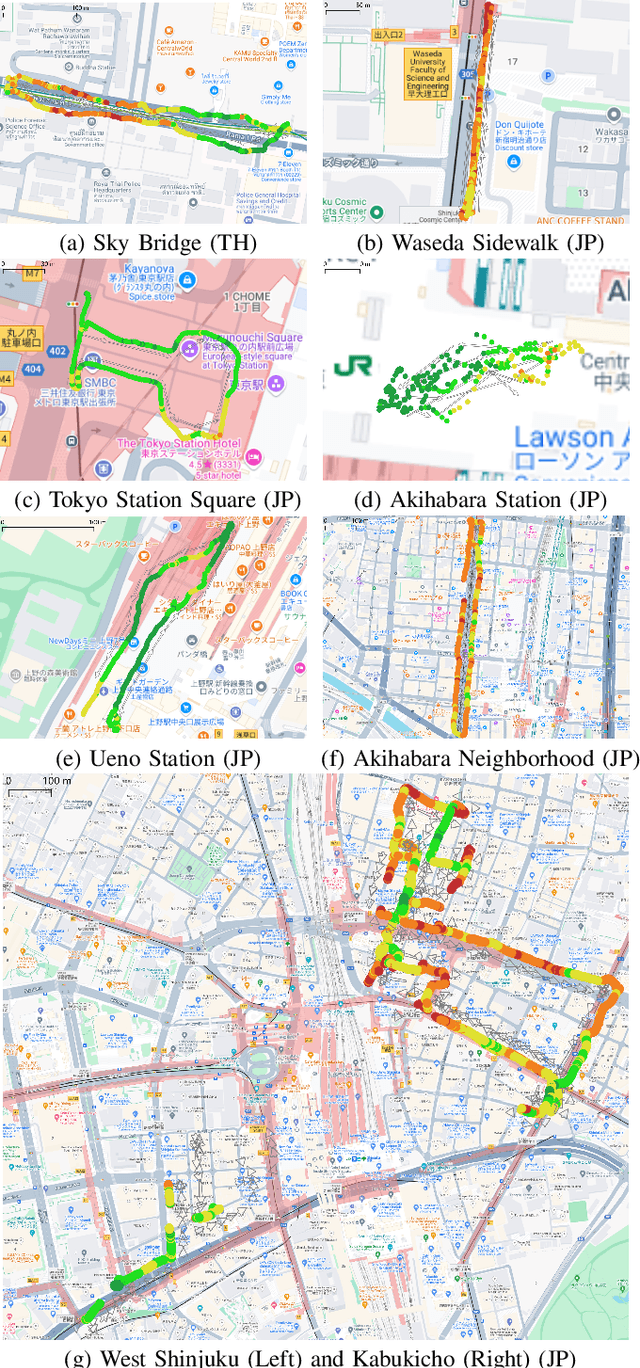
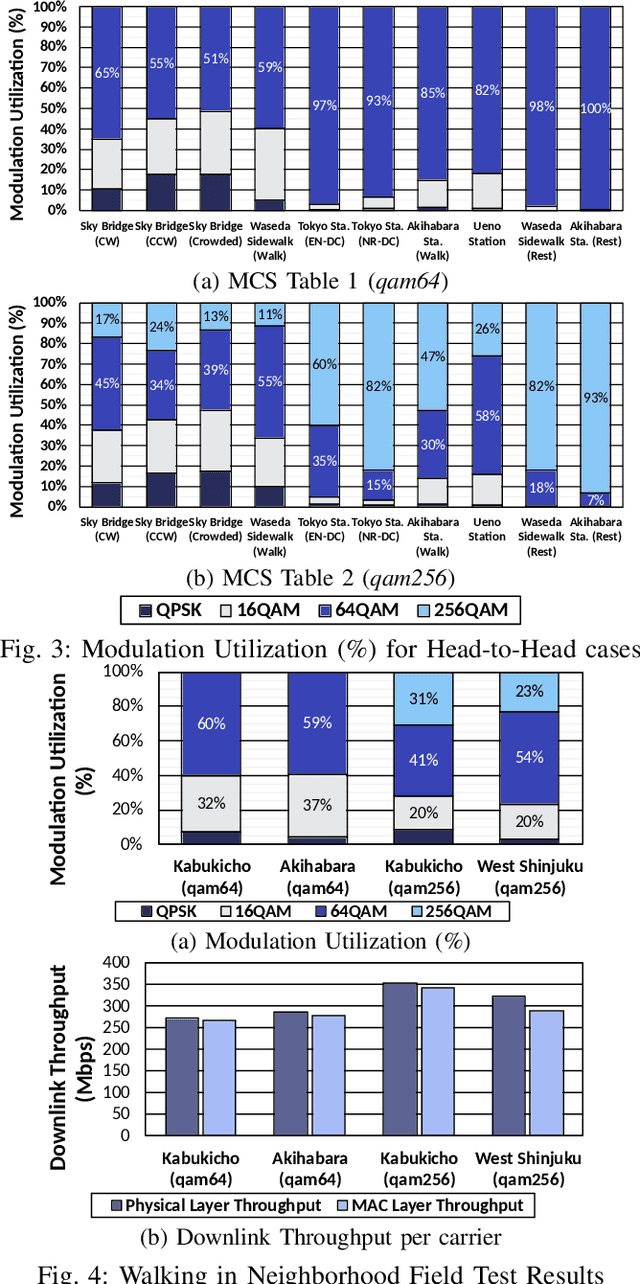
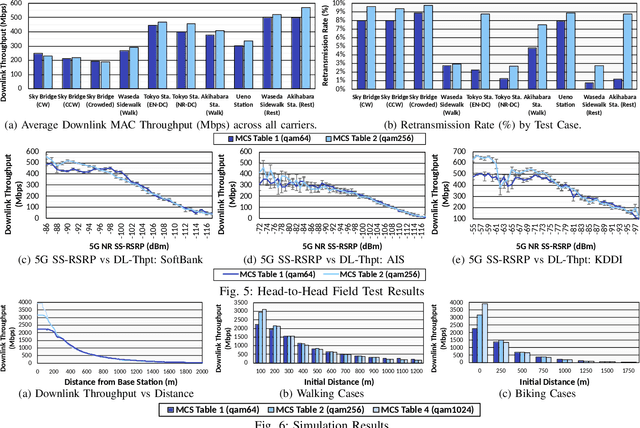
The 5G New Radio (NR) standard introduces new frequency bands allocated in Frequency Range 2 (FR2) to support enhanced Mobile Broadband (eMBB) in congested environments and enables new use cases such as Ultra-Reliable Low Latency Communication (URLLC). The 3GPP introduced 256QAM support for FR2 frequency bands to further enhance downlink capacity. However, sustaining 256QAM on FR2 in practical environments is challenging due to strong path loss and susceptibility to distortion. While 256QAM can improve theoretical throughput by 33%, compared to 64QAM, and is widely adopted in FR1, its real-world impact when utilized in FR2 is questionable, given the significant path loss and distortions experienced in the FR2 range. Additionally, using higher modulation correlates to higher BLER, increased instability, and retransmission. Moreover, 256QAM also utilizes a different MCS table defining the modulation and code rate at different Channel Quality Indexes (CQI), affecting the UE's link adaptation behavior. This paper investigates the real-world performance of 256QAM utilization on FR2 bands in two countries, across three RAN manufacturers, and in both NSA (EN-DC) and SA (NR-DC) configurations, under various scenarios, including open-air plazas, city centers, footbridges, train station platforms, and stationary environments. The results show that 256QAM provides a reasonable throughput gain when stationary but marginal improvements when there is UE mobility while increasing the probability of NACK responses, increasing BLER, and the number of retransmissions. Finally, MATLAB simulations are run to validate the findings as well as explore the effect of the recently introduced 1024QAM on FR2.
Practical Commercial 5G Standalone (SA) Uplink Throughput Prediction
Jul 23, 2023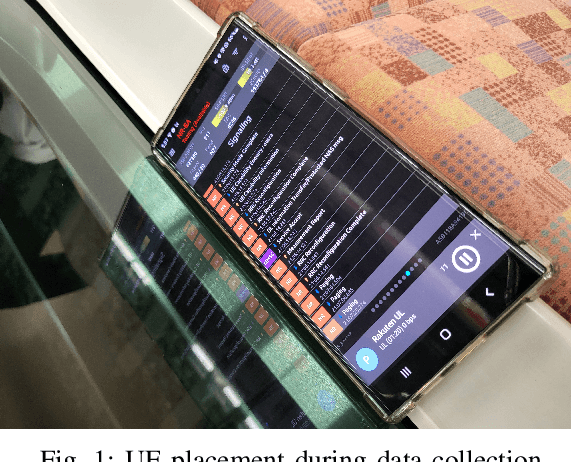
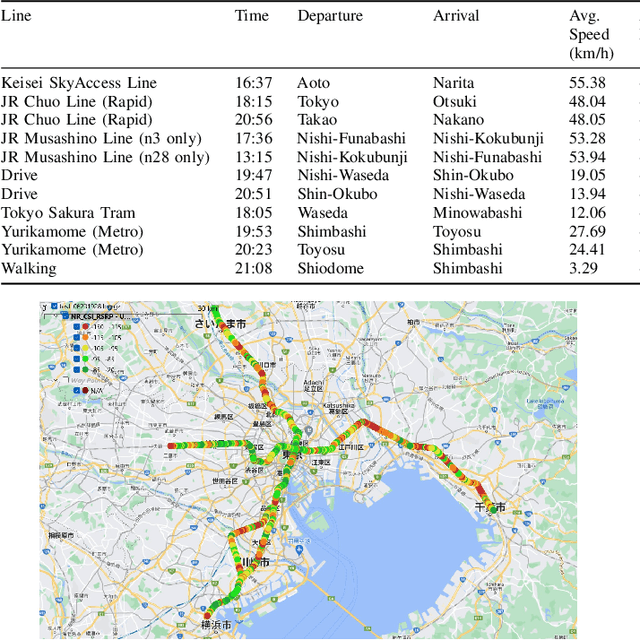

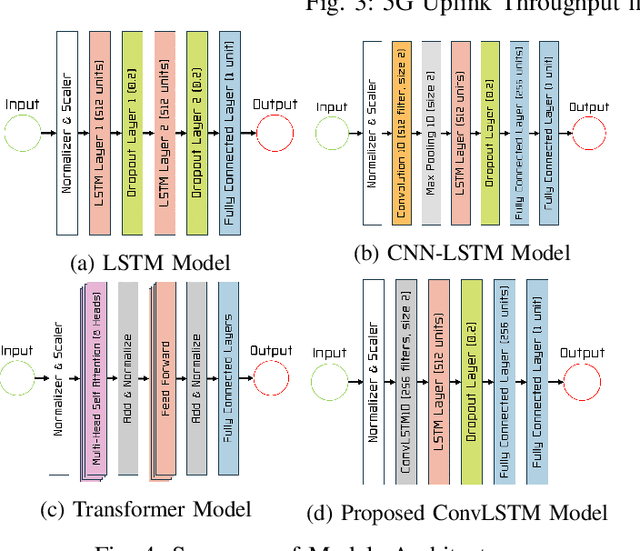
While the 5G New Radio (NR) network promises a huge uplift of the uplink throughput, the improvement can only be seen when the User Equipment (UE) is connected to the high-frequency millimeter wave (mmWave) band. With the rise of uplink-intensive smartphone applications such as the real-time transmission of UHD 4K/8K videos, and Virtual Reality (VR)/Augmented Reality (AR) contents, uplink throughput prediction plays a huge role in maximizing the users' quality of experience (QoE). In this paper, we propose using a ConvLSTM-based neural network to predict the future uplink throughput based on past uplink throughput and RF parameters. The network is trained using the data from real-world drive tests on commercial 5G SA networks while riding commuter trains, which accounted for various frequency bands, handover, and blind spots. To make sure our model can be practically implemented, we then limited our model to only use the information available via Android API, then evaluate our model using the data from both commuter trains and other methods of transportation. The results show that our model reaches an average prediction accuracy of 98.9\% with an average RMSE of 1.80 Mbps across all unseen evaluation scenarios.
Pensieve 5G: Implementation of RL-based ABR Algorithm for UHD 4K/8K Content Delivery on Commercial 5G SA/NR-DC Network
Dec 29, 2022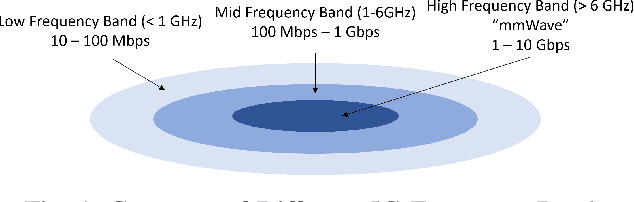
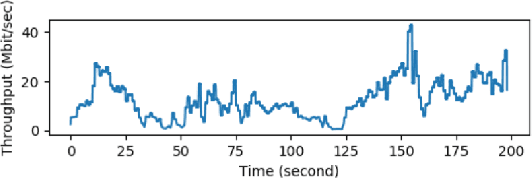
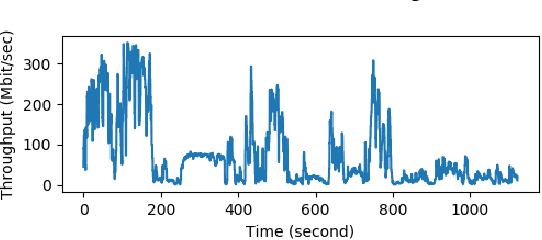
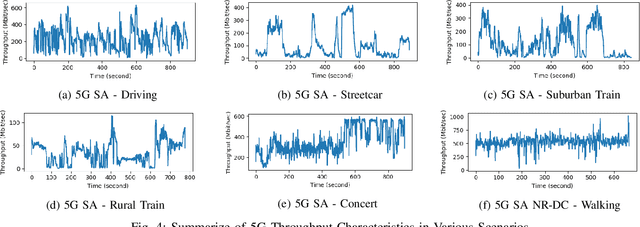
While the rollout of the fifth-generation mobile network (5G) is underway across the globe with the intention to deliver 4K/8K UHD videos, Augmented Reality (AR), and Virtual Reality (VR) content to the mass amounts of users, the coverage and throughput are still one of the most significant issues, especially in the rural areas, where only 5G in the low-frequency band are being deployed. This called for a high-performance adaptive bitrate (ABR) algorithm that can maximize the user quality of experience given 5G network characteristics and data rate of UHD contents. Recently, many of the newly proposed ABR techniques were machine-learning based. Among that, Pensieve is one of the state-of-the-art techniques, which utilized reinforcement-learning to generate an ABR algorithm based on observation of past decision performance. By incorporating the context of the 5G network and UHD content, Pensieve has been optimized into Pensieve 5G. New QoE metrics that more accurately represent the QoE of UHD video streaming on the different types of devices were proposed and used to evaluate Pensieve 5G against other ABR techniques including the original Pensieve. The results from the simulation based on the real 5G Standalone (SA) network throughput shows that Pensieve 5G outperforms both conventional algorithms and Pensieve with the average QoE improvement of 8.8% and 14.2%, respectively. Additionally, Pensieve 5G also performed well on the commercial 5G NR-NR Dual Connectivity (NR-DC) Network, despite the training being done solely using the data from the 5G Standalone (SA) network.
Efficient and Accurate Quantized Image Super-Resolution on Mobile NPUs, Mobile AI & AIM 2022 challenge: Report
Nov 07, 2022

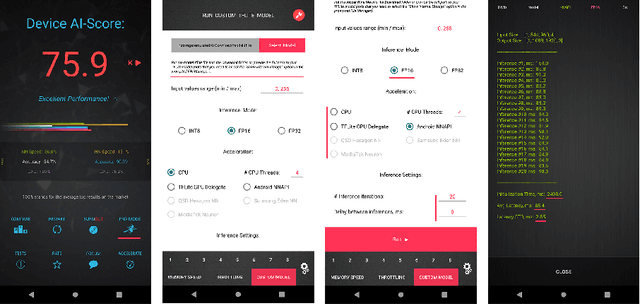
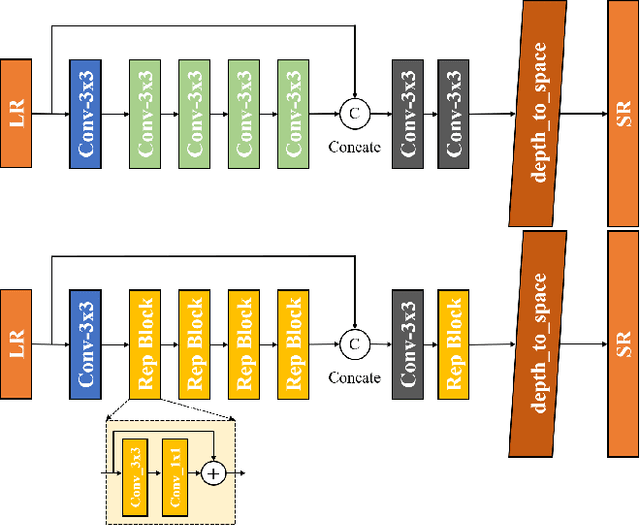
Image super-resolution is a common task on mobile and IoT devices, where one often needs to upscale and enhance low-resolution images and video frames. While numerous solutions have been proposed for this problem in the past, they are usually not compatible with low-power mobile NPUs having many computational and memory constraints. In this Mobile AI challenge, we address this problem and propose the participants to design an efficient quantized image super-resolution solution that can demonstrate a real-time performance on mobile NPUs. The participants were provided with the DIV2K dataset and trained INT8 models to do a high-quality 3X image upscaling. The runtime of all models was evaluated on the Synaptics VS680 Smart Home board with a dedicated edge NPU capable of accelerating quantized neural networks. All proposed solutions are fully compatible with the above NPU, demonstrating an up to 60 FPS rate when reconstructing Full HD resolution images. A detailed description of all models developed in the challenge is provided in this paper.