 Add to Chrome
 Add to Firefox
 Add to Edge
Traj-Evolve: A Self-Evolving Multi-Agent System for Patient Trajectory Modeling in Lung Cancer Early Detection
Jun 01, 2026
Modeling patient trajectories from longitudinal electronic health records (EHRs) requires reasoning over sparse, noisy, and long-context multimodal sequences. Existing LLM-based multi-agent systems address context length but process patients in isolation, failing to mirror how clinicians leverage accumulated experience from similar prior cases. We present Traj-Evolve, a self-evolving multi-agent system with two complementary evolving mechanisms. First, an Experience Pool (ExPool) acts as a non-parametric memory, indexing rejection-sampled reasoning traces to retrieve similar patients as few-shot contexts. Second, multi-agent reinforcement learning (MARL) via reward-ranked fine-tuning parametrically optimizes inter-agent and agent-memory collaboration. A leave-one-out cross-retrieval strategy unifies the two, aligning training- and inference-time behavior under retrieval augmentation. On a lung cancer prediction task utilizing up to five years of multimodal EHRs, Traj-Evolve outperforms 9 strong baselines on the overall population and a challenging never-smoker population. Analysis of the evolving dynamics highlights three key findings: (1) expanding the ExPool shifts optimal retrieval from diverse to specific samples; (2) under MARL, the manager agent's prediction loss converges quickly while the worker agents' temporal reasoning continues to benefit from more verified patients; and (3) the two mechanisms are complementary on the predicted risk, where ExPool improves specificity while MARL improves sensitivity.

Automated Detection and Classification of Delusion-related Content in Naturalistic Audio Diaries Using Multi-Agent Language Models
May 23, 2026Speech monologues recorded in naturalistic settings provide opportunities to characterize mental illness phenomenology and detect symptom exacerbation. Large language models (LLMs) offer new possibilities for automating this process, as they require annotated data primarily for evaluation rather than training. In this paper, we present a novel automated, multi-agent LLM pipeline for the fine-grained, multi-label extraction of language suggestive of delusional beliefs, associated affective responses, and behavioral responses from transcripts of naturalistic audio diaries collected from people with moderate persecutory ideation. Evaluating an ensemble of three foundation models, we demonstrate that detailed diagnostic prompt instructions successfully reduce false positives for delusional theme classification, but also constrain the interpretation of affective or behavioral responses. Furthermore, comparing multi-agent adjudication frameworks shows that complex conversational debate between agents diminishes accuracy on clinically ambiguous text by inducing premature consensus. Instead, majority voting establishes robust performance (Micro F1 of 0.872 and 0.779 for delusion detection and classification respectively). This work provides a validated and scalable pipeline for the automated detection and characterization of content suggesting delusional beliefs in naturalistic speech.
TrajOnco: a multi-agent framework for temporal reasoning over longitudinal EHR for multi-cancer early detection
Apr 12, 2026Accurate estimation of cancer risk from longitudinal electronic health records (EHRs) could support earlier detection and improved care, but modeling such complex patient trajectories remains challenging. We present TrajOnco, a training-free, multi-agent large language model (LLM) framework designed for scalable multi-cancer early detection. Using a chain-of-agents architecture with long-term memory, TrajOnco performs temporal reasoning over sequential clinical events to generate patient-level summaries, evidence-linked rationales, and predicted risk scores. We evaluated TrajOnco on de-identified Truveta EHR data across 15 cancer types using matched case-control cohorts, predicting risk of cancer diagnosis at 1 year. In zero-shot evaluation, TrajOnco achieved AUROCs of 0.64-0.80, performing comparably to supervised machine learning in a lung cancer benchmark while demonstrating better temporal reasoning than single-agent LLMs. The multi-agent design also enabled effective temporal reasoning with smaller-capacity models such as GPT-4.1-mini. The fidelity of TrajOnco's output was validated through human evaluation. Furthermore, TrajOnco's interpretable reasoning outputs can be aggregated to reveal population-level risk patterns that align with established clinical knowledge. These findings highlight the potential of multi-agent LLMs to execute interpretable temporal reasoning over longitudinal EHRs, advancing both scalable multi-cancer early detection and clinical insight generation.
RadTimeline: Timeline Summarization for Longitudinal Radiological Lung Findings
Mar 24, 2026Tracking findings in longitudinal radiology reports is crucial for accurately identifying disease progression, and the time-consuming process would benefit from automatic summarization. This work introduces a structured summarization task, where we frame longitudinal report summarization as a timeline generation task, with dated findings organized in columns and temporally related findings grouped in rows. This structured summarization format enables straightforward comparison of findings across time and facilitates fact-checking against the associated reports. The timeline is generated using a 3-step LLM process of extracting findings, generating group names, and using the names to group the findings. To evaluate such systems, we create RadTimeline, a timeline dataset focused on tracking lung-related radiologic findings in chest-related imaging reports. Experiments on RadTimeline show tradeoffs of different-sized LLMs and prompting strategies. Our results highlight that group name generation as an intermediate step is critical for effective finding grouping. The best configuration has some irrelevant findings but very good recall, and grouping performance is comparable to human annotators.
DermaVQA-DAS: Dermatology Assessment Schema (DAS) & Datasets for Closed-Ended Question Answering & Segmentation in Patient-Generated Dermatology Images
Dec 30, 2025Recent advances in dermatological image analysis have been driven by large-scale annotated datasets; however, most existing benchmarks focus on dermatoscopic images and lack patient-authored queries and clinical context, limiting their applicability to patient-centered care. To address this gap, we introduce DermaVQA-DAS, an extension of the DermaVQA dataset that supports two complementary tasks: closed-ended question answering (QA) and dermatological lesion segmentation. Central to this work is the Dermatology Assessment Schema (DAS), a novel expert-developed framework that systematically captures clinically meaningful dermatological features in a structured and standardized form. DAS comprises 36 high-level and 27 fine-grained assessment questions, with multiple-choice options in English and Chinese. Leveraging DAS, we provide expert-annotated datasets for both closed QA and segmentation and benchmark state-of-the-art multimodal models. For segmentation, we evaluate multiple prompting strategies and show that prompt design impacts performance: the default prompt achieves the best results under Mean-of-Max and Mean-of-Mean evaluation aggregation schemes, while an augmented prompt incorporating both patient query title and content yields the highest performance under majority-vote-based microscore evaluation, achieving a Jaccard index of 0.395 and a Dice score of 0.566 with BiomedParse. For closed-ended QA, overall performance is strong across models, with average accuracies ranging from 0.729 to 0.798; o3 achieves the best overall accuracy (0.798), closely followed by GPT-4.1 (0.796), while Gemini-1.5-Pro shows competitive performance within the Gemini family (0.783). We publicly release DermaVQA-DAS, the DAS schema, and evaluation protocols to support and accelerate future research in patient-centered dermatological vision-language modeling (https://osf.io/72rp3).
Identifying Imaging Follow-Up in Radiology Reports: A Comparative Analysis of Traditional ML and LLM Approaches
Nov 14, 2025Large language models (LLMs) have shown considerable promise in clinical natural language processing, yet few domain-specific datasets exist to rigorously evaluate their performance on radiology tasks. In this work, we introduce an annotated corpus of 6,393 radiology reports from 586 patients, each labeled for follow-up imaging status, to support the development and benchmarking of follow-up adherence detection systems. Using this corpus, we systematically compared traditional machine-learning classifiers, including logistic regression (LR), support vector machines (SVM), Longformer, and a fully fine-tuned Llama3-8B-Instruct, with recent generative LLMs. To evaluate generative LLMs, we tested GPT-4o and the open-source GPT-OSS-20B under two configurations: a baseline (Base) and a task-optimized (Advanced) setting that focused inputs on metadata, recommendation sentences, and their surrounding context. A refined prompt for GPT-OSS-20B further improved reasoning accuracy. Performance was assessed using precision, recall, and F1 scores with 95% confidence intervals estimated via non-parametric bootstrapping. Inter-annotator agreement was high (F1 = 0.846). GPT-4o (Advanced) achieved the best performance (F1 = 0.832), followed closely by GPT-OSS-20B (Advanced; F1 = 0.828). LR and SVM also performed strongly (F1 = 0.776 and 0.775), underscoring that while LLMs approach human-level agreement through prompt optimization, interpretable and resource-efficient models remain valuable baselines.
MORQA: Benchmarking Evaluation Metrics for Medical Open-Ended Question Answering
Sep 15, 2025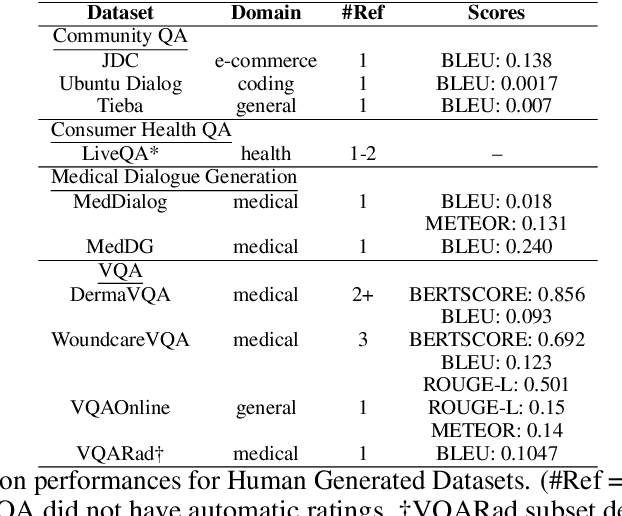
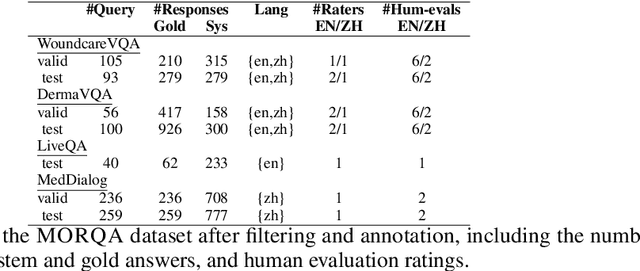

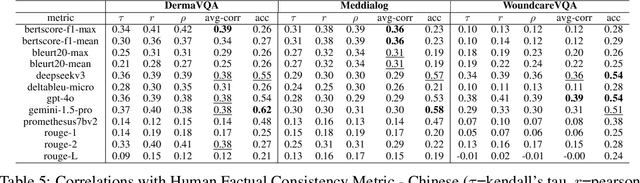
Evaluating natural language generation (NLG) systems in the medical domain presents unique challenges due to the critical demands for accuracy, relevance, and domain-specific expertise. Traditional automatic evaluation metrics, such as BLEU, ROUGE, and BERTScore, often fall short in distinguishing between high-quality outputs, especially given the open-ended nature of medical question answering (QA) tasks where multiple valid responses may exist. In this work, we introduce MORQA (Medical Open-Response QA), a new multilingual benchmark designed to assess the effectiveness of NLG evaluation metrics across three medical visual and text-based QA datasets in English and Chinese. Unlike prior resources, our datasets feature 2-4+ gold-standard answers authored by medical professionals, along with expert human ratings for three English and Chinese subsets. We benchmark both traditional metrics and large language model (LLM)-based evaluators, such as GPT-4 and Gemini, finding that LLM-based approaches significantly outperform traditional metrics in correlating with expert judgments. We further analyze factors driving this improvement, including LLMs' sensitivity to semantic nuances and robustness to variability among reference answers. Our results provide the first comprehensive, multilingual qualitative study of NLG evaluation in the medical domain, highlighting the need for human-aligned evaluation methods. All datasets and annotations will be publicly released to support future research.
TrajSurv: Learning Continuous Latent Trajectories from Electronic Health Records for Trustworthy Survival Prediction
Aug 01, 2025Trustworthy survival prediction is essential for clinical decision making. Longitudinal electronic health records (EHRs) provide a uniquely powerful opportunity for the prediction. However, it is challenging to accurately model the continuous clinical progression of patients underlying the irregularly sampled clinical features and to transparently link the progression to survival outcomes. To address these challenges, we develop TrajSurv, a model that learns continuous latent trajectories from longitudinal EHR data for trustworthy survival prediction. TrajSurv employs a neural controlled differential equation (NCDE) to extract continuous-time latent states from the irregularly sampled data, forming continuous latent trajectories. To ensure the latent trajectories reflect the clinical progression, TrajSurv aligns the latent state space with patient state space through a time-aware contrastive learning approach. To transparently link clinical progression to the survival outcome, TrajSurv uses latent trajectories in a two-step divide-and-conquer interpretation process. First, it explains how the changes in clinical features translate into the latent trajectory's evolution using a learned vector field. Second, it clusters these latent trajectories to identify key clinical progression patterns associated with different survival outcomes. Evaluations on two real-world medical datasets, MIMIC-III and eICU, show TrajSurv's competitive accuracy and superior transparency over existing deep learning methods.
A Scoping Review of Natural Language Processing in Addressing Medically Inaccurate Information: Errors, Misinformation, and Hallucination
Apr 16, 2025Objective: This review aims to explore the potential and challenges of using Natural Language Processing (NLP) to detect, correct, and mitigate medically inaccurate information, including errors, misinformation, and hallucination. By unifying these concepts, the review emphasizes their shared methodological foundations and their distinct implications for healthcare. Our goal is to advance patient safety, improve public health communication, and support the development of more reliable and transparent NLP applications in healthcare. Methods: A scoping review was conducted following PRISMA guidelines, analyzing studies from 2020 to 2024 across five databases. Studies were selected based on their use of NLP to address medically inaccurate information and were categorized by topic, tasks, document types, datasets, models, and evaluation metrics. Results: NLP has shown potential in addressing medically inaccurate information on the following tasks: (1) error detection (2) error correction (3) misinformation detection (4) misinformation correction (5) hallucination detection (6) hallucination mitigation. However, challenges remain with data privacy, context dependency, and evaluation standards. Conclusion: This review highlights the advancements in applying NLP to tackle medically inaccurate information while underscoring the need to address persistent challenges. Future efforts should focus on developing real-world datasets, refining contextual methods, and improving hallucination management to ensure reliable and transparent healthcare applications.
Adapting Biomedical Abstracts into Plain language using Large Language Models
Jan 26, 2025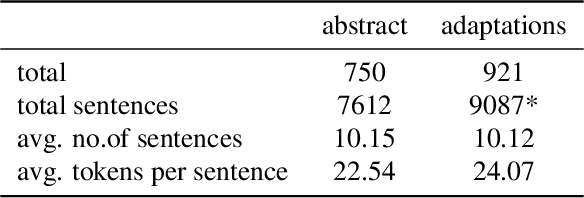

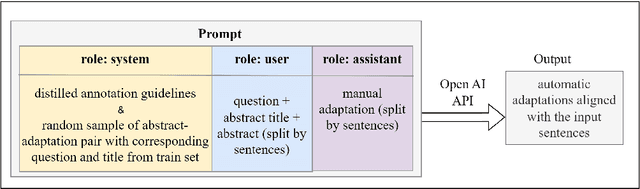

A vast amount of medical knowledge is available for public use through online health forums, and question-answering platforms on social media. The majority of the population in the United States doesn't have the right amount of health literacy to make the best use of that information. Health literacy means the ability to obtain and comprehend the basic health information to make appropriate health decisions. To build the bridge between this gap, organizations advocate adapting this medical knowledge into plain language. Building robust systems to automate the adaptations helps both medical and non-medical professionals best leverage the available information online. The goal of the Plain Language Adaptation of Biomedical Abstracts (PLABA) track is to adapt the biomedical abstracts in English language extracted from PubMed based on the questions asked in MedlinePlus for the general public using plain language at the sentence level. As part of this track, we leveraged the best open-source Large Language Models suitable and fine-tuned for dialog use cases. We compare and present the results for all of our systems and our ranking among the other participants' submissions. Our top performing GPT-4 based model ranked first in the avg. simplicity measure and 3rd on the avg. accuracy measure.