 Add to Chrome
 Add to Firefox
 Add to Edge
VERT: Reliable LLM Judges for Radiology Report Evaluation
Apr 03, 2026
Current literature on radiology report evaluation has focused primarily on designing LLM-based metrics and fine-tuning small models for chest X-rays. However, it remains unclear whether these approaches are robust when applied to reports from other modalities and anatomies. Which model and prompt configurations are best suited to serve as LLM judges for radiology evaluation? We conduct a thorough correlation analysis between expert and LLM-based ratings. We compare three existing LLM-as-a-judge metrics (RadFact, GREEN, and FineRadScore) alongside VERT, our proposed LLM-based metric, using open- and closed-source models (reasoning and non-reasoning) of different sizes across two expert-annotated datasets, RadEval and RaTE-Eval, spanning multiple modalities and anatomies. We further evaluate few-shot approaches, ensembling, and parameter-efficient fine-tuning using RaTE-Eval. To better understand metric behavior, we perform a systematic error detection and categorization study to assess alignment of these metrics against expert judgments and identify areas of lower and higher agreement. Our results show that VERT improves correlation with radiologist judgments by up to 11.7% relative to GREEN. Furthermore, fine-tuning Qwen3 30B yield gains of up to 25% using only 1,300 training samples. The fine-tuned model also reduces inference time up to 37.2 times. These findings highlight the effectiveness of LLM-based judges and demonstrate that reliable evaluation can be achieved with lightweight adaptation.

Overconfidence and Calibration in Medical VQA: Empirical Findings and Hallucination-Aware Mitigation
Apr 02, 2026As vision-language models (VLMs) are increasingly deployed in clinical decision support, more than accuracy is required: knowing when to trust their predictions is equally critical. Yet, a comprehensive and systematic investigation into the overconfidence of these models remains notably scarce in the medical domain. We address this gap through a comprehensive empirical study of confidence calibration in VLMs, spanning three model families (Qwen3-VL, InternVL3, LLaVA-NeXT), three model scales (2B--38B), and multiple confidence estimation prompting strategies, across three medical visual question answering (VQA) benchmarks. Our study yields three key findings: First, overconfidence persists across model families and is not resolved by scaling or prompting, such as chain-of-thought and verbalized confidence variants. Second, simple post-hoc calibration approaches, such as Platt scaling, reduce calibration error and consistently outperform the prompt-based strategy. Third, due to their (strict) monotonicity, these post-hoc calibration methods are inherently limited in improving the discriminative quality of predictions, leaving AUROC at the same level. Motivated by these findings, we investigate hallucination-aware calibration (HAC), which incorporates vision-grounded hallucination detection signals as complementary inputs to refine confidence estimates. We find that leveraging these hallucination signals improves both calibration and AUROC, with the largest gains on open-ended questions. Overall, our findings suggest post-hoc calibration as standard practice for medical VLM deployment over raw confidence estimates, and highlight the practical usefulness of hallucination signals to enable more reliable use of VLMs in medical VQA.
CoRe-BT: A Multimodal Radiology-Pathology-Text Benchmark for Robust Brain Tumor Typing
Mar 04, 2026Accurate brain tumor typing requires integrating heterogeneous clinical evidence, including magnetic resonance imaging (MRI), histopathology, and pathology reports, which are often incomplete at the time of diagnosis. We introduce CoRe-BT, a cross-modal radiology-pathology-text benchmark for brain tumor typing, designed to study robust multimodal learning under missing modality conditions. The dataset comprises 310 patients with multi-sequence brain MRI (T1, T1c, T2, FLAIR), including 95 cases with paired H&E-stained whole-slide pathology images and pathology reports. All cases are annotated with tumor type and grade, and MRI volumes include expert-annotated tumor masks, enabling both region-aware modeling and auxiliary learning tasks. Tumors are categorized into six clinically relevant classes capturing the heterogeneity of common and rare glioma subtypes. We evaluate tumor typing under variable modality availability by comparing MRI-only models with multimodal approaches that incorporate pathology information when present. Baseline experiments demonstrate the feasibility of multimodal fusion and highlight complementary modality contributions across clinically relevant typing tasks. CoRe-BT provides a grounded testbed for advancing multimodal glioma typing and representation learning in realistic scenarios with incomplete clinical data.
BTReport: A Framework for Brain Tumor Radiology Report Generation with Clinically Relevant Features
Feb 17, 2026Recent advances in radiology report generation (RRG) have been driven by large paired image-text datasets; however, progress in neuro-oncology has been limited due to a lack of open paired image-report datasets. Here, we introduce BTReport, an open-source framework for brain tumor RRG that constructs natural language radiology reports using deterministically extracted imaging features. Unlike existing approaches that rely on large general-purpose or fine-tuned vision-language models for both image interpretation and report composition, BTReport performs deterministic feature extraction for image analysis and uses large language models only for syntactic structuring and narrative formatting. By separating RRG into a deterministic feature extraction step and a report generation step, the generated reports are completely interpretable and less prone to hallucinations. We show that the features used for report generation are predictive of key clinical outcomes, including survival and IDH mutation status, and reports generated by BTReport are more closely aligned with reference clinical reports than existing baselines for RRG. Finally, we introduce BTReport-BraTS, a companion dataset that augments BraTS imaging with synthetically generated radiology reports produced with BTReport. Code for this project can be found at https://github.com/KurtLabUW/BTReport.
DermaVQA-DAS: Dermatology Assessment Schema (DAS) & Datasets for Closed-Ended Question Answering & Segmentation in Patient-Generated Dermatology Images
Dec 30, 2025Recent advances in dermatological image analysis have been driven by large-scale annotated datasets; however, most existing benchmarks focus on dermatoscopic images and lack patient-authored queries and clinical context, limiting their applicability to patient-centered care. To address this gap, we introduce DermaVQA-DAS, an extension of the DermaVQA dataset that supports two complementary tasks: closed-ended question answering (QA) and dermatological lesion segmentation. Central to this work is the Dermatology Assessment Schema (DAS), a novel expert-developed framework that systematically captures clinically meaningful dermatological features in a structured and standardized form. DAS comprises 36 high-level and 27 fine-grained assessment questions, with multiple-choice options in English and Chinese. Leveraging DAS, we provide expert-annotated datasets for both closed QA and segmentation and benchmark state-of-the-art multimodal models. For segmentation, we evaluate multiple prompting strategies and show that prompt design impacts performance: the default prompt achieves the best results under Mean-of-Max and Mean-of-Mean evaluation aggregation schemes, while an augmented prompt incorporating both patient query title and content yields the highest performance under majority-vote-based microscore evaluation, achieving a Jaccard index of 0.395 and a Dice score of 0.566 with BiomedParse. For closed-ended QA, overall performance is strong across models, with average accuracies ranging from 0.729 to 0.798; o3 achieves the best overall accuracy (0.798), closely followed by GPT-4.1 (0.796), while Gemini-1.5-Pro shows competitive performance within the Gemini family (0.783). We publicly release DermaVQA-DAS, the DAS schema, and evaluation protocols to support and accelerate future research in patient-centered dermatological vision-language modeling (https://osf.io/72rp3).
Overview of the MEDIQA-OE 2025 Shared Task on Medical Order Extraction from Doctor-Patient Consultations
Oct 30, 2025Clinical documentation increasingly uses automatic speech recognition and summarization, yet converting conversations into actionable medical orders for Electronic Health Records remains unexplored. A solution to this problem can significantly reduce the documentation burden of clinicians and directly impact downstream patient care. We introduce the MEDIQA-OE 2025 shared task, the first challenge on extracting medical orders from doctor-patient conversations. Six teams participated in the shared task and experimented with a broad range of approaches, and both closed- and open-weight large language models (LLMs). In this paper, we describe the MEDIQA-OE task, dataset, final leaderboard ranking, and participants' solutions.
MORQA: Benchmarking Evaluation Metrics for Medical Open-Ended Question Answering
Sep 15, 2025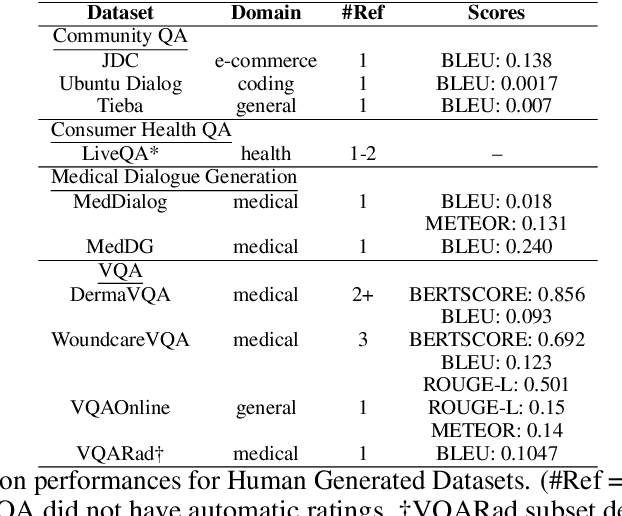
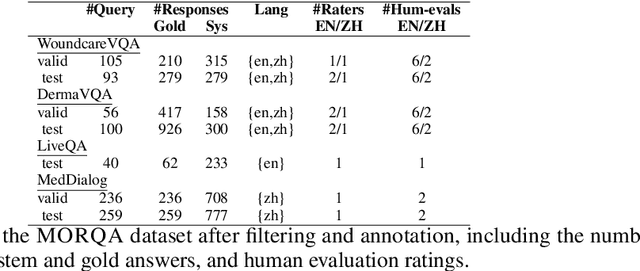

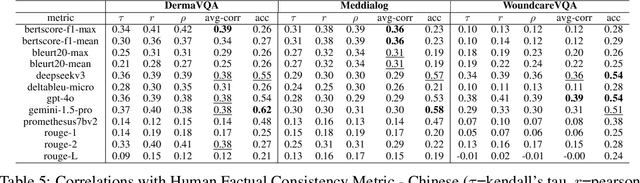
Evaluating natural language generation (NLG) systems in the medical domain presents unique challenges due to the critical demands for accuracy, relevance, and domain-specific expertise. Traditional automatic evaluation metrics, such as BLEU, ROUGE, and BERTScore, often fall short in distinguishing between high-quality outputs, especially given the open-ended nature of medical question answering (QA) tasks where multiple valid responses may exist. In this work, we introduce MORQA (Medical Open-Response QA), a new multilingual benchmark designed to assess the effectiveness of NLG evaluation metrics across three medical visual and text-based QA datasets in English and Chinese. Unlike prior resources, our datasets feature 2-4+ gold-standard answers authored by medical professionals, along with expert human ratings for three English and Chinese subsets. We benchmark both traditional metrics and large language model (LLM)-based evaluators, such as GPT-4 and Gemini, finding that LLM-based approaches significantly outperform traditional metrics in correlating with expert judgments. We further analyze factors driving this improvement, including LLMs' sensitivity to semantic nuances and robustness to variability among reference answers. Our results provide the first comprehensive, multilingual qualitative study of NLG evaluation in the medical domain, highlighting the need for human-aligned evaluation methods. All datasets and annotations will be publicly released to support future research.
A Modular Approach for Clinical SLMs Driven by Synthetic Data with Pre-Instruction Tuning, Model Merging, and Clinical-Tasks Alignment
May 15, 2025High computation costs and latency of large language models such as GPT-4 have limited their deployment in clinical settings. Small language models (SLMs) offer a cost-effective alternative, but their limited capacity requires biomedical domain adaptation, which remains challenging. An additional bottleneck is the unavailability and high sensitivity of clinical data. To address these challenges, we propose a novel framework for adapting SLMs into high-performing clinical models. We introduce the MediPhi collection of 3.8B-parameter SLMs developed with our novel framework: pre-instruction tuning of experts on relevant medical and clinical corpora (PMC, Medical Guideline, MedWiki, etc.), model merging, and clinical-tasks alignment. To cover most clinical tasks, we extended the CLUE benchmark to CLUE+, doubling its size. Our expert models deliver relative improvements on this benchmark over the base model without any task-specific fine-tuning: 64.3% on medical entities, 49.5% on radiology reports, and 44% on ICD-10 coding (outperforming GPT-4-0125 by 14%). We unify the expert models into MediPhi via model merging, preserving gains across benchmarks. Furthermore, we built the MediFlow collection, a synthetic dataset of 2.5 million high-quality instructions on 14 medical NLP tasks, 98 fine-grained document types, and JSON format support. Alignment of MediPhi using supervised fine-tuning and direct preference optimization achieves further gains of 18.9% on average.
MEDEC: A Benchmark for Medical Error Detection and Correction in Clinical Notes
Dec 26, 2024Several studies showed that Large Language Models (LLMs) can answer medical questions correctly, even outperforming the average human score in some medical exams. However, to our knowledge, no study has been conducted to assess the ability of language models to validate existing or generated medical text for correctness and consistency. In this paper, we introduce MEDEC (https://github.com/abachaa/MEDEC), the first publicly available benchmark for medical error detection and correction in clinical notes, covering five types of errors (Diagnosis, Management, Treatment, Pharmacotherapy, and Causal Organism). MEDEC consists of 3,848 clinical texts, including 488 clinical notes from three US hospital systems that were not previously seen by any LLM. The dataset has been used for the MEDIQA-CORR shared task to evaluate seventeen participating systems [Ben Abacha et al., 2024]. In this paper, we describe the data creation methods and we evaluate recent LLMs (e.g., o1-preview, GPT-4, Claude 3.5 Sonnet, and Gemini 2.0 Flash) for the tasks of detecting and correcting medical errors requiring both medical knowledge and reasoning capabilities. We also conducted a comparative study where two medical doctors performed the same task on the MEDEC test set. The results showed that MEDEC is a sufficiently challenging benchmark to assess the ability of models to validate existing or generated notes and to correct medical errors. We also found that although recent LLMs have a good performance in error detection and correction, they are still outperformed by medical doctors in these tasks. We discuss the potential factors behind this gap, the insights from our experiments, the limitations of current evaluation metrics, and share potential pointers for future research.
MedImageInsight: An Open-Source Embedding Model for General Domain Medical Imaging
Oct 09, 2024
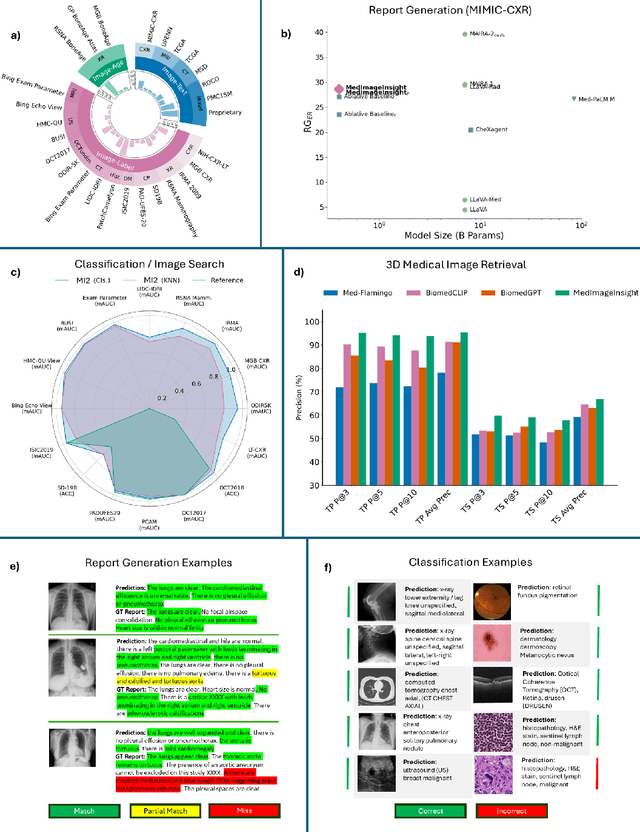


In this work, we present MedImageInsight, an open-source medical imaging embedding model. MedImageInsight is trained on medical images with associated text and labels across a diverse collection of domains, including X-Ray, CT, MRI, dermoscopy, OCT, fundus photography, ultrasound, histopathology, and mammography. Rigorous evaluations demonstrate MedImageInsight's ability to achieve state-of-the-art (SOTA) or human expert level performance across classification, image-image search, and fine-tuning tasks. Specifically, on public datasets, MedImageInsight achieves SOTA in CT 3D medical image retrieval, as well as SOTA in disease classification and search for chest X-ray, dermatology, and OCT imaging. Furthermore, MedImageInsight achieves human expert performance in bone age estimation (on both public and partner data), as well as AUC above 0.9 in most other domains. When paired with a text decoder, MedImageInsight achieves near SOTA level single image report findings generation with less than 10\% the parameters of other models. Compared to fine-tuning GPT-4o with only MIMIC-CXR data for the same task, MedImageInsight outperforms in clinical metrics, but underperforms on lexical metrics where GPT-4o sets a new SOTA. Importantly for regulatory purposes, MedImageInsight can generate ROC curves, adjust sensitivity and specificity based on clinical need, and provide evidence-based decision support through image-image search (which can also enable retrieval augmented generation). In an independent clinical evaluation of image-image search in chest X-ray, MedImageInsight outperformed every other publicly available foundation model evaluated by large margins (over 6 points AUC), and significantly outperformed other models in terms of AI fairness (across age and gender). We hope releasing MedImageInsight will help enhance collective progress in medical imaging AI research and development.