 Add to Chrome
 Add to Firefox
 Add to Edge
VDG: Vision-Only Dynamic Gaussian for Driving Simulation
Jun 26, 2024
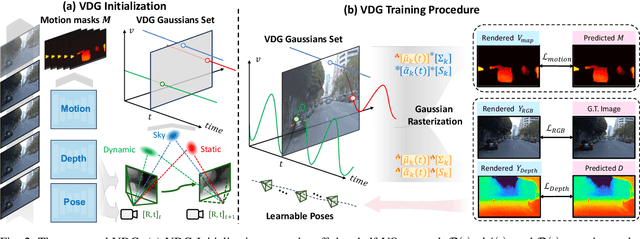


Dynamic Gaussian splatting has led to impressive scene reconstruction and image synthesis advances in novel views. Existing methods, however, heavily rely on pre-computed poses and Gaussian initialization by Structure from Motion (SfM) algorithms or expensive sensors. For the first time, this paper addresses this issue by integrating self-supervised VO into our pose-free dynamic Gaussian method (VDG) to boost pose and depth initialization and static-dynamic decomposition. Moreover, VDG can work with only RGB image input and construct dynamic scenes at a faster speed and larger scenes compared with the pose-free dynamic view-synthesis method. We demonstrate the robustness of our approach via extensive quantitative and qualitative experiments. Our results show favorable performance over the state-of-the-art dynamic view synthesis methods. Additional video and source code will be posted on our project page at https://3d-aigc.github.io/VDG.

Center-Sensitive Kernel Optimization for Efficient On-Device Incremental Learning
Jun 13, 2024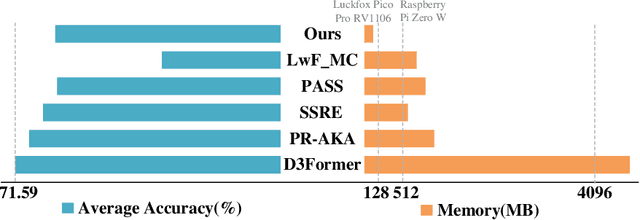

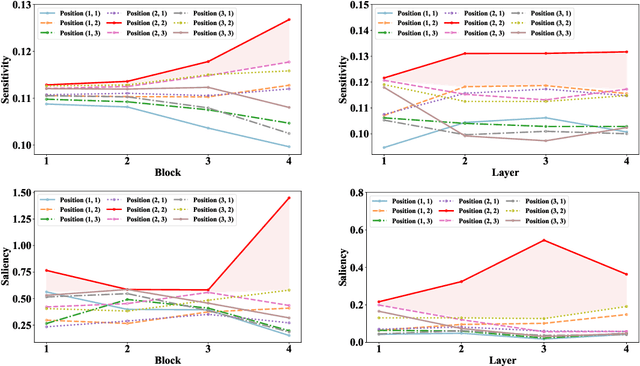
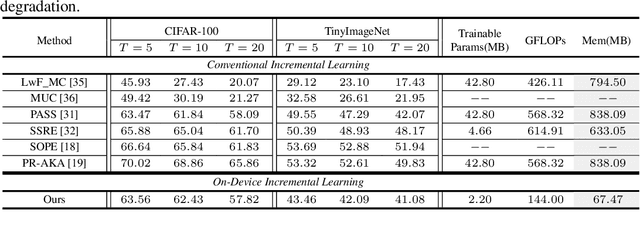
To facilitate the evolution of edge intelligence in ever-changing environments, we study on-device incremental learning constrained in limited computation resource in this paper. Current on-device training methods just focus on efficient training without considering the catastrophic forgetting, preventing the model getting stronger when continually exploring the world. To solve this problem, a direct solution is to involve the existing incremental learning mechanisms into the on-device training framework. Unfortunately, such a manner cannot work well as those mechanisms usually introduce large additional computational cost to the network optimization process, which would inevitably exceed the memory capacity of the edge devices. To address this issue, this paper makes an early effort to propose a simple but effective edge-friendly incremental learning framework. Based on an empirical study on the knowledge intensity of the kernel elements of the neural network, we find that the center kernel is the key for maximizing the knowledge intensity for learning new data, while freezing the other kernel elements would get a good balance on the model's capacity for overcoming catastrophic forgetting. Upon this finding, we further design a center-sensitive kernel optimization framework to largely alleviate the cost of the gradient computation and back-propagation. Besides, a dynamic channel element selection strategy is also proposed to facilitate a sparse orthogonal gradient projection for further reducing the optimization complexity, upon the knowledge explored from the new task data. Extensive experiments validate our method is efficient and effective, e.g., our method achieves average accuracy boost of 38.08% with even less memory and approximate computation compared to existing on-device training methods, indicating its significant potential for on-device incremental learning.
Boosting Medical Image-based Cancer Detection via Text-guided Supervision from Reports
May 23, 2024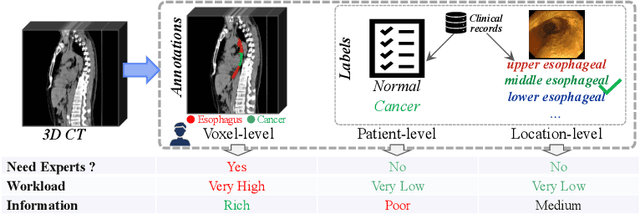
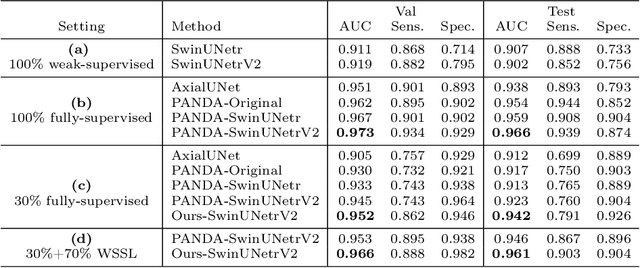
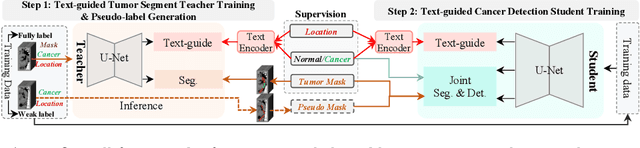
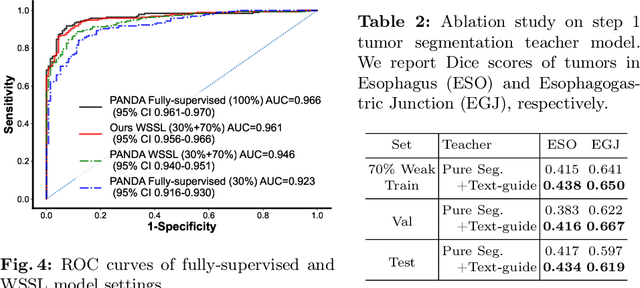
The absence of adequately sufficient expert-level tumor annotations hinders the effectiveness of supervised learning based opportunistic cancer screening on medical imaging. Clinical reports (that are rich in descriptive textual details) can offer a "free lunch'' supervision information and provide tumor location as a type of weak label to cope with screening tasks, thus saving human labeling workloads, if properly leveraged. However, predicting cancer only using such weak labels can be very changeling since tumors are usually presented in small anatomical regions compared to the whole 3D medical scans. Weakly semi-supervised learning (WSSL) utilizes a limited set of voxel-level tumor annotations and incorporates alongside a substantial number of medical images that have only off-the-shelf clinical reports, which may strike a good balance between minimizing expert annotation workload and optimizing screening efficacy. In this paper, we propose a novel text-guided learning method to achieve highly accurate cancer detection results. Through integrating diagnostic and tumor location text prompts into the text encoder of a vision-language model (VLM), optimization of weakly supervised learning can be effectively performed in the latent space of VLM, thereby enhancing the stability of training. Our approach can leverage clinical knowledge by large-scale pre-trained VLM to enhance generalization ability, and produce reliable pseudo tumor masks to improve cancer detection. Our extensive quantitative experimental results on a large-scale cancer dataset, including 1,651 unique patients, validate that our approach can reduce human annotation efforts by at least 70% while maintaining comparable cancer detection accuracy to competing fully supervised methods (AUC value 0.961 versus 0.966).
Unsupervised Pre-training with Language-Vision Prompts for Low-Data Instance Segmentation
May 22, 2024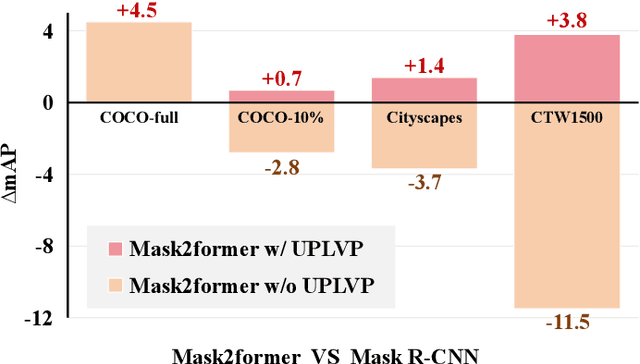
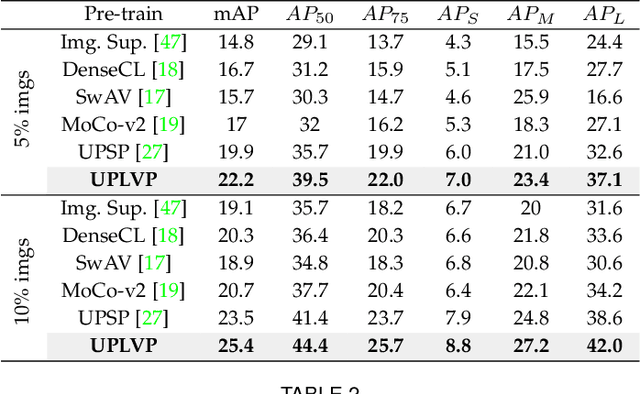
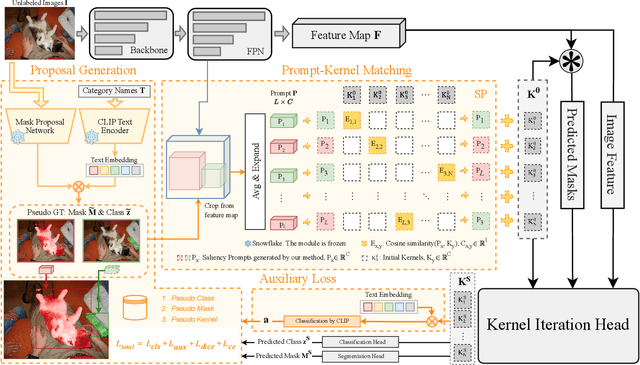
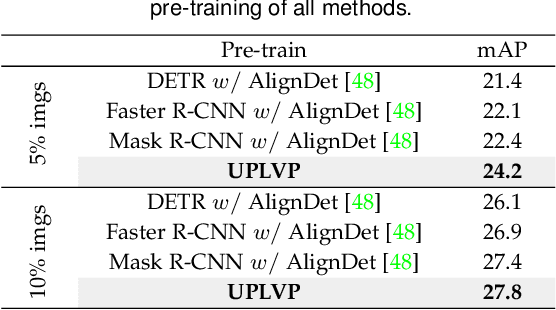
In recent times, following the paradigm of DETR (DEtection TRansformer), query-based end-to-end instance segmentation (QEIS) methods have exhibited superior performance compared to CNN-based models, particularly when trained on large-scale datasets. Nevertheless, the effectiveness of these QEIS methods diminishes significantly when confronted with limited training data. This limitation arises from their reliance on substantial data volumes to effectively train the pivotal queries/kernels that are essential for acquiring localization and shape priors. To address this problem, we propose a novel method for unsupervised pre-training in low-data regimes. Inspired by the recently successful prompting technique, we introduce a new method, Unsupervised Pre-training with Language-Vision Prompts (UPLVP), which improves QEIS models' instance segmentation by bringing language-vision prompts to queries/kernels. Our method consists of three parts: (1) Masks Proposal: Utilizes language-vision models to generate pseudo masks based on unlabeled images. (2) Prompt-Kernel Matching: Converts pseudo masks into prompts and injects the best-matched localization and shape features to their corresponding kernels. (3) Kernel Supervision: Formulates supervision for pre-training at the kernel level to ensure robust learning. With the help of our pre-training method, QEIS models can converge faster and perform better than CNN-based models in low-data regimes. Experimental evaluations conducted on MS COCO, Cityscapes, and CTW1500 datasets indicate that the QEIS models' performance can be significantly improved when pre-trained with our method. Code will be available at: https://github.com/lifuguan/UPLVP.
AUG: A New Dataset and An Efficient Model for Aerial Image Urban Scene Graph Generation
Apr 11, 2024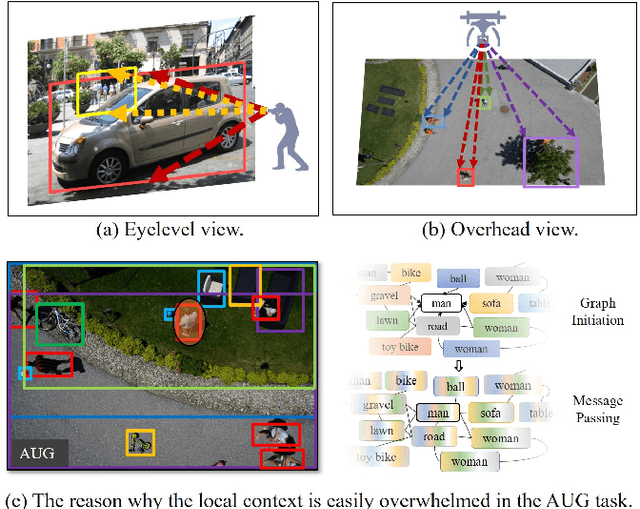
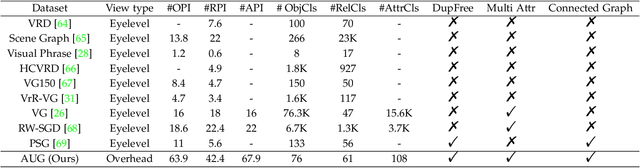
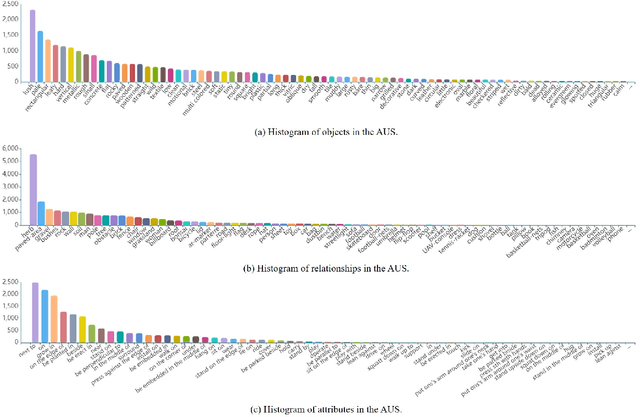
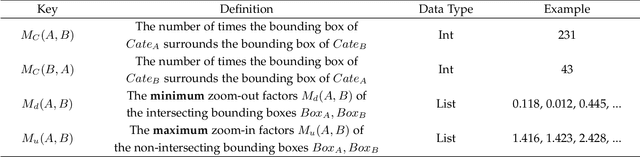
Scene graph generation (SGG) aims to understand the visual objects and their semantic relationships from one given image. Until now, lots of SGG datasets with the eyelevel view are released but the SGG dataset with the overhead view is scarcely studied. By contrast to the object occlusion problem in the eyelevel view, which impedes the SGG, the overhead view provides a new perspective that helps to promote the SGG by providing a clear perception of the spatial relationships of objects in the ground scene. To fill in the gap of the overhead view dataset, this paper constructs and releases an aerial image urban scene graph generation (AUG) dataset. Images from the AUG dataset are captured with the low-attitude overhead view. In the AUG dataset, 25,594 objects, 16,970 relationships, and 27,175 attributes are manually annotated. To avoid the local context being overwhelmed in the complex aerial urban scene, this paper proposes one new locality-preserving graph convolutional network (LPG). Different from the traditional graph convolutional network, which has the natural advantage of capturing the global context for SGG, the convolutional layer in the LPG integrates the non-destructive initial features of the objects with dynamically updated neighborhood information to preserve the local context under the premise of mining the global context. To address the problem that there exists an extra-large number of potential object relationship pairs but only a small part of them is meaningful in AUG, we propose the adaptive bounding box scaling factor for potential relationship detection (ABS-PRD) to intelligently prune the meaningless relationship pairs. Extensive experiments on the AUG dataset show that our LPG can significantly outperform the state-of-the-art methods and the effectiveness of the proposed locality-preserving strategy.
GGRt: Towards Pose-free Generalizable 3D Gaussian Splatting in Real-time
Mar 19, 2024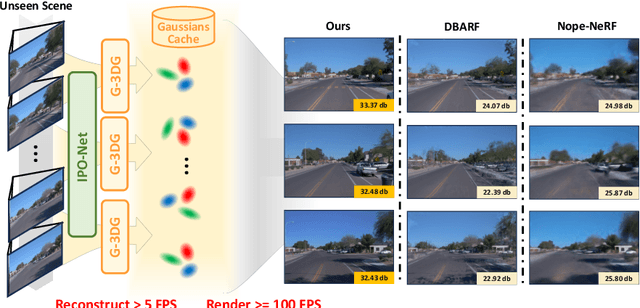

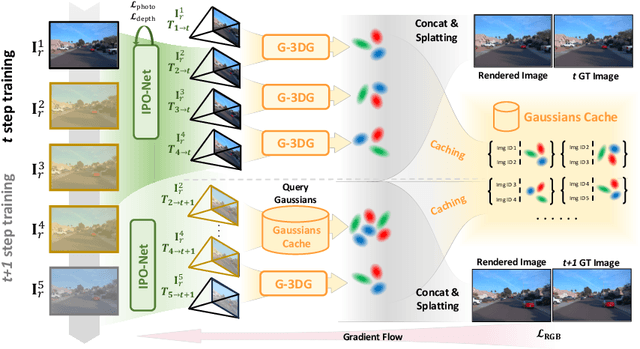

This paper presents GGRt, a novel approach to generalizable novel view synthesis that alleviates the need for real camera poses, complexity in processing high-resolution images, and lengthy optimization processes, thus facilitating stronger applicability of 3D Gaussian Splatting (3D-GS) in real-world scenarios. Specifically, we design a novel joint learning framework that consists of an Iterative Pose Optimization Network (IPO-Net) and a Generalizable 3D-Gaussians (G-3DG) model. With the joint learning mechanism, the proposed framework can inherently estimate robust relative pose information from the image observations and thus primarily alleviate the requirement of real camera poses. Moreover, we implement a deferred back-propagation mechanism that enables high-resolution training and inference, overcoming the resolution constraints of previous methods. To enhance the speed and efficiency, we further introduce a progressive Gaussian cache module that dynamically adjusts during training and inference. As the first pose-free generalizable 3D-GS framework, GGRt achieves inference at $\ge$ 5 FPS and real-time rendering at $\ge$ 100 FPS. Through extensive experimentation, we demonstrate that our method outperforms existing NeRF-based pose-free techniques in terms of inference speed and effectiveness. It can also approach the real pose-based 3D-GS methods. Our contributions provide a significant leap forward for the integration of computer vision and computer graphics into practical applications, offering state-of-the-art results on LLFF, KITTI, and Waymo Open datasets and enabling real-time rendering for immersive experiences.
Continual All-in-One Adverse Weather Removal with Knowledge Replay on a Unified Network Structure
Mar 12, 2024


In real-world applications, image degeneration caused by adverse weather is always complex and changes with different weather conditions from days and seasons. Systems in real-world environments constantly encounter adverse weather conditions that are not previously observed. Therefore, it practically requires adverse weather removal models to continually learn from incrementally collected data reflecting various degeneration types. Existing adverse weather removal approaches, for either single or multiple adverse weathers, are mainly designed for a static learning paradigm, which assumes that the data of all types of degenerations to handle can be finely collected at one time before a single-phase learning process. They thus cannot directly handle the incremental learning requirements. To address this issue, we made the earliest effort to investigate the continual all-in-one adverse weather removal task, in a setting closer to real-world applications. Specifically, we develop a novel continual learning framework with effective knowledge replay (KR) on a unified network structure. Equipped with a principal component projection and an effective knowledge distillation mechanism, the proposed KR techniques are tailored for the all-in-one weather removal task. It considers the characteristics of the image restoration task with multiple degenerations in continual learning, and the knowledge for different degenerations can be shared and accumulated in the unified network structure. Extensive experimental results demonstrate the effectiveness of the proposed method to deal with this challenging task, which performs competitively to existing dedicated or joint training image restoration methods. Our code is available at https://github.com/xiaojihh/CL_all-in-one.
SA-MixNet: Structure-aware Mixup and Invariance Learning for Scribble-supervised Road Extraction in Remote Sensing Images
Mar 03, 2024Mainstreamed weakly supervised road extractors rely on highly confident pseudo-labels propagated from scribbles, and their performance often degrades gradually as the image scenes tend various. We argue that such degradation is due to the poor model's invariance to scenes with different complexities, whereas existing solutions to this problem are commonly based on crafted priors that cannot be derived from scribbles. To eliminate the reliance on such priors, we propose a novel Structure-aware Mixup and Invariance Learning framework (SA-MixNet) for weakly supervised road extraction that improves the model invariance in a data-driven manner. Specifically, we design a structure-aware Mixup scheme to paste road regions from one image onto another for creating an image scene with increased complexity while preserving the road's structural integrity. Then an invariance regularization is imposed on the predictions of constructed and origin images to minimize their conflicts, which thus forces the model to behave consistently on various scenes. Moreover, a discriminator-based regularization is designed for enhancing the connectivity meanwhile preserving the structure of roads. Combining these designs, our framework demonstrates superior performance on the DeepGlobe, Wuhan, and Massachusetts datasets outperforming the state-of-the-art techniques by 1.47%, 2.12%, 4.09% respectively in IoU metrics, and showing its potential of plug-and-play. The code will be made publicly available.
Revisiting the Power of Prompt for Visual Tuning
Feb 04, 2024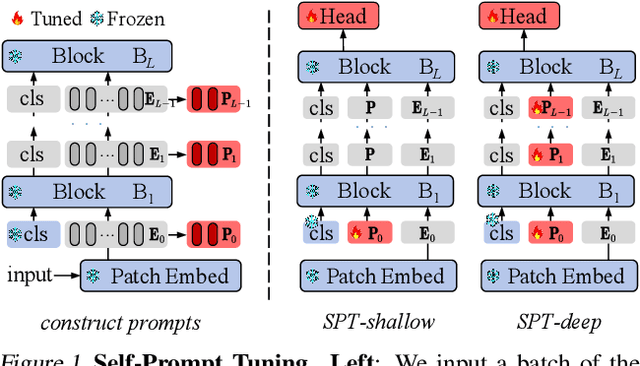
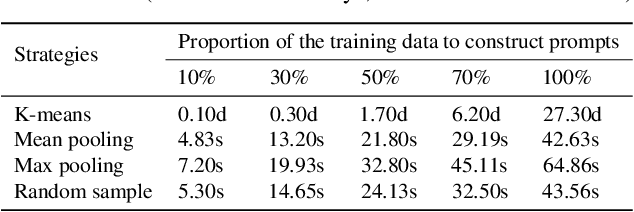
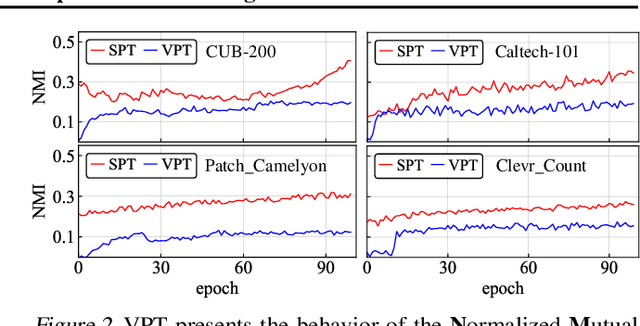
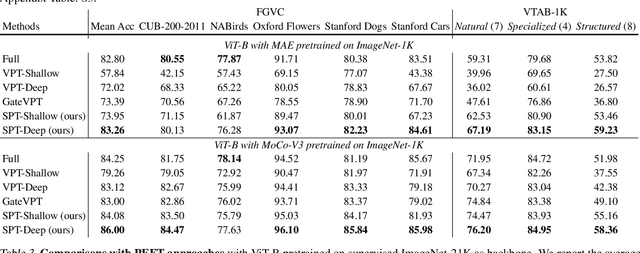
Visual prompt tuning (VPT) is a promising solution incorporating learnable prompt tokens to customize pre-trained models for downstream tasks. However, VPT and its variants often encounter challenges like prompt initialization, prompt length, and subpar performance in self-supervised pretraining, hindering successful contextual adaptation. This study commences by exploring the correlation evolvement between prompts and patch tokens during proficient training. Inspired by the observation that the prompt tokens tend to share high mutual information with patch tokens, we propose initializing prompts with downstream token prototypes. The strategic initialization, a stand-in for the previous initialization, substantially improves performance in fine-tuning. To refine further, we optimize token construction with a streamlined pipeline that maintains excellent performance with almost no increase in computational expenses compared to VPT. Exhaustive experiments show our proposed approach outperforms existing methods by a remarkable margin. For instance, it surpasses full fine-tuning in 19 out of 24 tasks, using less than 0.4% of learnable parameters on the FGVC and VTAB-1K benchmarks. Notably, our method significantly advances the adaptation for self-supervised pretraining, achieving impressive task performance gains of at least 10% to 30%. Besides, the experimental results demonstrate the proposed SPT is robust to prompt lengths and scales well with model capacity and training data size. We finally provide an insightful exploration into the amount of target data facilitating the adaptation of pre-trained models to downstream tasks.
VSCode: General Visual Salient and Camouflaged Object Detection with 2D Prompt Learning
Nov 25, 2023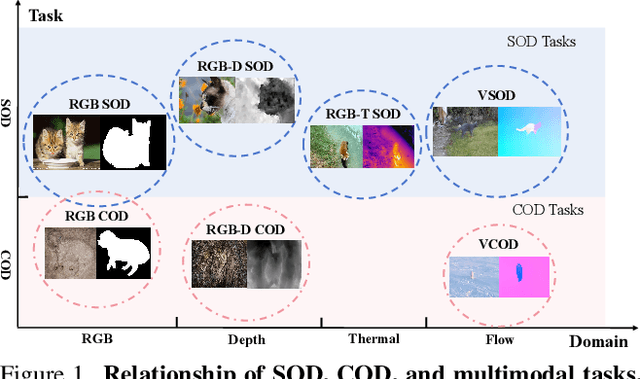
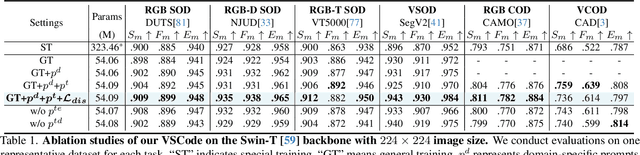
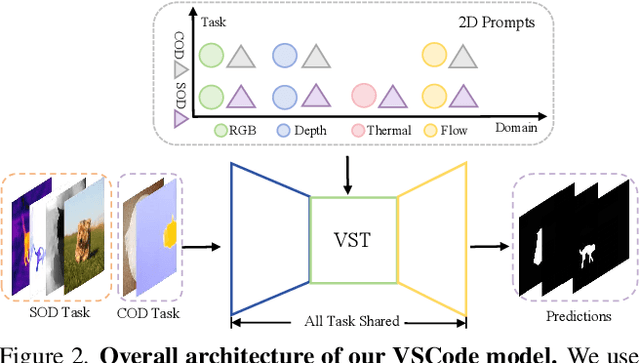
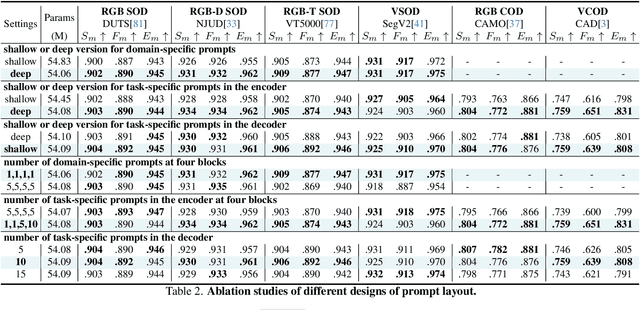
Salient object detection (SOD) and camouflaged object detection (COD) are related yet distinct binary mapping tasks. These tasks involve multiple modalities, sharing commonalities and unique cues. Existing research often employs intricate task-specific specialist models, potentially leading to redundancy and suboptimal results. We introduce VSCode, a generalist model with novel 2D prompt learning, to jointly address four SOD tasks and three COD tasks. We utilize VST as the foundation model and introduce 2D prompts within the encoder-decoder architecture to learn domain and task-specific knowledge on two separate dimensions. A prompt discrimination loss helps disentangle peculiarities to benefit model optimization. VSCode outperforms state-of-the-art methods across six tasks on 26 datasets and exhibits zero-shot generalization to unseen tasks by combining 2D prompts, such as RGB-D COD.