 Add to Chrome
 Add to Firefox
 Add to Edge
$h$-control: Training-Free Camera Control via Block-Conditional Gibbs Refinement
May 12, 2026
Training-free camera control for pretrained flow-matching video generators is a partial-observation inverse problem: a depth-warped guidance video supplies noisy evidence on a subset of latent sites, which the sampler must reconcile with the pretrained prior. Existing methods struggle to balance the trade-off between trajectory adherence and visual quality and the heuristic guidance-strength tuning lacks robustness. We propose \textbf{$h$-control}, which resolves this dilemma through a structural change to the sampler: each outer hard-replacement guidance step is augmented with an inner-loop \emph{block-conditional pseudo-Gibbs refinement} on the unobserved complement at the same noise level, with provable convergence to the partial-observation conditional data law. To accelerate convergence on high-dimensional video latents, we exploit their conditional locality, partitioning the unobserved complement into 3D patches, each tracked by a custom mixing indicator that adaptively freezes converged patches. On RealEstate10K and DAVIS, \textbf{$h$-control} attains the best FVD against all seven training-free and training-based competitors, outperforming every training-free baseline on every reported metric.

PowerLens: Taming LLM Agents for Safe and Personalized Mobile Power Management
Mar 20, 2026Battery life remains a critical challenge for mobile devices, yet existing power management mechanisms rely on static rules or coarse-grained heuristics that ignore user activities and personal preferences. We present PowerLens, a system that tames the reasoning power of Large Language Models (LLMs) for safe and personalized mobile power management on Android devices. The key idea is that LLMs' commonsense reasoning can bridge the semantic gap between user activities and system parameters, enabling zero-shot, context-aware policy generation that adapts to individual preferences through implicit feedback. PowerLens employs a multi-agent architecture that recognizes user context from UI semantics and generates holistic power policies across 18 device parameters. A PDL-based constraint framework verifies every action before execution, while a two-tier memory system learns individualized preferences from implicit user overrides through confidence-based distillation, requiring no explicit configuration and converging within 3--5 days. Extensive experiments on a rooted Android device show that PowerLens achieves 81.7% action accuracy and 38.8% energy saving over stock Android, outperforming rule-based and LLM-based baselines, with high user satisfaction, fast preference convergence, and strong safety guarantees, with the system itself consuming only 0.5% of daily battery capacity.
Moving Speaker Separation via Parallel Spectral-Spatial Processing
Feb 25, 2026Multi-channel speech separation in dynamic environments is challenging as time-varying spatial and spectral features evolve at different temporal scales. Existing methods typically employ sequential architectures, forcing a single network stream to simultaneously model both feature types, creating an inherent modeling conflict. In this paper, we propose a dual-branch parallel spectral-spatial (PS2) architecture that separately processes spectral and spatial features through parallel streams. The spectral branch uses a bi-directional long short-term memory (BLSTM)-based frequency module, a Mamba-based temporal module, and a self-attention module to model spectral features. The spatial branch employs bi-directional gated recurrent unit (BGRU) networks to process spatial features that encode the evolving geometric relationships between sources and microphones. Features from both branches are integrated through a cross-attention fusion mechanism that adaptively weights their contributions. Experimental results demonstrate that the PS2 outperforms existing state-of-the-art (SOTA) methods by 1.6-2.2 dB in scale-invariant signal-to-distortion ratio (SI-SDR) for moving speaker scenarios, with robust separation quality under different reverberation times (RT60), noise levels, and source movement speeds. Even with fast source movements, the proposed model maintains SI-SDR improvements of over 13 dB. These improvements are consistently observed across multiple datasets, including WHAMR! and our generated WSJ0-Demand-6ch-Move dataset.
DTT-BSR: GAN-based DTTNet with RoPE Transformer Enhancement for Music Source Restoration
Feb 23, 2026Music source restoration (MSR) aims to recover unprocessed stems from mixed and mastered recordings. The challenge lies in both separating overlapping sources and reconstructing signals degraded by production effects such as compression and reverberation. We therefore propose DTT-BSR, a hybrid generative adversarial network (GAN) combining rotary positional embeddings (RoPE) transformer for long-term temporal modeling with dual-path band-split recurrent neural network (RNN) for multi-resolution spectral processing. Our model achieved 3rd place on the objective leaderboard and 4th place on the subjective leaderboard on the ICASSP 2026 MSR Challenge, demonstrating exceptional generation fidelity and semantic alignment with a compact size of 7.1M parameters.
Multi-Utterance Speech Separation and Association Trained on Short Segments
Jul 03, 2025Current deep neural network (DNN) based speech separation faces a fundamental challenge -- while the models need to be trained on short segments due to computational constraints, real-world applications typically require processing significantly longer recordings with multiple utterances per speaker than seen during training. In this paper, we investigate how existing approaches perform in this challenging scenario and propose a frequency-temporal recurrent neural network (FTRNN) that effectively bridges this gap. Our FTRNN employs a full-band module to model frequency dependencies within each time frame and a sub-band module that models temporal patterns in each frequency band. Despite being trained on short fixed-length segments of 10 s, our model demonstrates robust separation when processing signals significantly longer than training segments (21-121 s) and preserves speaker association across utterance gaps exceeding those seen during training. Unlike the conventional segment-separation-stitch paradigm, our lightweight approach (0.9 M parameters) performs inference on long audio without segmentation, eliminating segment boundary distortions while simplifying deployment. Experimental results demonstrate the generalization ability of FTRNN for multi-utterance speech separation and speaker association.
Attractor-Based Speech Separation of Multiple Utterances by Unknown Number of Speakers
May 22, 2025This paper addresses the problem of single-channel speech separation, where the number of speakers is unknown, and each speaker may speak multiple utterances. We propose a speech separation model that simultaneously performs separation, dynamically estimates the number of speakers, and detects individual speaker activities by integrating an attractor module. The proposed system outperforms existing methods by introducing an attractor-based architecture that effectively combines local and global temporal modeling for multi-utterance scenarios. To evaluate the method in reverberant and noisy conditions, a multi-speaker multi-utterance dataset was synthesized by combining Librispeech speech signals with WHAM! noise signals. The results demonstrate that the proposed system accurately estimates the number of sources. The system effectively detects source activities and separates the corresponding utterances into correct outputs in both known and unknown source count scenarios.
Revisiting the Power of Prompt for Visual Tuning
Feb 04, 2024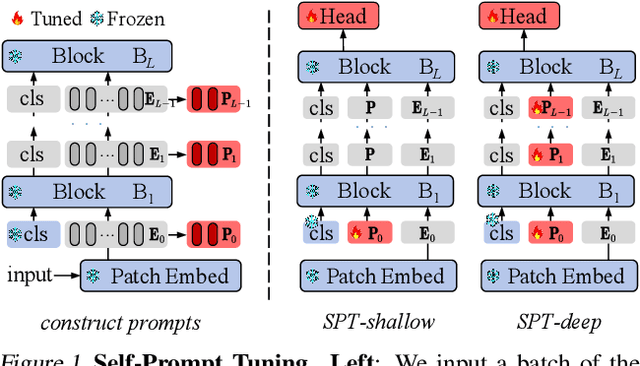
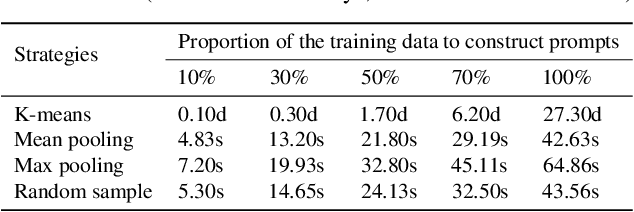
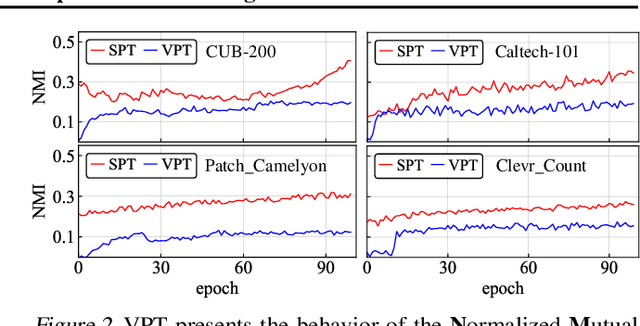
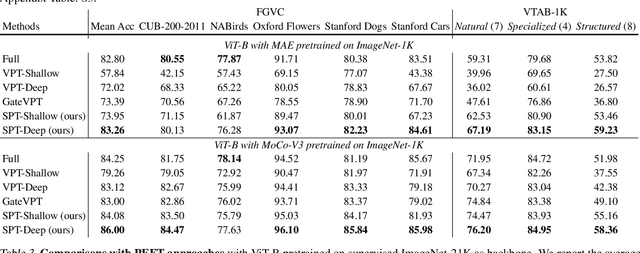
Visual prompt tuning (VPT) is a promising solution incorporating learnable prompt tokens to customize pre-trained models for downstream tasks. However, VPT and its variants often encounter challenges like prompt initialization, prompt length, and subpar performance in self-supervised pretraining, hindering successful contextual adaptation. This study commences by exploring the correlation evolvement between prompts and patch tokens during proficient training. Inspired by the observation that the prompt tokens tend to share high mutual information with patch tokens, we propose initializing prompts with downstream token prototypes. The strategic initialization, a stand-in for the previous initialization, substantially improves performance in fine-tuning. To refine further, we optimize token construction with a streamlined pipeline that maintains excellent performance with almost no increase in computational expenses compared to VPT. Exhaustive experiments show our proposed approach outperforms existing methods by a remarkable margin. For instance, it surpasses full fine-tuning in 19 out of 24 tasks, using less than 0.4% of learnable parameters on the FGVC and VTAB-1K benchmarks. Notably, our method significantly advances the adaptation for self-supervised pretraining, achieving impressive task performance gains of at least 10% to 30%. Besides, the experimental results demonstrate the proposed SPT is robust to prompt lengths and scales well with model capacity and training data size. We finally provide an insightful exploration into the amount of target data facilitating the adaptation of pre-trained models to downstream tasks.
Attention-Driven Multichannel Speech Enhancement in Moving Sound Source Scenarios
Dec 17, 2023Current multichannel speech enhancement algorithms typically assume a stationary sound source, a common mismatch with reality that limits their performance in real-world scenarios. This paper focuses on attention-driven spatial filtering techniques designed for dynamic settings. Specifically, we study the application of linear and nonlinear attention-based methods for estimating time-varying spatial covariance matrices used to design the filters. We also investigate the direct estimation of spatial filters by attention-based methods without explicitly estimating spatial statistics. The clean speech clips from WSJ0 are employed for simulating speech signals of moving speakers in a reverberant environment. The experimental dataset is built by mixing the simulated speech signals with multichannel real noise from CHiME-3. Evaluation results show that the attention-driven approaches are robust and consistently outperform conventional spatial filtering approaches in both static and dynamic sound environments.
Improving Knowledge Distillation via Regularizing Feature Norm and Direction
May 26, 2023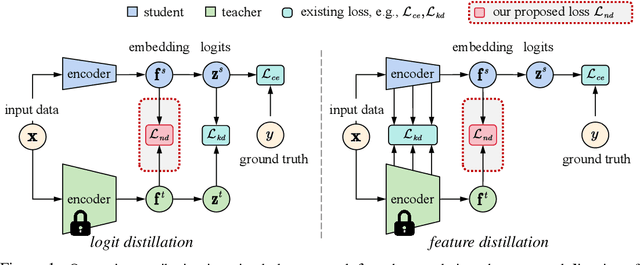
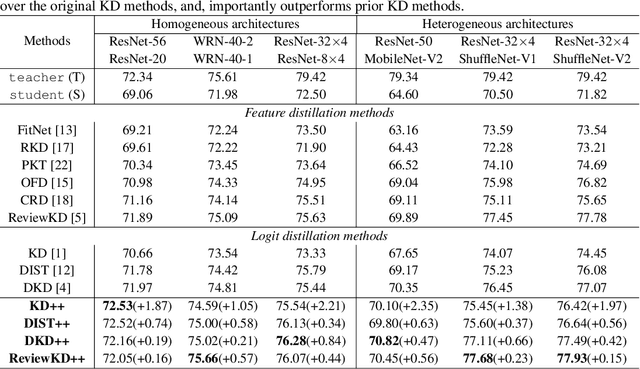
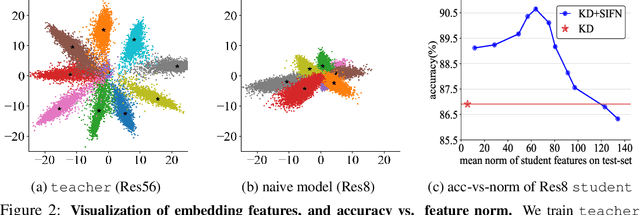

Knowledge distillation (KD) exploits a large well-trained model (i.e., teacher) to train a small student model on the same dataset for the same task. Treating teacher features as knowledge, prevailing methods of knowledge distillation train student by aligning its features with the teacher's, e.g., by minimizing the KL-divergence between their logits or L2 distance between their intermediate features. While it is natural to believe that better alignment of student features to the teacher better distills teacher knowledge, simply forcing this alignment does not directly contribute to the student's performance, e.g., classification accuracy. In this work, we propose to align student features with class-mean of teacher features, where class-mean naturally serves as a strong classifier. To this end, we explore baseline techniques such as adopting the cosine distance based loss to encourage the similarity between student features and their corresponding class-means of the teacher. Moreover, we train the student to produce large-norm features, inspired by other lines of work (e.g., model pruning and domain adaptation), which find the large-norm features to be more significant. Finally, we propose a rather simple loss term (dubbed ND loss) to simultaneously (1) encourage student to produce large-\emph{norm} features, and (2) align the \emph{direction} of student features and teacher class-means. Experiments on standard benchmarks demonstrate that our explored techniques help existing KD methods achieve better performance, i.e., higher classification accuracy on ImageNet and CIFAR100 datasets, and higher detection precision on COCO dataset. Importantly, our proposed ND loss helps the most, leading to the state-of-the-art performance on these benchmarks. The source code is available at \url{https://github.com/WangYZ1608/Knowledge-Distillation-via-ND}.