 Add to Chrome
 Add to Firefox
 Add to Edge
Distilling Physical Priors into Streaming World Models
Aug 08, 2026
Streaming world models predict future visual states online while maintaining physically coherent dynamics over long horizons. However, their rollouts often violate basic physical constraints. A common approach distills pretrained bidirectional DiTs into few-step causal generators. However, this paradigm suffers from two fundamental limitations: generic bidirectional teachers acquire limited physical priors from visually oriented pretraining, and the limited priors suffer further loss during bidirectional-to-causal distillation. We present PhyS, a three-stage framework for distilling physical priors into streaming world models. To acquire physical priors from real-world interactions, we construct PhyS-120K, a dataset of 120K real-world physical-interaction videos spanning rigid-body dynamics, soft-body deformation, fluid phenomena, and phase transitions. Each video is annotated with structured descriptions of object properties and causal state transitions. Physics-aware supervised fine-tuning injects the physical priors into a bidirectional 14B DiT teacher, which we then distill into a lightweight 1.3B causal DiT for few-step autoregressive streaming generation. Finally, we use online reinforcement learning to incentivize the distilled model to generate physically plausible rollouts and further propose Temporal Credit Routing (TCR) to address temporal credit assignment. TCR evaluates physical consistency over overlapping temporal windows and routes the resulting group-relative advantages to temporally aligned denoising actions. On PhysicsIQ, PhyS improves the Wan2.1-14B teacher by 18.2\% and the Self Forcing, Rolling Forcing, and Causal Forcing by 23.7\%, 14.8\%, and 31.4\%, respectively. Results also improve the physics-aware video benchmarks VideoPhy, VideoPhy2, and PhyGenBench. The dataset, code, and more sample videos are available on our Project Page.

RS-RIE-Bench: Benchmarking Reasoning-Guided Remote Sensing Image Editing
Jul 22, 2026Remote sensing image editing aims to modify remote sensing images according to natural language instructions while preserving geographic rules and sensor observation characteristics. Existing benchmarks mainly target natural images or general visual scenes, and thus may not fully capture the reasoning, regional control, and sensor-consistency abilities required in remote sensing editing. To fill this gap, we introduce RS-RIE-Bench, the first benchmark for reasoning-guided remote sensing image editing. RS-RIE-Bench organizes tasks into three categories: temporal reasoning, causal reasoning, and spatial reasoning. These categories capture temporal evolution, causal consequence, and spatial imaging consistency in remote sensing scenes. The evaluation protocol covers three dimensions: target region plausibility, non-target region preservation, and image quality consistency. We further demonstrate the feasibility of MLLM-based evaluation through cross-judge consistency analysis and stratified expert review. Systematic evaluation on eight open-source and closed-source image editing models shows that current models still have clear limitations in reasoning-guided remote sensing editing. Even the strongest model achieves only 24.28\% overall accuracy under the strict joint-satisfaction criterion, while the mean relaxed joint-4 success rate across all eight models is 32.23\%. Causal reasoning and spatial reasoning remain especially challenging, and several open-source models are close to zero in some categories. These results show that RS-RIE-Bench can effectively reveal the limitations of current models in geographic reasoning, regional control, and sensor-consistent generation. It also provides a standardized benchmark and a clear research direction for future remote sensing intelligent editing models.
Towards Characterizing Scientific Image Utility and Upgradability
Jun 02, 2026Scientific images function as critical evidence in research communication, yet their integrity faces unprecedented threats from AI-generated content that introduces subtle but consequential errors. Existing evaluation paradigms prove inadequate: perceptual quality metrics poorly correlate with scientific validity, while language models lack domain-specific verification capabilities. To address this gap, we propose the \textbf{S}cientific \textbf{I}mage \textbf{U}tility and \textbf{U}pgradability \textbf{A}ssessment (\textbf{SIU$^2$A}) framework, which introduces two complementary dimensions for scientific image evaluation. \textbf{Utility} encompasses \textit{error detection} (identifying scientific inaccuracies) and \textit{correction feasibility} (assessing whether errors can be reliably repaired). \textbf{Upgradability} measures the quality of correction. We categorize scientific image corruption into four fundamental types: Detail Distortion, Incompleteness, False Content, and Entity Confusion. Based on this taxonomy, we construct SIU$^2$A-Benchmark, a dataset with expert annotations for error identification and repair. The framework implements a two-stage evaluation protocol: the \textit{Utility} stage evaluates error detection capability and repair instruction generation, while the \textit{Upgradability} stage assesses whether corrections faithfully restore scientific validity without compromising existing accurate information. Experiments reveal that current multimodal systems exhibit significant limitations in both scientific error assessment and faithful correction, exposing a fundamental gap between visual perception and scientific usability.
Every Step Counts: Step-Level Credit Assignment for Tool-Integrated Text-to-SQL
May 06, 2026Tool-integrated Text-to-SQL parsing has emerged as a promising paradigm, framing SQL generation as a sequential decision-making process interleaved with tool execution. However, existing reinforcement learning approaches mainly rely on coarse-grained outcome supervision, resulting in a fundamental credit assignment problem: models receive the same reward for any trajectory that yields the correct answer, even when intermediate steps are redundant, inefficient, or erroneous. Consequently, models are encouraged to explore suboptimal reasoning spaces, limiting both efficiency and generalization. To address this problem, we propose FineStep, a novel framework for step-level credit assignment in tool-augmented Text-to-SQL. First, we introduce a reward design with independent process rewards to alleviate the signal sparsity of outcome supervision. Next, we present a step-level credit assignment mechanism to precisely quantify the value of each reasoning step. Finally, we develop a policy optimization method based on step-level advantages for efficient updates. Extensive experiments on BIRD benchmarks show that FineStep achieves state-of-the-art performance and reduces redundant tool interactions, with a 3.25% average EX gain over GRPO at the 4B scale.
STAR : Bridging Statistical and Agentic Reasoning for Large Model Performance Prediction
Feb 12, 2026As comprehensive large model evaluation becomes prohibitively expensive, predicting model performance from limited observations has become essential. However, existing statistical methods struggle with pattern shifts, data sparsity, and lack of explanation, while pure LLM methods remain unreliable. We propose STAR, a framework that bridges data-driven STatistical expectations with knowledge-driven Agentic Reasoning. STAR leverages specialized retrievers to gather external knowledge and embeds semantic features into Constrained Probabilistic Matrix Factorization (CPMF) to generate statistical expectations with uncertainty. A reasoning module guided by Expectation Violation Theory (EVT) then refines predictions through intra-family analysis, cross-model comparison, and credibility-aware aggregation, producing adjustments with traceable explanations. Extensive experiments show that STAR consistently outperforms all baselines on both score-based and rank-based metrics, delivering a 14.46% gain in total score over the strongest statistical method under extreme sparsity, with only 1--2 observed scores per test model.
EvolMem: A Cognitive-Driven Benchmark for Multi-Session Dialogue Memory
Jan 07, 2026Despite recent advances in understanding and leveraging long-range conversational memory, existing benchmarks still lack systematic evaluation of large language models(LLMs) across diverse memory dimensions, particularly in multi-session settings. In this work, we propose EvolMem, a new benchmark for assessing multi-session memory capabilities of LLMs and agent systems. EvolMem is grounded in cognitive psychology and encompasses both declarative and non-declarative memory, further decomposed into multiple fine-grained abilities. To construct the benchmark, we introduce a hybrid data synthesis framework that consists of topic-initiated generation and narrative-inspired transformations. This framework enables scalable generation of multi-session conversations with controllable complexity, accompanied by sample-specific evaluation guidelines. Extensive evaluation reveals that no LLM consistently outperforms others across all memory dimensions. Moreover, agent memory mechanisms do not necessarily enhance LLMs' capabilities and often exhibit notable efficiency limitations. Data and code will be released at https://github.com/shenye7436/EvolMem.
DGH: Dynamic Gaussian Hair
Dec 18, 2025The creation of photorealistic dynamic hair remains a major challenge in digital human modeling because of the complex motions, occlusions, and light scattering. Existing methods often resort to static capture and physics-based models that do not scale as they require manual parameter fine-tuning to handle the diversity of hairstyles and motions, and heavy computation to obtain high-quality appearance. In this paper, we present Dynamic Gaussian Hair (DGH), a novel framework that efficiently learns hair dynamics and appearance. We propose: (1) a coarse-to-fine model that learns temporally coherent hair motion dynamics across diverse hairstyles; (2) a strand-guided optimization module that learns a dynamic 3D Gaussian representation for hair appearance with support for differentiable rendering, enabling gradient-based learning of view-consistent appearance under motion. Unlike prior simulation-based pipelines, our approach is fully data-driven, scales with training data, and generalizes across various hairstyles and head motion sequences. Additionally, DGH can be seamlessly integrated into a 3D Gaussian avatar framework, enabling realistic, animatable hair for high-fidelity avatar representation. DGH achieves promising geometry and appearance results, providing a scalable, data-driven alternative to physics-based simulation and rendering.
A Multi-To-One Interview Paradigm for Efficient MLLM Evaluation
Sep 18, 2025The rapid progress of Multi-Modal Large Language Models (MLLMs) has spurred the creation of numerous benchmarks. However, conventional full-coverage Question-Answering evaluations suffer from high redundancy and low efficiency. Inspired by human interview processes, we propose a multi-to-one interview paradigm for efficient MLLM evaluation. Our framework consists of (i) a two-stage interview strategy with pre-interview and formal interview phases, (ii) dynamic adjustment of interviewer weights to ensure fairness, and (iii) an adaptive mechanism for question difficulty-level chosen. Experiments on different benchmarks show that the proposed paradigm achieves significantly higher correlation with full-coverage results than random sampling, with improvements of up to 17.6% in PLCC and 16.7% in SRCC, while reducing the number of required questions. These findings demonstrate that the proposed paradigm provides a reliable and efficient alternative for large-scale MLLM benchmarking.
The Ever-Evolving Science Exam
Jul 22, 2025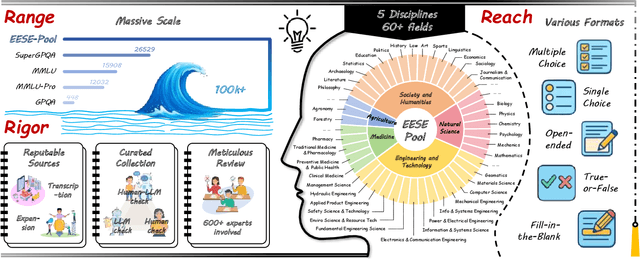
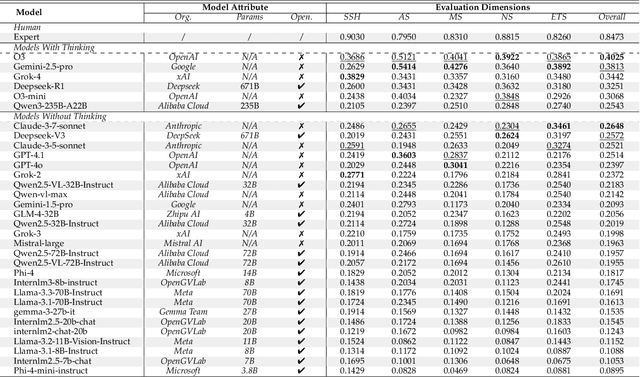
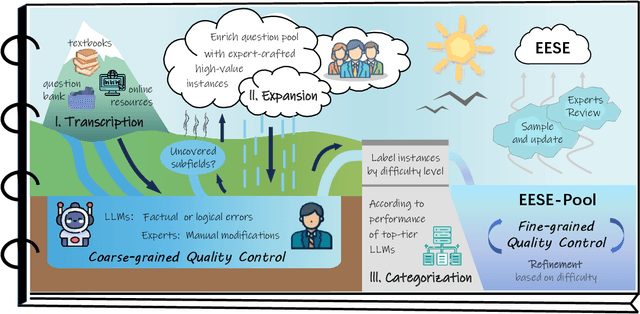
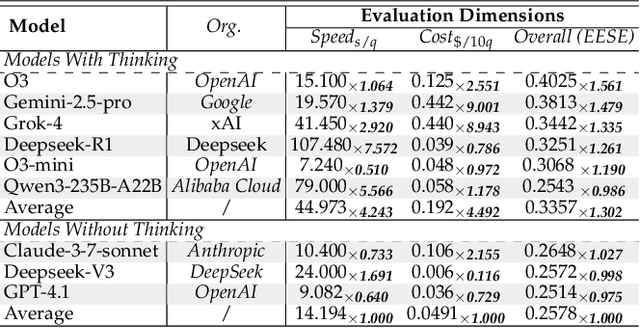
As foundation models grow rapidly in capability and deployment, evaluating their scientific understanding becomes increasingly critical. Existing science benchmarks have made progress towards broad **Range**, wide **Reach**, and high **Rigor**, yet they often face two major challenges: **data leakage risks** that compromise benchmarking validity, and **evaluation inefficiency** due to large-scale testing. To address these issues, we introduce the **Ever-Evolving Science Exam (EESE)**, a dynamic benchmark designed to reliably assess scientific capabilities in foundation models. Our approach consists of two components: 1) a non-public **EESE-Pool** with over 100K expertly constructed science instances (question-answer pairs) across 5 disciplines and 500+ subfields, built through a multi-stage pipeline ensuring **Range**, **Reach**, and **Rigor**, 2) a periodically updated 500-instance subset **EESE**, sampled and validated to enable leakage-resilient, low-overhead evaluations. Experiments on 32 open- and closed-source models demonstrate that EESE effectively differentiates the strengths and weaknesses of models in scientific fields and cognitive dimensions. Overall, EESE provides a robust, scalable, and forward-compatible solution for science benchmark design, offering a realistic measure of how well foundation models handle science questions. The project page is at: https://github.com/aiben-ch/EESE.
Adv-CPG: A Customized Portrait Generation Framework with Facial Adversarial Attacks
Mar 11, 2025Recent Customized Portrait Generation (CPG) methods, taking a facial image and a textual prompt as inputs, have attracted substantial attention. Although these methods generate high-fidelity portraits, they fail to prevent the generated portraits from being tracked and misused by malicious face recognition systems. To address this, this paper proposes a Customized Portrait Generation framework with facial Adversarial attacks (Adv-CPG). Specifically, to achieve facial privacy protection, we devise a lightweight local ID encryptor and an encryption enhancer. They implement progressive double-layer encryption protection by directly injecting the target identity and adding additional identity guidance, respectively. Furthermore, to accomplish fine-grained and personalized portrait generation, we develop a multi-modal image customizer capable of generating controlled fine-grained facial features. To the best of our knowledge, Adv-CPG is the first study that introduces facial adversarial attacks into CPG. Extensive experiments demonstrate the superiority of Adv-CPG, e.g., the average attack success rate of the proposed Adv-CPG is 28.1% and 2.86% higher compared to the SOTA noise-based attack methods and unconstrained attack methods, respectively.