 Add to Chrome
 Add to Firefox
 Add to Edge
XPolicyLab: A Unified Standard and Open Ecosystem for Robot Policy Evaluation and Deployment
Aug 11, 2026
Robot policy evaluation and deployment remain fragmented by model-specific software dependencies, data representations, and runtime interfaces, so that connecting N policies to M evaluation environments requires O(NM) separate integrations. We present XPolicyLab, a unified standard and open ecosystem that reduces this cost to O(N+M). XPolicyLab specifies common observation, action, and trajectory schemas together with a minimal adapter interface for observation updates, action prediction, batched execution, and episode reset, while a dependency-isolated client/server architecture separates policy inference from environment execution, so that each side retains its native software stack and may run locally or remotely. The ecosystem integrates 42 robot policies and standardizes their installation, debugging, serving, and evaluation workflows. Across these adapters, model-specific code varies by an order of magnitude while the environment-facing loop stays within a few lines of a fixed reference, confirming that the contract confines heterogeneity to the policy side. In a controlled study, conforming to the standard reduces the integration effort of a representative policy from over five hours to two hours, and packaged agent skills reduce it further to thirty minutes. The same adapters serve RoboTwin, RoboDojo simulation, and standardized real-robot evaluation through one interface. XPolicyLab is released as shared infrastructure for reproducible policy comparison and standardized deployment across simulation and physical platforms. Project website: https://xpolicylab.github.io/.

Cortex: A Bidirectionally Aligned Embodied Agent Framework for Long-horizon Manipulation
Jul 06, 2026While recent Vision-Language-Action (VLA) models show promise toward generalist manipulation policies, they struggle with long-horizon tasks due to their Markovian nature-relying solely on current observations. Hierarchical dual-system methods address this but suffer from a gap between high-level planning semantics and low-level execution kinematics. We introduce Cortex, a bidirectionally aligned embodied agent framework with a customized planning interface that conveys executable and tractable subtask plans from high-level VLM to low-level VLA. Specifically, we standardize manipulation subtasks into 32 canonical skill primitives and inject tractability principles, such as representative object attributes and improved trajectory reachability, into the data generation pipeline. This enables automatic annotation of over 4k hours of open-source video data and generation of 30 hours of simulation data. We further devise an event-balanced sampling strategy to construct training data for fine-tuning the framework to better handle planning ambiguity during subtask transitions, enhanced by carefully designed harness engineering from task contexts to skill constraints during inference. Both open-loop VLM and closed-loop system evaluations demonstrate Cortex's efficacy, e.g., it outperforms monolithic baselines by 3.1% on Libero-long and 4.1% on RoboTwin. Notably, Cortex's generalist VLM enables zero-shot completion of unseen real-world long-horizon tasks, such as multi-stage chemistry experiments, by simply combining with a fine-tuned VLA-a capability infeasible through VLA fine-tuning alone.
EventVLA: Event-Driven Visual Evidence Memory for Long-Horizon Vision-Language-Action Policies
Jun 18, 2026Memory remains a critical bottleneck for long-horizon robotic manipulation, as standard Vision-Language-Action (VLA) policies often fail when task-relevant cues become occluded or unobservable over time. While existing memory-augmented methods utilize historical context, they either suffer from severe information bottlenecks, incur high latency via decoupled dual systems, or rely on unselective buffers that accumulate massive visual redundancies. To address these limitations, we introduce EventVLA, an end-to-end framework founded on the concept of sparse visual evidence memory that comprises two core components: foundational visual anchors to retain initial and short-term contexts, and a dynamic Keyframe Evidence Memory (KEM) module. Specifically, KEM directly predicts future keyframe probabilities from the VLA's latent embeddings to autonomously capture and store sparse, task-critical visual events. This foresight-driven mechanism empowers the policy to dynamically evaluate the future causal utility of current observations, preserving transient visual evidence before it becomes unobservable. Furthermore, we propose RoboTwin-MeM, a diagnostic benchmark specifically designed to evaluate non-Markovian manipulation tasks with interactive visual evidence. Extensive evaluations show that across 17 memory-requiring simulation tasks and 4 real-world bimanual tasks, EventVLA achieves an average success rate improvement of +40% over state-of-the-art memory-augmented VLAs.
ScaleEdit-12M: Scaling Open-Source Image Editing Data Generation via Multi-Agent Framework
Mar 21, 2026Instruction-based image editing has emerged as a key capability for unified multimodal models (UMMs), yet constructing large-scale, diverse, and high-quality editing datasets without costly proprietary APIs remains challenging. Previous image editing datasets either rely on closed-source models for annotation, which prevents cost-effective scaling, or employ fixed synthetic editing pipelines, which suffer from limited quality and generalizability. To address these challenges, we propose ScaleEditor, a fully open-source hierarchical multi-agent framework for end-to-end construction of large-scale, high-quality image editing datasets. Our pipeline consists of three key components: source image expansion with world-knowledge infusion, adaptive multi-agent editing instruction-image synthesis, and a task-aware data quality verification mechanism. Using ScaleEditor, we curate ScaleEdit-12M, the largest open-source image editing dataset to date, spanning 23 task families across diverse real and synthetic domains. Fine-tuning UniWorld-V1 and Bagel on ScaleEdit yields consistent gains, improving performance by up to 10.4% on ImgEdit and 35.1% on GEdit for general editing benchmarks and by up to 150.0% on RISE and 26.5% on KRIS-Bench for knowledge-infused benchmarks. These results demonstrate that open-source, agentic pipelines can approach commercial-grade data quality while retaining cost-effectiveness and scalability. Both the framework and dataset will be open-sourced.
InternVL-U: Democratizing Unified Multimodal Models for Understanding, Reasoning, Generation and Editing
Mar 10, 2026Unified multimodal models (UMMs) that integrate understanding, reasoning, generation, and editing face inherent trade-offs between maintaining strong semantic comprehension and acquiring powerful generation capabilities. In this report, we present InternVL-U, a lightweight 4B-parameter UMM that democratizes these capabilities within a unified framework. Guided by the principles of unified contextual modeling and modality-specific modular design with decoupled visual representations, InternVL-U integrates a state-of-the-art Multimodal Large Language Model (MLLM) with a specialized MMDiT-based visual generation head. To further bridge the gap between aesthetic generation and high-level intelligence, we construct a comprehensive data synthesis pipeline targeting high-semantic-density tasks, such as text rendering and scientific reasoning, under a reasoning-centric paradigm that leverages Chain-of-Thought (CoT) to better align abstract user intent with fine-grained visual generation details. Extensive experiments demonstrate that InternVL-U achieves a superior performance - efficiency balance. Despite using only 4B parameters, it consistently outperforms unified baseline models with over 3x larger scales such as BAGEL (14B) on various generation and editing tasks, while retaining strong multimodal understanding and reasoning capabilities.
ACE-Brain-0: Spatial Intelligence as a Shared Scaffold for Universal Embodiments
Mar 03, 2026Universal embodied intelligence demands robust generalization across heterogeneous embodiments, such as autonomous driving, robotics, and unmanned aerial vehicles (UAVs). However, existing embodied brain in training a unified model over diverse embodiments frequently triggers long-tail data, gradient interference, and catastrophic forgetting, making it notoriously difficult to balance universal generalization with domain-specific proficiency. In this report, we introduce ACE-Brain-0, a generalist foundation brain that unifies spatial reasoning, autonomous driving, and embodied manipulation within a single multimodal large language model~(MLLM). Our key insight is that spatial intelligence serves as a universal scaffold across diverse physical embodiments: although vehicles, robots, and UAVs differ drastically in morphology, they share a common need for modeling 3D mental space, making spatial cognition a natural, domain-agnostic foundation for cross-embodiment transfer. Building on this insight, we propose the Scaffold-Specialize-Reconcile~(SSR) paradigm, which first establishes a shared spatial foundation, then cultivates domain-specialized experts, and finally harmonizes them through data-free model merging. Furthermore, we adopt Group Relative Policy Optimization~(GRPO) to strengthen the model's comprehensive capability. Extensive experiments demonstrate that ACE-Brain-0 achieves competitive and even state-of-the-art performance across 24 spatial and embodiment-related benchmarks.
InternVL3.5: Advancing Open-Source Multimodal Models in Versatility, Reasoning, and Efficiency
Aug 25, 2025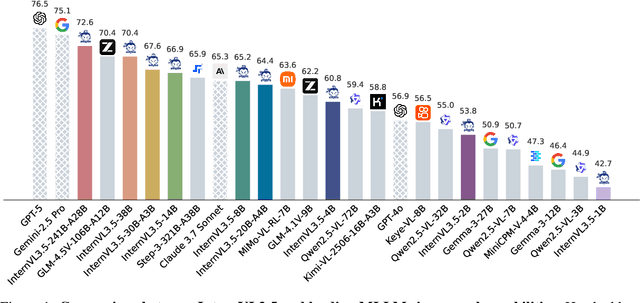
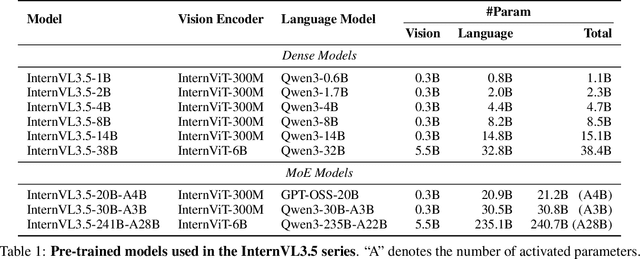
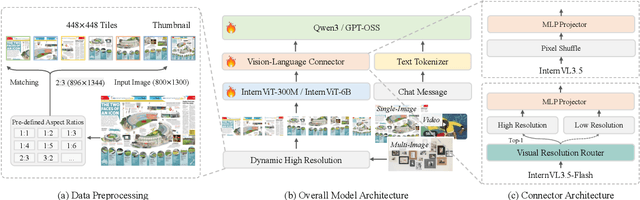
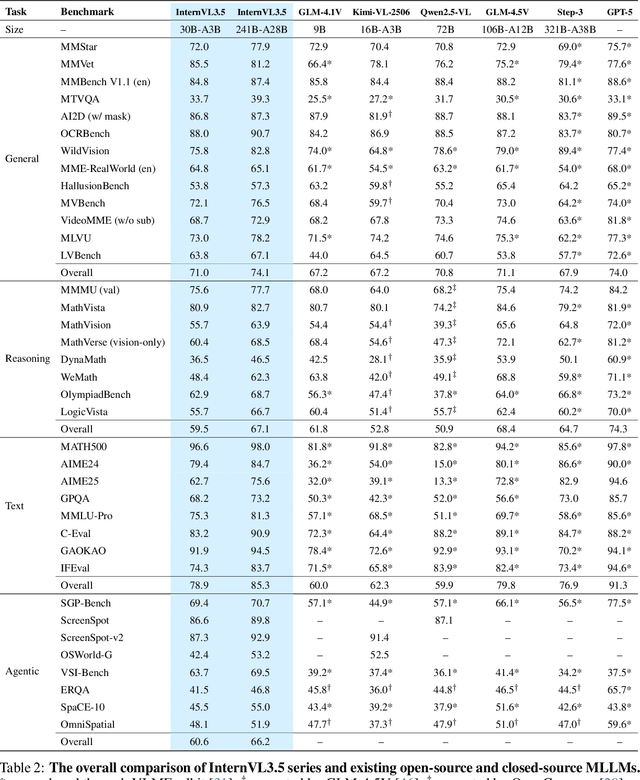
We introduce InternVL 3.5, a new family of open-source multimodal models that significantly advances versatility, reasoning capability, and inference efficiency along the InternVL series. A key innovation is the Cascade Reinforcement Learning (Cascade RL) framework, which enhances reasoning through a two-stage process: offline RL for stable convergence and online RL for refined alignment. This coarse-to-fine training strategy leads to substantial improvements on downstream reasoning tasks, e.g., MMMU and MathVista. To optimize efficiency, we propose a Visual Resolution Router (ViR) that dynamically adjusts the resolution of visual tokens without compromising performance. Coupled with ViR, our Decoupled Vision-Language Deployment (DvD) strategy separates the vision encoder and language model across different GPUs, effectively balancing computational load. These contributions collectively enable InternVL3.5 to achieve up to a +16.0\% gain in overall reasoning performance and a 4.05$\times$ inference speedup compared to its predecessor, i.e., InternVL3. In addition, InternVL3.5 supports novel capabilities such as GUI interaction and embodied agency. Notably, our largest model, i.e., InternVL3.5-241B-A28B, attains state-of-the-art results among open-source MLLMs across general multimodal, reasoning, text, and agentic tasks -- narrowing the performance gap with leading commercial models like GPT-5. All models and code are publicly released.
NeRF Inpainting with Geometric Diffusion Prior and Balanced Score Distillation
Nov 23, 2024
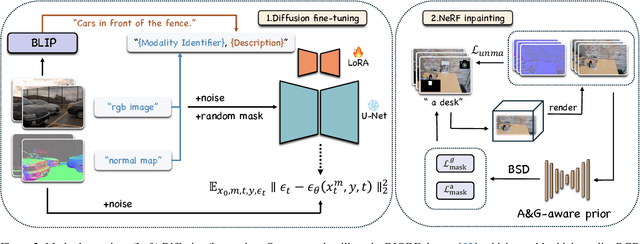
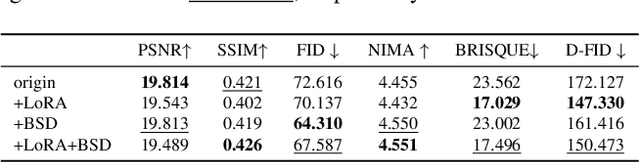

Recent advances in NeRF inpainting have leveraged pretrained diffusion models to enhance performance. However, these methods often yield suboptimal results due to their ineffective utilization of 2D diffusion priors. The limitations manifest in two critical aspects: the inadequate capture of geometric information by pretrained diffusion models and the suboptimal guidance provided by existing Score Distillation Sampling (SDS) methods. To address these problems, we introduce GB-NeRF, a novel framework that enhances NeRF inpainting through improved utilization of 2D diffusion priors. Our approach incorporates two key innovations: a fine-tuning strategy that simultaneously learns appearance and geometric priors and a specialized normal distillation loss that integrates these geometric priors into NeRF inpainting. We propose a technique called Balanced Score Distillation (BSD) that surpasses existing methods such as Score Distillation (SDS) and the improved version, Conditional Score Distillation (CSD). BSD offers improved inpainting quality in appearance and geometric aspects. Extensive experiments show that our method provides superior appearance fidelity and geometric consistency compared to existing approaches.
Drantal-NeRF: Diffusion-Based Restoration for Anti-aliasing Neural Radiance Field
Jul 10, 2024Aliasing artifacts in renderings produced by Neural Radiance Field (NeRF) is a long-standing but complex issue in the field of 3D implicit representation, which arises from a multitude of intricate causes and was mitigated by designing more advanced but complex scene parameterization methods before. In this paper, we present a Diffusion-based restoration method for anti-aliasing Neural Radiance Field (Drantal-NeRF). We consider the anti-aliasing issue from a low-level restoration perspective by viewing aliasing artifacts as a kind of degradation model added to clean ground truths. By leveraging the powerful prior knowledge encapsulated in diffusion model, we could restore the high-realism anti-aliasing renderings conditioned on aliased low-quality counterparts. We further employ a feature-wrapping operation to ensure multi-view restoration consistency and finetune the VAE decoder to better adapt to the scene-specific data distribution. Our proposed method is easy to implement and agnostic to various NeRF backbones. We conduct extensive experiments on challenging large-scale urban scenes as well as unbounded 360-degree scenes and achieve substantial qualitative and quantitative improvements.
MRVM-NeRF: Mask-Based Pretraining for Neural Radiance Fields
Apr 11, 2023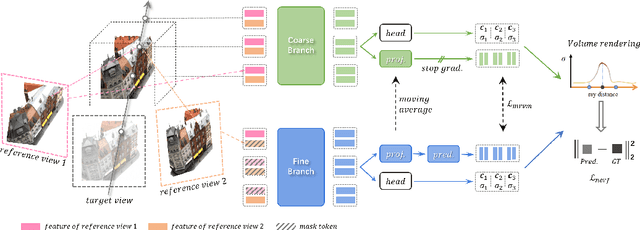
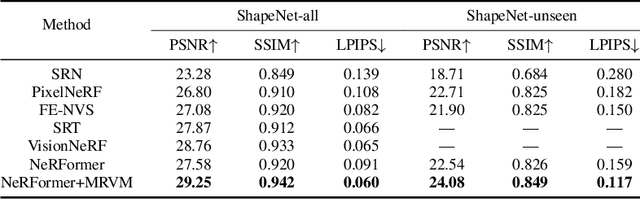
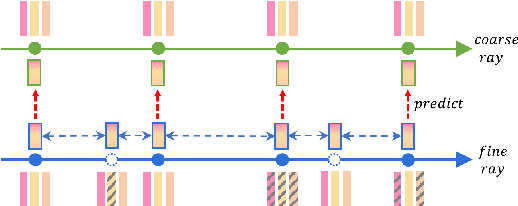
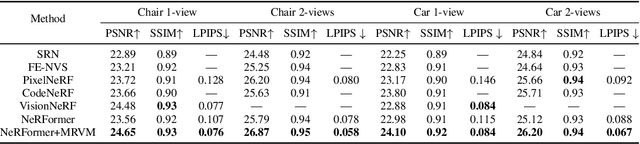
Most Neural Radiance Fields (NeRFs) have poor generalization ability, limiting their application when representing multiple scenes by a single model. To ameliorate this problem, existing methods simply condition NeRF models on image features, lacking the global understanding and modeling of the entire 3D scene. Inspired by the significant success of mask-based modeling in other research fields, we propose a masked ray and view modeling method for generalizable NeRF (MRVM-NeRF), the first attempt to incorporate mask-based pretraining into 3D implicit representations. Specifically, considering that the core of NeRFs lies in modeling 3D representations along the rays and across the views, we randomly mask a proportion of sampled points along the ray at fine stage by discarding partial information obtained from multi-viewpoints, targeting at predicting the corresponding features produced in the coarse branch. In this way, the learned prior knowledge of 3D scenes during pretraining helps the model generalize better to novel scenarios after finetuning. Extensive experiments demonstrate the superiority of our proposed MRVM-NeRF under various synthetic and real-world settings, both qualitatively and quantitatively. Our empirical studies reveal the effectiveness of our proposed innovative MRVM which is specifically designed for NeRF models.