 Add to Chrome
 Add to Firefox
 Add to Edge
Intern-S2-Preview: Scientific Agentic Foundation Model
Aug 13, 2026
Scientific discovery increasingly requires AI systems that can reason over scientific evidence of heterogeneous modalities, interact with scientific tools and environments, and sustain progress across long task horizons. We present Intern-S2-Preview, a series of scientific agentic foundation models designed to support multimodal scientific understanding, reasoning, generation, and long-horizon tasks. The training pipeline begins with scientific multimodal pre-training over rendered scientific documents, interleaved image-text data, and diverse scientific corpora. Starting from the pretrained checkpoint, we apply a unified post-training pipeline consisting of supervised fine-tuning, scalable multi-task reinforcement learning (RL), black- and white-box agentic RL, and on-policy distillation. This pipeline is supported by practical techniques that improve rollout and training stability and efficiency, including partial rollout with off-policy correction, adaptive length regularization, online speculative decoding, robust multi-task optimization, and trace-aware experience assembly for agentic tasks. At the architecture level, Intern-S2-Preview-397B extends time series modelling from efficient long-sequence understanding to numerical forecasting, while Memory Decoder is studied as a separate memory-augmented path for rapid scientific specialization without modifying the frozen 397B backbone. Evaluations across scientific, multimodal, agentic, and general-purpose benchmarks show that Intern-S2-Preview-397B achieves competitive or leading results in multiple settings. The time series modules improve scientific signal understanding and forecasting on SciTS, while the separate Intern-MemDec-4B extension improves the Biology-Instructions average score from 56.92 to 60.32 without modifying the frozen 397B backbone.

Scaling the Horizon, Not the Parameters: Reaching Trillion-Parameter Performance with a 35B Agent
Jun 29, 2026We introduce Agents-A1, a 35B Mixture-of-Experts Agentic Model that reaches trillion-parameter-level performance by scaling the agent horizon. We investigate agent-horizon scaling from two perspectives: scaling long-horizon trajectories and scaling heterogeneous agent abilities. To support this goal, we build a long-horizon knowledge-action infrastructure that connects external knowledge, actions, observations, and verifier outcomes, producing agentic trajectories with an average length of 45K tokens. Based on this, we train Agents-A1 with a three-stage recipe. First, we perform full-domain supervised fine-tuning to align the base model with broad agentic behaviors. Second, we train domain-level teacher models to capture specialized expertise in each domain. Third, we propose a multi-teacher domain-routed on-policy distillation with salient vocabulary alignment to improve knowledge transfer efficiency across different domains, unifying six heterogeneous domains into one deployable student model. Agents-A1 achieves strong and broad performance for long-horizon agent benchmarks. Compared with 1T-parameter model such as Kimi-K2.6 and DeepSeek-V4-pro, Agents-A1 achieves leading results on SEAL-0 (56.4), IFBench (80.6), HiPhO (46.4), FrontierScience-Olympiad (79.0), and MolBench-Bind (56.8), and remains highly competitive on SciCode (44.3), HLE (47.6) and BrowseComp (75.5). We hope this work provides the community with a practical path for scaling the horizon using a 35B agent that can reach or match the performance of 1T models on long-horizon tasks.
MLEvolve: A Self-Evolving Framework for Automated Machine Learning Algorithm Discovery
Jun 04, 2026Large language model (LLM) agents are increasingly applied to long-horizon tasks such as scientific discovery and machine learning engineering (MLE), where sustained self-evolution becomes a key capability. However, existing MLE agents suffer from inter-branch information isolation, memoryless search, and lack of hierarchical control, which together hinder long-horizon optimization. We present MLEvolve, an LLM-based self-evolving multi-agent framework for end-to-end machine learning algorithm discovery. By extending tree search to Progressive MCGS, MLEvolve enables cross-branch information flow through graph-based reference edges and gradually shifts the search from broad exploration to focused exploitation with an entropy-inspired progressive schedule. To allow the agent to evolve with accumulated experience, we introduce Retrospective Memory, which combines a cold-start domain knowledge base with a dynamic global memory for task-specific experience retrieval and reuse. For stable long-horizon iteration, we further decouple strategic planning from code generation with adaptive coding modes. Evaluation on MLE-Bench shows that MLEvolve achieves state-of-the-art performance across multiple dimensions including average medal rate and valid submission rate under a 12-hour budget (half the standard runtime). Moreover, MLEvolve also outperforms specialized algorithm discovery methods including AlphaEvolve on mathematical algorithm optimization tasks, demonstrating strong cross-domain generalization. Our code is available at https://github.com/InternScience/MLEvolve.
InternAgent-1.5: A Unified Agentic Framework for Long-Horizon Autonomous Scientific Discovery
Feb 09, 2026We introduce InternAgent-1.5, a unified system designed for end-to-end scientific discovery across computational and empirical domains. The system is built on a structured architecture composed of three coordinated subsystems for generation, verification, and evolution. These subsystems are supported by foundational capabilities for deep research, solution optimization, and long horizon memory. The architecture allows InternAgent-1.5 to operate continuously across extended discovery cycles while maintaining coherent and improving behavior. It also enables the system to coordinate computational modeling and laboratory experimentation within a single unified system. We evaluate InternAgent-1.5 on scientific reasoning benchmarks such as GAIA, HLE, GPQA, and FrontierScience, and the system achieves leading performance that demonstrates strong foundational capabilities. Beyond these benchmarks, we further assess two categories of discovery tasks. In algorithm discovery tasks, InternAgent-1.5 autonomously designs competitive methods for core machine learning problems. In empirical discovery tasks, it executes complete computational or wet lab experiments and produces scientific findings in earth, life, biological, and physical domains. Overall, these results show that InternAgent-1.5 provides a general and scalable framework for autonomous scientific discovery.
A Survey on the Optimization of Large Language Model-based Agents
Mar 16, 2025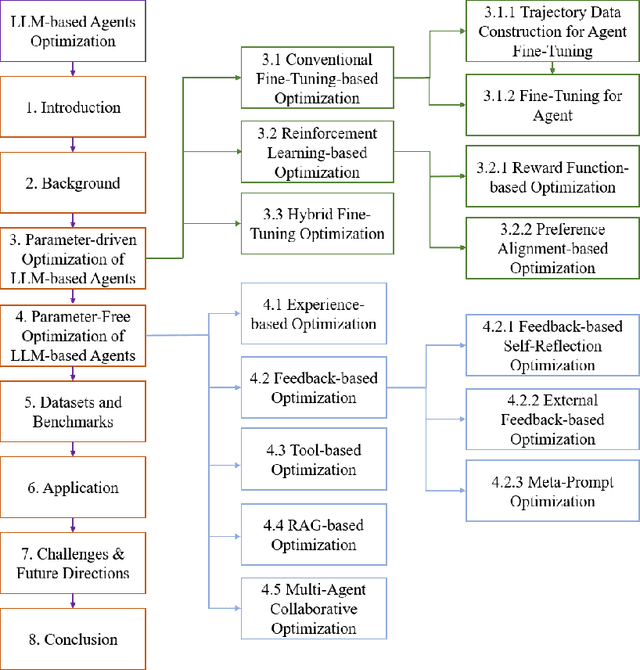
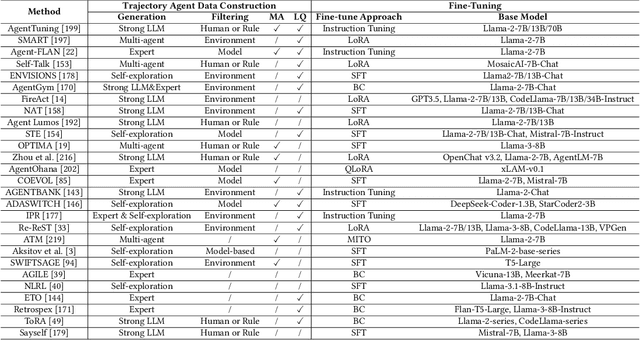
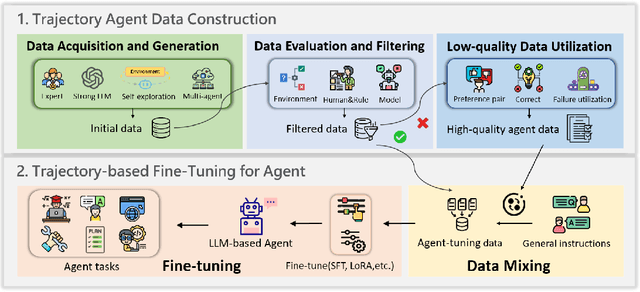
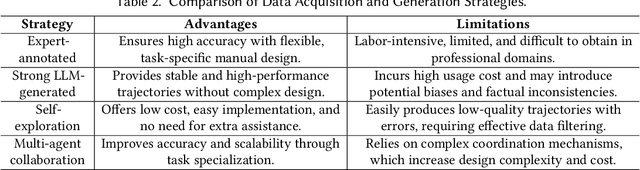
With the rapid development of Large Language Models (LLMs), LLM-based agents have been widely adopted in various fields, becoming essential for autonomous decision-making and interactive tasks. However, current work typically relies on prompt design or fine-tuning strategies applied to vanilla LLMs, which often leads to limited effectiveness or suboptimal performance in complex agent-related environments. Although LLM optimization techniques can improve model performance across many general tasks, they lack specialized optimization towards critical agent functionalities such as long-term planning, dynamic environmental interaction, and complex decision-making. Although numerous recent studies have explored various strategies to optimize LLM-based agents for complex agent tasks, a systematic review summarizing and comparing these methods from a holistic perspective is still lacking. In this survey, we provide a comprehensive review of LLM-based agent optimization approaches, categorizing them into parameter-driven and parameter-free methods. We first focus on parameter-driven optimization, covering fine-tuning-based optimization, reinforcement learning-based optimization, and hybrid strategies, analyzing key aspects such as trajectory data construction, fine-tuning techniques, reward function design, and optimization algorithms. Additionally, we briefly discuss parameter-free strategies that optimize agent behavior through prompt engineering and external knowledge retrieval. Finally, we summarize the datasets and benchmarks used for evaluation and tuning, review key applications of LLM-based agents, and discuss major challenges and promising future directions. Our repository for related references is available at https://github.com/YoungDubbyDu/LLM-Agent-Optimization.